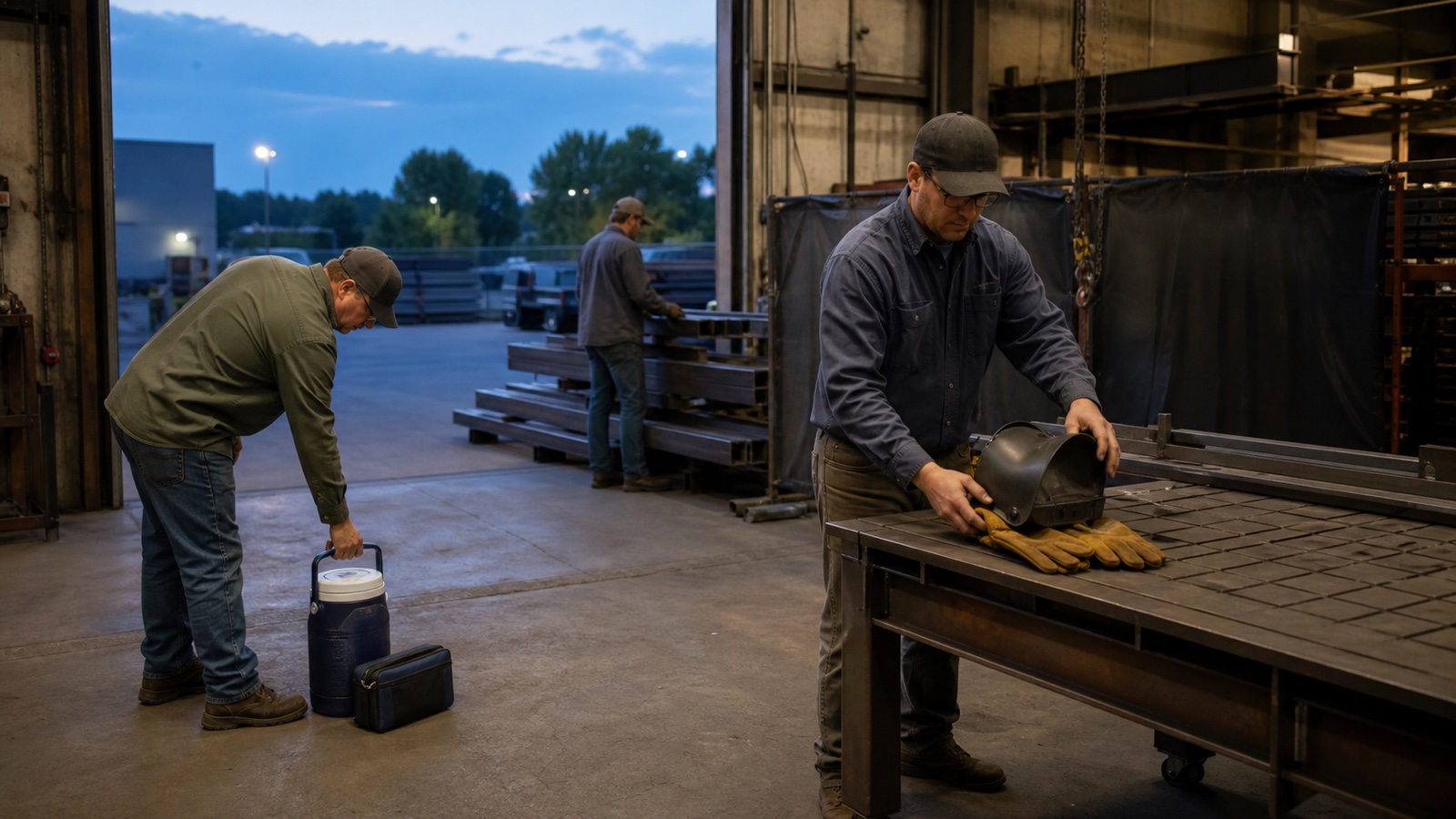
Before sunrise, an industrial parking lot has a different kind of honesty.
Headlights move across steel racks. Coolers land beside lunchboxes. A roll-up door climbs into the dark, and for a few minutes the building holds onto the night’s cooler air. Nobody needs to announce why the shift is starting early. By midafternoon, the concrete will be throwing heat back at everything above it.
Summer changes the shape of a workday. For some crews, that means moving the clock. For others, production cannot move, so the people do: more water staged close, breaks taken with purpose, work sequenced around the hardest hours. The details vary from shop to shop and site to site. The principle is older than any heat advisory—respect the conditions before the conditions make the decision for you.
The First Hour Feels Borrowed From the Day
An early summer shift has a sound of its own. Fans are already turning, but the grinders have not yet taken over. Fitters can hear a tape snap back into its case. The first arc of the morning feels brighter because the rest of the shop is still blue with dawn.
That quiet hour is not romantic when the alarm rang at three-thirty. It is useful.
The American summer has always moved some trades toward the edges of daylight: roofers, concrete crews, road workers, farm crews, utility workers, and welders whose work sits inside a hot building or out in the open. The schedule is a practical response, not proof that one crew is tougher than another. The National Institute for Occupational Safety and Health recommends scheduling heavy work for the coolest part of the work shift when possible. An early start is one way a crew can put that guidance into practice.
But the clock only creates an opportunity. What a crew does with the cooler hours still matters.
Cool Air Does Not Make the Work Easy
At five in the morning, the hood, jacket, gloves, and boots weigh the same as they will at noon. The joint still has to be cleaned. The lift still needs a plan. A rushed fit-up made before breakfast can create just as much trouble as one made after lunch.
Welding adds a complication that people outside the trade can miss: much of the clothing and protective equipment needed for the job also holds heat near the body. NIOSH specifically notes that protective clothing and personal protective equipment can increase the risk of heat-related illness. That does not make PPE optional. It means heat has to be managed with the real job and real protection in mind.
This is why “start early” is not a complete heat plan. Current NIOSH workplace guidance also calls for accessible drinking water, appropriate rest breaks, cooler recovery areas, acclimatization for workers who are new to the heat, and a buddy system so people watch for signs of heat-related illness in one another. OSHA likewise emphasizes gradually increasing heat exposure for new workers instead of treating the first hot day like a test of character.
The strongest crews understand the difference between grit and denial. Grit keeps the work deliberate when conditions are uncomfortable. Denial ignores what the body and the people nearby are saying until the job makes the correction for you.
The Shift Starts the Night Before
Anyone who has worked an early call knows the morning is usually won or lost before bed.
Water gets chilled. Food gets packed. Clean gloves are put where they can be found without turning on every light in the house. Fuel is checked. The alarm is set with enough margin to arrive awake instead of sliding into the parking lot already behind.
That preparation is ordinary, which is exactly why it matters. A trade is built on thousands of small decisions that never make a highlight reel. Showing up with what the day requires is one of them.
The shop has its own version of the same ritual. Leads decide what should be fitted before the building heats up. Material is moved so the crew does not spend the best hour searching for it. Water is close enough to be used. New people are not left to guess the pace. When conditions change, the plan can change with them.
None of this looks dramatic. It looks like a crew that intends to finish the day with the same judgment it brought to the first joint.
Heat Changes What Professionalism Looks Like
On a mild day, a coworker taking an extra minute at the water cooler may barely register. On a hot day, noticing changes in pace, coordination, or behavior can be part of looking after the crew. The person beside you may see the problem before you do.
That kind of awareness is not softness, and it is not somebody else’s department. Shops run on people catching things early: a lead that has been dragged too close to an edge, a cylinder that needs securing, a dimension that does not match the print. Heat deserves the same attention.
Professionalism in summer can mean making the unpopular call to pause. It can mean giving a new hire time to acclimatize instead of measuring them against someone who has worked through hot weather for years. It can mean accepting that the plan made yesterday needs adjustment today.
The work still has standards. So does the way a crew gets there.
What First Light Reveals
By the time sunlight reaches the back wall, the shop is no longer quiet. The first assemblies have moved. The radio is on. Somebody has already asked where the ten-millimeter socket went, even if the shop works mostly in fractions.
What remains from that early hour is a certain clarity. Nobody beat the heat; they made room to work before its hardest stretch. Nobody proved invincible; they prepared, paid attention, and kept the people around them in the plan.
That is a version of trade pride worth carrying. Not the loud kind. The kind that gets the door open, the water staged, the material ready, and the first joint right while most of the road is still dark.
Shop question: What changes on your summer shift—start time, break rhythm, crew handoff, or nothing at all?
For more stories about the people, habits, and culture behind the hood, visit About Arc Life or explore the Arc Life collection.

Leave a Reply