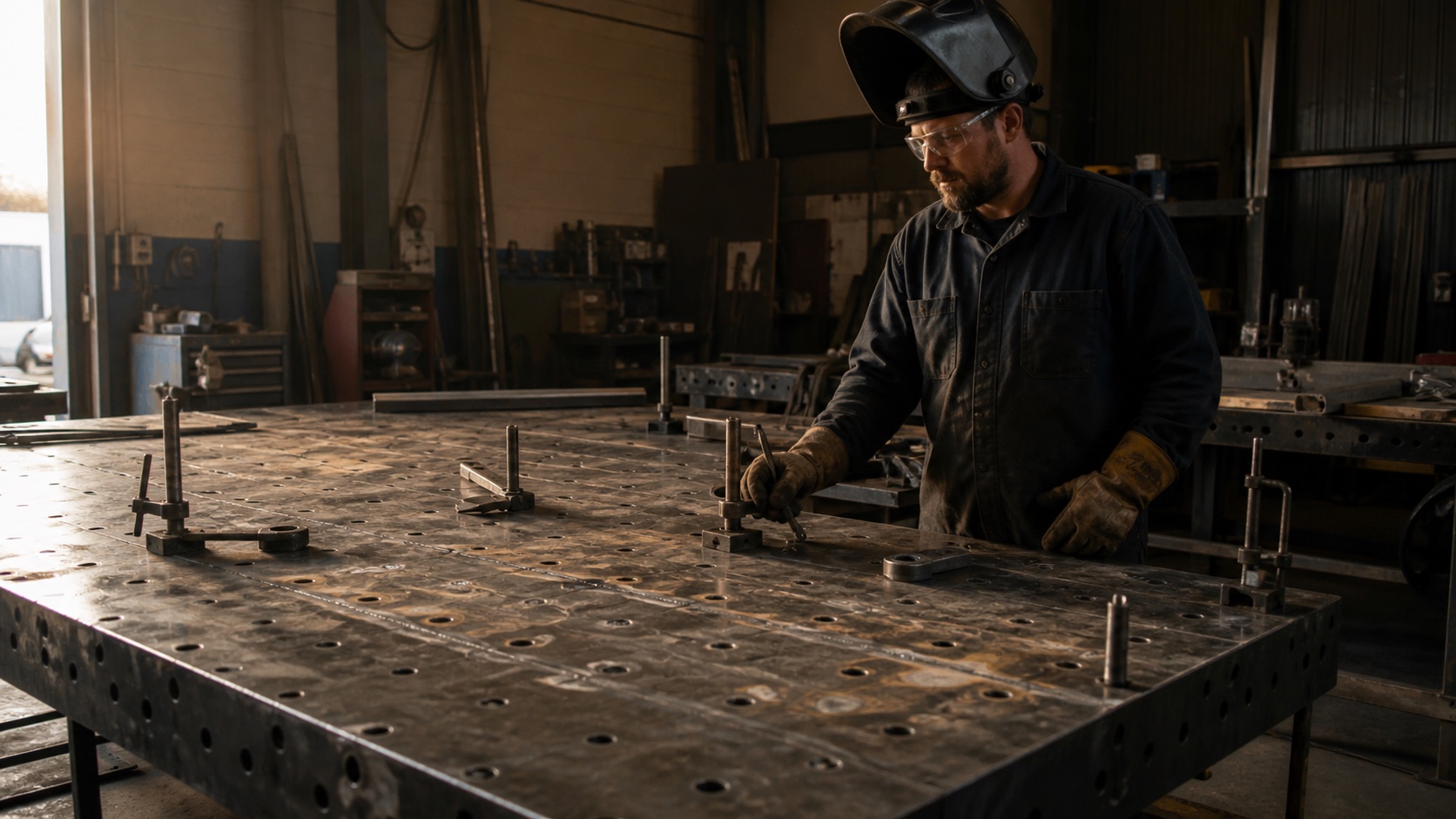
Before a welding table holds the next job, it holds the evidence of everything that came before it.
Walk into a fabrication shop before the grinders wake up and look at the table. Not the machine. Not the fresh steel in the rack. The table.
It may be scarred around the edge where clamps have landed a thousand times. A few fixture holes are cleaner than the others. There are bright ground spots, the ghost of a soapstone line, and a rectangle that only exists because an old jig once sat there. None of it is decoration. It is a record of decisions: where something was held, where it moved, where somebody stopped and tried again.
Finished work leaves the building. The table stays. In that way, a welding bench becomes one of the quietest historians in the trade.
A shop history written in marks
A new table presents a clean surface and a promise. An old one presents questions. What was clamped across that corner? Why is one spot polished smooth? Which job required so many temporary stops? The answers are rarely labeled, but people who work around steel learn to read the clues.
Some marks are ordinary. Others become shop landmarks. There is the cut nobody is proud of, the repaired edge that has held for years, or the little sequence of tack scars that belongs to a fixture long since retired. A veteran may remember the job immediately. An apprentice may only know that everyone avoids putting a square over one particular scar.
Modern fixture tables make repeatable work easier by giving clamps and stops a predictable system of holes. Strong Hand Tools describes its BuildPro tables around that basic idea: spaced boreholes let fabricators position tooling for different jobs. The specifications matter when accuracy matters, but the culture around the table grows from repetition. The same surface sees prototypes, repairs, production runs, rushed favors, and the one-off piece that takes longer than anyone expected.
Strong Hand Tools’ current BuildPro overview shows how deliberately today’s fixture tables are built for adaptable clamping. What the catalog cannot show is what happens after years of crews make that system their own.
The table is shared even when the job is not
A welding table is personal space with a public life. One person sets a job on it, but the next person inherits whatever was left behind: a useful stop, a stubborn BB of spatter, a clamp in the right place, or a mystery that needs to be cleaned up before work can begin.
That makes the bench a small test of shop culture. Good habits travel across it. So do bad ones. Leaving a surface ready is not glamorous, but it tells the next shift that their time matters. Protecting reference surfaces, returning fixtures, and clearing combustible trash are not social-media moments. They are how a shared workspace keeps working.
There is a safety reason beneath that respect. OSHA’s hot-work guidance says hot work must be done where fire hazards are absent or controlled, and its shipyard recommendations specifically call for good housekeeping and removal of rags and trash near hot work. The rulebook language is formal. The shop-floor version is simpler: know what is on the table, know what is under it, and do not hand the next person a preventable problem.
OSHA’s current hot-work precautions are worth reading for the actual requirements and context. They are a reminder that a working table should carry history—not hazards.
Do not polish away every honest scar
There is a difference between neglect and evidence. A bench buried in scrap is not a monument. Spatter where a part needs to sit flat is not character. Damaged tooling does not become wise because it is old. The table still has to do its job.
But a table does not need to look untouched to be respected. The best ones often look used with purpose. Their wear tells you people have solved real problems there. Their clean working areas tell you those people still expect the next measurement to matter.
That balance is familiar across the trade. Welders are asked to make finished work look intentional while using tools that absorb the rougher parts of the process. The table takes the clamp pressure, the setup changes, and the false starts. It helps turn loose pieces into something that can leave the shop square, straight, and ready for its real life.
The next job adds another line
Most of the objects built on a welding table will never know where they started. A handrail goes to a stairwell. A bracket disappears behind a machine. A repair goes back into service. The table remains, carrying a little evidence from each one.
That is why the old bench deserves more than a quick wipe or a complaint about its scars. It is a shared piece of shop memory. Treat it like a tool, leave it ready, and pay attention to what it can teach before covering it with the next drawing.
Shop question
What mark, repair, or homemade fixture on your shop’s welding table has a story everyone still remembers?
Arc Life is building a place for the stories that live between the finished welds. Read what Arc Life stands for, then see the current Arc Life collection when you want to carry a little of that shop-floor identity beyond the booth.

Leave a Reply