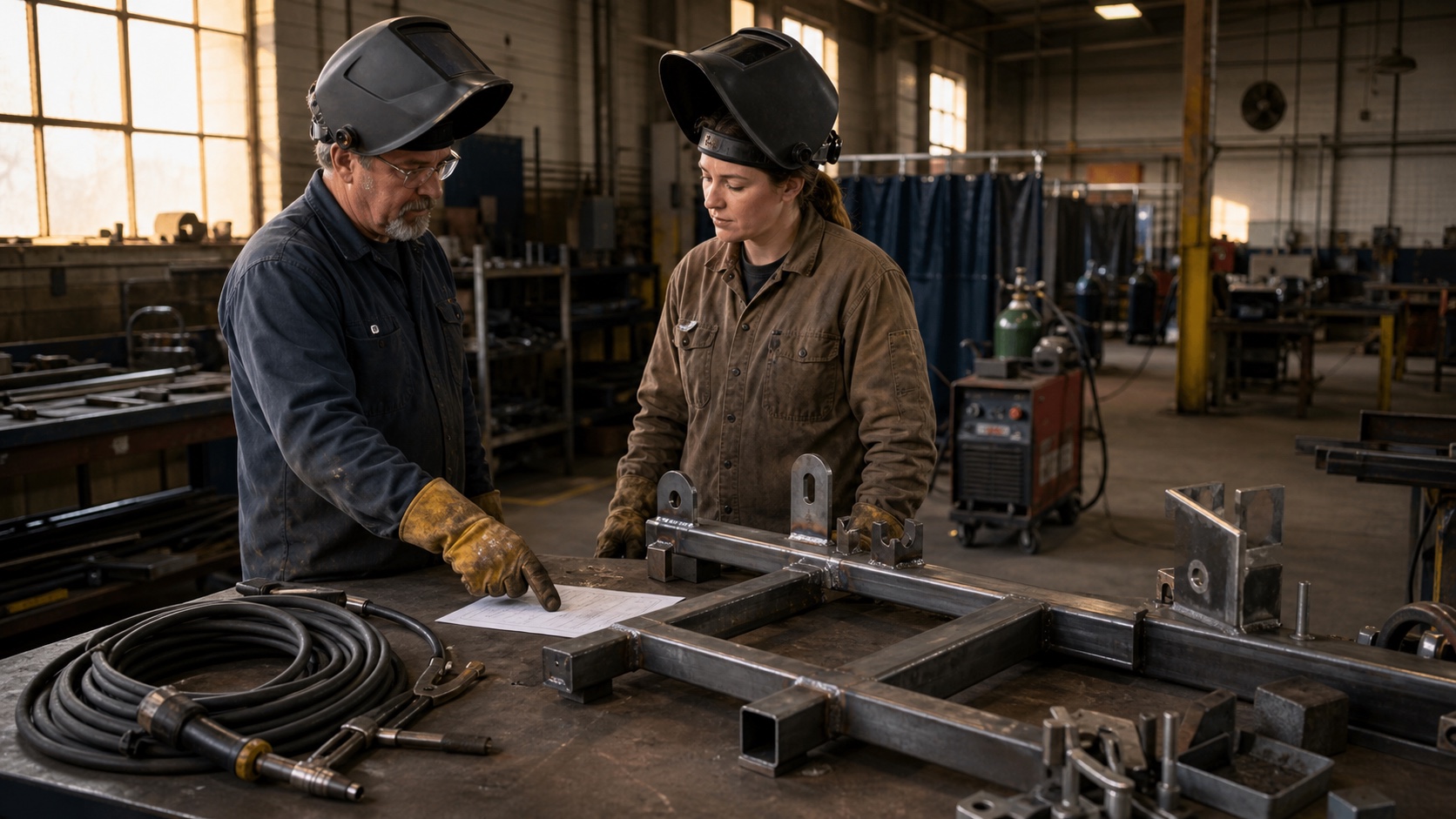
There is a point near the end of a welding shift when the shop starts telling the truth about its culture. The clock is getting loud. Gloves come off. The next crew is walking in. A half-built frame is still on the table, one clamp has been moved, a machine setting changed, and the easy thing would be to leave the whole story for somebody else to decode.
That is where a good handoff begins—not with a long speech, but with respect for the person who has to pick up the work next.
Welding culture talks a lot about individual skill. The trade also depends on continuity: what one person notices, records, stages, protects, and explains before the next set of hands takes over. The last ten minutes of a shift may not make the highlight reel, but they can decide whether the next crew starts with confidence or confusion.
A handoff is part of the work
A finished bead is visible. A good handoff is quieter. It might mean marking where the drawing changed, identifying which dimension still needs confirmation, pointing out a fixture that was moved, or saying plainly that a problem is not solved yet. It might mean leaving the leads coiled, consumables where they belong, and the bench clear enough for someone to see what comes next.
None of that is glamorous. All of it is professional.
The UK Health and Safety Executive describes effective shift handover as preparation by the outgoing crew, an exchange of task-relevant information, and cross-checking by the incoming crew. Its guidance recommends face-to-face, two-way communication supported by both verbal and written information. The point is not paperwork for its own sake. It is shared understanding.
That principle reaches far beyond one industry. In a fabrication shop, the useful question is simple: what does the next person need to know to take responsibility for this work without guessing?
The bench carries a story
A workbench at shift change can look like a random pile to anyone passing through. To the person leaving, every clamp and chalk line may make sense. The incoming welder does not have that private map.
A strong handoff turns the private map into a shared one. What has been fit? What is only tacked? Which surface is a reference? What was checked, and what still needs checking? Did the job change direction? Is there a concern that needs a lead person, inspector, or supervisor before work continues?
The outgoing welder does not need to bury the next shift in every detail from the day. Good communication is selective. It separates what is merely interesting from what changes the next decision. The incoming welder has a job too: ask, repeat back the critical point, and look at the work rather than pretending the message was obvious.
Fatigue makes clarity more valuable
Shift change often happens when one crew is ready to leave and another is still getting oriented. That is exactly when memory and assumptions deserve less trust. The National Institute for Occupational Safety and Health notes that work-related fatigue can reduce attention, short-term memory, reaction time, and judgment. Hot work, demanding tasks, long hours, and nonstandard schedules can all be part of that picture.
The answer is not to blame tired people for being human. It is to build a handoff that does not depend on someone remembering everything at the worst possible moment. A short written note, an updated traveler, a marked drawing, and a direct conversation give the next crew more than one way to understand the condition of the job.
Just as important, an honest handoff gives people permission to say, “I am not sure.” Concealing uncertainty may feel faster. Naming it keeps a question from hardening into somebody else’s assumption.
Leave it ready does not mean pretend it is perfect
A ready bench is not necessarily an empty bench. A ready job is not necessarily a completed job. “Leave it ready” means the condition is understandable. Tools are staged with purpose. Loose ends are identified. Problems are visible. The next person can tell what belongs to the job and what does not.
That standard also protects pride. There is a difference between inheriting another person’s work and inheriting another person’s mess. A clean, clear handoff says that the incoming crew is trusted with the next decision—not tested with a scavenger hunt.
The best shops pass down habits, not just jobs
New welders learn what matters by watching what experienced people do when nobody is taking a photograph. If a veteran stops long enough to explain an unusual fit, returns the fixture to a known condition, and leaves a useful note, that behavior teaches a version of craftsmanship that no bend test can measure by itself.
The lesson travels in both directions. A new person may ask the question that exposes a vague assumption. A second-shift welder may see a sequence differently. A good handoff is two-way because good work is not protected by ego; it is protected by information moving clearly between people.
The question for the shop
What is the one thing you wish the previous shift would always leave clear: job status, machine condition, drawing changes, material location, fixture setup, or something else?
The answers will be different from shop to shop. The principle holds: the work continues after one person clocks out. Leaving the bench ready is a small act of respect for whoever keeps the arc moving next.
Arc Life tells the human stories behind the hood—the habits, identity, humor, and standards that turn a trade into a community. You can also explore the current Arc Life collection, built around that shared shop-floor culture.
Sources
- UK Health and Safety Executive, “Shift handover”
- National Institute for Occupational Safety and Health, “Fatigue and Work”

Leave a Reply