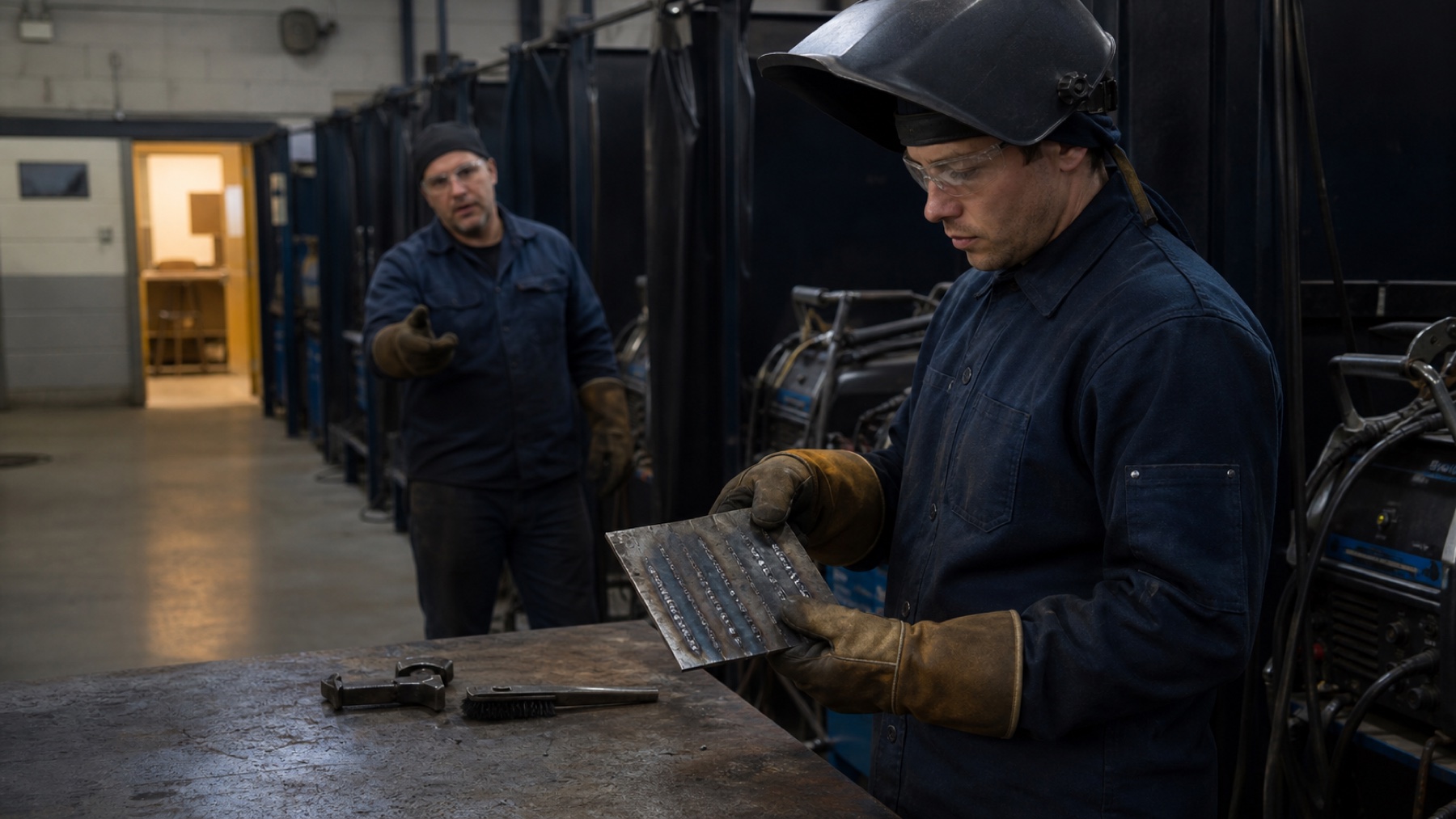
The first practice plate has a way of telling the truth. The bead wanders. The starts are heavy. The stops leave craters. You lift the hood, look at the coupon, and wonder whether everyone else in the lab understands something you missed.
They probably do not. They are learning, too.
The opening weeks of welding school are not a highlight reel. They are an introduction to repetition, observation, safety, and the strange experience of training your hands to follow what your eyes are only beginning to see. Nobody walks into that booth with years of hood time already earned.
The First Lesson Is Not About Looking Talented
New welders often arrive carrying an invisible pressure to prove they belong. Maybe a parent welded. Maybe friends already work in the trades. Maybe this is a career change, and starting over feels heavier than expected.
But the booth does not care about anybody’s backstory. It responds to preparation, position, consistency, and time. That can be humbling, but it is also fair. The work gives immediate feedback. A rough bead is not a verdict on your future; it is information about the next attempt.
You Begin by Learning to See
Before a student develops smooth travel, there is a more basic skill taking shape: noticing. You start seeing the difference between clean and contaminated material. You notice how body position changes control. You begin to recognize when the puddle is doing what you intended and when you are simply chasing it.
This is why an instructor may spend more time asking what you see than telling you exactly what to do. Good feedback teaches a student to diagnose the work instead of waiting for somebody else to rescue every pass. The goal is not to memorize one magic motion. It is to build judgment that travels with you to the next joint, process, and job.
Safety Becomes Part of the Craft
Early training can make safety feel like a long list that stands between the student and the arc. Experienced welders understand it differently. PPE, ventilation, fire prevention, cylinder handling, housekeeping, and awareness of the people around the booth are part of doing the work correctly.
The Occupational Safety and Health Administration’s welding overview organizes welding, cutting, and brazing requirements around recognized hazards and protective measures. A student does not need to memorize every standard in the first week, but the habits start immediately: protect your eyes and skin, understand the space, respect hot material, and ask when something is unclear.
Feedback Is Where Confidence Actually Starts
Real confidence is not announcing that you have it figured out. It is being willing to hear why a pass failed, make one deliberate change, and try again. That process can be frustrating because improvement rarely arrives in a straight line. One plate looks better. The next one falls apart. Then something clicks that you could not force the day before.
The students who keep progressing are not always the loudest or fastest. They are often the ones who stay curious. They compare attempts. They keep notes. They watch a demonstration closely. They ask a specific question instead of hiding a mistake. Humility is not weakness in a welding lab; it is a practical tool.
There Is More Than One Door Into the Trade
Welding careers do not begin through one universal route. The U.S. Bureau of Labor Statistics describes a mix of technical education and on-the-job training, with opportunities through vocational programs, community colleges, private schools, military training, employers, and apprenticeships. The American Welding Society’s student resources also include education, certification information, and a school directory.
That variety matters. A seventeen-year-old in a career center and a forty-year-old changing industries may stand at neighboring booths with different goals and the same assignment. Neither path makes the first plate easier. Both deserve room to learn.
The Culture Is Being Built Around You
The first weeks also reveal what kind of shop culture a class will create. Does somebody explain a setup without making the new person feel foolish? Do students clean the booth for whoever comes next? Does the class treat safety as shared responsibility? Can people laugh at a rough practice plate without laughing at the person who made it?
Those small choices matter because welding is rarely a completely solitary trade. Even when one person holds the torch, the work depends on fitters, inspectors, operators, supervisors, helpers, instructors, and customers. Skill earns respect, but so does being the person others can trust around the work.
Keep the First Plate
If the program allows it, keep an early practice coupon. Months later, it becomes evidence—not of where you failed, but of how far repetition carried you. The wandering bead, the ugly restart, and the uneven rhythm are part of the record.
That is the part of Arc Life worth remembering: pride in the trade does not begin when the work looks perfect. It begins when you decide the work is worth learning. Read more about the community behind Arc Life Co., built around people who keep showing up for the craft.
Shop question: What did your first practice weld teach you that you still remember?
