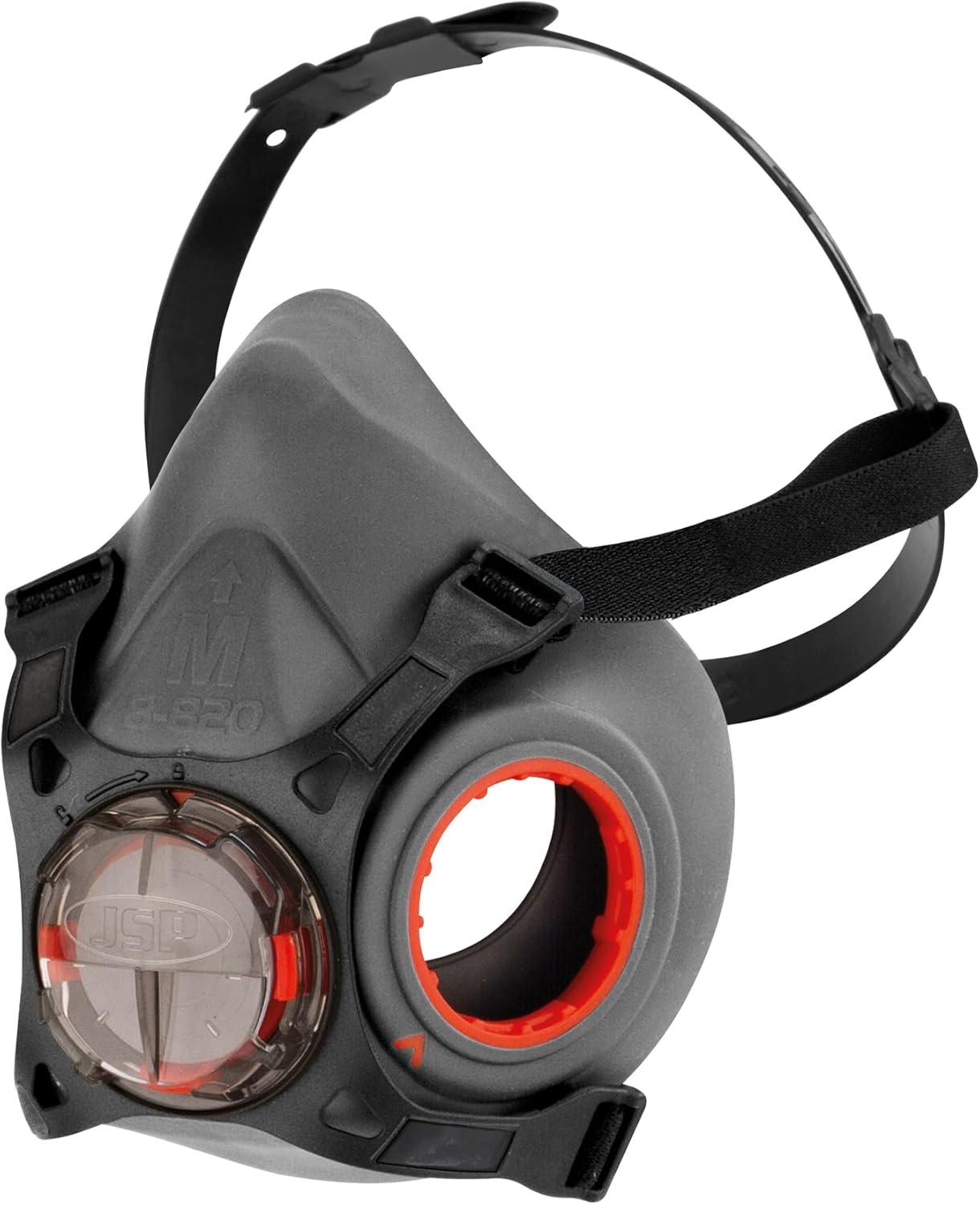
Tag: welding respirator

  • PAPR Welding Helmet Airflow Troubleshooting: Low-Flow Alarm, Filter Loading, Hose Leaks, Battery, and Blower Checks

    If a PAPR welding helmet has weak airflow, a low-flow alarm, fogging, heat buildup, or reduced breathing comfort, stop welding and troubleshoot before continuing. A PAPR depends on a battery-powered blower, correct filter, sealed hose, clean airflow path, and compatible helmet/headtop. Common causes are loaded filters, blocked spark arrestors or prefilters, weak batteries, loose hose connections, damaged breathing tubes, clogged inlet screens, poor face seal or shroud fit, and blower faults.

    Do not silence or ignore a low-airflow alarm. Install a fully charged battery, replace the prefilter and main filter if loaded, inspect the hose and seals, verify the headtop connection, and perform the manufacturerโ€™s airflow check with the correct flow indicator. If the unit still fails the airflow test, remove it from service and replace the failed component or send it for qualified service.

    Related helmet and respiratory checks include welding helmet replacement parts, auto-darkening welding helmet buying guide, PAPR welding safety support, and respirator-under-helmet fit checks.

    Common Symptoms

    SymptomLikely CauseFirst Check
    Low-flow alarm soundsLoaded filter, blocked prefilter, weak battery, hose restrictionReplace prefilter/filter and run airflow test
    Weak airflow in helmetBattery low, blower inlet blocked, hose kinkedFully charge battery and inspect hose route
    Lens fogs inside headtopLow airflow, poor shroud fit, blocked outletCheck airflow and head seal/shroud position
    Airflow starts strong then dropsBattery capacity issue or filter loading under loadTest with fresh battery and clean filters
    Blower runs louder than normalFilter restriction or blower working against blockageInspect filter stack and inlet screen
    No blower operationDead battery, bad contacts, switch/blower failureCheck battery seating and contacts

    What the PAPR Airflow System Does

    A powered air-purifying respirator uses a fan/blower to pull air through approved filters and deliver filtered air into the helmet or headtop. The filter protects against the approved hazard class only when the correct filter is installed, the blower delivers required airflow, the breathing tube is sealed, and the headtop is worn as designed. A PAPR is not a substitute for ventilation, fume extraction, confined-space controls, or correct filter selection.

    Inspection Steps

    1. Leave the weld area if airflow drops. Do not keep welding through a low-flow alarm.
    2. Check battery charge and seating. Confirm the battery is fully charged, latched, and making clean contact.
    3. Inspect the filter stack. Replace loaded, wet, damaged, expired, or wrong filters. Check prefilter and spark arrestor if equipped.
    4. Inspect blower inlet and outlet. Remove dust, grinding debris, tape, bags, or blocked screens.
    5. Inspect the breathing tube. Look for kinks, crushed sections, pinholes, cracks, loose swivels, and damaged O-rings.
    6. Check headtop connection. The hose must lock into the helmet or hood without leaks.
    7. Check face seal, shroud, or hood skirt. Tears, poor fit, or worn elastic can reduce protection and comfort.
    8. Perform the airflow check. Use the manufacturerโ€™s required flow indicator and procedure before welding.
    9. Confirm the alarm works. Follow the manualโ€™s alarm-check procedure; do not block hoses or sensors except as instructed.

    Filter Loading and Airflow Loss

    Welding fume, grinding dust, metal dust, and shop debris load filters faster than clean-air use. A clogged prefilter or spark arrestor can trigger alarms even when the main filter still looks usable. If airflow improves after replacing the prefilter but drops again quickly, check the work process, fume extraction, filter type, and whether grinding dust is overloading the system.

    Field Fix vs Proper Fix

    ProblemField FixProper Fix
    Low-flow alarmStop welding and move to clean airReplace loaded filters and pass airflow test
    Weak batteryInstall charged spare batteryTest charger, contacts, and battery runtime
    Kinked hoseReroute hoseReplace crushed or cracked breathing tube
    Fogging in helmetCheck head seal and fan speedFix airflow restriction and worn shroud/seal
    Alarm remains after new filtersRemove from serviceInspect blower, sensors, hose seals, and service parts

    Common Wrong-Part Mistakes

    • Installing a filter from the wrong PAPR system because it appears to fit.
    • Using a particulate-only filter where gas/vapor cartridge protection is required.
    • Replacing the main filter but leaving a packed spark arrestor or prefilter in place.
    • Using a non-compatible breathing tube or helmet adapter.
    • Assuming a charged battery is good without checking runtime under blower load.
    • Using damaged head seals, shrouds, or hose O-rings and blaming the blower.

    Compatibility Notes

    PAPR parts must match the complete system approval: blower, battery, charger, filter/cartridge, prefilter, spark arrestor, breathing tube, belt, helmet/headtop, face seal or shroud, and airflow indicator. Do not mix 3M, Miller, Lincoln, ESAB, ArcOne, Jackson, or other PAPR components unless the manufacturer specifically approves the configuration. For verified WSP category references, see welding helmet and PAPR support by brand and ESAB welding helmet support.

    What To Verify Before Ordering

    • PAPR brand, model, and approval label.
    • Blower unit part number and serial/date information.
    • Filter type required for welding fume and any coating, metal, or gas/vapor hazard.
    • Battery and charger model.
    • Breathing tube connection style and length.
    • Helmet/headtop model and face seal or shroud style.
    • Required airflow indicator or test kit.
    • Whether the system is still within service life and approved configuration.

    Related Failure Paths

    • Low-flow alarm caused by filter loading.
    • Helmet fogging caused by weak airflow or seal damage.
    • Battery runtime collapse during long weld shifts.
    • Fume exposure caused by wrong filter type.
    • Blower overwork from blocked inlet screens or packed prefilters.
    • Loss of protection from torn shrouds, loose hoses, or mixed-brand parts.

    Safety Notes

    • Do not use a PAPR that fails airflow, alarm, battery, or fit checks.
    • Do not bypass low-flow alarms, sensors, filters, or manufacturer interlocks.
    • Use only filters approved for the hazard; welding fume, stainless, galvanized, coatings, and solvents may require different controls.
    • PAPRs do not supply oxygen and are not for oxygen-deficient or immediately dangerous atmospheres unless specifically designed and approved for that use.
    • Maintain ventilation and fume extraction; a respirator is the last line of protection, not the only control.

    Sources Checked

    • NIOSH PAPR overview.
    • 3M PAPR system overview.
    • Weld Support Parts PAPR welding safety and helmet replacement support pages.
    • Weld Support Parts ESAB and welding helmet/PAPR support pages.
    • Welding helmet PAPR blog references for airflow, filter, and battery status.
  • Why a PAPR Welding Helmet Low Airflow Alarm Keeps Going Off

    Why a PAPR Welding Helmet Low Airflow Alarm Keeps Going Off

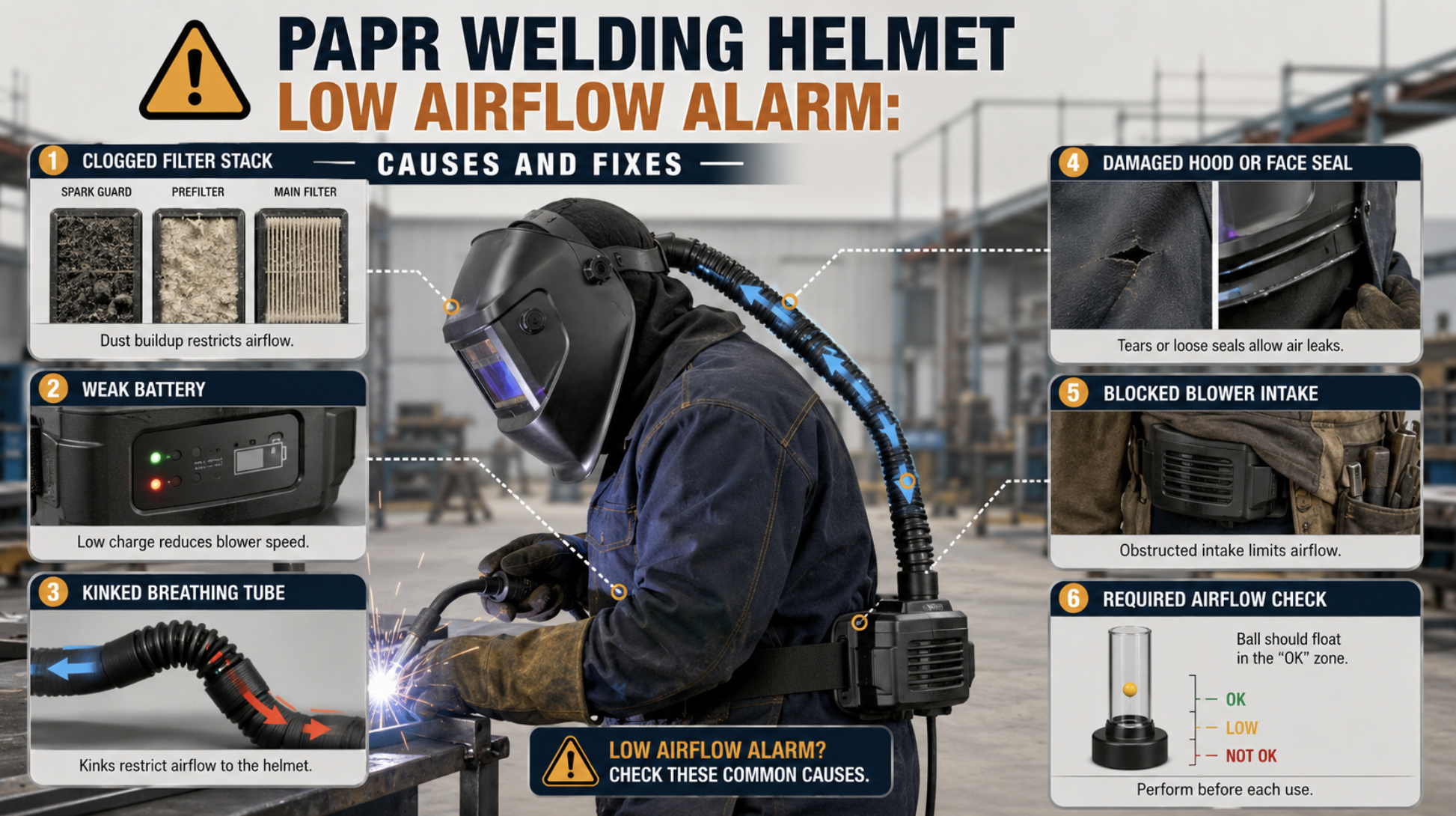
    A PAPR welding helmet’s low airflow alarm usually means the blower cannot deliver the required air volume through the hood, breathing tube, filter stack, or battery-powered blower system. The most common causes are clogged filters, blocked prefilters, a weak battery, a kinked breathing tube, a damaged face seal or hood seal, or a system that has not passed its required airflow check before use.

    This PAPR Helmet Support guide is a troubleshooting follow-up to Lincoln K3930-1 PAPR welding helmet setup and ArcOne AirPlus PAPR kit selection. It focuses on low-airflow alarms, maintenance checks, and respiratory-protection failure paths instead of general PAPR buying advice.

    Key Takeaways

    • A low airflow alarm should be treated as a stop-work warning, not a nuisance sound.
    • Clogged prefilters, spark guards, and main filters are the first items to inspect.
    • A charged battery does not prove the blower is delivering enough air.
    • Loose-fitting PAPR welding helmets still require correct assembly, airflow checks, and a respiratory protection program when used for required protection.
    • Do not mix non-approved filters, hoses, batteries, helmets, or blower parts across systems.
    • PAPR systems do not supply oxygen and must not be used in oxygen-deficient, unknown, or IDLH atmospheres.

    Problem / Context

    PAPR welding helmets are used to reduce exposure to welding fumes and particulates while improving comfort during long weld, grind, and fabrication work. A powered air-purifying respirator uses a battery-powered blower to pull contaminated air through approved filters or cartridges and deliver filtered air to the wearerโ€™s breathing zone.

    When the low airflow alarm sounds, the system may not be moving enough air through the breathing zone. That can happen during high-fume MIG, flux-core, stainless, galvanized, hardfacing, gouging, or grinding work. If the shop is also struggling with source capture, review welding fume extractor airflow troubleshooting because a PAPR should not be used as the only control when ventilation and fume extraction are required.

    Root Causes

    1. The Prefilter or Spark Guard Is Loaded

    Grinding dust, spatter, smoke residue, and shop debris can load the outer protection layers before the main filter is fully used. A dirty prefilter or spark guard can restrict airflow enough to trigger the alarm even when the main filter looks usable.

    2. The Main Filter Is Clogged or Wrong for the System

    Main PAPR filters have specific fitment, approval, and service requirements. A clogged filter increases resistance and makes the blower work harder. A non-approved substitute may fit physically but fail the system approval or airflow requirement. Only use filters listed for the exact blower and helmet assembly.

    3. The Battery Is Weak Under Load

    A battery can show charge but still fail under blower load, especially if it is old, cold, damaged, or not fully seated. Low airflow alarms that appear late in a shift often trace back to battery capacity, dirty contacts, or a charger problem.

    4. The Breathing Tube Is Kinked, Crushed, or Leaking

    The breathing tube must move air from the blower to the helmet without restriction. Kinks behind the shoulder, crushed sections under a harness, loose bayonet fittings, torn cuffs, or heat damage can reduce airflow or leak filtered air before it reaches the helmet.

    5. The Hood, Head Seal, or Face Seal Is Damaged

    Loose-fitting PAPR helmets depend on the complete hood or head seal assembly. A torn seal, missing cape, worn head seal, or poorly seated helmet can disrupt the intended airflow pattern around the breathing zone. If the issue is mostly helmet fit and visibility, compare it with auto-darkening helmet fit and lens standards before assuming the blower is the only problem.

    6. The Blower Inlet Is Blocked by Clothing or Position

    A jacket, tool belt, harness, welding curtain, or body position can partially cover the blower intake. This can happen when welding out of position, crawling inside equipment, or leaning against a workpiece. The alarm may stop when the welder stands up because the intake is no longer blocked.

    7. The System Was Not Flow-Tested Before Use

    Many PAPR systems require a pre-use airflow check with a manufacturer-specified airflow indicator or procedure. Skipping this step can hide clogged filters, weak batteries, damaged tubes, or incorrect assembly until the alarm sounds during welding.

    Solution

    Step 1: Stop Welding and Move to Clean Air

    Do not keep welding through a low airflow alarm. Stop the arc, leave the fume area when safe, and inspect the PAPR in clean air. A low airflow alarm means the respirator may not be performing as intended.

    Step 2: Check the Filter Stack in the Correct Order

    Inspect the spark guard, prefilter, main filter, filter cover, gasket, and latch. Replace loaded or damaged consumables according to the manufacturerโ€™s instructions. Do not blow filters clean with compressed air unless the manufacturer specifically allows it. Compressed air can damage filter media or drive contamination deeper into the filter.

    Step 3: Confirm Battery Seating, Charge, and Contacts

    Remove and reseat the battery. Inspect contacts for dirt, corrosion, heat damage, or looseness. Confirm the charger is the correct charger for the battery. If the low-airflow alarm appears on one battery but not the other, tag the questionable battery out of service.

    Step 4: Inspect the Breathing Tube

    Run a hand along the full breathing tube. Look for flattened sections, cracks, melted spots, loose swivel fittings, missing O-rings, or damaged cuffs. Re-route the tube so it does not pinch when the welder bends, kneels, or turns the head.

    Step 5: Inspect the Helmet Seal and Headgear

    Check the hood seal, cape, head seal, sweatband, headgear, and helmet shell. Replace torn or contaminated soft goods. Do not tape over damaged seals as a permanent repair. If the helmet is uncomfortable enough that workers loosen or misposition it, the respiratory protection may not be used consistently. For half-mask alternatives under a hood, compare P100 welding respirator options and low-profile respirator fit under welding helmets.

    Step 6: Run the Required Airflow Check

    Use the manufacturerโ€™s airflow indicator, test tube, or built-in test procedure. Pass/fail values are system-specific. Do not estimate airflow by feel. A helmet can feel breezy and still fail the required test, especially if the flow path is leaking or assembled incorrectly.

    Step 7: Remove the System From Service if It Fails

    If the PAPR fails the airflow check after filters, battery, tube, and seals are inspected, remove it from service. Tag the blower, battery, hose, or helmet assembly and follow the employerโ€™s repair procedure. Do not return a failed respirator to production because replacement parts are inconvenient.

    Specs / Verification Notes

    Item to VerifyWhy It MattersField Note
    NIOSH approvalPAPR protection depends on approved complete assemblies.Verify exact blower, helmet, filter, battery, and tube combination.
    Airflow test methodLow airflow checks are system-specific.Unknown (Verify in manual).
    Filter part numberWrong filters can void approval or restrict airflow.Use manufacturer-listed filters only.
    Prefilter and spark guardLoaded outer layers can cause alarms before the main filter is fully spent.Inspect before each shift.
    Battery runtimeRuntime varies by battery age, filter load, airflow setting, and temperature.Unknown (Verify).
    Breathing tube conditionKinks, leaks, and heat damage reduce delivered airflow.Inspect full length.
    Helmet seal or hood sealDamaged soft goods can disrupt airflow pattern.Replace damaged seals.
    Hazard typeParticulate filters may not control gases or vapors.Verify exposure and cartridge/filter selection.

    Product Section

    If the existing PAPR welding helmet repeatedly fails airflow checks or replacement parts are no longer available, a complete manufacturer-matched PAPR welding helmet system may be a better path than mixing parts. The listing below is for a Lincoln Electric VIKING 3350 XG PAPR welding helmet system. Confirm part number, battery type, included filters, replacement consumables, approval status, and workplace requirements before ordering.

    Last update on 2026-06-04 / Affiliate links / Images from Amazon Product Advertising API

    Comparison Table

    SymptomLikely CauseCheck FirstDo Not Do
    Alarm starts as soon as blower turns onBlocked filter stack, wrong assembly, failed airflow testFilter cover, prefilter, main filter, airflow indicatorDo not weld until it passes the test.
    Alarm starts late in the shiftBattery sag or filter loadingBattery charge, charger, filter conditionDo not assume the battery is good by indicator lights only.
    Alarm changes when bending or kneelingKinked tube or blocked blower intakeTube routing, belt position, clothing interferenceDo not route the tube under straps that crush it.
    Helmet feels drafty but fails flow checkLeak, missing seal, wrong setup, or incorrect test methodHood seal, breathing tube, manual procedureDo not judge airflow by feel.
    Alarm appears during grindingHeavy dust loading or intake blockageSpark guard, prefilter, intake screenDo not use damaged or clogged filters.

    Related Failure Paths

    Safety Notes

    OSHA 29 CFR 1910.134 requires an appropriate respiratory protection program when respirators are necessary to protect employee health. That program includes selection, medical evaluation, fit testing where required, use procedures, maintenance, training, and program evaluation. Loose-fitting PAPR hoods and helmets may not require fit testing, but they still require correct selection, training, inspection, cleaning, storage, and maintenance.

    NIOSH describes PAPRs as reusable respirators that use a battery-powered blower to pull air through filters, cartridges, or canisters before delivering it to the breathing zone. PAPRs can protect against gases, vapors, or particles only when equipped with the correct approved filter, cartridge, or canister. A particulate PAPR filter should not be assumed to protect against gases, vapors, oxygen deficiency, or unknown atmospheres.

    PAPR welding helmets do not supply oxygen. Do not use a PAPR in oxygen-deficient spaces, immediately dangerous to life or health atmospheres, confined spaces without proper evaluation, or areas with unknown contaminants. Welding stainless, galvanized, painted, coated, or plated materials may require exposure assessment, ventilation, source capture, and specific respiratory protection beyond a basic particulate setup.

    FAQ

    Can a PAPR welding helmet be used after the low airflow alarm sounds?

    No. Stop welding and move to clean air when safe. Inspect the PAPR and run the required airflow check before returning it to service.

    Does a full battery mean the PAPR airflow is safe?

    No. Battery charge is only one part of the system. Filters, prefilters, tubes, seals, blower condition, and assembly all affect delivered airflow.

    Can PAPR filters be cleaned with compressed air?

    Do not clean filters with compressed air unless the manufacturer specifically allows it. Many filters are replaceable consumables, and compressed air can damage the media or spread contamination.

    Do loose-fitting PAPR welding helmets require fit testing?

    Loose-fitting PAPR hoods and helmets generally do not require fit testing, while tight-fitting PAPR facepieces do. OSHA respiratory protection requirements still apply when the respirator is required for workplace protection.

    Can a PAPR replace fume extraction?

    No. A PAPR is respiratory PPE, not source capture. Use ventilation, local exhaust, process controls, and exposure assessment as required by the job and employer program.

    Can filters, batteries, or hoses be mixed between PAPR brands?

    No. Use only parts approved for the exact PAPR assembly. Mixing parts can affect airflow, approval status, and respiratory protection.

    Next Step

    If the low airflow alarm keeps going off, start with the filter stack, battery, breathing tube, intake blockage, helmet seal, and required airflow test. If the system fails after approved replacement consumables are installed, remove it from service. For broader shop exposure control, pair this check with fume extractor troubleshooting and verify whether the job requires a PAPR, half-mask respirator, ventilation change, or process control.

    Sources Checked

    • Weld Support Parts Blog: Lincoln K3930-1 PAPR Powered Air Purifying Respirator with Black Viking 3350 Welding Helmet.
    • Weld Support Parts Blog: ArcOne AP1K-V-BFFVX AirPlus w/Vison BFFVX Kit.
    • Weld Support Parts Blog: Welding Fume Extractor Not Pulling Smoke: Causes and Fixes.
    • Weld Support Parts Blog: Best Welding Respirator for Fumes (P100) โ€“ Top 3 3M Picks.
    • Weld Support Parts Blog: Miller LPR-100 Gen II Half Mask Respirator.
    • Weld Support Parts Blog: Welding Galvanized: Safe Fume Control Tactics.
    • Weld Support Parts Blog: Auto-Darkening Welding Helmet Buying Guide 2025.
    • OSHA 29 CFR 1910.134 Respiratory Protection.
    • NIOSH Powered Air-Purifying Respirators page.
    • 3M Powered Air Purifying Respirator overview.
    • Lincoln Electric VIKING 3350 PAPR / VIKING 3350 XG PAPR product and operator manual references.
    • Amazon listing checked for ASIN B0FC2PRFV8: Lincoln Electric VIKING 3350 XG PAPR with Standard Battery.
  • Welding Safety Equipment Inspection Checklist for Shop PPE

    Routine PPE inspection helps reduce welding injuries, exposure incidents, arc flash risk, burns, respiratory hazards, and equipment-related downtime. This checklist is designed for fabrication shops, maintenance departments, welding booths, and industrial welding environments where daily PPE verification is required.

    The goal is simple: identify damaged, contaminated, expired, improperly fitted, or non-compliant protective equipment before welding starts.

    Key Takeaways

    • Inspect PPE before every shift and after high-exposure work.
    • Replace cracked lenses, damaged gloves, contaminated respirator filters, and heat-damaged clothing immediately.
    • Verify ANSI, OSHA, AWS, and manufacturer markings where applicable.
    • Do not assume PPE is safe because it โ€œlooks usable.โ€
    • Respirators, helmets, gloves, jackets, and hearing protection all have wear limits.
    • Fit, seal condition, and contamination matter as much as visible damage.

    Problem / Context

    Many welding PPE failures happen gradually. Helmet shells weaken from UV and heat exposure. Respirator seals harden. Gloves absorb oil and solvents. Auto-darkening lenses become unreliable. Grinding debris damages face shields and hearing protection.

    Without a structured inspection process, damaged PPE often stays in service longer than it should.

    Shops performing MIG, TIG, flux-core, stick, plasma cutting, carbon arc gouging, or grinding operations should maintain documented PPE inspection procedures and replacement criteria.

    Daily Welding PPE Inspection Checklist

    PPE ItemInspection CheckCommon Failure SignsAction Required
    Welding HelmetInspect shell, headgear, lens frame, sensors, and controlsCracks, loose headgear, failed auto-darkening response, damaged shellRemove from service if lens response fails or shell is damaged
    Auto-Darkening LensTest switching function before weldingFlickering, delayed darkening, inconsistent shadeReplace batteries, cover lenses, or filter cartridge
    Safety GlassesInspect lenses and side shieldsScratches, cracks, missing side shieldsReplace immediately
    Face ShieldCheck visor clarity and mountingClouding, deep scratches, loose pivotsReplace damaged visor
    RespiratorInspect seal, straps, valves, and filtersSeal deformation, cracked housing, clogged filtersReplace filters or respirator components
    PAPR SystemVerify airflow, battery condition, and filter statusLow airflow alarms, damaged hoses, weak batteryService before use
    Welding GlovesInspect palms, seams, cuffs, and insulationBurn-through, oil saturation, holes, stiff leatherReplace gloves
    Welding JacketInspect sleeves, snaps, and flame-resistant areasBurn holes, contamination, torn cuffsRepair or replace
    FR Sleeves / ApronsCheck stitching and heat damageLoose seams, spark damageReplace if compromised
    Hearing ProtectionInspect ear plugs or earmuffsDirty foam, cracked cushions, loose fitReplace disposable plugs regularly
    Welding BootsCheck soles, metatarsal guards, and lacesHeat damage, exposed toe caps, sole separationRemove from service if protection compromised
    Gas Hose PPE AreaVerify hoses do not contact clothing or hot surfacesBurn marks, abrasion, leaksReplace damaged hoses immediately

    Welding Helmet Inspection Procedure

    • Inspect helmet shell for cracks, warping, or heat damage.
    • Verify headgear tightens correctly and holds position.
    • Check cover lenses for pitting, scratches, and spatter damage.
    • Perform a safe function test on auto-darkening filters before welding.
    • Confirm shade settings match the welding process and amperage.
    • Inspect sensor areas for blockage from dirt or spatter.
    • Verify ANSI Z87.1 markings where applicable.

    Do not use a welding helmet with intermittent darkening performance, cracked filter housings, or damaged retaining frames.

    Respiratory Protection Inspection Steps

    • Inspect face seal for cracking, stiffness, or deformation.
    • Verify straps maintain proper tension.
    • Inspect inhalation and exhalation valves.
    • Check filter expiration and contamination level.
    • Confirm filters match the welding hazard.
    • Perform a seal check before entering the work area.
    • Verify airflow on powered air systems.
    • Inspect hoses and blower connections on PAPRs.

    P100 filters are commonly used for welding particulate, but gas, vapor, stainless steel, galvanized coatings, confined-space work, and chemical exposure may require additional verification.

    For workplace use, respirator selection and maintenance should follow OSHA 1910.134 requirements and the site respiratory protection program.

    Glove and Protective Clothing Inspection

    ItemWhat Usually Wears Out FirstVisual Wear IndicatorsField Fix vs Proper Fix
    MIG GlovesFinger seams and palm areaThin leather, burn-throughTape is not a safe repair โ€” replace gloves
    TIG GlovesFinger sensitivity zonesHeat hardening, seam splitsReplace once dexterity drops
    FR JacketSleeves and front closureBurn holes, oil contaminationRepair minor stitching only if the FR rating is maintained
    Leather SleevesForearm exposure zonesHeat cracking and sparks embedded in leatherReplace if flexibility is lost
    Welding ApronsLower spark zonesBurn-through and torn strapsReplace heavily damaged aprons

    Common Wrong-PPE Mistakes

    • Using grinding face shields without safety glasses underneath.
    • Using expired or overloaded respirator filters.
    • Wearing oil-soaked gloves or jackets near sparks.
    • Using cracked auto-darkening lenses.
    • Ignoring damaged helmet headgear.
    • Using non-FR clothing around sparks or molten metal.
    • Wearing hearing protection incorrectly during grinding operations.
    • Failing to inspect PPE after plasma cutting or carbon arc gouging.

    Compatibility Notes

    Verify helmet lens size, respirator fitment, filter part number, cartridge compatibility, battery type, PAPR airflow rating, and headgear configuration before replacement.

    Compatibility may vary by helmet shell, respirator platform, welding process, and work environment.

    Unknown (Verify) for undocumented aftermarket compatibility claims.

    Related Failure Paths

    • Lens contamination is causing poor visibility and weld defects
    • Respirator seal failure increases fume exposure
    • Burn-through in gloves increases electrical and thermal injury risk
    • Helmet sensor blockage is causing flash exposure
    • Oil-contaminated clothing increases fire risk
    • Damaged hearing protection is contributing to long-term hearing loss
    • Improper boot condition increases slip and crush hazards

    Safety Notes

    • Follow ANSI Z49.1 for welding safety practices.
    • Use ANSI Z87.1-compliant eye and face protection where required.
    • Inspect PPE before every shift.
    • Replace damaged PPE immediately.
    • Maintain respirators according to OSHA respiratory protection requirements.
    • Do not modify PPE outside manufacturer guidance.
    • Do not use damaged FR clothing contaminated with oil or solvents.
    • Always maintain proper ventilation and fume extraction.

    FAQ

    How often should welding PPE be inspected?

    Basic inspection should occur before every shift. More detailed inspections should occur weekly or monthly depending on shop exposure conditions.

    When should respirator filters be replaced?

    Replace filters according to manufacturer schedules, site exposure requirements, or sooner if breathing resistance increases.

    Can cracked welding helmet shells be repaired?

    Generally no. Cracked helmet shells should be removed from service and replaced.

    Do safety glasses still matter under a welding helmet?

    Yes. Many shops require ANSI-rated safety glasses to be worn under welding helmets for additional impact protection.

    What is the most commonly ignored PPE issue in welding shops?

    Respirator fit and filter condition are commonly overlooked, especially in high-fume environments.

    Next Step

    Create a documented PPE inspection log for each welding station, grinding station, and fabrication area. Standardized inspection routines improve consistency, reduce missed hazards, and simplify safety audits.

    Internal Links

    Sources Checked

    • AWS ANSI Z49.1 Safety in Welding, Cutting, and Allied Processes
    • OSHA 1910.132 Personal Protective Equipment
    • OSHA 1910.134 Respiratory Protection
    • NIOSH respirator guidance
    • Manufacturer PPE inspection guidance
    • Weld Support Parts internal safety content
  • Do I Need a Respirator If I Already Have a Fume Extractor?

    A welding fume extractor reduces airborne fume at the source, but it does not automatically replace a respirator. The right answer depends on whether the extractor is capturing the plume before it reaches the breathing zone, what material is being welded, how long the weld lasts, whether coatings are present, and whether exposure levels are below applicable limits.

    For many shop and field welders, the practical answer is: use the fume extractor first, then add respiratory protection when extraction is not enough, not practical, poorly positioned, or not verified. If the extractor is not pulling smoke well, start with the WSP guide on why a welding fume extractor is not pulling smoke. If the respirator is already in use but fumes are still noticeable, check respirator seal leaks and fume smell.

    Key Takeaways

    • A fume extractor is an engineering control. A respirator is personal protective equipment. They solve different parts of the exposure problem.
    • Extraction reduces the amount of fume in the breathing zone, but capture depends on hood position, airflow, filter loading, weld position, drafts, and plume direction.
    • A respirator may still be needed for stainless, galvanized, hardfacing, flux-core, coated material, enclosed areas, long weld shifts, poor extraction capture, or unknown exposure levels.
    • P100 filters are commonly used for welding fume particulate, but gases, vapors, coatings, and confined-space hazards require separate verification.
    • For workplace use, respirator selection must follow the OSHA respiratory protection program, including medical evaluation, fit testing, training, and written procedures when required.

    Problem / Context

    The common mistake is treating a fume extractor like a guarantee. A portable arm can be rated correctly and still fail at the weld if the hood is too far away, positioned behind the plume, blocked by the workpiece, overloaded with dust, or competing with cross-drafts. In that situation, the welder may still inhale fume even though the machine is running.

    The opposite mistake is relying only on a respirator when local capture could reduce the fume load for everyone nearby. A respirator protects the wearer only when it seals correctly and uses the correct filter. A fume extractor helps reduce airborne contamination at the source. The strongest setup often uses both: capture at the arc plus properly selected respiratory PPE when exposure conditions require it.

    Root Causes: Why a Fume Extractor May Not Be Enough

    • The capture hood is too far from the arc.
    • The hood is not positioned so the plume moves away from the breathing zone.
    • The extractor filter is loaded, clogged, damaged, or overdue for replacement.
    • The duct, hose, nozzle, or prefilter is restricted.
    • Cross-drafts from fans, doors, or shop airflow pull fumes past the welderโ€™s face.
    • The weld position puts the welderโ€™s head directly above the plume.
    • The process produces high fume volume, such as some flux-core, stick, stainless, galvanized, or hardfacing work.
    • The base metal has paint, oil, zinc coating, primer, plating, solvent residue, or unknown contamination.
    • The job occurs in a corner, tank, trailer, pit, booth, or enclosed structure where plume behavior changes.

    Solution: Use This Decision Path

    Start by asking whether the fume extractor is actually controlling exposure at the breathing zone. Visible smoke moving away from the welder is a good sign, but it is not the same as exposure verification. When the material, process, or exposure level is uncertain, treat the answer as Unknown (Verify) until the shop safety plan, SDS data, and exposure assessment confirm the control method.

    • Use a fume extractor whenever indoor welding or high-fume work makes local capture practical.
    • Add a respirator when extraction is not verified to keep exposure below applicable limits.
    • Add a respirator when welding stainless, galvanized, coated, hardfacing, or high-fume flux-core work unless the hazard assessment supports another control plan.
    • Use a PAPR or other approved system when a tight-fitting half mask does not seal, causes repeated removal, or does not meet the required protection level.
    • Do not use a fume extractor or air-purifying respirator as a substitute for confined-space evaluation, oxygen monitoring, or required supplied-air protection.

    Specs / Verification Notes

    ControlWhat It DoesWhat It Does Not ProveVerification Needed
    Portable fume extractorCaptures fume near the arc when positioned and maintained correctlyDoes not prove exposure is below limitsHood position, airflow, filter condition, capture direction, and exposure assessment
    Fume extraction gunCaptures near the weld while weldingDoes not eliminate all plume exposure in every positionGun setup, nozzle condition, weld access, and airflow balance
    Downdraft tablePulls fumes downward through the work surfaceDoes not protect well when the plume rises around large parts or poor work positioningPart size, table airflow, work height, and plume path
    P100 half-mask respiratorFilters particulate when properly selected and sealedDoes not automatically cover gases, vapors, oxygen deficiency, or unknown coatingsFilter class, fit test, seal check, cartridge choice, and change schedule
    Welding PAPRProvides filtered powered airflow through an approved systemDoes not automatically solve oxygen-deficient or IDLH conditionsFilter setup, airflow check, battery condition, assigned protection factor, and program approval

    Product Section

    Check Arc Weld Store first for Miller respirators, replacement filters, and fume-control equipment when available. Amazon fallback boxes are included only for verified ASINs.

    No products found.

    The Miller LPR-100 is a practical low-profile P100 respirator option when a welder already uses local fume extraction but still needs under-hood respiratory protection for particulate welding fume. Confirm size, filter version, fit-test requirements, and workplace approval before use.

    3M Adflo PAPR and Versaflo M-Series Helmet Kit Speedglas Welding Shield, 38-1101-30iSW, Li Ion Battery, ADF 9100 XXi 1 EA/CASE
    • New, more durable leather shroud
    • 10% weight reduction from L-905SG
    • Protection from welding arc (ANSI Z87) plus spark and splatter
    • See resources section below
    • Larger viewing area compared to L-905SG

    Last update on 2026-06-04 / Affiliate links / Images from Amazon Product Advertising API

    The 3M Adflo and Versaflo welding PAPR kit is an escalation option when a half-mask is not enough because of fit issues, comfort problems, long weld shifts, facial hair conflicts, or a higher respiratory protection need. Confirm the exact configuration, filter type, assigned protection factor, airflow check procedure, and welding helmet compatibility before use.

    Comparison Table: Extractor Only vs Extractor Plus Respirator

    Job ConditionExtractor Only May Be Enough?Respirator Should Be Considered?
    Short mild steel welds in open air with verified capturePossiblyUnknown (Verify)
    Flux-core welding indoorsNot assumedYes, especially if visible fume remains near the breathing zone
    Stainless weldingNot assumedYes, based on exposure assessment and applicable limits
    Galvanized or plated steelNot assumedYes, plus coating removal and strong local capture
    Painted, oily, primed, or solvent-contaminated materialNoStop and identify the hazard first
    Confined or enclosed spaceNoRequires confined-space evaluation and approved respiratory plan
    Extractor smoke capture is visibly poorNoYes, but fix extraction instead of relying only on PPE
    Long production welding shiftNot assumedOften yes, especially if monitoring has not verified exposure control

    How to Check Whether the Extractor Is Doing Its Job

    • Place the capture hood as close to the arc as the work allows without disturbing the weld.
    • Position the hood so the plume moves away from the welderโ€™s breathing zone.
    • Watch the plume during actual welding, not just while the extractor is idling.
    • Check for cross-drafts from fans, open doors, air conditioning, or nearby equipment.
    • Inspect the hose, nozzle, prefilter, main filter, spark arrestor, and seals for restriction or damage.
    • Confirm the extractor is rated and configured for welding fume, not just general dust collection.
    • Use exposure monitoring when the process, material, or ventilation effectiveness is uncertain.

    Related Failure Paths

    Safety Notes

    OSHA guidance says local exhaust ventilation can remove fumes and gases from the welderโ€™s breathing zone, but respiratory protection may be required if work practices and ventilation do not reduce exposures to safe levels. AWS guidance also emphasizes keeping the head out of the plume, using ventilation or exhaust controls, and wearing an appropriate NIOSH-approved respirator when ventilation is not adequate or practical.

    • Do not weld over coatings, paint, solvent residue, oil, plating, or unknown contamination without identifying the hazard.
    • Do not assume outdoor welding is automatically safe; plume direction and body position still matter.
    • Do not use room fans as a substitute for source capture; they may push fumes through the breathing zone.
    • Do not use a tight-fitting respirator over facial hair that crosses the sealing surface.
    • Do not rely on odor to prove protection. Some hazardous exposures do not provide a reliable warning smell.
    • Do not use an air-purifying respirator in oxygen-deficient or IDLH conditions unless it is specifically approved for that use.

    FAQ

    Does a fume extractor replace a respirator?

    No, not automatically. A fume extractor reduces airborne fume at the source, while a respirator protects the wearer when correctly selected and sealed. A respirator may still be required if extraction does not keep exposure below safe limits.

    How do I know if my fume extractor is enough?

    Visible capture is helpful, but the stronger answer comes from correct hood placement, airflow verification, filter maintenance, SDS review, and exposure assessment. If the answer is uncertain, label it Unknown (Verify) and do not assume the extractor alone is enough.

    Should I wear a P100 respirator while using a fume extractor?

    Often yes for high-fume or higher-risk work such as flux-core, stainless, galvanized, hardfacing, coated material, enclosed work, or long production welding. P100 addresses particulate fume when properly selected and sealed, but it does not automatically cover gases or vapors.

    Why can I still smell fumes with the extractor running?

    The hood may be too far away, the plume may be passing through the breathing zone before capture, the filter may be loaded, or cross-drafts may be moving fumes toward the welder. A respirator smell complaint can also point to a poor face seal or the wrong filter for the hazard.

    Is a PAPR better than a half-mask if I already have extraction?

    A PAPR can be better when half-mask fit, facial hair, heat, comfort, long weld shifts, or exposure level makes a tight-fitting respirator the wrong tool. It still must be selected for the actual hazard and used under the workplace respiratory protection program.

    Next Step

    Use the fume extractor as the first control, then verify whether it keeps fumes out of the breathing zone during real welding. If capture is uncertain, fumes remain visible near the face, the material is stainless or galvanized, the work is enclosed, or the shift is long, add properly selected respiratory protection instead of assuming extraction alone is enough.

    Sources Checked

    • OSHA, Controlling Hazardous Fume and Gases during Welding: https://www.osha.gov/sites/default/files/publications/OSHA_FS-3647_WELDING.pdf
    • OSHA, 29 CFR 1910.134 Respiratory Protection: https://www.osha.gov/laws-regs/regulations/standardnumber/1910/1910.134
    • OSHA, 1926.353 Ventilation and protection in welding, cutting, and heating: https://www.osha.gov/laws-regs/regulations/standardnumber/1926/1926.353
    • AWS Safety and Health Fact Sheet No. 38, Respiratory Protection Basics for Welding Operations: https://aws-p-001-delivery.sitecorecontenthub.cloud/api/public/content/c09ba1fbf05a4badb79b2a9c2b47df9d
    • AWS Safety and Health Fact Sheet No. 36, Ventilation for Welding and Cutting: https://aws-p-001-delivery.sitecorecontenthub.cloud/api/public/content/Fact-Sheet-No.36
    • AWS Safety and Health Fact Sheet No. 1, Fumes and Gases: https://aws-p-001-delivery.sitecorecontenthub.cloud/api/public/content/Fact-Sheet-No.1
    • NIOSH Engineering Controls Database, Welding Operations: Local Exhaust Ventilation Systems: https://www.cdc.gov/niosh/engcontrols/ecd/detail44.html
    • 3M Adflo Powered Air Purifying Respirator System: https://www.3m.com/3M/en_US/speedglas-welding-helmets-us/adflo/
    • Arc Weld Store, Air Cleaning Equipment and Respirators: https://www.arcweld.store/collections/air-cleaning-equipment-and-respirators
    • WSP, Welding Fume Extractor Not Pulling Smoke: https://blog.weldsupportparts.com/2026/05/05/welding-fume-extractor-not-pulling-smoke-causes-and-fixes/

  • Best Low-Profile Welding Respirators That Fit Under a Hood

    A welding respirator can have the right filter rating and still fail in the shop if it pushes the hood outward, breaks the face seal, fogs the lens, or blocks the view of the puddle. The best low-profile welding respirator is the one that fits the face, clears the helmet shell, and uses the correct filter for the hazard.

    This guide narrows the buying decision to respirators that make sense under a welding hood, with practical checks for seal, filter profile, exhaust direction, helmet interference, and replacement filter availability. For a broader respirator comparison, see the existing WSP guide on welding respirators for under a welding helmet. If the issue is odor or fume breakthrough, start with why you smell fumes through your respirator.

    Key Takeaways

    • Low-profile shape matters, but seal quality matters more. A compact mask that leaks is not protective.
    • P100 particulate filters are commonly used for welding fume particulate, but filter selection must match the actual hazard.
    • Helmet clearance should be checked with the hood down, head turned, and chin tucked as if welding out of position.
    • Downward-facing exhaust valves can reduce warm exhaled air toward the lens, but they do not replace correct helmet ventilation or lens maintenance.
    • For workplace use, follow the site respiratory protection program, fit testing, filter change schedule, and applicable OSHA requirements.

    Problem / Context

    Welders often buy a respirator based on the filter rating, then find out the mask is too bulky once a hood is lowered. Common complaints include the filter hitting the helmet, the lower shell pressing on the mask, the nose bridge shifting during head movement, and the seal opening when the jaw moves.

    This is why under-hood respirator selection should be treated as a fitment problem, not just a filter problem. The respirator, welding helmet, safety glasses, beard or stubble condition, headgear position, and work posture all affect whether the mask keeps a seal. If galvanized, stainless, flux-cored, or heavy grinding work is involved, also review the WSP safety guide on safe fume control tactics for welding galvanized material.

    Root Causes of Poor Under-Hood Respirator Fit

    • Filter cartridges are too tall or too wide for the helmet shell.
    • The mask body contacts the inside of the hood when the chin is lowered.
    • The headgear is adjusted too close to the face, reducing front clearance.
    • The respirator size is wrong for the wearerโ€™s face shape.
    • Safety glasses, hood headgear, or straps disturb the face seal.
    • Facial hair crosses the sealing surface.
    • The welder uses the same respirator for grinding, painting, and welding without verifying filter compatibility.
    • Filters are loaded, damaged, wet, or overdue for replacement.

    Solution: How to Choose a Low-Profile Welding Respirator

    Start with the hazard, then verify the fit. For welding fume particulate, many welders look for a NIOSH-approved P100 setup. For coatings, solvents, stainless, galvanized material, confined work, or unknown exposures, do not guess. Use the SDS, site safety plan, ventilation assessment, and competent safety guidance before selecting filters or cartridges.

    • Choose a respirator size that seals on the face before considering helmet clearance.
    • Pick a low-profile filter layout that does not hit the hood shell at the cheeks or chin.
    • Check the exhaust valve direction. Downward exhaust can help reduce warm air toward the lens.
    • Verify that replacement filters are easy to source before committing to the mask system.
    • Test the setup with the exact hood, safety glasses, and headgear used in the shop.
    • Perform a user seal check every time the respirator is worn.

    Practical Under-Hood Clearance Test

    • Put on the respirator and safety glasses.
    • Perform the required user seal check.
    • Lower the welding hood fully.
    • Turn the head left and right as if checking bead position.
    • Tuck the chin toward the chest to simulate awkward weld positions.
    • Open and close the jaw slightly to check whether the seal shifts.
    • Look down through the lens and confirm the mask does not block the puddle view.
    • Repeat the check after adjusting the helmet headgear forward or back.

    Specs / Verification Notes

    RespiratorVerified NotesBest Use CaseWatch-Out
    Miller LPR-100 Gen. IILow-profile half mask; Miller lists S/M and M/L versions; Miller describes it as designed to fit under most welding helmets.Welders who want a purpose-built under-hood welding respirator.Confirm size and filter version before purchase.
    3M 7502 Half Facepiece3M lists silicone face seal, Cool Flow valve, dual-mode head harness, bayonet-style filter/cartridge compatibility, and NIOSH approval with approved 3M filters and cartridges.Welders who already use 3M bayonet filters and want a reusable comfort-focused half mask.Filter choice determines profile and hazard coverage; bulky cartridges may interfere with some hoods.
    3M 6200 Series Half FacepieceReusable half mask using 3M 6000 Series style filter/cartridge system.Budget reusable setup where helmet clearance is verified before use.Facepiece material and comfort differ from premium silicone models.

    Product Section

    Check Arc Weld Store first for the Miller LPR-100 Gen. II respirator and replacement filters when available. Amazon fallback boxes are included only for verified ASINs.

    No products found.

    The Miller LPR-100 is the cleanest first choice when the main buying problem is under-hood clearance. Miller describes the LPR-100 Gen. II as a reusable respirator designed to fit comfortably underneath most welding helmets, and Arc Weld Store lists the 295274 M/L version with P100 nuisance organic vapor relief filters.

    3M Medium 7500 Series Half Face Air Purifying Respirator
    • APR Masks
    • Manufacturer: 3M
    • Made in: United States

    Last update on 2026-06-04 / Affiliate links / Images from Amazon Product Advertising API

    The 3M 7502 is a practical alternative when a shop already stocks 3M bayonet-style filters and cartridges. It should be treated as a system: the facepiece, selected filter, helmet shell, and headgear all determine whether it truly fits under a hood.

    Comparison Table

    Selection FactorWhy It Matters Under a HoodRecommended Check
    Mask profileBulky masks push the hood outward or break the seal.Lower the hood and turn the head before welding.
    Filter profileFilters often hit the helmet at the cheeks first.Verify clearance with the exact filter installed.
    Face sealA leak defeats the filter rating.Perform seal checks and follow fit-test requirements where applicable.
    Exhaust directionWarm exhaled air can contribute to lens fogging.Look for downward exhaust and keep lenses clean.
    Replacement filtersA good mask becomes useless if filters are unavailable.Confirm filter part numbers before buying the facepiece.
    Hazard matchWelding fume, paint, solvents, stainless, and galvanized work may require different controls.Use SDS data, air monitoring, and the site safety plan.

    Related Failure Paths

    Safety Notes

    Respirators are not a substitute for ventilation, local exhaust, process changes, or keeping the head out of the plume. AWS fume guidance emphasizes using ventilation or other controls whenever possible, and OSHA respiratory protection rules require proper selection, medical evaluation, fit testing, training, and use procedures when respirators are required in the workplace.

    • Do not use a respirator in an oxygen-deficient or IDLH atmosphere unless it is specifically approved for that condition.
    • Do not weld coated, galvanized, painted, plated, or unknown material without identifying the hazard.
    • Do not rely on odor as a protection test. Some hazardous exposures may not provide a reliable warning smell.
    • Do not wear tight-fitting respirators over facial hair that crosses the sealing surface.
    • Use the manufacturerโ€™s instructions for cleaning, storage, inspection, and filter replacement.

    FAQ

    What is the best respirator for welding under a hood?

    For many welders, the Miller LPR-100 Gen. II is the strongest first pick because it is purpose-built as a low-profile welding respirator. The correct size and filter version still need to be verified for the wearer and hood.

    Is P100 enough for welding fumes?

    P100 filters are commonly used for welding fume particulate and are rated by NIOSH to filter at least 99.97% of airborne particles. They do not automatically cover every gas, vapor, coating, solvent, stainless, galvanized, or confined-space hazard.

    Why does a respirator make the welding helmet fog?

    Fogging is usually caused by warm exhaled air moving toward the lens, poor hood airflow, dirty lenses, cold shop conditions, or a mask exhaust path that points upward. A downward-facing exhaust valve can help, but it does not fix a poor seal or wrong helmet setup.

    Can a 3M 7502 fit under a welding hood?

    It can fit under some welding hoods, but clearance depends on the selected filters or cartridges, face size, hood shell, and headgear position. Always test it with the exact filter set installed.

    Can welders use disposable N95 masks?

    A disposable N95 may be inadequate for many welding fume tasks. Respirator selection should be based on the actual exposure, applicable standards, and the employerโ€™s respiratory protection program. For welding fume particulate, many shops move to P100-rated reusable systems.

    Next Step

    Start with the Miller LPR-100 Gen. II if the main problem is respirator clearance under a welding hood. Choose the correct size, verify the filter version, perform a seal check, and confirm that the mask does not shift when the hood is lowered. If the mask fits but fumes or odors are still noticed, troubleshoot the seal and filter path before continuing to weld.

    Sources Checked

    • MillerWelds, LPR-100 Gen. II Half Mask Respirators: https://www.millerwelds.com/safety/respiratory/half-mask-respirators-m00469
    • Arc Weld Store, Miller 295274 LPR-100 Gen. II Half Mask Respirator with P-100 Nuisance Organic Vapor Relief, M/L:
      Miller LPR-100 Gen. II Half Mask Respirator with P-100 Nuisance Organic Vapor Relief, M/L

      Miller LPR-100 Gen. II Half Mask Respirator with P-100 Nuisance Organic Vapor Relief, M/L

      $60.28

      In Stock

      View Product
    • Arc Weld Store, Miller 295273 LPR-100 Gen. II Half Mask Respirator with Nuisance OV Relief, S/M:
      Miller 295273 LPR-100 Gen. II Half Mask Respirator with Nuisance OV Relief, S/M Size

      Miller 295273 LPR-100 Gen. II Half Mask Respirator with Nuisance OV Relief, S/M Size

      $60.28

      In Stock

      View Product
    • 3M, 3M Half Facepiece Reusable Respirator 7500 Series: https://www.3m.com/3M/en_US/p/d/b00039314/
    • CDC/NIOSH, Respirators and Mask Types and Performance: https://www.cdc.gov/niosh/ppe/php/community-respirators-masks/types-of-respirators-and-masks.html
    • CDC/NIOSH, Approved Particulate Filtering Facepiece Respirators: https://www.cdc.gov/niosh/ppe/niosh-approved-respirators/ffr-cel.html
    • OSHA, 29 CFR 1910.134 Respiratory Protection: https://www.osha.gov/laws-regs/regulations/standardnumber/1910/1910.134
    • OSHA, User Seal Check Procedures: https://www.osha.gov/laws-regs/regulations/standardnumber/1910/1910.134AppB1
    • OSHA, Fit Testing Procedures: https://www.osha.gov/laws-regs/regulations/standardnumber/1910/1910.134AppA
    • AWS Safety and Health Fact Sheet, Fumes and Gases: https://aws-p-001-delivery.sitecorecontenthub.cloud/api/public/content/Fact-Sheet-No.1
  • Miller LPR-100 Gen II Half Mask Respirator (low-profile under-helmet design)

    If your main requirement is โ€œfits under my hood,โ€ the LPR-100 is one of the few half masks designed specifically around that constraint. The filter layout stays tight to the face to reduce interference with the helmet shell and bib.

    No products found.

    Manufacturer-sourced specs (verify exact variant/size)

    • Filter type: P100 particulate filter
    • Filtration efficiency: 99.97% (P100 class)
    • Design intent: low-profile to fit under most welding helmets
    • Sizes: S/M and M/L (choose for seal, not โ€œwhat you usually wearโ€)

    Best for

    • MIG and stick welding in shops where you need a practical under-hood solution
    • Anyone who keeps abandoning bulky respirators because they wonโ€™t clear the helmet

    Watch-outs

    • Fit is everything: do a seal check every time you don it. If it leaks, it doesnโ€™t matter what the label says.

    GVS Elipse P100 (SPR457 M/L)

    The Elipse is popular for one reason: itโ€™s compact. The filters sit close to the cheeks, which can reduce the โ€œmask hits the hoodโ€ problem compared to many cartridge-style respirators.

    GVS SPR457 Elipse P100 Dust Half Mask Respirator with replaceable and reusable filters included, blue, m/l size
    • This mask is recommended for dust and fumes containing substances such as micro-organisms, marble, gypsum, titanium oxide, soapstone, rock wool, wood, detergents, textile fibres, spices, salt, animal feeds, etc.. Protects against dust that can cause lung disease. In particular, protects against coal, silica, cotton, iron ore, graphite, kaolin, zinc, aluminium dusts. Protects against harmful dusts such as asbestos, bauxite, coal, silica, iron, and against toxic dusts.
    • Extremely lightweight and compact to give the wearer as much comfort as possible. It offers a full range of vision without interfering with other eye or ear protection which users are required to wear.
    • Low breathing resistance to reduce the risk of user fatigue and to add additional comfort. Filters last up to 5 years and can be easily replaced.
    • Made from soft thermoplastic odorless elastomer that is hypoallergenic (without latex and silicone) and an easy-to-adjust headband
    • NIOSH Approval number: P100 TC-84A-6949. Elipse P100 respirator has met the requirements of 42CFR84 (Code of Federal Regulations).

    Last update on 2026-06-04 / Affiliate links / Images from Amazon Product Advertising API

    Manufacturer-sourced specs (verify exact model)

    • Approval: NIOSH P100
    • Intended protection: harmful dusts and metal fumes (per manufacturer wording)
    • Filter type: pleated HESPA P100 style (manufacturer terminology varies by region)
    • Form factor: compact twin-filter half mask

    Best for

    • Tight-clearance helmets and welders who need a slim profile for fitment
    • Grinding + welding workflows where you want one compact half mask (with correct filters)

    Watch-outs

    • Comfort is user-specific. If the seal pressure points you, youโ€™ll stop wearing itโ€”size correctly.

    3M 7502 Half Facepiece (7500 Series)

    This is the โ€œbuild a systemโ€ option. The 7500 series facepiece is known for comfort, and the bayonet connection opens up a wide range of 3M filters/cartridgesโ€”useful if you switch between particulate-only and nuisance/OV situations (based on your hazard assessment).

    Last update on 2026-06-04 / Affiliate links / Images from Amazon Product Advertising API

    Manufacturer-sourced specs (series-level; verify exact configuration)

    • Facepiece material: silicone
    • Connection: 3M bayonet-style filter/cartridge interface
    • Suspension: drop-down style (helps doff without removing hard hat/hood in some setups)
    • Size: 7502 = Medium (in the 7500 series sizing)

    Best for

    • Welders who prioritize comfort and want flexible filter options
    • Shops standardized on 3M cartridges/filters

    Watch-outs

    • Cartridge/filter choice changes profile. Some combinations will fit under a hood; some wonโ€™t. Keep it low-profile if โ€œunder helmetโ€ is the goal.

    TOP PICK (plain text callout)

    TOP PICK: Miller LPR-100 Gen II โ€” If your #1 requirement is โ€œfits under my welding helmet,โ€ start here. Itโ€™s purpose-built around low-profile clearance, which is the usual deal-breaker with half masks.


    Buying Guide: how to choose a respirator that fits under a welding helmet

    1. Prioritize seal over brand
      A perfect โ€œunder-helmetโ€ shape that leaks is a fail. Choose the size that seals on your face, then solve clearance.
    2. Keep the filter profile tight
      Under-hood fit usually fails at the cheeks. Compact filters (or low-profile P100 designs) reduce helmet interference.
    3. Match filters to the job (donโ€™t guess)
    • Welding fume and grinding dust often point you toward P100 particulate filtration.
    • If you have solvents/paint/cleaners in the area, you may need additional cartridge capability (follow your shopโ€™s safety program).
    1. Donโ€™t ignore ventilation and capture
      A respirator is not a substitute for fume extraction. If you can add local capture, do itโ€”less exposure, less filter loading, better visibility.
    2. Do a quick fit check every time
      Negative/positive pressure checks take seconds and prevent hours of exposure.

    FAQ

    Q1) Whatโ€™s the best welding respirator that fits under a helmet?
    For most people, itโ€™s the one that seals correctly and stays low-profile at the cheeks. Purpose-built low-profile designs (like the LPR-100 style) are often the easiest starting point.

    Q2) Do I need P100 filters for welding?
    Many welding and grinding exposures are particulate-based, where P100 is commonly used. Your exact needs depend on the materials, coatings, ventilation, and your shopโ€™s safety requirements.

    Q3) Why does my respirator break seal when I drop my hood?
    Usually the helmet shell contacts the filter area and shifts the mask. Fix it by switching to a lower-profile filter design, adjusting headgear, or changing helmet clearance.

    Q4) Can I wear a half-mask with safety glasses under a hood?
    Yes, but fogging and seal interference are common. Anti-fog eyewear, proper hood ventilation, and correct strap routing help. If glasses break the seal, address that first.

    Q5) When should I step up to a PAPR?
    If you canโ€™t get a reliable seal, you have high fume loads, or you need higher comfort for long shifts, a PAPR may be the practical solution (shop policy and budget permitting).


    Safety Notes (ANSI/ISEA Z87.1 + PPE reminders)

    • Wear ANSI/ISEA Z87.1 compliant eye protection under the hood when required by your environment and task.
    • Respiratory protection only works when it seals and is worn consistently. Facial hair can prevent a proper seal on tight-fitting respirators.
    • Use fume extraction when possible, maintain adequate ventilation, and follow your shopโ€™s hazard assessment and PPE program.
    • Replace filters per manufacturer guidance and when breathing resistance increases or filters are damaged/loaded.
  • Best Welding Respirator for Under a Welding Helmet (Low-Profile Picks)

    Welding fumes and grinding dust are a real exposure problemโ€”especially when youโ€™re doing short, frequent welds and โ€œjust dealing with it.โ€ The issue is fit: most respirators either hit the inside of your hood, block your view, or fog your lens. This page focuses on low-profile, helmet-compatible half masks with verified filtration specs from the manufacturer.

    Where to Buy (Fast Links) ArcWeld.store (if available):

    • Miller LPR-100 Gen. II: N/A
    • 3M 7502 (7500 Series): N/A
    • 3M 6200 (6000 Series): N/A

    Amazon (verified ASINs):

    Key Takeaways

    • Low-profile matters: if the mask pushes your hood forward, youโ€™ll stop wearing it.
    • P100 particulate filtration is the baseline for welding fume particulates (verify your hazard and compliance needs).
    • Comfort drives compliance: silicone facepieces and better exhalation design reduce hot spots and fogging.
    • Always confirm fit and do a seal check; the โ€œbestโ€ respirator is the one that seals on your face every time.

    Comparison Table

    ModelKey Specs (Manufacturer)Best For
    Miller LPR-100 Gen. II Half Mask (ML00995 shown)P100 particulate filter; 99.97% filtration; low-profile design; downward-facing exhaust valve (fog/heat reduction)Welders needing a purpose-built low-profile mask under most hoods
    3M Half Facepiece 7502 (7500 Series, Medium)Silicone facepiece; 3M Cool Flow Valve; bayonet filter connection; approx. 135 g (facepiece weight)All-day comfort + better seal feel; good choice if you already run 3M bayonet filters
    3M Half Facepiece 6200 (6000 Series, Medium)3 sizes (6100/6200/6300); soft lightweight elastomer; bayonet filter connection; approx. 82 g (facepiece weight)Budget-friendly reusable half mask; lighter facepiece

    Top Pick (Most Helmet-Friendly) If your #1 requirement is โ€œfits under the hood without messing up my view,โ€ start with the Miller LPR-100 Gen. II. Itโ€™s designed around welding-helmet clearance and includes a downward exhaust design intended to reduce heat buildup and lens fogging. Amazon:

    No products found.

    Product Picks (Details)

    1. Miller LPR-100 Gen. II Half Mask Respirator (Odor Relief) โ€” ASIN: B01BZAHQMS Why itโ€™s on this list: This is one of the few half masks marketed specifically around welding helmet fitment, with a low-profile shape thatโ€™s meant to stay out of your sightline.

    Key specs (Manufacturer):

    • Filter type: P100 particulate filter
    • Filtration: 99.97% filtration of airborne particles and aerosols (oil-based and non-oil-based)
    • Design: low-profile to fit under most welding helmets
    • Exhaust: downward-facing exhaust valve (intended to reduce heat buildup and lens fogging)

    Best for:

    • MIG/flux-core and general shop welding where fume particulates are the primary concern
    • Welders who wonโ€™t wear a bulky mask under a hood

    Where to buy:

    • ArcWeld.store: N/A
    • Amazon:

      No products found.

    1. 3M Half Facepiece Reusable Respirator 7502 (7500 Series, Medium) โ€” ASIN: B004HXBCMG Why itโ€™s on this list: The 7500 series is a comfort-first upgrade path (silicone facepiece + valve design). If you already use 3M bayonet filters/cartridges, this is a practical long-term setup.

    Key specs (Manufacturer):

    • Facepiece material: silicone
    • Valve: 3M Cool Flow Valve
    • Connection: 3M bayonet-style filter/cartridge connection
    • Weight (approx.): 135 g (facepiece)

    Best for:

    • Longer wear time (comfort and seal feel)
    • Shops standardized on 3M bayonet filters/cartridges

    Where to buy:

    1. 3M Half Facepiece Reusable Respirator 6200 (6000 Series, Medium) โ€” ASIN: B001QF9C5C Why itโ€™s on this list: This is the common โ€œget startedโ€ reusable half mask. Itโ€™s lighter on the facepiece weight and widely supported with 3M bayonet filters/cartridges.

    Key specs (Manufacturer):

    • Sizes: 6100 (S), 6200 (M), 6300 (L)
    • Facepiece: soft, lightweight elastomeric design
    • Connection: 3M bayonet-style filter/cartridge connection
    • Weight (approx.): 82 g (facepiece)

    Best for:

    • Budget-conscious buyers who still want a reusable system
    • Occasional welding/grinding where you want a dedicated half mask

    Where to buy:

    Buying Guide: How to Choose a Welding Respirator That Fits Under Your Hood

    1. Start with clearance, not filtration marketing
      If it hits your chin area and pushes the hood out, youโ€™ll stop wearing it. Low-profile shape and exhaust direction matter.
    2. Match filters to the hazard (do not guess)
      P100 handles particulates. Welding environments can also involve gases/vapors depending on process, coatings, cleaners, and ventilation. If you need OV/acid gas protection, confirm the correct cartridge/filter combo and compliance requirements.
    3. Comfort = compliance
      Silicone facepieces and better valve designs typically reduce pressure points and heat. If itโ€™s miserable, it wonโ€™t get used.
    4. Do a seal check every time
      Facial hair, strap tension, and hood pressure can break the seal. A respirator that leaks is not doing the job.

    FAQ

    1. Will these respirators fit under every welding helmet? No. โ€œFits under mostโ€ is common language, but helmet shell shape, headgear position, and how low you run the hood all change clearance. Verify by donning the respirator, then lowering the hood fully and checking for contact points.
    2. Is a P100 filter โ€œenoughโ€ for welding fumes? P100 is a common baseline for particulate filtration, but โ€œenoughโ€ depends on the specific exposure (process, material, coatings, ventilation, duration) and your safety program requirements. Verify against your shopโ€™s hazard assessment and applicable regulations.
    3. What causes lens fogging when wearing a respirator under a hood? Warm exhaled air moving upward, plus restricted airflow under the hood. Downward exhaust designs and better exhalation valves can help, but fit and hood airflow still matter.
    4. Can I use the same respirator for grinding and welding? Often yes (particulates), but confirm the correct filter type and replacement interval. Grinding dust loads filters quickly and increases breathing resistance.

    Safety Notes (Minimum Baseline)

    • Eye/face protection: Use safety glasses that meet ANSI Z87.1 under the hood when appropriate for your task and shop rules.
    • PPE reminder: Respirators only work with a proper seal. Perform a user seal check each time you put it on.
    • Ventilation still matters: Local exhaust/airflow reduces exposure and improves comfort.
    • If you are welding on coated/painted/galvanized material: stop and verify the correct respiratory protection and controls for that specific hazard.

    [SOURCES & VERIFICATION] Sources Checked (Manufacturer specs only)

    Amazon ASIN Verification (product pages)

  • Best Welding Respirator for Fumes (P100) โ€“ Top 3 3M Picks

    Best welding respirator for fumes (P100): 3 proven 3M options

    If youโ€™re welding in a shop or garage, the โ€œburnt metalโ€ smell is the least of the problem. Welding fumes and fine particulate can hang in the air, especially during MIG/flux-core, grinding, and stainless work. A reusable half-mask respirator paired with P100 filters is a common, practical step up from disposable masksโ€”when it fits correctly and you use the right cartridges/filters for the hazard.

    Where to Buy (quick links)

    • ArcWeld.store (preferred): Check availability below per product (some may be N/A).
    • Amazon (backup): Use the AAWP boxes/shortcodes below.

    Key takeaways

    • P100 filters are a common choice for welding fume particulate; add the right cartridge if you also need gas/vapor protection (verify your hazard).
    • Comfort drives compliance: silicone face seals and good harness design matter if you wear it for hours.
    • Fit is everything: a great respirator that leaks is the wrong respirator.
    • Low-profile masks are easier to run under many welding helmets and face shields.

    Comparison table

    Model Key Specs (manufacturer) Best For ArcWeld Link Amazon
    3M 6502QL (6500QL Series) Quick Latch drop-down; bayonet connection; silicone faceseal; low-profile design Welders who need fast on/off between tacks and grinding N/A
    3M Rugged Comfort Quick Latch Half Facepiece Reusable Respirator 6502QL, NIOSH, Cool Flow Exhalation Valve, Bayonet Connection, Silicone Face Seal, for Gases, Vapors, Dust, Maintenance, Construction,M
    • NIOSH-APPROVED: NIOSH, a USA federal government regulatory agency, has tested and approved the 3M Rugged Comfort 6500 Series Quick Latch Half Facepiece Reusable Respirator with 3M cartridges, filters or supplied air systems to help reduce inhaling certain airborne contaminants
    • EASY ON AND OFF: Quick latch design offers an easy, one hand touch drop down mechanism for putting the face piece on and off while moving in and out of contaminated areas
    • COMFORTABLE: Adjustable head harness assembly promotes a comfortable fit with 3 size adjustable head cradle; long lasting polyester/spandex straps
    • COOL COMFORT: Proprietary 3M Cool Flow Valve is designed for easy exhalation to help keep the wearer more comfortable
    • DURABLE: Resilient silicone faceseal provides comfort, durability, and stability with a soft but firm seal. Keeps its shape in high heat environments

    Last update on 2026-06-04 / Affiliate links / Images from Amazon Product Advertising API

    3M 7502 (7500 Series) Advanced silicone faceseal; Cool Flow valve; bayonet connection; dual-mode head harness All-day comfort for shop welding + fabrication N/A
    3M OV/P95 Paint Project Respirator 6311, Reusable Respirator, 1-Facepiece, 1-pair of Replaceable NIOSH-Approved 6001 Cartridges, 2 -pairs of 5P71 Filters and 1-pair of 501 Retainers, Large, 1 per pack
    • NIOSH-APPROVED 6001 OV CARTRIDGE HELPS REDUCE EXPOSURE to certain organic vapors encountered during activities involving latex and oil-based painting, including paint spraying, varnishes, stains, sealants, solvents, certain solvent-based cleaners or pesticides
    • NIOSH-APPROVED 5P71 P95 RATED FILTERS HELP REDUCE EXPOSURE to certain particles from paint spraying, spray adhesives and pesticide
    • FOR WORKPLACE/OCCUPATIONAL USE ONLY
    • LIGHTWEIGHT, FLEXIBLE, THERMOPLASTIC FACESEAL for comfort
    • 3M BAYONET CONNECTION compatible with 3M cartridges and filters

    Last update on 2026-06-04 / Affiliate links / Images from Amazon Product Advertising API

    3M 2097 P100 Filter (pair) NIOSH P100; 99.97% filter efficiency (P100 test criteria); nuisance-level organic vapor relief (carbon layer); bayonet-style connection Welding fume particulate + reduced โ€œshop smellโ€ (nuisance OV relief) N/A

    Last update on 2026-06-04 / Affiliate links / Images from Amazon Product Advertising API

    Top pick (most welders should start here)

    Top Pick: 3M 7502 + 3M 2097 P100 filters

    If you want one setup thatโ€™s comfortable enough to actually wear and easy to maintain, the 7502 (medium) paired with 2097 P100 filters is a straightforward, widely-used combination. The key is getting the right size and doing a proper seal check every time.

    Product details

    1) 3M Rugged Comfort Quick Latch Half Facepiece Reusable Respirator 6502QL (Medium)

    Why itโ€™s on this list: The Quick Latch feature is legitimately useful in a welding workflowโ€”drop it down without removing your headgear when you need to talk, check fit-up, or step out of the fume zone.

    Best for: Short-cycle welding (tack/fit/tack), frequent on/off, dirty shop environments.

    Key specs (manufacturer):

    • Quick Latch drop-down mechanism (6500QL series)
    • Bayonet connection system (compatible with approved 3M filters/cartridges)
    • Silicone faceseal (comfort/durability)
    • Low-profile design (helps with compatibility under many shields/helmets)

    ArcWeld link: N/A

    Amazon (verified ASIN): B00IF7RBS4

    3M Rugged Comfort Quick Latch Half Facepiece Reusable Respirator 6502QL, NIOSH, Cool Flow Exhalation Valve, Bayonet Connection, Silicone Face Seal, for Gases, Vapors, Dust, Maintenance, Construction,M
    • NIOSH-APPROVED: NIOSH, a USA federal government regulatory agency, has tested and approved the 3M Rugged Comfort 6500 Series Quick Latch Half Facepiece Reusable Respirator with 3M cartridges, filters or supplied air systems to help reduce inhaling certain airborne contaminants
    • EASY ON AND OFF: Quick latch design offers an easy, one hand touch drop down mechanism for putting the face piece on and off while moving in and out of contaminated areas
    • COMFORTABLE: Adjustable head harness assembly promotes a comfortable fit with 3 size adjustable head cradle; long lasting polyester/spandex straps
    • COOL COMFORT: Proprietary 3M Cool Flow Valve is designed for easy exhalation to help keep the wearer more comfortable
    • DURABLE: Resilient silicone faceseal provides comfort, durability, and stability with a soft but firm seal. Keeps its shape in high heat environments

    Last update on 2026-06-04 / Affiliate links / Images from Amazon Product Advertising API

    2) 3M Half Facepiece Reusable Respirator 7502 (Medium, 7500 Series)

    Why itโ€™s on this list: This is the comfort-biased option. For many welders, the 7500 series silicone seal and harness design makes it easier to wear for longer sessionsโ€”especially when youโ€™re also wearing a hood, glasses, and hearing protection.

    Best for: Longer welding sessions, general fabrication, anyone who hates stiff face seals.

    Key specs (manufacturer):

    • Advanced silicone faceseal (comfort/durability)
    • 3M Cool Flow exhalation valve (reduces heat/moisture buildup)
    • Bayonet connection system (approved 3M filters/cartridges)
    • Dual-mode head harness (per 3M 7500 series documentation)

    ArcWeld link: N/A

    Amazon (verified ASIN): B0009F5KDS

    3M OV/P95 Paint Project Respirator 6311, Reusable Respirator, 1-Facepiece, 1-pair of Replaceable NIOSH-Approved 6001 Cartridges, 2 -pairs of 5P71 Filters and 1-pair of 501 Retainers, Large, 1 per pack
    • NIOSH-APPROVED 6001 OV CARTRIDGE HELPS REDUCE EXPOSURE to certain organic vapors encountered during activities involving latex and oil-based painting, including paint spraying, varnishes, stains, sealants, solvents, certain solvent-based cleaners or pesticides
    • NIOSH-APPROVED 5P71 P95 RATED FILTERS HELP REDUCE EXPOSURE to certain particles from paint spraying, spray adhesives and pesticide
    • FOR WORKPLACE/OCCUPATIONAL USE ONLY
    • LIGHTWEIGHT, FLEXIBLE, THERMOPLASTIC FACESEAL for comfort
    • 3M BAYONET CONNECTION compatible with 3M cartridges and filters

    Last update on 2026-06-04 / Affiliate links / Images from Amazon Product Advertising API

    3) 3M 2097 P100 Particulate Filter (with nuisance-level organic vapor relief)

    Why itโ€™s on this list: If youโ€™re specifically searching โ€œbest welding respirator for fumes,โ€ this filter is a common go-to because itโ€™s P100-rated for particulates and includes nuisance-level organic vapor relief (carbon layer). For many shops, itโ€™s a practical baseline for welding fume particulateโ€”assuming your hazard assessment doesnโ€™t require a different cartridge.

    Best for: Welding fume particulate; grinding dust; nuisance-level organic vapor odors (not a substitute for proper OV cartridges where required).

    Key specs (manufacturer):

    • NIOSH-approved P100 particulate filter
    • 99.97% filter efficiency (P100-series test criteria)
    • Nuisance-level organic vapor relief (carbon layer)
    • Bayonet-style connection for compatible 3M facepieces

    ArcWeld link: N/A

    Amazon (verified ASIN): B07WSQKTTB

    Note: Filters are only half the system. You still need a compatible 3M half-mask facepiece (like the 6502QL or 7502 above).

    Last update on 2026-06-04 / Affiliate links / Images from Amazon Product Advertising API

    Buying guide: how to choose the right welding respirator for fumes

    • Start with the hazard: โ€œFumesโ€ can mean particulate, gases/vapors, or both. P100 filters address particulate; gases/vapors may require a different cartridge. If you donโ€™t know, treat it as Unknown (Verify) and do a basic hazard assessment.
    • Pick the facepiece for comfort + workflow: If you take it on/off constantly, Quick Latch can be worth it. If you wear it for hours, prioritize silicone comfort and harness stability.
    • Confirm compatibility: Use only approved 3M filters/cartridges for your specific facepiece series (bayonet connection system).
    • Fit test mindset: At minimum, do a user seal check every time. A formal fit test is better if youโ€™re relying on it for real exposure control.
    • Plan for helmet/eye pro: Make sure the respirator doesnโ€™t break your safety glasses seal or interfere with your hoodโ€™s headgear.

    FAQ

    Whatโ€™s the best welding respirator for fumes in a small shop?

    For many welders, a comfortable reusable half-mask (like the 3M 7502) paired with P100 filters (like the 3M 2097) is a practical baseline for particulate. If you also have solvent/paint/VOC exposure, you may need additional cartridgesโ€”Unknown (Verify) based on your materials and ventilation.

    Is a P100 filter enough for welding fumes?

    P100 is commonly used for particulate. Welding environments can also include gases/vapors depending on process, coatings, cleaners, and ventilation. Treat โ€œenoughโ€ as job-specific and verify against your hazard controls and SDS.

    Will these fit under a welding helmet?

    Many half-mask respirators are designed with a low-profile shape to improve compatibility under face shields and welding helmets, but fit varies by helmet/headgear. Verify clearance before committing.

    How do I know if my respirator fits correctly?

    Do a user seal check every time you put it on, and consider a formal fit test if youโ€™re relying on it for exposure reduction. Facial hair can prevent a proper seal.

    How often should I replace P100 filters?

    Replace per the manufacturer guidance and your conditions (loading, breathing resistance, damage, contamination). If breathing becomes noticeably harder or filters are damaged/contaminated, replace immediately.

    Safety notes (eye/face + PPE)

    • Eye protection: Use safety glasses/goggles that meet ANSI Z87.1 when grinding, chipping, or when thereโ€™s flying debris risk. A respirator does not replace eye protection.
    • Ventilation still matters: Respirators are not a substitute for local exhaust or adequate shop ventilationโ€”use both when possible.
    • Fit and facial hair: A proper seal is critical. Facial hair can compromise performance.
    • Follow 3M user instructions: Inspect, don/doff, clean, and store the facepiece per the manufacturer documentation.

    SOURCES & VERIFICATION

    Sources Checked (manufacturer specs only)

    • 3M 6500QL Series Half Facepiece Reusable Respirator Data Sheet (PDF): https://multimedia.3m.com/mws/media/1730560O/3m-6500ql-series-half-face-respirator-data-sheet.pdf
    • 3M 7500 Series Half Facepiece Reusable Respirator Data Sheet (PDF): https://multimedia.3m.com/mws/media/1731320O/3m-7500-series-reusable-half-mask-data-sheet.pdf?&fn=3M-7500-Series-Reusable-Half-Mask-Datasheet.pdf
    • 3M Particulate Filter 2097, P100 (PDF): https://multimedia.3m.com/mws/media/5188O/3m-particulate-filter-2097-p100.pdf
    • 3M product page (6500QL series): https://www.3m.com/3M/en_US/p/d/b00039317/
    • 3M product page (7500 series): https://www.3m.com/3M/en_US/p/d/b00039314/

  • JSP Force Typhoonโ„ข8 PressToCheckโ„ข Filters (For JSP Force Typhoonโ„ข8 Half-Mask)

    JSP Force Typhoonโ„ข8 PressToCheckโ„ข Filters (For JSP Force Typhoonโ„ข8 Half-Mask)

    Intro:
    If youโ€™re running a reusable half-mask in a welding shop, the filters are the real consumableโ€”and the most common failure point when performance drops. These JSP PressToCheckโ„ข filters are the correct โ€œkeep it workingโ€ purchase for the JSP Force Typhoonโ„ข8 system (verify exact compatibility before ordering).

    Key Takeaways

    • Filters are the ongoing cost and the critical safety component of a reusable respirator setup.
    • PressToCheckโ„ข design is intended to help confirm seal/fit (verify how the check works on your exact mask + filter).
    • Best practice is to keep spare filters on hand to avoid โ€œone more jobโ€ with clogged media.
    • Welding fume protection depends on the filter rating (do not assumeโ€”verify).
    • Compatibility matters: confirm these filters match the JSP Force Typhoonโ„ข8 half-mask youโ€™re using.

    Performance & Use

    For welding and grinding environments, filter performance is about two things: the rating (what itโ€™s designed to capture) and the seal (whether air is actually going through the filter media).

    What this post will not guess:

    • Exact filtration rating (P100, etc.) unless explicitly stated on the listing and packaging.
    • Whether these filters are intended for organic vapors, nuisance OV relief, or particulates only.

    What to do before you buy:

    • Confirm the filter rating on the Amazon listing and/or manufacturer documentation.
    • Confirm these are the correct PressToCheckโ„ข filters for your exact JSP mask model (Force Typhoonโ„ข8).

    Durability & Build

    Filters are consumables. In welding shops, service life can shorten fast with grinding dust, high fume load, and poor storage.

    Unknown (Verify):

    • Filter media type and rated service life
    • Whether the filters are individually sealed
    • Storage/case inclusion

    Power / Specs

    • System: PressToCheckโ„ข filter system (verify)
    • Compatibility: JSP Force Typhoonโ„ข8 half-mask respirator (verify)
    • Filtration rating: Unknown (Verify on listing/packaging)
    • Quantity per pack: Unknown (Verify)
    • Included: Filters only (Verify if adapters/caps are included)

    Who Itโ€™s For

    • Welders/fabricators already using the JSP Force Typhoonโ„ข8 half-mask and needing replacement filters.
    • Shops standardizing PPE so everyone is on the same filter platform.

    Skip if:

    • You cannot confirm the filter rating meets your shopโ€™s requirements.
    • Youโ€™re using a different respirator brand/model (fitment is not universal).

    Quick FAQ

    Q: Are these filters for welding fumes?
    A: Possibly, depending on the filter rating. Verify the rating and intended use on the listing and packaging.

    Q: Do these fit the JSP Force Typhoonโ„ข8 mask?
    A: Theyโ€™re listed as PressToCheckโ„ข filters; verify they match the Force Typhoonโ„ข8 half-mask before ordering.

    Q: How do I know when to replace filters?
    A: Replace when breathing resistance increases, filters are damaged, or per manufacturer schedule (verify guidance).

    Q: Can I use these for grinding dust too?
    A: Potentiallyโ€”depends on the rating. Verify.

    Q: Do filters fix a poor seal?
    A: No. You need correct sizing and a proper seal check every time.

    Safety Notes

    • Do not assume protection without verifying filter rating + fit + seal.
    • Perform seal checks each time you don the respirator; facial hair can compromise sealing.
    • Store filters clean and dry; contaminated filters can create exposure risk.
    • Use ventilation and fume control whenever possible; PPE is the last line of defense.
    • Always follow the machine manual, SDS, and applicable code requirements. If unsure, verify with the manufacturer.

    Where to Buy

    JSP Force Typhoonโ„ข8 Half-Mask Reuseable Respirator – Medium – Low Breathing Resistance, NIOSH, Enhanced Comfort and fit, Compatible with PressToCheckโ„ข Filters
    • [ADJUSTABLE] Fully adjustable 4-point cradle suspension ensures an effective facial fit.
    • [COMFORT] Soft thermoplastic rubber (TPR) facepiece for enhanced comfort and fit.
    • [LOW BREATHING RESISTANCE] Unique Typhoon low resistance exhalation valve increase comfort and reduces fatigue.
    • [REPLACEABLE FILTERS] Works with PressToCheck twin filters that ensure a correct seal every time.
    • [PROTECTION] APF 10 when properly fit tested and used with compatible filters and cartridges.

    Last update on 2026-06-04 / Affiliate links / Images from Amazon Product Advertising API

    JSP P100 PressToCheckโ„ข Particulate Filter Cartridges for The JSP Force Typhoonโ„ข8 Half-Mask Respirator – Pack of 2 (1 Pair) – NIOSH 99.97% Filter Efficiency
    • [NIOSH APPROVED] NIOSH 99.97% filter efficiency. Effective against all solid and oil particulate aerosols.
    • [COMPATIBLE] Compatible with all JSP Force Typhoon8 half mask respirators.
    • [PROTECTION] APF 10* when Quantiative Fit Testing is performed.
    • [LOW RESISTANCE] Evolutionary pleated filter provides lower breathing resistance.
    • [CHECK] PressToCheck twin filters ensure a correct seal every time.

    Last update on 2026-06-04 / Affiliate links / Images from Amazon Product Advertising API

  • GVS SPR457 Elipse P100 Dust Half Mask Respirator (M/L)

    GVS SPR457 Elipse P100 Dust Half Mask Respirator (M/L)

    Intro
    If youโ€™re welding in a shop that stays hazy, a low-profile P100 half mask can be the difference between โ€œgetting byโ€ and actually protecting your lungs. The GVS Elipse P100 is a popular option for welders who want a compact respirator that fits under most hoods.

    Key Takeaways

    • P100 filtration for welding fume particulate (verify exact rating on included filters)
    • Low-profile shape helps clearance under many welding helmets
    • Lightweight mask body for longer wear time
    • Replaceable filters keep ongoing cost predictable
    • Fit matters: M/L sizingโ€”verify before ordering

    Performance & Use

    This style of half mask is typically used for welding fume particulate and grinding dust. The key advantage is the compact filter profile, which can reduce interference with helmet fit and head movement.

    Processes: MIG/TIG/Stick usage is Unknown (Verify) for this exact listing (mask is PPE; suitability depends on fume type, ventilation, and filter configuration). Use local exhaust ventilation whenever possible.

    Durability & Build

    The Elipse design is known for a rigid mask body with a soft face seal and replaceable filter cartridges. Long-term durability depends on how often itโ€™s cleaned, how itโ€™s stored, and whether filters are replaced on schedule.

    Power / Specs

    • Respirator type: Half mask, reusable
    • Filter class: P100: Verified (listing indicates P100)
    • Size: M/L (Medium/Large): Verified
    • Replaceable filters: Verified
    • NIOSH approval details: Unknown (Verify on packaging/listing details)
    • Included accessories (extra filters, storage case): Unknown (Verify)

    Who Itโ€™s For

    • Welders and fabricators who need a compact half mask thatโ€™s less likely to fight helmet fit
    • Shops doing frequent grinding, prep, and welding where particulate control is a daily issue
    • Skip if you need specific vapor protection (OV/acid gas) unless you verify the correct cartridge/filter configuration

    Quick FAQ

    Q: Is this a P100 respirator?
    A: The listing indicates P100; verify the exact filter markings when it arrives.

    Q: Will it fit under my welding hood?
    A: Often yes due to low-profile filters, but helmet fit is personalโ€”verify clearance.

    Q: Does it protect against organic vapors?
    A: Not necessarily. Vapor protection depends on cartridge type. Unknown (Verify).

    Q: Are replacement filters available?
    A: Yes, replaceable filters are part of this system.

    Q: What size is this?
    A: M/L (Medium/Large), per listing.

    Q: How often should filters be changed?
    A: Depends on exposure and breathing resistance; follow manufacturer guidance. Unknown (Verify).

    Safety Notes

    • Do a seal check every time you put it on (leaks defeat the point)
    • Donโ€™t weld in confined spaces without proper ventilation and a documented safety plan
    • Replace filters when breathing resistance increases or per manufacturer schedule
    • Always follow the machine manual, SDS, and applicable code requirements. If unsure, verify with the manufacturer.

    Where to Buy

    Amazon pick (1 item): GVS SPR457 Elipse P100 Dust Half Mask Respirator with replaceable and reusable filters included, blue, m/l size โ€” ASIN: B013SIIBFQ
    Amazon link (affiliate): https://www.amazon.com/dp/B013SIIBFQ?tag=weldsupport-20
    AAWP shortcode:

    GVS SPR457 Elipse P100 Dust Half Mask Respirator with replaceable and reusable filters included, blue, m/l size
    • This mask is recommended for dust and fumes containing substances such as micro-organisms, marble, gypsum, titanium oxide, soapstone, rock wool, wood, detergents, textile fibres, spices, salt, animal feeds, etc.. Protects against dust that can cause lung disease. In particular, protects against coal, silica, cotton, iron ore, graphite, kaolin, zinc, aluminium dusts. Protects against harmful dusts such as asbestos, bauxite, coal, silica, iron, and against toxic dusts.
    • Extremely lightweight and compact to give the wearer as much comfort as possible. It offers a full range of vision without interfering with other eye or ear protection which users are required to wear.
    • Low breathing resistance to reduce the risk of user fatigue and to add additional comfort. Filters last up to 5 years and can be easily replaced.
    • Made from soft thermoplastic odorless elastomer that is hypoallergenic (without latex and silicone) and an easy-to-adjust headband
    • NIOSH Approval number: P100 TC-84A-6949. Elipse P100 respirator has met the requirements of 42CFR84 (Code of Federal Regulations).

    Last update on 2026-06-04 / Affiliate links / Images from Amazon Product Advertising API

Read with Kindle Unlimited