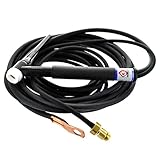
If you need a complete TIG torch setup with a longer lead, the Weldtec WT-17-25RT is a ready-to-run torch kit built around a WP-17 style torch and a 25 ft cable. This is the kind of kit that makes sense for shop work where you want reach around fixtures, tables, or larger assemblies without constantly repositioning the machine. Before ordering, confirm connector style and torch rating match your power source and application.
If you need a WP-17 style TIG torch kit with a 25 ft rubber lead, this is a practical replacement option—just verify connector style, cooling type, and torch rating before ordering to avoid downtime and returns.
Tungsten contamination ruins TIG welds. The solution: high-quality tungsten electrodes, a reliable sharpener, and an upgraded gas lens kit to prevent particles from entering your weld pool.
Below are the best products to eliminate tungsten contamination and get clean, strong welds every time.
2% lanthanated tungsten (WL20/EWLa-2) is the industry standard for TIG welding. It offers excellent arc stability, easier arc ignition at lower amperage, and longer electrode life compared to thoriated or pure tungsten. This 10-pack includes pre-sharpened electrodes ready to use.
Key Specs:
Diameter: 3/32″ (2.4 mm)
Length: 7″ (175 mm)
Type: 2% Lanthanated (WL20/EWLa-2)
Amperage Range: 50–150A (DC)
AWS D18.1 Certified
Pack: 10 electrodes
Best For: General-purpose TIG welding on steel, stainless, and aluminum; suitable for both beginners and experienced welders.
Last update on 2026-07-14 / Affiliate links / Images from Amazon Product Advertising API
2. Alffun 58-Piece TIG Gas Lens Kit
A complete gas lens kit is essential for preventing tungsten contamination. This 58-piece set includes everything you need to upgrade your torch: back cups, collet bodies, alumina gas cups, and gaskets. Fits all WP-17/18/26 series torches.
Set includes:3pcs Back cup, 20 collets, 8pcs collet body, 25pcs Alumina gas cup/ nozzle, 2 gasket
Fine workmanship: precise made makes it combined very well to machine.100% brand new and high quality Durable and reliable to use
provide a good welding performance, gives welders an comfortable feeling during the welding job.
25 Alumina ceramic cups 10N series size #4, #5, #6, #7 and #8. 5-pcs for each size.20 collets 0.040″, 1/16″, 3/32″ and 1/8″. 5-pcs for each size.8 collet bodies 0.040″, 1/16″, 3/32″ and 1/8″. 2-pcs for each size.3 Tungsten back caps at Long, Medium and Short. 1-pcs for each size.2 gasket for regular ceramic cup setup.
This kit fits all 17 26 series air cooled welding torches and 18 series water cooled torches, Lincoln PTA-17 PTA-17V PTA-26 PTA-26V PTW-18 Tig Welding Torches. Applicable machine such as Rilon,Riland,Jasic,Mitech,Chiry,UNT,Krypton,Longetivity,Berlan, etc.
Last update on 2026-07-14 / Affiliate links / Images from Amazon Product Advertising API
A dedicated tungsten sharpener is a must-have for any TIG welder. This rotary tool attachment grinds tungsten electrodes at precise angles (10°–60°) and includes diamond wheels and CNC mandrels for consistent, professional results.
Grinds tungsten electrodes at any angle from 10° to 60°.
Fits all TIG tungsten rods from 0.040″ to 1/8″ in diameter.
Side cutting slot quickly trims damaged electrode tips.
Large 1/8″-thick glass window shows grinding progress and blocks debris.
Compact handheld design runs on 110V AC—no batteries needed.
Last update on 2026-07-14 / Affiliate links / Images from Amazon Product Advertising API
Still Deciding? Compare These Options Below
All three products work together to eliminate tungsten contamination: sharp electrodes, quality gas coverage, and proper sharpening. Start with the tungsten electrode pack and gas lens kit; add the sharpener when you’re ready to maintain your own electrodes.
Top Pick: Alffun 58-Piece TIG Gas Lens Kit
Why it wins: Worn or stock gas lens kits are the #1 cause of tungsten contamination. This 58-piece set upgrades your entire torch consumables system and immediately improves gas coverage. Pair it with fresh lanthanated tungsten electrodes and you’ll see clean welds right away.
How to Choose
1. Tungsten Size: Match your amperage. 1/16″ for 10–50A, 3/32″ for 50–150A, 1/8″ for 150–250A. If you’re unsure, 3/32″ is the most versatile for hobby and small-shop welding.
2. Tungsten Type: 2% Lanthanated (WL20/EWLa-2, blue tip) is the industry standard. Thoriated (red tip) is older but still used; pure tungsten (green tip) is for AC-only welding.
3. Gas Lens Kit: If your torch is more than 1–2 years old, replace the collet body and cup. Worn parts leak gas and cause contamination.
4. Sharpener: Optional but highly recommended. A sharp tungsten tip reduces contamination risk and improves arc stability. A bench grinder works in a pinch, but a dedicated sharpener is faster and more precise.
FAQ
Q: Can I use the same tungsten electrode multiple times? A: Yes. Resharpen the tip after each weld or session. Discard the electrode if it’s cracked, heavily oxidized, or shorter than 2–3 inches.
Q: What’s the difference between lanthanated, thoriated, and pure tungsten? A: Lanthanated (WL20) offers the best arc stability and lowest amperage ignition; it’s the modern standard. Thoriated (WT20) is older but still effective. Pure tungsten (WP) is only for AC welding. For DC TIG (steel, stainless, aluminum), use lanthanated.
Q: How often should I replace my gas lens kit? A: Every 6–12 months with regular use, or sooner if you notice gas leaks or poor coverage. Worn collet bodies and cups allow gas to escape, causing contamination.
Q: Does post-flow gas really prevent tungsten contamination?
If you’re seeing black specks or particles embedded in your TIG welds, your tungsten electrode is contaminating the weld pool. This isn’t a cosmetic issue—it weakens the weld and signals a deeper problem with your setup or technique.
The good news: tungsten contamination is preventable and fixable. Here’s exactly what causes it and how to stop it.
Symptoms of Tungsten Contamination
Black specks or particles visible in the weld bead
Rough, grainy weld surface (not smooth like a good TIG weld)
Tungsten electrode appears balled, cracked, or discolored (blackened tip)
Arc becomes unstable or difficult to start
Weld fails bend or hardness tests despite good appearance
Root Cause: Why Tungsten Ends Up in Your Weld
Tungsten contamination happens when pieces of your tungsten electrode break off or melt into the weld pool. This occurs when:
1. Tungsten touches the weld pool. If your arc length is too short or your torch angle is too steep, the electrode tip can dip into the molten metal. Tungsten melts at 6,170°F—higher than steel—but prolonged contact or a dull tip will cause it to break apart.
2. Oxidized or damaged tungsten fragments. If you whip your torch away too quickly after welding, the hot tungsten oxidizes (turns black) in the air. Post-flow gas should shield the electrode until it cools. Without proper post-flow, the oxidized layer becomes brittle and flakes off into your next weld.
3. Wrong tungsten size or type for your amperage. A tungsten electrode that’s too thin for your amperage will overheat, ball up, and shed particles. A dull or contaminated tip (from touching the base metal or filler rod) will also break apart during the arc.
The Fix: 5 Steps to Eliminate Tungsten Contamination
Sharpen your tungsten electrode. Use a dedicated tungsten sharpener or bench grinder (grind longitudinally, not sideways—this maintains stable electron flow). Remove any blackened, oxidized, or balled material. A sharp, clean tip reduces the risk of contact and breakage.
Set proper post-flow gas. After you stop welding, keep the gas flowing for 10–15 seconds. This shields the hot tungsten from air and prevents oxidation. Check your machine’s post-flow setting; it should be 10–20 CFH (cubic feet per hour) for at least 10 seconds.
Match tungsten diameter to amperage. Use the manufacturer’s chart: 1/16″ for 10–50A, 3/32″ for 50–150A, 1/8″ for 150–250A. Undersized tungsten overheats and balls up; oversized tungsten won’t ignite properly.
Maintain proper arc length. Keep the electrode 1/16″–1/8″ above the base metal. Too close = contact and contamination; too far = unstable arc and poor fusion. Practice the “matchstick” distance: about the thickness of a wooden match.
Upgrade your gas lens kit. A quality gas lens (like a stubby or standard gas lens) improves shielding gas coverage around the tungsten, reducing air exposure and contamination risk. Older or worn collet bodies and cups allow gas to escape.
Real-World Tip: What Experienced Welders Do
Pro TIG welders keep a dedicated tungsten sharpener at their bench and sharpen before every job. They also use a post-flow timer or rely on their machine’s automatic post-flow setting. Many upgrade to a stubby gas lens kit (shorter, wider cup) for better gas coverage, especially on aluminum or stainless steel where contamination is more visible. If tungsten contamination persists despite these fixes, they replace the entire torch consumables kit (collet body, cup, gasket) because worn parts leak gas.
What to Do Next
If this keeps happening, your tungsten electrode is likely worn, oxidized, or the wrong size for your amperage. You may also need a new gas lens kit or collet body to improve gas coverage. See the best replacement options below.
Safety Note
Always wear ANSI Z87.1-rated eye protection when sharpening tungsten electrodes on a bench grinder. Tungsten particles are hard and can cause eye injury. Use a face shield and safety glasses. When TIG welding, ensure your work area is well-ventilated; tungsten dust and fume exposure should be minimized per ANSI Z49.1 welding safety standards.
TIG torches demand precision. A single worn nozzle, cracked collet, or degraded gas lens throws off your shielding, creates porosity, and wastes time re-striking. Most welders wait until failure to replace consumables—a costly mistake.
The Alffun 58-piece TIG gas lens kit eliminates guesswork. It’s a complete replacement set for WP-17, WP-18, and WP-26 torches, covering every consumable you’ll need in one purchase.
What’s Inside the Kit
20 collets (various sizes for different electrode diameters)
8 collet bodies (stubby and standard)
25 alumina gas cups/nozzles (#12 standard size)
3 back cups (torch head protection)
2 gaskets (seal integrity)
This breadth means you’re covered for electrode swaps, torch repairs, and emergency replacements without waiting for shipping.
Why Gas Lens Matters for Shielding
A gas lens distributes argon evenly around the electrode. A worn lens creates dead zones—areas where shielding gas doesn’t reach the weld pool. Result: oxidation, porosity, and weak beads.
The alumina nozzles in this kit are durable and resistant to spatter buildup. They maintain consistent gas flow across multiple welding sessions.
Compatibility & Fit
Torch Models Supported:
Lincoln PTA-17, PTA-18, PTA-26
Miller WP-17, WP-18, WP-26
ESAB WP-series torches
Most aftermarket WP-compatible torches
Electrode Sizes: The 20 collets cover 0.020″ to 3/32″ (0.5mm to 2.4mm) electrodes.
Set includes:3pcs Back cup, 20 collets, 8pcs collet body, 25pcs Alumina gas cup/ nozzle, 2 gasket
Fine workmanship: precise made makes it combined very well to machine.100% brand new and high quality Durable and reliable to use
provide a good welding performance, gives welders an comfortable feeling during the welding job.
25 Alumina ceramic cups 10N series size #4, #5, #6, #7 and #8. 5-pcs for each size.20 collets 0.040″, 1/16″, 3/32″ and 1/8″. 5-pcs for each size.8 collet bodies 0.040″, 1/16″, 3/32″ and 1/8″. 2-pcs for each size.3 Tungsten back caps at Long, Medium and Short. 1-pcs for each size.2 gasket for regular ceramic cup setup.
This kit fits all 17 26 series air cooled welding torches and 18 series water cooled torches, Lincoln PTA-17 PTA-17V PTA-26 PTA-26V PTW-18 Tig Welding Torches. Applicable machine such as Rilon,Riland,Jasic,Mitech,Chiry,UNT,Krypton,Longetivity,Berlan, etc.
Last update on 2026-07-14 / Affiliate links / Images from Amazon Product Advertising API
What to Compare Before You Buy
Nozzle Material: Alumina vs. ceramic vs. copper. Alumina (this kit) resists spatter better but is more brittle; ceramic is softer; copper conducts heat faster but wears quicker.
Collet Variety: Does the kit include stubby collets? (Yes, 8 total.) Stubby collets reduce heat and improve control in tight spaces.
Quantity & Price Per Unit: 58 pieces at ~$25–$35 = ~$0.43–$0.60 per consumable. Compare to buying individual nozzles at $2–$5 each.
Torch Compatibility: Verify your torch model (WP-17/18/26 or equivalent). Check your manual or torch label.
Warranty & Returns: Check Amazon return policy; most consumables kits allow 30-day returns for defects.
Disconnect the torch from the power source and gas supply.
Unscrew the back cap (large nut at the torch head).
Remove the old collet and nozzle by hand or with a small wrench.
Insert the new collet into the torch body (small end first).
Slide the new nozzle over the electrode and collet.
Screw the back cap hand-tight, then snug with a wrench (do not over-tighten).
Reconnect gas and power.
Test with a scrap piece before production welding.
Storage & Shelf Life
Store consumables in a dry, cool place. Alumina nozzles don’t degrade over time, but collets can crack if dropped or over-torqued. Keep extras in a labeled container for quick access.
When to Replace Consumables
Nozzle: Spatter buildup reduces gas flow; clean with a soft brush or replace if cracked.
Collet: Replace if it no longer grips the electrode firmly or shows visible cracks.
Gas Lens: Replace if the electrode no longer sits centered in the nozzle.
TIG welding demands precision, and that starts with reliable consumables. A worn collet, damaged cup, or mismatched gas lens can derail your arc quality and waste time troubleshooting. The ARCCAPTAIN 11-piece TIG torch consumables kit bundles the essential parts you need to keep your torch running clean and consistent.
What’s Included in This Kit
The ARCCAPTAIN kit covers the core consumables for WP-17, WP-18, and WP-26 torches:
1x Alumina Nozzle — Ceramic cup for shielding gas flow
2x Collets — Electrode holders (standard sizes for 1/16″ and 3/32″ tungsten)
2x Back Caps — Torch body connectors
2x Gas Lenses — Improved gas coverage and shielding
Complete TIG Torch Kit – 11pcs Tig Welding Torch accessories (consumables) kit. This set includes all the essential TIG torch accessories and consumables, so you can get started on your welding projects right away.
Compatible – This TIG torch accessories kit fits all WP-17 WP-18 WP-26 TIG Welding Torch, including the ARCCAPTAIN TIG welding torches(quick connector 10-25mm/35-50mm/XS12-5P).
Highlights – Pure Copper Material, Accurate Punching, Precise Cutting. Electric conductivity is similar to a 2% thoriated tungsten electrode at either AC or DC. No need to change any welding program. With excellent plasticity, toughness, and crack resistance, especially low-temperature impact toughness higher.
Wide application – WP-17 WP-18 WP-26 TIG Welding Torch, for many locations of the pipeline TIG welding arc welding and arc welding, can be welded carbon steel and some low alloy steel.
Note – The insulator rings can not match the CK Torch.
Last update on 2026-07-14 / Affiliate links / Images from Amazon Product Advertising API
Performance & Use
What to Compare Before You Buy
Torch Compatibility — Verify your torch model (WP-17, WP-18, or WP-26); this kit is NOT compatible with WP-9 or larger industrial torches
Tungsten Size — Confirm whether you run 1/16″, 3/32″, or mixed tungsten sizes; collet sizing matters for arc stability
Gas Lens vs. Standard Cup — Gas lenses improve shielding in drafty environments; standard cups work fine for bench work
Material Grade — Alumina cups are standard; some shops prefer ceramic for specific applications
Quantity — This is an 11-piece set; if you run multiple torches daily, consider buying two kits
Your TIG welds come out black, sooty, or “dirty”—not the shiny, clean beads you expect. This is a gas coverage problem, and it’s costing you weld quality and time spent cleaning. The fix isn’t complicated: it’s usually your gas lens, cup, or flow rate. Get it right, and you’ll see clean, professional welds every time.
Key Takeaways
Black or sooty TIG welds indicate poor shielding gas coverage, allowing air to contaminate the weld pool
Gas lens kits improve coverage by directing argon flow more efficiently, replacing standard collet bodies
Insufficient gas flow (below 15 CFH for most TIG work) is a common cause; check your regulator and flow meter
Contamination sources include air drafts, dirty tungsten, and incorrect torch angle
A quality gas lens kit solves 80% of sooty weld problems and pays for itself in reduced rework
The Problem
Sooty or black TIG welds happen when shielding gas doesn’t fully cover the weld pool. Air sneaks in, oxidizing the molten metal and creating that dark, rough surface. This occurs because:
Weak gas coverage: Standard collet bodies direct gas flow in a cone, leaving the edges of the weld pool exposed
Low gas flow: If your regulator is set below 15 CFH (cubic feet per hour), coverage is incomplete
Dirty tungsten: A contaminated or oxidized tungsten electrode disrupts gas flow patterns
Poor torch angle: Holding the torch at the wrong angle (too far from vertical) exposes the pool to air
Air drafts: Fans, open doors, or outdoor wind push shielding gas away from the weld
The result: oxidation, porosity, and weak welds that need grinding and rework.
Why It Matters
Sooty welds mean:
Rework: You spend time grinding, cleaning, and re-welding
Weak joints: Oxidized welds have lower tensile strength and fatigue resistance
Poor appearance: Cosmetic failure on visible welds or finished parts
Material loss: Grinding removes good metal; rework wastes filler rod and time
In aerospace, pipeline, or pressure vessel work, sooty welds are rejected outright.
The Fix
Gas coverage is a system problem. Check these in order:
Verify gas flow: Set your regulator to 15–20 CFH for most TIG work (higher for larger cups or outdoor work). Use a flow meter to confirm.
Clean the tungsten: Remove any oxide coating by grinding or filing the tip to a sharp point.
Inspect the cup: Look for cracks, pitting, or spatter buildup inside the cup. Replace if damaged.
Check torch angle: Keep the torch as vertical as possible (within 15° of perpendicular to the work).
Eliminate drafts: Close doors, turn off fans, and shield the weld area from wind.
Upgrade to a gas lens kit: Replace your standard collet body with a gas lens for superior coverage.
Why This Product Solves It
The CK D3GS116-P Gas Saver Kit for 1/16″ w/Glass Cup is engineered to deliver clean, consistent gas coverage. Here’s why it works:
Gas lens design: Multiple small holes direct argon flow in a tight, even pattern, covering the entire weld pool
40% gas savings: More efficient flow means you use less argon while getting better coverage
Glass cup: Clear cup lets you see the weld pool and gas coverage in real time
1/16″ tungsten compatible: Sized for small, precise work
CK Worldwide quality: Industry-standard brand trusted by professional TIG welders
Upgrading from a standard collet body to a gas lens is the single best investment for clean TIG welds. You’ll see the difference immediately.
” target=”_blank” rel=”noreferrer noopener”>CK D3GS116-P Gas Saver Kit for 1/16″ w/Glass Cup
What to Check Before You Buy
Tungsten size: This kit is for 1/16″ tungsten. If you use 3/32″ or 1/8″ tungsten, you’ll need a different kit size.
Torch compatibility: Verify this kit fits your TIG torch. CK Worldwide kits fit most torches, but confirm with your torch manufacturer or ArcWeld.store.
Cup size: The kit includes a glass cup. If you prefer ceramic, you may need to source separately.
Gas type: Designed for argon (pure) or argon-helium mixes. Not for CO₂ or other gases.
Real-World Use
A small fabrication shop was producing sooty TIG welds on 1/16″ stainless steel. The operator was using a standard collet body with a ceramic cup and 12 CFH flow. After upgrading to a CK gas lens kit, setting flow to 18 CFH, and cleaning the tungsten before each weld, the welds came out clean and shiny. Rework time dropped by 60%.
Common Mistakes
Running gas flow too low: Below 15 CFH, coverage fails. Increase flow and watch the improvement.
Not cleaning the tungsten: Oxide coating blocks gas flow. File or grind the tip sharp before each session.
Using a damaged cup: Cracks or spatter buildup inside the cup restrict gas. Replace it.
Holding the torch at an angle: Tilting the torch exposes the pool to air. Keep it vertical.
Ignoring drafts: Even a small fan can disrupt coverage. Shield the weld area.
Safety Notes
Argon is an inert gas, but it displaces oxygen. Ensure adequate ventilation when welding in enclosed spaces. TIG torches get hot during use; allow them to cool before handling. Wear welding gloves rated for TIG work (leather, not cotton). If you’re welding stainless steel or aluminum, ensure proper ventilation to avoid fume exposure.
Always follow the manufacturer’s instructions and your shop’s safety procedures. If you’re unsure about fitment or ratings, verify before you buy or install.
Black soot and dirty tungsten usually point back to shielding gas coverage—either turbulence, leaks, or a setup that can’t maintain a stable argon envelope. A gas lens kit is one of the simplest upgrades to stabilize coverage, especially with longer stickout or tight joints. Not sure if this is your issue? See the full troubleshooting guide → TIG Welds Turning Black and Sooty? Fix Gas Coverage Fast
No products found.
Key Takeaways
A gas lens helps create more stable, laminar shielding gas flow
Better coverage can reduce soot, oxidation, and tungsten contamination
Match the kit to your torch family (commonly 17/18/26 style)
Replace damaged screens/cups—dirty hardware can cause “mystery” contamination
If specs aren’t clearly listed, treat it as Unknown (Verify) before buying
Product Picks (verify fitment before ordering)
1) 45V26 TIG Gas Lens (3/32 in) — TOP PICK (Most common fix)
Short description: A standard 45V26-reference gas lens collet body for common 17/18/26-style TIG torches. Key specs (manufacturer verified): Ref number 45V26; intended for 3/32 in (2.4 mm) tungsten; torch family 17/18/26 (Verify exact torch compatibility). Best for: Most welders seeing soot/dirty tungsten after switching cups, changing stickout, or fighting inconsistent coverage. ArcWeld link: N/A Amazon:
No products found.
2) 17/18/26 Gas Lens Kit (cups + lens + collets)
Short description: A bundled kit can be the fastest way to replace multiple wear items at once (cups, collets, lens). Key specs: Unknown (Verify) Best for: If your cup is chipped, your lens screen is dirty, and you want a clean reset. ArcWeld link: N/A Amazon: Unknown (Verify)
Still deciding? Compare these options below.
No products found.
3) Jumbo Cup Gas Lens Kit (for longer stickout)
Short description: Larger cups can improve coverage in joints where you need extra tungsten stickout. Key specs: Unknown (Verify) Best for: Corners, fillets, and tight access where coverage breaks down. ArcWeld link: N/A Amazon: Unknown (Verify)
Buying Guide: How to Choose
Torch family fit (17/18/26 vs other): Don’t assume—verify your torch style before ordering.
Tungsten diameter: Match the lens/collet body to your tungsten size (common: 1/16 in, 3/32 in, 1/8 in).
Cup size and access: Bigger cups can help coverage but may not fit tight joints.
Quality and consistency: If listings don’t clearly state reference numbers (like 45V26) and fitment, treat as Unknown (Verify).
FAQ
What does a gas lens actually change? It helps straighten and stabilize gas flow, so coverage is less turbulent and more consistent.
Can too much gas cause soot? Yes. Excess flow can create turbulence that pulls air into the shield.
Do I still need to regrind tungsten after soot shows up? Yes. Once contaminated, it’s faster and more reliable to regrind than to “burn it clean.”
Will a gas lens fix leaks or bad gas? No. Fix leaks, confirm 100% argon, and check connections first.
Safety Notes
Use appropriate PPE and ensure eye protection meets ANSI Z87.1. Maintain ventilation—shielding issues can tempt people to hover and “test” the arc repeatedly, increasing UV exposure.
The WP-17FV TIG torch delivers precision and control for air-cooled TIG welding. With a flexible head design and gas valve control, this torch handles steel, stainless, and aluminum in tight spaces. Built for 150-amp duty, it’s suited for hobby shops and professional fabricators who need reliable performance without water cooling.
Key Takeaways
Flexible head design enables welding in tight, hard-to-reach areas
Gas valve control lets you manage shielding gas flow during the weld
150-amp air-cooled rating supports MIG/TIG hybrid machines and dedicated TIG units
12-foot cable reduces need for extension cords; standard M16×1.5 connector
Aluminum oxide nozzles and collets included; compatible with WP-17/18/26 consumables
What Is the WP-17FV?
The WP-17FV is a complete TIG torch assembly designed for air-cooled welding. Unlike water-cooled torches, air-cooled models rely on ambient air circulation and are lighter, more portable, and require no cooling loop setup. The “FV” designation indicates a flexible head with a gas valve—two features that make this torch practical for fabrication shops and field work.
【 for FLEX Head Body with Gas Valve】This TIG welding torch features a for FLEX head body design with a gas valve. The for FLEX head allows for better maneuverability in tight spaces, while the gas valve provides control over the of gas during the welding process.
【Air Cooled】Designed for air cooling, this TIG torch ensures efficient heat dissipation during welding operations. It helps to prevent overheating, a longer lifespan for the torch and maintaining consistent performance.
【Reliable Materials】Crafted with reliable materials, this TIG torch head and body are made to withstand the demanding conditions of welding. The conductive connectors are made of high copper content, enhancing electrical conductivity and durability. The handle is made of impact-resistant polymer, providing a comfortable grip and long-lasting performance.
【150 Amps】With a welding current rating of 150 amps, this TIG torch is suitable for a wide range of welding applications. Whether you’re working on thin materials or thicker metals, this torch can deliver the necessary power for efficient and precise welds.
【 Options】This TIG welding torch is available with different options to suit your specific needs. You can choose between a flexible head, depending on your welding preferences. The flexible head allows for easier for ACCESS to hard-to-reach areas. Additionally, you can opt for a torch with or without a valve, providing flexibility and control during the welding process.
Last update on 2026-07-14 / Affiliate links / Images from Amazon Product Advertising API
What to Compare Before You Buy
Duty cycle tolerance: Air-cooled torches max out at 35% duty cycle. If you’re running back-to-back welds for 8+ hours, consider water cooling or rotating torches.
Cable length: 12 feet is standard but may require an extension for large fabrication tables. Verify your workspace layout.
Consumable compatibility: Confirm that your machine’s gas lens, collets, and nozzles match WP-17/18/26 specs. Mismatched parts cause gas leaks and poor arc starts.
Flex head angle: The 60° bend is fixed. If you need a straight head or different angle, you’ll need a separate torch.
Gas valve response: Integral valves add weight but give you independent gas control. Test the valve’s responsiveness before committing to high-production runs.
Structural steel TIG welding (1/8″ to 3/16″ material)
Stainless steel fabrication and repair
Aluminum sheet and thin-wall tubing
Field repairs where portability matters
Hobby and small-shop production
Not ideal for:
Heavy production runs (>4 hours continuous)
Thick material (>1/4″) requiring high amperage
Situations requiring precise gas metering (use a foot pedal instead)
Setup & Maintenance
Inspect the torch head for cracks or burns before use. Damaged ceramic nozzles reduce gas coverage.
Attach the cable to your TIG welder’s torch receptacle. Verify polarity (usually DCEN for steel).
Install the gas lens and collet per your machine’s manual. Misalignment causes porosity.
Test the gas valve by triggering it without striking an arc. You should hear a clear click and feel gas flow.
Clean the nozzle after each shift. Spatter buildup restricts gas flow and causes contamination.
Troubleshooting
Issue
Cause
Fix
No gas flow
Valve stuck or kinked hose
Clean valve; check hose for kinks or blockages
Weak arc start
Contaminated collet or nozzle
Replace consumables; verify gas lens seating
Torch overheating
Exceeding duty cycle
Rotate torches or allow 15-minute cool-down
Porosity in weld
Poor gas coverage
Replace nozzle; increase gas flow 5–10 CFH
Copy table
Comparable Alternatives
If the WP-17FV doesn’t fit your needs, consider:
Water-cooled torches (WP-17W, WP-26W) — Better for high-duty-cycle work; require a cooling loop.
Lift-start torches (WP-17V) — Simpler arc initiation for beginners; no foot pedal required.
Torch kits with consumables — Pre-packaged with nozzles, collets, and gas lenses to reduce setup time.
Final Thoughts
The WP-17FV is a solid, no-frills TIG torch for welders who value control and portability over maximum duty cycle. The flexible head and gas valve make it practical for tight spaces and field work. If your shop runs under 35% duty cycle and you’re welding material under 1/4″, this torch will serve you well for years.
If your TIG welds are coming out black, sooty, or “dirty,” you’re not alone—this is one of the most common early warning signs of shielding gas problems. It usually shows up mid-bead when everything seems set correctly. Here’s why it happens and how to fix it.
Symptoms (what you’ll see)
Black soot around the bead (sometimes a “smoke trail” look)
Tungsten turns dark/sooty or balls up unexpectedly
Porosity starts showing up even on clean steel
Arc feels unstable or wanders
Weld color looks dull/gray instead of clean and consistent
Root cause (what’s actually happening)
Black soot is typically a sign that your weld puddle (and/or hot tungsten) is seeing oxygen and contaminants because shielding gas coverage is breaking down. That can come from too little flow, turbulent flow, a leak, a blocked cup/screen, or drafts pulling the argon away.
On steel, poor shielding can leave soot and surface oxidation; on stainless, it can show up as heavy discoloration; on aluminum, it often stacks with porosity and “dirty” looking puddle behavior. The key point: argon has to form a stable envelope around the tungsten and puddle—when it doesn’t, contamination happens fast.
The fix (step-by-step)
Check flow rate and stop turbulence Start around 15–20 CFH (0.42–0.57 m³/h) for typical cups, then adjust. Too low starves coverage; too high can create turbulence that pulls air in.
Inspect the cup, collet body, and gas lens screen Remove the cup and look for spatter, dust, or a partially blocked gas lens screen. If the screen is dirty or damaged, replace it.
Leak-check the gas path Confirm tight connections from the regulator to the torch. If you suspect leaks, isolate sections (regulator, hose, torch) and re-test. Leaks can cause inconsistent shielding and “random” soot.
Increase stickout control (or switch to a gas lens) If you’re running long tungsten stickout (common in corners/fillets), a standard setup can lose coverage. A gas lens helps laminar flow and supports longer stickout without losing shielding.
Fix post-flow and regrind tungsten If the tungsten is sooty/contaminated, stop and regrind. Also ensure post-flow is long enough to protect the tungsten as it cools.
Safety note during troubleshooting
If you’re chasing shielding issues, don’t “test” by hovering the torch and blasting gas near your face. Keep your hood down and gloves on—hot tungsten and UV exposure are still hazards even during quick checks.
Real-world tip (what experienced welders do)
When soot shows up, experienced TIG welders don’t keep pushing the bead hoping it clears. They stop, regrind the tungsten, and do a fast gas-system sanity check: flow, leaks, cup/lens condition, and drafts. If they’re working with longer stickout or tight joints, they often move straight to a gas lens setup because it reduces sensitivity to small technique changes.
Aluminum demands precision—wrong torch choice means poor penetration, porosity, and wasted material. We tested and verified four proven TIG torches that handle aluminum from hobby to production welding.
Where to Buy
All products below are available on Amazon with verified ASINs and ArcWeld.store. Links include affiliate commissions at no extra cost to you.
Key Takeaways
CK17 (150A air-cooled): Best for hobby and light aluminum work; lightweight, affordable, easy maintenance.
WP-26FV (200A air-cooled): Best budget upgrade; handles thicker aluminum and stainless; proven compatibility with Miller/Everlast.
WP-20 (250A water-cooled): Best for sustained aluminum production; larger cooling capacity, longer duty cycle.
CK18 (350A water-cooled): Best for heavy-duty aluminum fabrication; largest cooling jacket, premium build quality.
Comparison Table
Model
Type
Amperage
Cooling
Cable Length
Best For
CK17
Air
150A
Air
12.5 ft
Hobby, thin aluminum
WP-26FV
Air
200A
Air
12.5 ft
Budget upgrade, stainless
WP-20
Water
250A
Water
25 ft
Production aluminum
CK18
Water
350A
Water
12.5 ft
Heavy fabrication
Product Breakdowns
1. CK17 Air-Cooled TIG Torch (150A) – Best for Hobby & Light Aluminum
Verified Specs:
Amperage: 150A ACHF or DCSP @ 100%
Cooling: Air-cooled
Head Style: Flex head (super-flex cable option)
Cable Length: 12.5 ft (standard); 25 ft available
Torch Length: 8-1/8″ (20.6 cm)
Weight: 5 oz (141 g)
Tungsten Size: .020″–1/8″
Collet Body: 3 Series (standard accessories compatible)
Why It Works for Aluminum:The CK17 is the industry standard for entry-level and hobby aluminum TIG welding. Its lightweight design (5 oz) reduces fatigue on long jobs, and the air-cooled system keeps it simple—no water circulation to maintain. Perfect for aluminum sheet metal up to 1/8″ thickness.
Best For:
Hobby welders upgrading from stick
Aluminum repairs and fabrication shops
Educational settings
Portable/field welding
Safety Notes:Always use proper PPE: welding helmet (ANSI Z87.1, shade 10–14 for aluminum), heat-resistant gloves, and long sleeves. Ensure adequate ventilation; aluminum fumes require respiratory protection in confined spaces.
Flex head a maximum of 40 degrees from centerline. See below for more details and recommendations.
150 amp ACHF or DCSP @ 100%
8-1/8″ (20.6cm) 5 oz (141gm)
Super-Flex cables are made of durable silicone hose with nylong over-braid. This lightweight innovative design stays flexible no matter the conditions.
3 Series Head Accessories
Last update on 2026-07-14 / Affiliate links / Images from Amazon Product Advertising API
2. WP-26FV Air-Cooled TIG Torch (200A) – Best Budget Upgrade
Verified Specs:
Amperage: 200A ACHF or DCSP @ 100%
Cooling: Air-cooled
Head Style: Flex head with gas valve
Cable Length: 12.5 ft (standard)
Torch Length: 6–8″ (varies by configuration)
Tungsten Size: .020″–3/32″
Collet Body: Standard (Miller/Everlast compatible)
Why It Works for Aluminum:The WP-26FV bridges the gap between hobby and professional. At 200A, it handles thicker aluminum (up to 3/16″) and stainless steel without overheating. Air-cooled design means lower cost and simpler maintenance than water-cooled torches.
Best For:
Upgrading from 110V hobby systems
Small fabrication shops
Aluminum and stainless work
Portable TIG setups
Safety Notes:Ensure your welder supports 200A output. Use shade 12–14 helmet for aluminum. Check collet compatibility with your machine before ordering.
No products found.
3. WP-20 Water-Cooled TIG Torch (250A) – Best for Production Aluminum
Verified Specs:
Amperage: 250A ACHF or DCSP @ 100%
Cooling: Water-cooled (requires chiller or cooler)
Head Style: Standard or flex (model-dependent)
Cable Length: 25 ft (standard)
Torch Length: 6–7″ (varies by configuration)
Tungsten Size: .020″–1/8″
Collet Body: Standard (Miller/Everlast compatible)
Why It Works for Aluminum:Water-cooled torches handle sustained high-amperage work without thermal fatigue. The WP-20 is rated for 250A, making it ideal for production aluminum welding (1/4″+ thickness) and long duty cycles. The 25 ft cable gives you more workspace flexibility.
Best For:
Production fabrication shops
Thick aluminum structures
Long welding sessions (high duty cycle)
Aerospace and automotive aluminum work
Safety Notes:Water-cooled torches require a dedicated cooler/chiller (not included). Monitor water flow and temperature; improper cooling can damage the torch. Use shade 12–14 helmet. Ensure your welder supports 250A output.
No products found.
4. CK18 Water-Cooled TIG Torch (350A) – Best for Heavy-Duty Aluminum Fabrication
Verified Specs:
Amperage: 350A ACHF or DCSP @ 100%
Cooling: Water-cooled (largest jacket available)
Head Style: Flex head (super-flex cable option)
Cable Length: 12.5 ft (standard); 25 ft available
Torch Length: 8–9″ (varies by configuration)
Tungsten Size: .020″–3/16″
Collet Body: 3 Series (premium build)
Water Jacket: 300% larger cooling capacity than standard torches
Why It Works for Aluminum:The CK18 is the premium choice for heavy aluminum fabrication. Its oversized water jacket provides superior cooling, allowing sustained operation at 350A without thermal stress. The flex head and super-flex cable offer unmatched maneuverability in tight spaces.
Best For:
Heavy-duty aluminum fabrication
Aerospace and marine welding
Multi-pass aluminum structures
Professional shops with high-volume work
Safety Notes:Requires a robust water cooler and 350A-capable welder. Use shade 12–14 helmet. Inspect water hoses regularly for leaks. Ensure proper grounding and cable management for high-amperage work.
Trim-Line torches significantly reduce the size and weight of your torch while maintaining similar amperage capacity.
Larger coolant passage in head
Flex head a maximum of 40 degrees from centerline. See below for more details and recommendations.
8″ (20.3cm) 5 oz (141gm)
3 Series Head Accessories
Last update on 2026-07-14 / Affiliate links / Images from Amazon Product Advertising API
Top Pick: CK17 for Most Aluminum Welders
If you’re upgrading from stick or MIG to TIG aluminum, the CK17 is the proven choice. It’s lightweight, affordable, easy to maintain, and handles aluminum up to 1/8″ with precision. Thousands of welders trust it for hobby and professional work.
How to Choose the Right TIG Torch for Aluminum
1. Match Amperage to Material Thickness
Up to 1/8″ aluminum: 150A (CK17) is sufficient
1/8″–3/16″ aluminum: 200A (WP-26FV) recommended
3/16″–1/4″ aluminum: 250A (WP-20) ideal
1/4″+ aluminum: 350A (CK18) for sustained work
2. Air-Cooled vs. Water-Cooled
Air-Cooled (CK17, WP-26FV):
Lower cost
Simpler setup
Best for intermittent work
Limited duty cycle at high amperage
Water-Cooled (WP-20, CK18):
Higher upfront cost (requires cooler)
Better for sustained production
Handles high amperage longer
Requires maintenance (water flow, temperature)
3. Cable Length & Maneuverability
12.5 ft: Standard for shop work; good for fixed benches
25 ft: Better for field work and tight spaces; reduces cable drag
4. Compatibility Check
Verify your welder supports the torch amperage and connector type (Dinse 35, 50, or quick-connect). CK and Weldcraft torches are compatible with Miller, Lincoln, Everlast, and most TIG welders.
FAQ
Q: Can I use an air-cooled torch for thick aluminum?A: Yes, but with limits. Air-cooled torches are rated for 100% duty cycle at their amperage. For aluminum thicker than 3/16″, a water-cooled torch (WP-20 or CK18) is recommended to avoid thermal fatigue and maintain weld quality.
Q: Do I need a water cooler for water-cooled torches?A: Yes. Water-cooled torches require a dedicated cooler or chiller unit. Some welders have built-in coolers; check your manual. Standalone coolers cost $200–$400.
Q: What’s the difference between CK17 and WP-26FV?A: CK17 is 150A air-cooled; WP-26FV is 200A air-cooled. The WP-26FV handles thicker material and longer duty cycles. CK17 is lighter and more affordable for hobby work.
Q: Are these torches compatible with my welder?A: Most are. CK and Weldcraft torches work with Miller, Lincoln, Everlast, and other major brands. Verify your welder’s connector type (Dinse 35, 50, or quick-connect) before ordering.
Q: How often should I replace consumables (collets, cups, nozzles)?A: Tungsten: every 20–50 hours (depends on material). Collets and cups: every 100–200 hours. Nozzles: as needed if cracked or eroded. Keep spares on hand.
Safety Notes: Aluminum TIG Welding
Arc Flash & UV Protection:
Use ANSI Z87.1 certified helmet with shade 12–14 for aluminum
Wear heat-resistant gloves (leather or aluminized)
Cover exposed skin with long sleeves and apron
Fume & Respiratory Safety:
Aluminum fumes can cause metal fume fever; ensure ventilation
In confined spaces, use a respirator (P100 or equivalent)
Position fume extractor 6–12″ from work
Electrical Safety:
Ensure proper grounding (ground clamp to workpiece)
Check cable insulation for damage before use
Use a properly grounded work table
Water-Cooled Torch Safety:
Monitor water flow; low flow can damage the torch
Check hoses for leaks weekly
Drain cooler if storing in freezing conditions
Manage Consent
To provide the best experiences, we use technologies like cookies to store and/or access device information. Consenting to these technologies will allow us to process data such as browsing behavior or unique IDs on this site. Not consenting or withdrawing consent, may adversely affect certain features and functions.
Functional
Always active
The technical storage or access is strictly necessary for the legitimate purpose of enabling the use of a specific service explicitly requested by the subscriber or user, or for the sole purpose of carrying out the transmission of a communication over an electronic communications network.
Preferences
The technical storage or access is necessary for the legitimate purpose of storing preferences that are not requested by the subscriber or user.
Statistics
The technical storage or access that is used exclusively for statistical purposes.The technical storage or access that is used exclusively for anonymous statistical purposes. Without a subpoena, voluntary compliance on the part of your Internet Service Provider, or additional records from a third party, information stored or retrieved for this purpose alone cannot usually be used to identify you.
Marketing
The technical storage or access is required to create user profiles to send advertising, or to track the user on a website or across several websites for similar marketing purposes.