The WEN 94396 is a corded, handheld metal-cutting band saw to consider when the job needs portable cutting within a nominal 5-by-5-inch workpiece envelope. The buying decision turns on actual stock dimensions, available 120-volt power, blade specification, how the work is held and whether handheld cutting suits the volume. The manufacturer’s dimension is not a guarantee that every material cuts equally well.
This guide covers one exact model, WEN 94396—not a similarly named replacement blade, a cordless saw, a mounted bandsaw, or a seller-created bundle. Its purpose is to match documented specifications to a shop’s actual constraints, not claim firsthand testing, choose a cutting procedure or approve a safety setup.
As an Amazon Associate I earn from qualifying purchases.
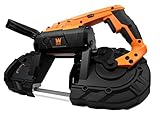
- Huge cutting capacity makes cuts up to 5 inches wide and 5 inches deep
- Variable speed operation adjusts the blade speed anywhere from 60 to 420 feet per minute
- Powerful 10-amp motor glides through metal, plastics, and more
- Lightweight portable design weighs in at a mere 14.5 pounds
- Features a 10/14 TPI metal-cutting blade, an adjustable front handle, ball-bearing blade guides, an external blade tensioning lever, and a two-year warranty

Last update on 2026-10-23 / Affiliate links / Images from Amazon Product Advertising API
Five checks before ordering this saw
- Cut envelope: compare actual outside width and height of the stock and safe access to WEN’s stated 5-inch by 5-inch capacity.
- Power: this model requires corded 120-volt, 60-Hz, 10-amp service. Review the official electrical and extension-cord instructions.
- Blade: the manual specifies 44-7/8-inch length, 1/2-inch width and 0.025-inch thickness. Confirm a suitable blade for the material.
- Workholding: make sure the workpiece can be safely supported and secured, with an appropriate cutting position and cord route.
- Package: identify whether the listing supplies the saw, included 10/14-TPI blade, any extras, and a case or no case.
Published WEN 94396 specifications
WEN’s official 94396 product page lists a 10-amp motor, 5-inch-wide by 5-inch-deep capacity, variable blade travel from 60 to 420 feet per minute and tool weight of 14.5 pounds. It identifies an adjustable front handle, ball-bearing blade guides, external blade-tensioning lever and an included 10/14-TPI metal-cutting blade. Those are manufacturer specifications, not independently measured shop results.
The manufacturer-linked manual provides the rated 120-volt, 60-Hz electrical supply and blade thickness. It also contains the equipment-specific safety information. Keep the distinction between the machine’s geometric envelope and cutting capability in mind: neither a 5-inch capacity label nor the top blade speed establishes an approved cutting speed, material limit, accuracy tolerance or production rate for every metal.
Measure what must actually pass through the cut
A stock description such as nominal pipe size may differ from its outside diameter. Structural sections and assemblies can have flanges, corners and nearby obstructions that determine the practical approach. Record the dimensions at the cut, not a convenient catalog description. A piece of square tube with outside dimensions near the nominal capacity also needs clearance for the shoe, clamping and safe handling.
Think about the finished requirement before selecting a portable cutter. One-off trimming on an accessible bench poses a different workflow from cutting dozens of identical parts to length. A handheld saw’s portability may reduce moving large stock, but it does not by itself provide a stop, fixture or controlled feed for repeatability. Decide which controls the job requires rather than assuming that cutting capacity resolves the entire purchasing question.
Blade length, tooth pitch and replacement planning
WEN lists the included blade as 44-7/8 by 1/2 inches, with 10/14 teeth per inch; the manual adds 0.025-inch thickness. Record all three physical dimensions along with blade type before buying spares. A label saying only ‘five-inch band-saw blade’ is insufficient to prove that it fits the machine. The WEN accessory listing names the BB4550 family; verify the exact current accessory before ordering.
The supplied blade is a starting package component, not proof that it suits every alloy, wall thickness or finish requirement. Thin-wall tubing and thick solid stock can have different tooth-engagement behavior. Blade maker guidance and the workpiece are more important than an unsupported one-size-fits-all speed chart. For a production purchase, ask which tooth form and blade material are actually recommended for the stated work.
The variable-speed range of 60–420 feet per minute lets an operator choose among machine speeds, but a published range is not a material-specific recommendation. Read the current blade and machine instructions before the first cut. Do not infer guaranteed stainless-steel life, metal removal rates or blade longevity from a marketplace description.
The corded-power tradeoff
The WEN 94396 is not a cordless tool. The listed weight of 14.5 pounds helps assess portability, but the actual work also depends on how long it will be held, the cutting posture, material support and available electrical supply. The adjustable front handle may help positioning; it does not eliminate the need to secure the work or respect the manufacturer-approved operating arrangement.
For a corded saw, check the intended circuit, extension-cord rules in the manual and routing away from moving blades, material edges and pinch points. If the material is part of installed electrical, fuel or pressurized equipment, the system must be properly isolated and authorized for work before cutting. This buying guide is not a lockout, gas-system or machine-setup procedure.
Check the seller’s exact carton
WEN describes a handheld saw with a metal-cutting blade, but third-party listings may differ in how they describe accessories. Confirm the chosen offer is the corded 94396 and separately verify its actual included items. Do not assume a storage case, stand, extra blade, clamp or workbench attachment is present because it appears in a nearby photo. The seller’s exact offer controls what is shipped.
That package distinction is central when comparing this machine with cordless alternatives. A tool-only battery saw can require a separate battery and charger, while the WEN 94396 requires a usable corded power supply. Prices, availability and listed accessories may change. A fair comparison accounts for the full working package instead of relying on a headline number.
Where it belongs in a fabrication shop
A portable saw may fit a shop doing occasional site work, short batches or cuts on stock that is difficult to move. A fixed metal-cutting saw may fit better when repeat length, continuous use or workholding fixtures drive the process. Neither conclusion can be reached from amperage alone. Specify the actual material and required finished condition so the buyer is comparing tools against the job.
For separate examples of power and kit decisions, see WSP’s Milwaukee 6232-21 kit-versus-blade guide and DEWALT DCS374B tool-only buying guide. These are distinct models; do not assume identical blades, dimensions or packages.
What to put on the purchasing request
- Material: alloy, stock shape, outside dimensions and wall thickness at the planned cut.
- Work: number of cuts, available access, support or fixtures, and required dimensional accuracy.
- Power: verified corded supply and safe cable route.
- Blade: 44-7/8 × 1/2 × 0.025 inches with the tooth pattern and material suitability independently confirmed.
- Order: exact WEN 94396 model, selected seller, included accessories and current return or service terms.
- Safety record: current manufacturer manual and applicable workplace requirements.
If those details match your application, use the exact-model Amazon box above to inspect the current seller listing and included items. This article does not state that the product is currently in stock or that an unknown bundle is equivalent. Verify current offer information on the destination page. The WEN manufacturer’s own documentation remains the primary source for equipment specifications.
For more of the people and craft behind these shop decisions, explore Arc Life.
Leave a Reply