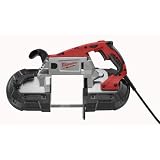
This Milwaukee 6232-21 buying guide starts with the package: Milwaukee lists a 6232-20 deep-cut band saw and carrying case in the kit, while the blade is sold separately. Before comparing prices, add the correct blade to the purchasing decision and confirm that the corded tool fits the stock, access and power supply at the actual job.
The Amazon selection covered here is ASIN B00ADX7OQW, titled as the 6232-21 kit. Its model field names 6232-20, which matches the tool Milwaukee lists inside that kit. Confirm the current seller’s case and package contents rather than assuming every listing that mentions the tool number supplies the complete kit. Arc Weld’s catalog search did not return this exact product.
Know what the kit number buys
The official Milwaukee kit page separates 6232-21 from its included 6232-20 saw. That distinction helps explain why both numbers may appear in a quotation. It does not excuse an incomplete seller description: the order should identify the intended kit, the saw, the case and any separately added blades.
A carrying case can make sense when the saw moves between jobs or needs organized storage. It is not evidence that a blade, spare consumables, stand or mounting accessory is included. A seller may offer a bundle that differs from the manufacturer’s standard package; obtain the actual contents in the selected offer before checkout.
The documented electrical and capacity limits
Milwaukee’s operator manual for the 6232-20 and 6238-20 lists the 6232-20 at 120 V AC, 11 A and 0–380 surface feet per minute. It lists capacities of 5 inches for round stock and 5 by 5 inches for rectangular stock. Use the row for 6232-20; the two models in that manual do not have identical electrical and speed entries.
Compare those capacities with the actual workpiece in its intended cutting orientation. A maximum cross-section does not answer whether the saw can be positioned around an installed component or held correctly in a crowded area. Access and support can rule out a job that appears to fit the capacity chart.
For a shop’s recurring cut list, record stock shape, outside dimensions, wall thickness, material and location. Include the awkward piece that appears every week, not only the easy cut used to demonstrate a tool. That list helps establish whether this saw would be the main solution or a supplementary tool.
Budget for a blade that matches the work
The manual specifies blades 44-7/8 inches long, 1/2 inch wide and 0.020 inch thick. Dimensions are the first fit check, not the entire selection. Milwaukee also directs users to consider material size, shape and type when selecting tooth pitch. Do not choose a blade merely because it fits around the wheels.
Thin-wall tubing and solid stock can present very different tooth-engagement conditions. Keep the material and section information with the blade order, and follow the saw and blade manufacturer’s application guidance. This article does not prescribe one tooth count for all steel or promise that a finer blade always produces the best result.
Replacement-blade access is an ownership question. Identify a reliable source for the approved dimensions and the pitches your work requires. Record the successful blade designation with the tool rather than leaving the next buyer to reconstruct it from a worn blade. No blade-life, cuts-per-blade or cost-per-cut estimate is assumed here.
Corded portability is different from cordless portability
This is a corded kit, not a battery-platform purchase. It may deserve consideration when the work can be reached with suitable power and cable routing. It is a different decision when the job moves far from outlets or requires a setup where a cord cannot be managed appropriately.
Do not treat an available receptacle as proof that the complete supply arrangement is suitable. The manufacturer’s instructions cover electrical and extension-cord requirements. Match those instructions to the actual tool and work location; this guide does not approve a generator, extension length or shared circuit from the amp rating alone.
Plan for two-handed operation and supported work
The manual directs the operator to keep the second hand on the handle and away from the cutting area. That requirement belongs in the buying decision: a job that leaves only one hand available needs a different, properly planned arrangement. The word portable does not mean the saw can be used in any body position or while holding the workpiece with the other hand.
Consider where the material will be supported, how the cut piece will be controlled and whether the operator has the required access. A tool that reaches the stock but cannot be used according to its instructions is not a good match for that job. The workholding plan should come before the purchase, not after the saw arrives.
When a fixed cutting station may be the better investment
Repeated cuts in stock that can be brought to a bench raise a different workflow question from occasional cuts at different locations. Compare material handling, repeat-length control, work support and inspection. A stationary saw or dedicated cutting arrangement may better suit repetitive production even when the portable saw’s capacity is adequate.
Conversely, buying a large fixed machine can be unnecessary when the real problem is access to a few appropriate cuts. The strongest purchase justification names the operation that existing equipment cannot perform conveniently or correctly. It does not depend on a broad claim that one saw format is always faster.
Check the complete offer before buying
- Confirm the 6232-21 kit and its included 6232-20 saw, rather than a tool-only or unrelated model.
- Confirm the carrying case with the current seller.
- Add a suitable blade; Milwaukee’s standard kit does not include one.
- Compare actual stock and access with the manual’s capacity and operating requirements.
- Verify the corded electrical supply and a suitable workholding arrangement.
- Check product condition, seller, return terms and applicable manufacturer support.
Exact Amazon listing
As an Amazon Associate I earn from qualifying purchases.
Last update on 2026-10-15 / Affiliate links / Images from Amazon Product Advertising API
Bottom line: the 6232-21 is a kit to evaluate by the work, not just by its carrying case or capacity headline. Confirm the exact package, supply an appropriate blade and establish that the saw can be used correctly at the intended location. This is a documentation-based buying guide, not a hands-on test or an earnings forecast.
For related preparation decisions, the NOGA deburring guide addresses edge finishing after cutting, while Before the Arc explains why a cut part still needs proper fit-up checks.
Featured photograph: contextual workbench image by Caleb Woods via Unsplash. It does not show the Milwaukee 6232-21 kit or a tested cutting setup.
Leave a Reply