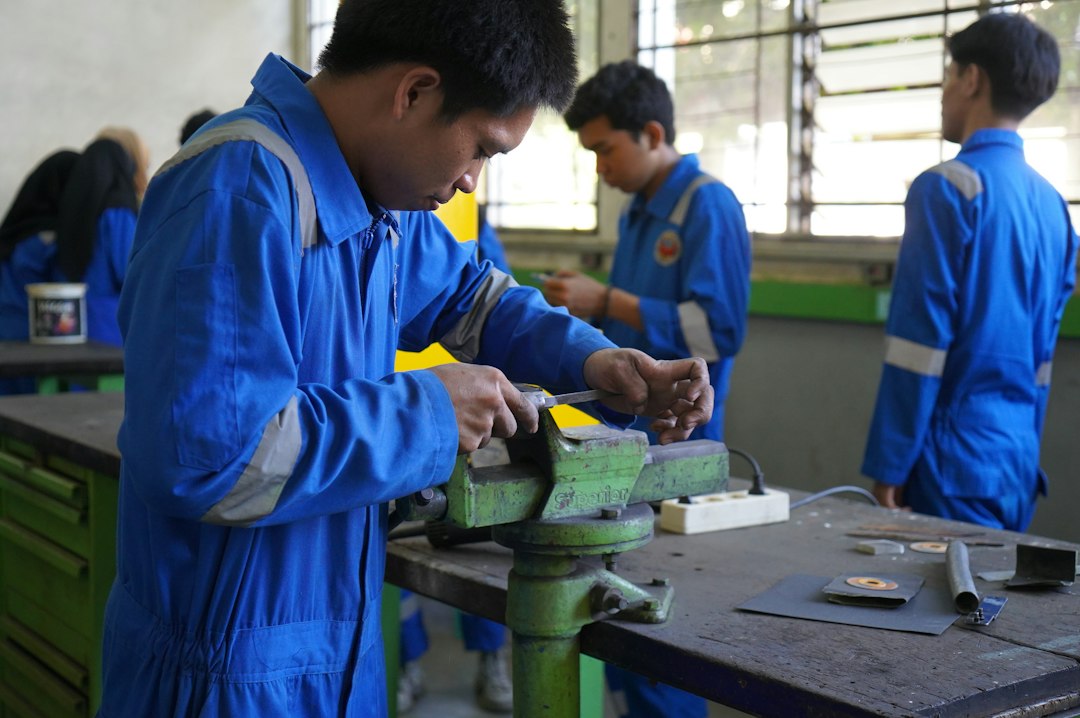
Good welding education lives in two places at once: the classroom, where students learn the language and logic behind a procedure, and the shop, where those ideas have to survive heat, fit-up, position, equipment, inspection, and repetition. Treating either side as optional weakens the other. A student who can repeat a definition but cannot use it at the bench is not finished learning; a student who can make an attractive bead without understanding the procedure, symbols, variables, or inspection criteria is not finished either.
AWS educator training reflects the same split
The American Welding Society’s current Certified Welding Educator program makes the classroom-and-shop relationship visible in its own structure. Part A is an online fundamentals program covering core welding knowledge. Part B is an in-person practical seminar that includes applying WPSs and PQRs plus hands-on work with inspection tools and weld replicas. The point is not that every school should copy one credential program. It is that a major welding organization still treats knowledge and practical application as separate skills that have to meet.
AWS’s Train the Trainer program makes the same connection more directly. Its current course description says welding educators work through structured teaching methods and hands-on experience in both classroom and shop settings across SMAW, FCAW, GMAW, and GTAW. That is a useful reminder for any instructor building a program: the theory lesson and the shop exercise should be designed as one learning sequence, not as two unrelated parts of the week.
The classroom gives the shop a vocabulary
Before a student can make good decisions at the booth, the student needs names for what is happening. Polarity, joint design, filler classification, travel angle, electrical characteristics, discontinuities, shielding, procedure variables, symbols, and acceptance criteria all become easier to recognize when they have already been explained clearly. Classroom time is where an instructor can slow a problem down and let students ask why before sparks and noise compete for attention.
That foundation also makes safety instruction more durable. “Do this because I said so” is weaker than understanding the hazard, the control, and the consequence. Students do not need to become engineers before they weld, but they should understand enough to know when a change is routine, when it affects the procedure, and when the correct answer is to stop and ask.
The shop turns vocabulary into judgment
Hands-on practice exposes the gap between recognizing a term and using it correctly. A student may understand what stickout means on paper and still struggle to keep it consistent around a joint. A student may know that contamination matters and only fully grasp it after seeing the difference between a clean tungsten and one that has been dipped into the puddle. The shop makes variables visible.
That is also where an instructor can teach observation instead of just correction. Rather than immediately fixing every setup, the instructor can ask the student to describe the sound, puddle shape, arc behavior, bead profile, or fit-up problem and connect that observation back to the procedure. The goal is not trial-and-error welding. The goal is disciplined troubleshooting inside the boundaries of the training plan.
A strong lesson loops between theory and practice
The most useful sequence is often short: explain one concept, demonstrate it, let the student practice it, inspect the result, then return to the concept with the evidence sitting on the table. That loop can be repeated with joint preparation, machine setup, electrode manipulation, filler selection, visual inspection, or procedure control. The classroom becomes more relevant because students have seen the problem. The shop becomes more intentional because students have a framework for understanding it.
This is one reason written shop knowledge matters. WSP’s earlier story The Notes in the Top Drawer looked at how experienced shops keep practical knowledge from disappearing when people leave. Welding education is the same knowledge-transfer problem at the beginning of a career: useful habits have to be explained, demonstrated, practiced, and preserved rather than left as unwritten instinct.
Procedure discipline is part of craftsmanship
Learning to follow a WPS is not the opposite of craftsmanship. It is part of learning how professional work is controlled. A student can still develop feel, rhythm, dexterity, and pride while also learning that some variables are governed by a procedure and cannot be changed casually. That balance helps move welding education beyond “make a bead that looks good” toward work that can be repeated, inspected, documented, and trusted.
The instructor’s real product is independence
The best outcome is not a student who needs the instructor standing beside every booth. It is a student who can read the task, set up within the rules, recognize when something is wrong, use available references, and know when the problem is beyond the student’s authority or experience. Classroom knowledge supports that independence. Shop practice tests it.
For welding culture, career stories, practical shop tools, and resources built around the people behind the trade, visit The Welders Life.
Sources
- AWS Certified Welding Educator program — current fundamentals and practical training structure.
- AWS Train the Trainer Welding Educator Program — current classroom/shop and hands-on educator training description.
Featured image: contextual vocational welding-training photo; no person shown is identified as an AWS instructor or program participant.

Leave a Reply