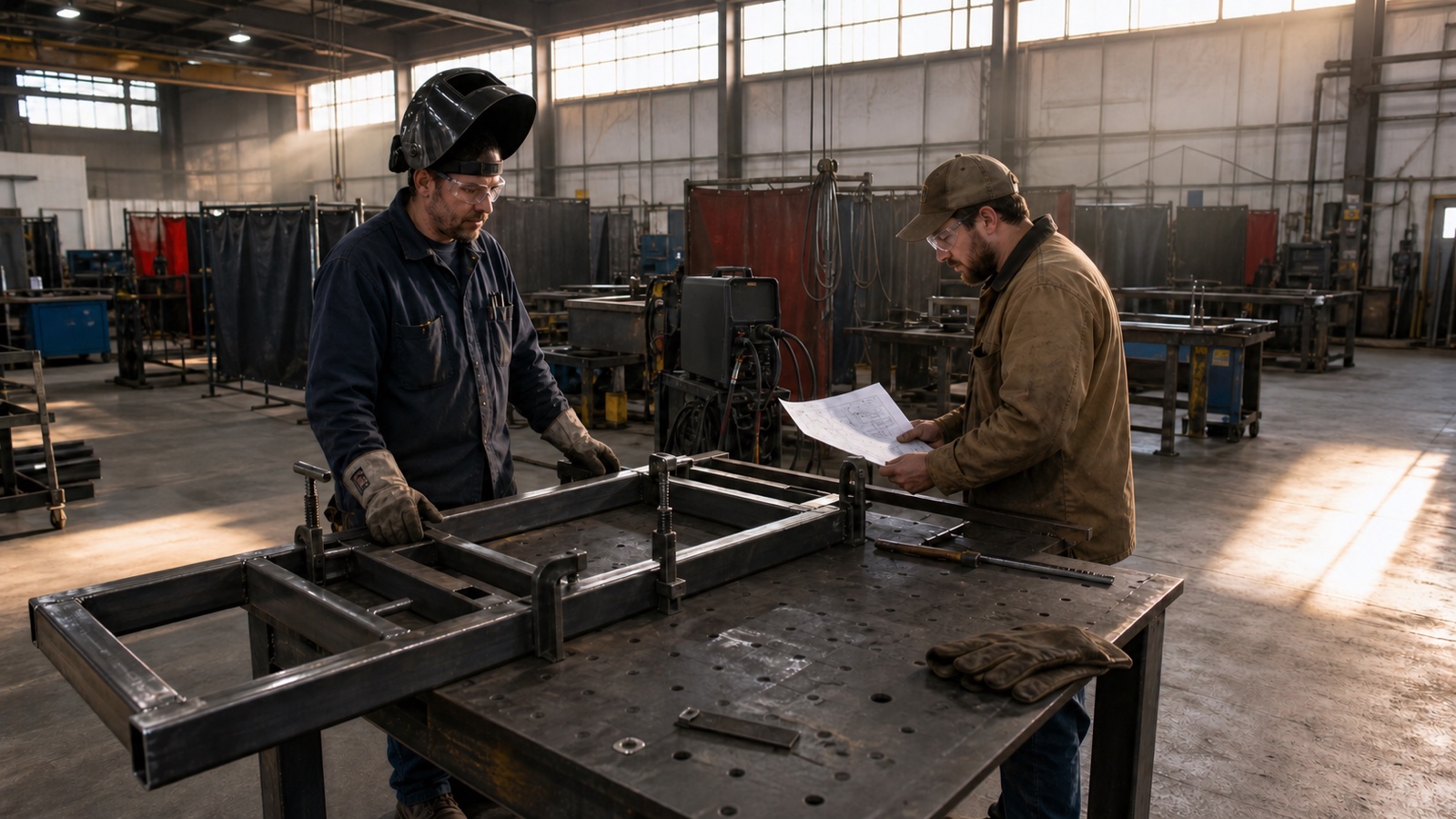
What does a welding engineer do? In simple terms, welding engineering connects the science and design of a welded product to the way that product is actually made, inspected, and controlled. The work can sit between engineering drawings, metallurgy, welding processes, codes, production constraints, qualification records, quality systems, and the people who have to make the joint work on the shop floor.
That makes welding engineering one of the trades-adjacent careers that is easy to overlook. The person behind a procedure may not be under the hood all day, but good welding engineering still has to respect what happens at the arc: access, heat, distortion, sequence, consumables, joint preparation, equipment limits, inspection, and repeatability.
Welding engineering is broader than choosing a process
The American Welding Society describes welding engineering knowledge as spanning design, materials, welding processes, and quality control. AWS says its Certified Welding Engineer credential is aimed at professionals who can develop and evaluate welded structures and components so they meet drawings, codes, contracts, and other technical requirements.
That description matters because welding engineering is not simply “an engineer who knows how to weld.” Depending on the employer and industry, the work can include helping select joining processes, reviewing joint design, evaluating filler-metal and base-metal combinations, supporting welding procedure development and qualification, troubleshooting production problems, coordinating with inspection and quality teams, and documenting why a process is acceptable.
What a welding engineer may work on during a normal week
There is no single daily routine. A welding engineer in a pressure-equipment shop may spend more time with procedure qualifications and materials than someone supporting robotic automotive production. An engineer in heavy fabrication may spend more time on distortion, sequence, joint access, repair planning, and code interpretation.
- Reviewing drawings and weld details for manufacturability and applicable requirements.
- Working with welding procedure specifications and qualification records rather than treating settings as tribal knowledge.
- Comparing processes, filler metals, shielding systems, heat input, and joint design against material and service requirements.
- Investigating recurring defects or production variation with welders, supervisors, inspectors, maintenance, and quality personnel.
- Helping production teams understand which variables can change freely and which changes require procedure review or requalification.
- Supporting automation, fixturing, productivity, or quality-control projects where the weld has to remain technically acceptable while the process becomes more repeatable.
The job works best when engineering and the shop respect each other
A drawing can be technically correct and still be miserable to weld. A shop shortcut can be fast and still violate the procedure. Welding engineering is strongest when those two realities meet before a problem becomes rework.
Experienced welders often see access, visibility, tack placement, sequence, fit-up, heat movement, and torch angle problems immediately. Engineers bring another set of tools: material behavior, design intent, code requirements, qualification logic, data analysis, and controlled change. The useful relationship is not one side overruling the other. It is a feedback loop in which production experience makes the engineering better and engineering gives production a repeatable technical framework.
How welding engineering differs from welding, inspection, and supervision
A welder is qualified to make welds within the limits of the applicable process and qualification. A welding inspector evaluates work against the applicable acceptance criteria and documents what is observed. A welding supervisor coordinates people, production, safety, and workflow. A welding engineer focuses on the technical design, development, evaluation, and control of welded systems and processes.
Real workplaces can blur those boundaries, especially in smaller companies. One person may wear several hats. But the responsibilities are still different, and the credential or job title should not be treated as permission to perform work outside the person’s actual qualification, employer authorization, or legal scope.
What AWS expects from a Certified Welding Engineer candidate
AWS’s Certified Welding Engineer program is one formal path for experienced professionals who want to demonstrate welding-engineering knowledge. AWS currently allows several combinations of education and welding-based work experience, ranging from an engineering degree plus relevant experience to much longer experience paths for applicants without an engineering degree.
The AWS exam structure reflects how broad the field is. It includes foundational science and mathematics, welding metallurgy and processes, codes and specifications, and practical engineering work involving design, production, and quality control. That breadth is a useful reminder that welding engineering is not a single-process specialty.
The AWS CWEng credential is a certification, not a blanket substitute for state professional-engineering licensure. The legal requirements for offering engineering services vary by jurisdiction and type of work, so employers and individuals still have to understand the rules that apply to the actual project.
Can a welder move toward welding engineering?
Yes, but there is no universal one-step transition. Shop experience can be a major advantage because it gives an engineer a physical understanding of arc access, fit-up, tooling, distortion, production pressure, consumable handling, and the difference between a procedure that reads well and one that can be executed consistently.
The education path depends on the role. Some welding-engineering positions are degree-based engineering jobs. Other technical roles in welding technology, manufacturing engineering technology, applications, process development, quality, or procedure support may have different education and experience requirements. AWS’s CWEng eligibility itself recognizes multiple education-and-experience combinations.
Why this career matters to welding culture
Welding culture is often told through the person holding the torch, and that should remain central. But every reliable welded product also depends on less visible work: someone defined the joint, selected or approved the procedure path, considered the material, planned how quality would be demonstrated, and helped decide what happens when production does not behave like the drawing.
The best welding engineers do not make the craft disappear into paperwork. They make the paperwork reflect the craft accurately enough that good work can be repeated by more than one person, on more than one shift, without guessing.
For more stories about the people, skills, work, and culture that surround the welding trade, visit The Welders Life.

Leave a Reply