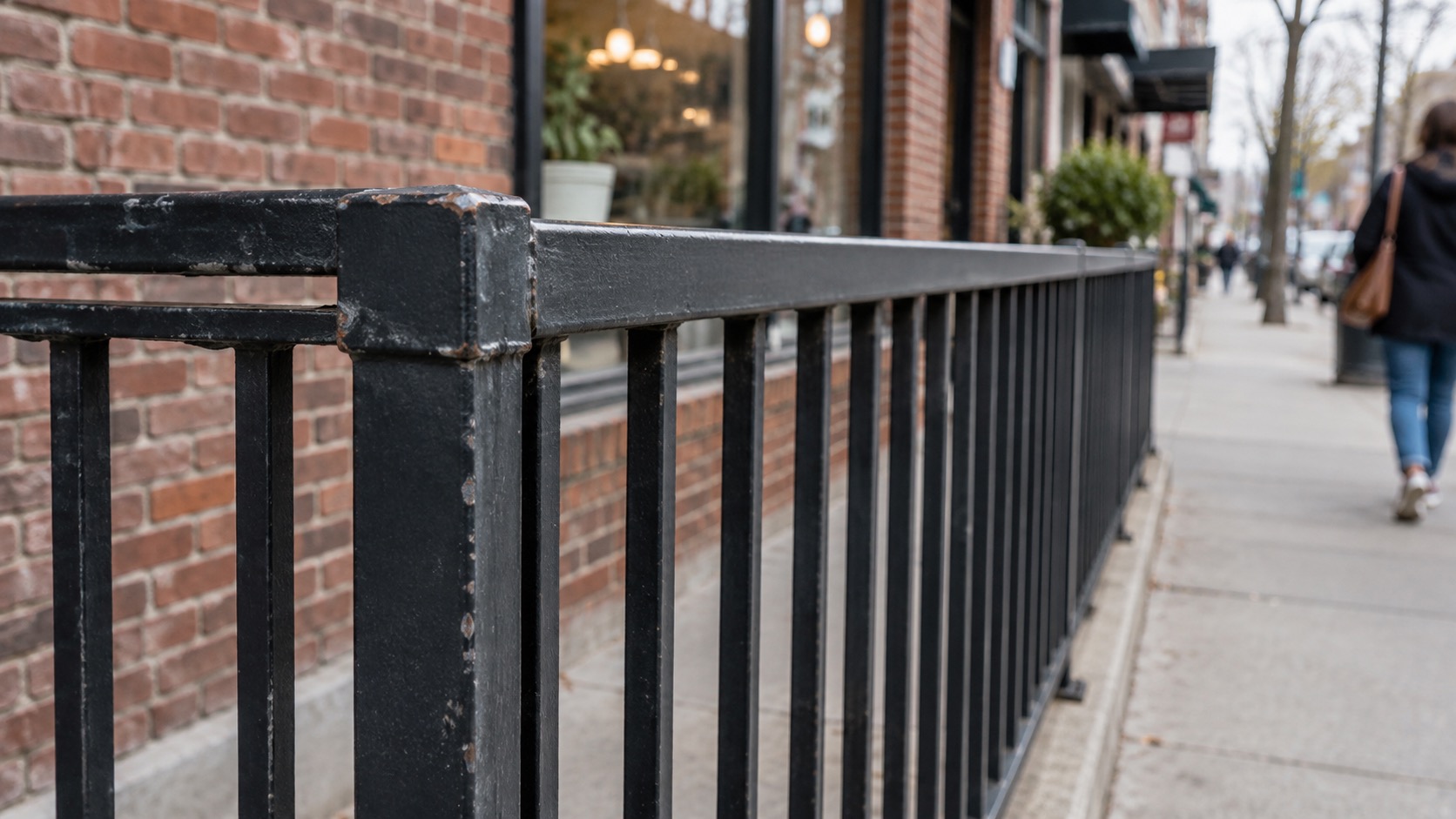
You came for lunch. The railing beside the door has other plans.
Maybe it is the corner where two pieces meet. Maybe it is the rhythm of the uprights, or the neat way a bracket disappears beneath a ledge. Everyone else keeps moving toward the menu. You spend another moment wondering how the person who built it held that assembly square.
If that sounds familiar, this is for you. Not every welder takes the trade sightseeing, and nobody owes work their whole weekend. But there is a particular pleasure in recognizing that an ordinary object once existed as loose material on somebody’s table. A finished railing can hide a surprising amount of thinking.
This is not a guide to judging public structures from the sidewalk. It is about the attention a trade can teach—and how to enjoy that attention without turning every outing into an unsolicited inspection.
Seeing the work before the finished object
A bench is a place to sit. It can also be a collection of decisions: where its legs meet the frame, how the ends were finished, which pieces repeat, and how the whole thing reached its final location. Once you have wrestled with an assembly yourself, those decisions become interesting in a different way.
The U.S. Bureau of Labor Statistics describes welding work as including the interpretation of drawings and specifications, measurement of parts, and inspection of material before welding. Those are occupational duties, not evidence that every welder studies restaurant furniture. But they help explain the kind of attention being practiced: looking at an object and thinking about how its pieces relate.
Out on the sidewalk, you do not have the drawing. You have the result. That leaves room for questions rather than answers. Did the builder assemble this as one section or several? Which joint would have been hardest to reach? What had to be finished before another piece went in the way?
The questions can be satisfying even when they stay unanswered. You are mentally taking the object apart, then trying to put it back together in an order that makes sense. The afternoon does not need to become a lesson. Sometimes the entire thought is simply: that was a clever way to handle the corner.
The quiet details deserve attention
Spectacular work is easy to notice. A sweeping staircase or a large sculpture asks for a second look. Ordinary fabrication has a harder assignment: do its job, fit its surroundings, and avoid getting in the way.
That makes the small details worth appreciating. A row of repeated parts that looks calm rather than busy. A junction that does not interrupt the line of a frame. A support placed where it belongs without demanding to be the first thing anyone sees. These are observations about appearance and arrangement, not declarations about structural adequacy.
It is tempting to make the weld bead the whole story. Yet the finished object contains more than the moment the arc was running. Someone interpreted the job, prepared material, arranged pieces, and dealt with the finish. Depending on the project, several people may have contributed. The person whose weld is visible is not necessarily the only person whose judgment deserves credit.
A useful change of question is to move from “Would I have made that weld differently?” to “What problem were they trying to solve?” The first question can become a contest with an absent stranger. The second makes room for the job you cannot see: access, sequence, appearance, installation, and the choices already fixed before fabrication began.
Curiosity is not a verdict
The second look has a limit. Standing beside a finished object does not give you its design requirements, material records, inspection history, or a view inside its joints. A tidy surface is not a complete account of the work beneath it. Nor does a finish you dislike tell you who made the original part or what happened to it afterward.
That is a good reason to keep casual conversation modest. “I wonder how they assembled that” is more honest than assigning a process, a defect, or a verdict from a distance. If there is a genuine concern about a public object, pass the observation to the responsible owner rather than experimenting with it yourself.
There is a social limit, too. The people with you may not want a running commentary on every table base. One interesting detail can invite someone into the trade. Ten minutes of criticism can make them wish they had chosen another restaurant.
Try sharing the part that made you curious. Point out how a shape repeats, or explain why you would like to know the assembly sequence. You do not have to know the answer to offer somebody a new way of seeing. Leave room for them to notice something you missed.
Take the idea home, not the whole job
For a hobby maker or working fabricator, an ordinary outing can leave behind a useful question for a future project. Not an instruction to copy somebody else’s design, and not a reason to start photographing private work without permission. Just a detail to think through on your own terms.
Perhaps a cleaner transition would help your next personal project. Perhaps you realize that you usually think about individual joints before stepping back to look at the whole shape. Or perhaps the object reminds you that successful work can be visually quiet. It does not always need to announce how much effort went into it.
There is no productivity requirement here. You can appreciate another person’s work and leave it at that. You can also walk past the railing, order lunch, and spend the afternoon thinking about anything except metal.
But if you do pause, give the unseen maker a little credit. Before that object became part of the background, it was somebody’s unfinished job.
Shop-talk question: What everyday object always gets a second look from you—railings, trailer gates, furniture frames, or something else? What detail catches your eye first?
For the connection to welding that follows you beyond the booth, explore Arc Life.
Source note: Occupational duties referenced above are described in the U.S. Bureau of Labor Statistics profile of welders, cutters, solderers, and brazers. This is an editorial reflection, not an inspection checklist or a reported interview.

Leave a Reply