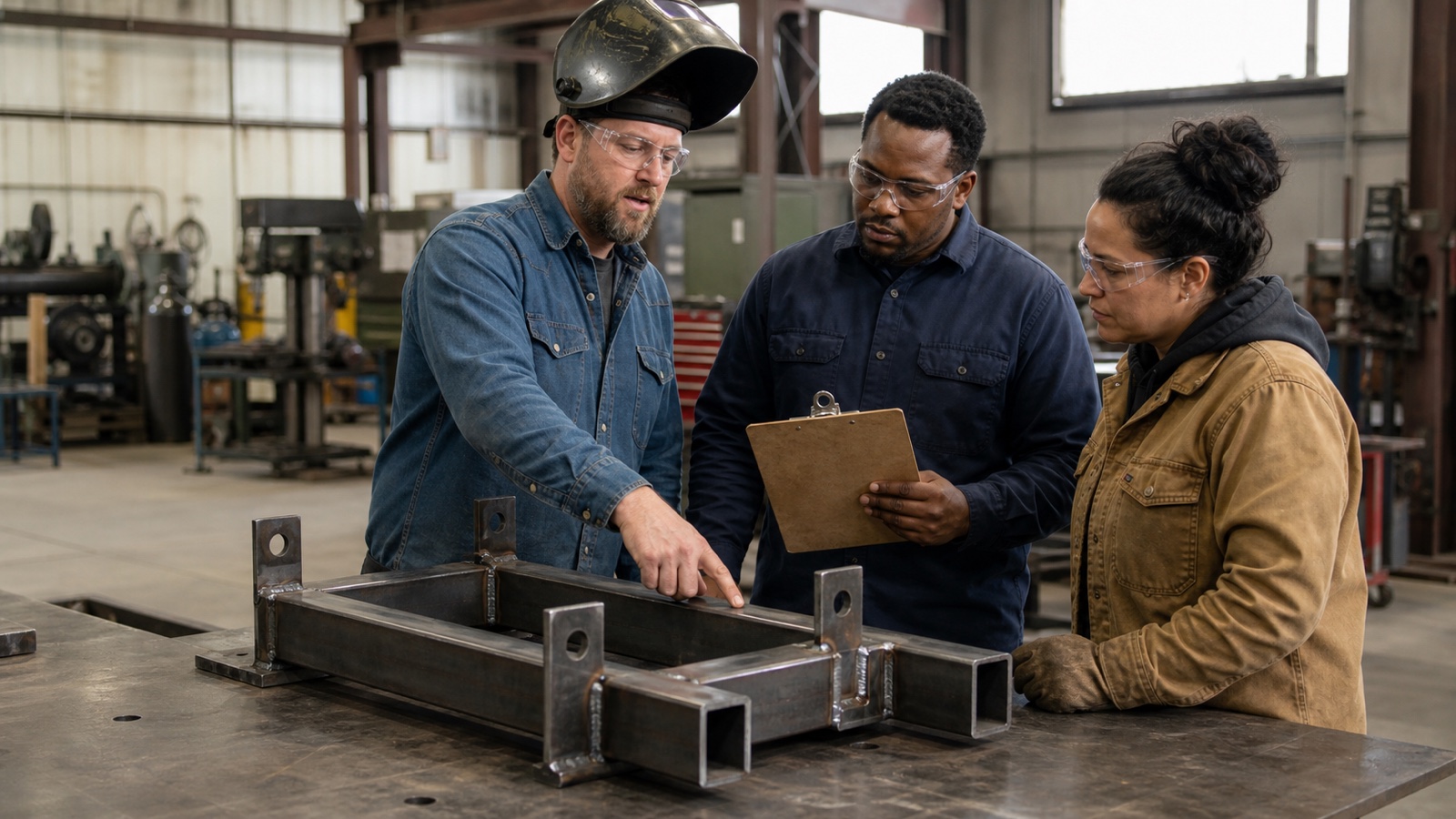
A finished assembly does not keep a diary. It keeps evidence.
The fit tells you how patiently the job began. Starts and stops show how well somebody stayed ahead of the puddle—or how long they chased it. The cleanup reveals if the piece was treated like finished work or pushed across the line at the end of a long shift. Long after the hood comes up, those decisions remain in the steel.
The welder’s actual name may be nowhere in sight. Still, the work carries it.
That idea is more than a shop-floor saying. In parts of structural fabrication, accountability can be formal. Current American Institute of Steel Construction certification materials call for welder performance records and traceability of welds to the welders who produce them. American Welding Society rules for accredited test facilities require test coupons and specimens to remain identifiable and traceable to the qualification test. AWS even offers a continuity logbook built around supervisor signatures or inspector stamps.
None of that means every welder should strike a stamp beside every weld. The required method depends on the job, contract, code, quality system, and company procedure; sometimes it is a weld map, traveler, number, electronic record, or another controlled method. On the floor, the practical point is simpler: somebody should be willing to stand behind the work.
A Name Is Not the Same as an Ego
There is a bad version of pride that needs everyone to know who burned the prettiest bead. There is a useful version that asks a quieter question: if this part comes back, will I help figure out why?
Useful pride is not territorial. A fabrication may pass through layout, cutting, fit-up, tacking, welding, grinding, inspection, coating, and shipping. No single person owns the whole story. Putting your name on the work means respecting every hand before and after yours—not pretending the other hands do not matter.
That is why the strongest crews can separate accountability from blame. Traceability gives the shop a place to start when something needs attention. It should help people find the material, procedure, machine, shift, sequence, and decisions involved. It should not become a shortcut for humiliation.
The Work Remembers the Boring Decisions
Most reputations in welding are not built on the dramatic moment. They are built on choices nobody photographs.
Did the welder stop when the fit was wrong, or try to make the arc solve a layout problem? Did they confirm the procedure instead of trusting a half-remembered setting? Did they keep the joint and consumables in the condition the job required? Did they leave clear information for the person taking over?
Those habits are not exciting enough for a highlight reel. They are exactly what makes a person dependable.
The trade has plenty of room for style. One hand may move faster; another may set up with almost fussy precision. Some people talk through every step, while others communicate with two words and a point of the soapstone. The signature is not that everyone works identically. It is that the result remains controlled when the day gets crowded, the material fights back, or the clock starts leaning on the crew.
Repeatability Beats the One Perfect Bead
A beautiful weld can be worth admiring. A professional reputation asks for more than one.
The harder standard is repeatability: the first joint on Monday, the awkward one before lunch, and the final piece on Thursday all receive the same attention. That does not mean perfection. It means the welder recognizes drift early and corrects the process before a small problem becomes a pile of rework.
That is the part of craftsmanship outsiders rarely see. The visible bead is the receipt. The real purchase was judgment.
Owning a Miss Is Part of the Signature
Every experienced welder has made work that needed another look. The difference is what happens next.
A person who stands behind the work does not bury uncertainty under another pass, send a questionable part downstream without a word, or hope inspection belongs to somebody else. They stop. They bring in the right lead, inspector, or supervisor. They follow the shop’s disposition and repair process instead of inventing one at the table.
That can feel uncomfortable, especially for an apprentice trying to prove they belong or a veteran who expects more from themselves. But silence is not toughness. Early communication protects the job, the schedule, the crew, and the person who made the call.
In a healthy shop, reporting a concern is evidence that the accountability system works. The goal is not to create welders who never speak up. It is to create welders who know when they must.
The Next Person Can Read Your Work
Standing behind a weld also means thinking one station ahead.
The inspector needs access and honest condition. The grinder needs to know what is finish work and what must remain. The painter or coater needs a surface prepared to the job’s requirements. The next shift needs a handoff that says what is complete, what is waiting, and what changed.
Good work leaves fewer mysteries. It does not force the next person to reverse-engineer a decision from a half-erased mark or discover an unfinished task after setup has moved on.
That is a form of respect as real as the weld itself. The person after you should be able to tell that somebody was paying attention before they arrived.
What Kind of Name Does the Work Carry?
Eventually, every shop learns who can be trusted with the difficult fit, the rushed repair, the new apprentice, or the job that cannot leave with loose ends. That trust rarely comes from a speech. It accumulates in small proof: clear questions, clean handoffs, honest calls, and work that stays consistent when nobody is watching closely.
Your name may be a stamp, an ID on a traveler, a line in a digital record, or nothing visible at all. The deeper signature is the pattern people recognize.
So here is the shop question: Has your work ever been tied to a stamp, weld map, traveler, or ID number—and what habit makes another welder’s work recognizable before you know who did it?
Arc Life is built around the people, habits, and unwritten standards that give the welding trade its character. Read more about Arc Life, then see the current Arc Life collection if that shop-floor identity belongs in your off-shift life too.
Sources and Further Reading
- American Institute of Steel Construction, Application Document Submittal for AISC Certification, revised February 3, 2025.
- American Welding Society, AWS QC47:2016-AMD3, Specification for AWS Certification of Welders and Accreditation of Test Facilities.
- American Welding Society, Welder Continuity Logbook.
Leave a Reply