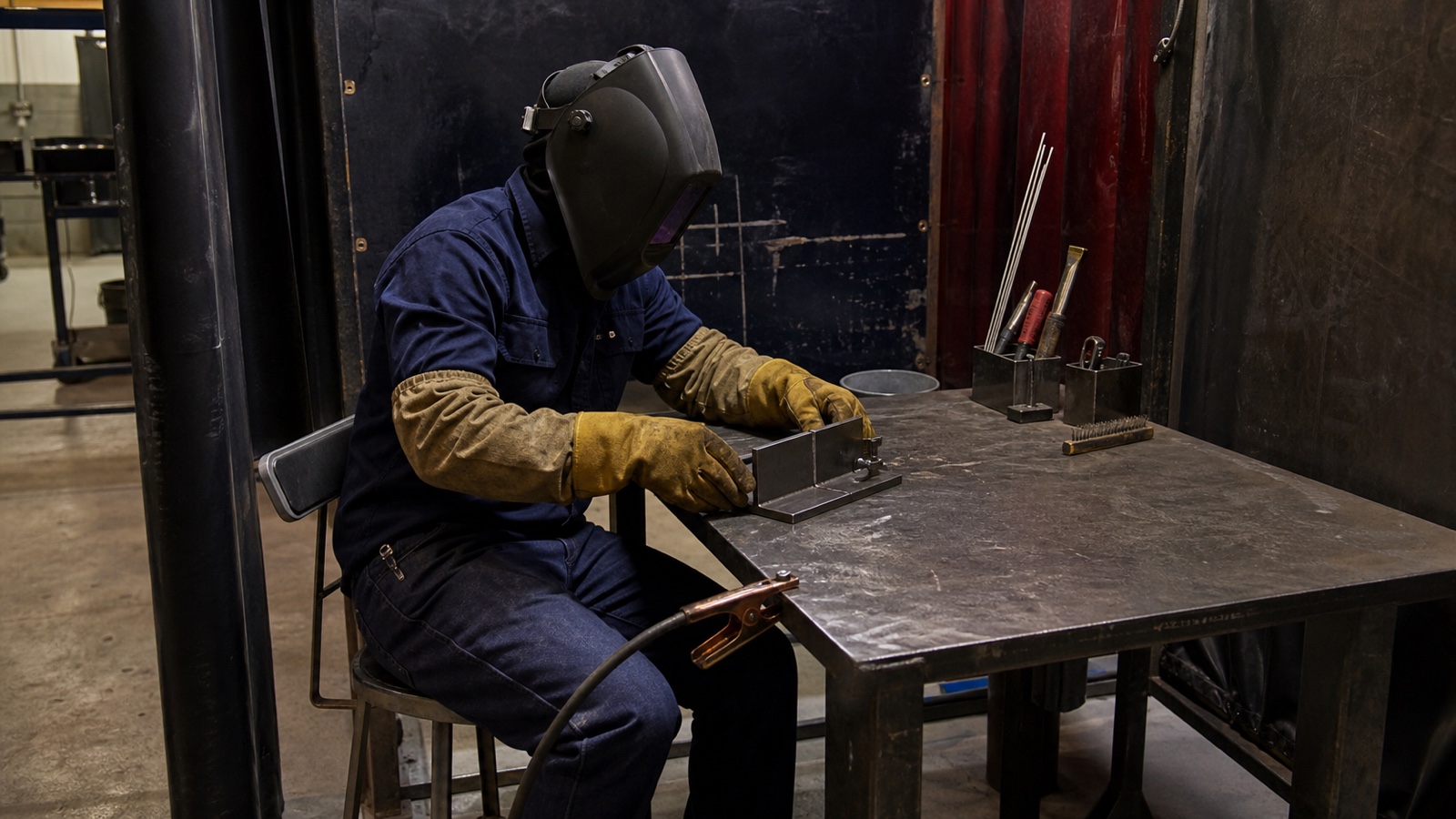
There is a particular kind of quiet inside a weld-test booth.
The coupon is fitted. The machine is set. The hood is down. Outside the booth, a new job, a certification, or the next step in a career may be waiting. Inside, none of that can run the puddle for you.
Many welders remember that moment more clearly than they remember the paperwork that followed. A test turns a familiar process into a concentrated hour when every habit feels louder: how you clean, how you tack, where you start, when you stop, and what you do after something does not feel right.
That is why a weld test measures more than the bead left on the coupon. It measures the welder who arrived to make it.
The Coupon Only Records the Final Answer
In the American Welding Society Certified Welder program, testing is performance-based. A candidate follows a specified Welding Procedure Specification, completes the required fit-up, assembly, positioning, and welding, and the result is evaluated to the applicable acceptance criteria. The test is about demonstrated ability, not a written explanation of what the welder intended to do.
That distinction matters. Shop knowledge can be broad, but a performance test narrows the field. The coupon cannot show how many good parts someone made last month. It cannot award points for a difficult repair finished on night shift. It records what happened this time, under this procedure, in this position.
That can feel severe. It is also honest.
The coupon does not care about confidence, reputation, or how good the practice piece looked yesterday. It holds the evidence of travel, heat, angle, tie-in, restarts, and preparation. The test gives a welder one clear question: can you put the required decisions together when the result counts?
Preparation Becomes Visible
The arc may be the dramatic part, but the test begins before it is struck.
A prepared welder knows the procedure, checks the joint, gets comfortable with the position, and removes small uncertainties before they can become large problems. None of that guarantees a passing result. It does reduce the number of preventable surprises competing for attention once the hood goes down.
This is where practice either becomes a routine or remains a collection of lucky beads. Repetition is useful, but purposeful repetition is better. The welder who can explain what changed between two practice coupons is building a process. The welder who only knows that one looked better is still chasing the result.
Under test pressure, reliable routines create room to think. Cleaning is not rushed. Body position is chosen before the puddle demands an awkward correction. Consumables and settings are checked instead of assumed. The work starts with fewer loose ends.
Composure Is a Welding Skill
Nerves do not mean a welder is unprepared. Often they mean the opportunity matters.
The useful question is not whether the nerves disappear. It is whether the welder can keep them from rewriting the process. Test-day adrenaline tempts people to move faster, hold tighter, skip a check, or keep welding through a moment that should have triggered a stop and reset.
Good composure is not swagger. It is staying close to the work. Watch the puddle. Listen to the arc. Follow the sequence. Make the next correct decision instead of mentally inspecting a coupon that is not finished.
The best welders are not people to whom nothing unexpected ever happens. They are people who notice early, respond within the procedure, and avoid turning one imperfect moment into three more. Recovery is not an excuse for poor preparation; it is what disciplined preparation makes possible.
Passing Is Specific, and Failing Is Information
An AWS Certified Welder test qualifies a welder for particular variables—such as process, material, position, and the procedure used. It is meaningful because it is specific. A passing test is not a declaration that someone can weld everything. It is evidence that the welder demonstrated the required ability for that qualification.
The same specificity makes a failed test useful, even when it is expensive or disappointing. The result points back toward something that can be examined: fit-up, preparation, parameter control, technique, restart discipline, or another part of the sequence. AWS allows candidates to retest, and many job tests also become part of a welder’s learning history whether or not a formal credential is involved.
Failure should not be romanticized. A missed opportunity can hurt. But it does not erase the work that came before it, and it does not have to become an identity. A test is a result from a defined set of conditions. The professional response is to find the lesson without inventing an excuse, practice the weak part, and return with a better process.
The Habit That Leaves the Booth
The lasting value of a weld test is not the few inches of weld metal deposited that day. It is the standard the welder carries into ordinary work afterward.
A job rarely announces every important moment with a test inspector standing nearby. Most of the trade happens on normal Tuesdays, when the schedule is full and nobody applauds clean prep, a careful restart, or the decision to grind something out before it becomes someone else’s problem.
The test booth concentrates those habits, but the shop is where they become character.
That is the part worth remembering. A credential can open a door. A successful job test can put a name on the schedule. The deeper proof comes later, in the steady work: reading the procedure, respecting the joint, catching trouble early, and leaving behind something the next person can trust.
Shop question: Who taught you how to handle the pressure of a weld test—and what part of their advice still comes back when the hood goes down?
For more stories about the people, habits, and culture that keep the trade moving, visit About Arc Life or explore the Arc Life collection.

Leave a Reply