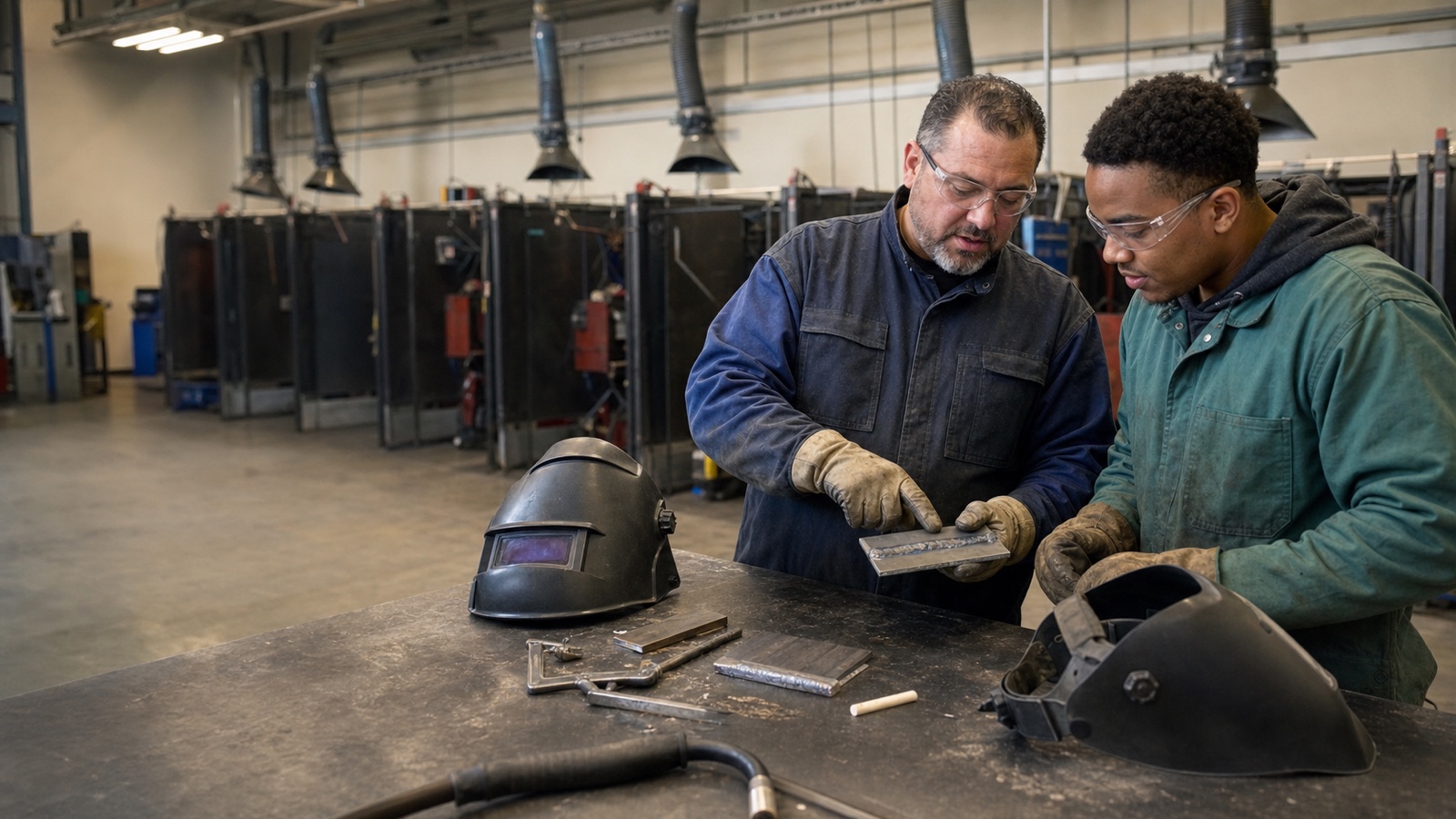
The first lesson in a welding booth is usually obvious: how to strike an arc, hold an angle, and keep the puddle moving. The lessons that stay with a welder for years are harder to name.
They show up later, when a print is incomplete, a joint does not fit the way it should, or the sound under the hood changes by half a note. That is when an old instructor’s voice comes back—not as a slogan, but as a question: What is the metal telling you?
A good welding instructor teaches a process. A great one teaches a person how to notice. As schools and apprenticeship programs settle into another term, it is worth looking at what really moves from one generation of the trade to the next.
More Than Moving the Puddle
Welding instruction has a wider job than demonstrating hand position. The American Welding Society’s Certified Welding Educator program covers teaching methods and lesson planning alongside welding processes, symbols, blueprints, metallurgy, and material science. That range matters. A student is not just learning to make a bead look right; they are learning to understand why the work is being done, how it will be judged, and what happens after it leaves the booth.
The best instructors keep those pieces connected. They can explain why a joint was prepared a certain way, what a procedure is controlling, and why a clean stop and restart matters. They do not turn every correction into a lecture. Sometimes they change one variable, hand the coupon back, and let the next pass make the point.
An Instructor Lends You Their Eyes
Early on, a student often sees only two categories: good weld and bad weld. An experienced instructor sees evidence. Travel speed. Heat. Fit-up. Arc length. A hesitation at the edge of the joint. The place where the welder stopped watching the puddle and started hoping.
That ability to read the work is not magic, and it cannot be transferred in one demonstration. It develops through repetition with useful feedback. A strong instructor does more than point at the flaw. They help the student connect the mark on the coupon to the decision that made it. Over time, the student begins making that connection alone.
This is one of the quietest gifts in trade education: borrowed judgment slowly becomes personal judgment. The student who once needed somebody at their shoulder learns when to stop, clean, reset, ask a question, or start over. That independence is the real destination.
Standards Before Style
Every shop has personalities. Every experienced welder has preferences. Good instruction separates preference from requirement. It makes room for more than one effective technique while staying firm about procedure, inspection criteria, and safe practice.
That distinction protects students from learning the trade as a collection of shop legends. The instructor can say, “This is how I like to do it,” without pretending that personal habit is the only acceptable method. They can also say, “This part is not optional,” and explain the reason.
AWS describes welding educators as people who teach processes, blueprint reading, symbols, metallurgy, proper equipment use, PPE, and job readiness across high schools, technical colleges, apprenticeships, and training centers. That official career profile makes the responsibility plain: the job is not to produce copies of the instructor. It is to prepare welders who can work safely, read requirements, accept inspection, and keep learning.
The Correction That Builds Confidence
Welding exposes mistakes quickly. That can make a booth a rough place to learn if every failed coupon is treated like a verdict on the person who made it. Good instructors do not lower the standard. They make the path back to the standard visible.
Useful feedback is specific enough to act on: shorten the arc, watch the leading edge, clean the restart, steady the travel, check the fit-up before blaming the machine. The student leaves with a next move instead of a vague feeling that they are not cut out for the work.
That matters because confidence in a skilled trade should not mean believing every weld is good. It should mean trusting that you can examine the result honestly, find the cause, and improve the next one. An instructor who teaches that kind of confidence is building more than test-day performance.
A Trade Survives by Being Passed On
The welding trade is full of knowledge that lives between the lines of a textbook: how a shop communicates under pressure, how to hand off work cleanly, how to ask for help before a bad decision becomes expensive, and how to give a newer welder room to think. Those habits travel person to person.
Not every excellent welder wants to teach, and not every excellent teacher has the loudest voice in the room. The instructors who last tend to combine technical credibility with patience, consistency, and the humility to keep updating their own knowledge. They remember that the goal is not to be the most impressive person in the lab. It is to make the lab produce capable people.
Years later, students may forget the exact coupon, amperage, or day. They remember who made them slow down and look again. They remember the person who held the line on safety, explained the “why,” and treated improvement as something earned rather than something granted.
Who Helped You See the Work?
What did a welding instructor, foreman, journeyman, or patient coworker teach you that still shows up in your work? Was it a technique, a standard, a habit, or simply a better question? Tell us about the person—and the lesson—that you still carry into the booth.
Arc Life tells the stories behind the trade: the people, habits, and hard-earned judgment that keep welding knowledge moving forward. You can also visit the Arc Life collection for gear built around that working culture.
Sources: American Welding Society, Certified Welding Educator Program and Welding Educator Career Profile, accessed August 14, 2026.

Leave a Reply