Arc Life Explained
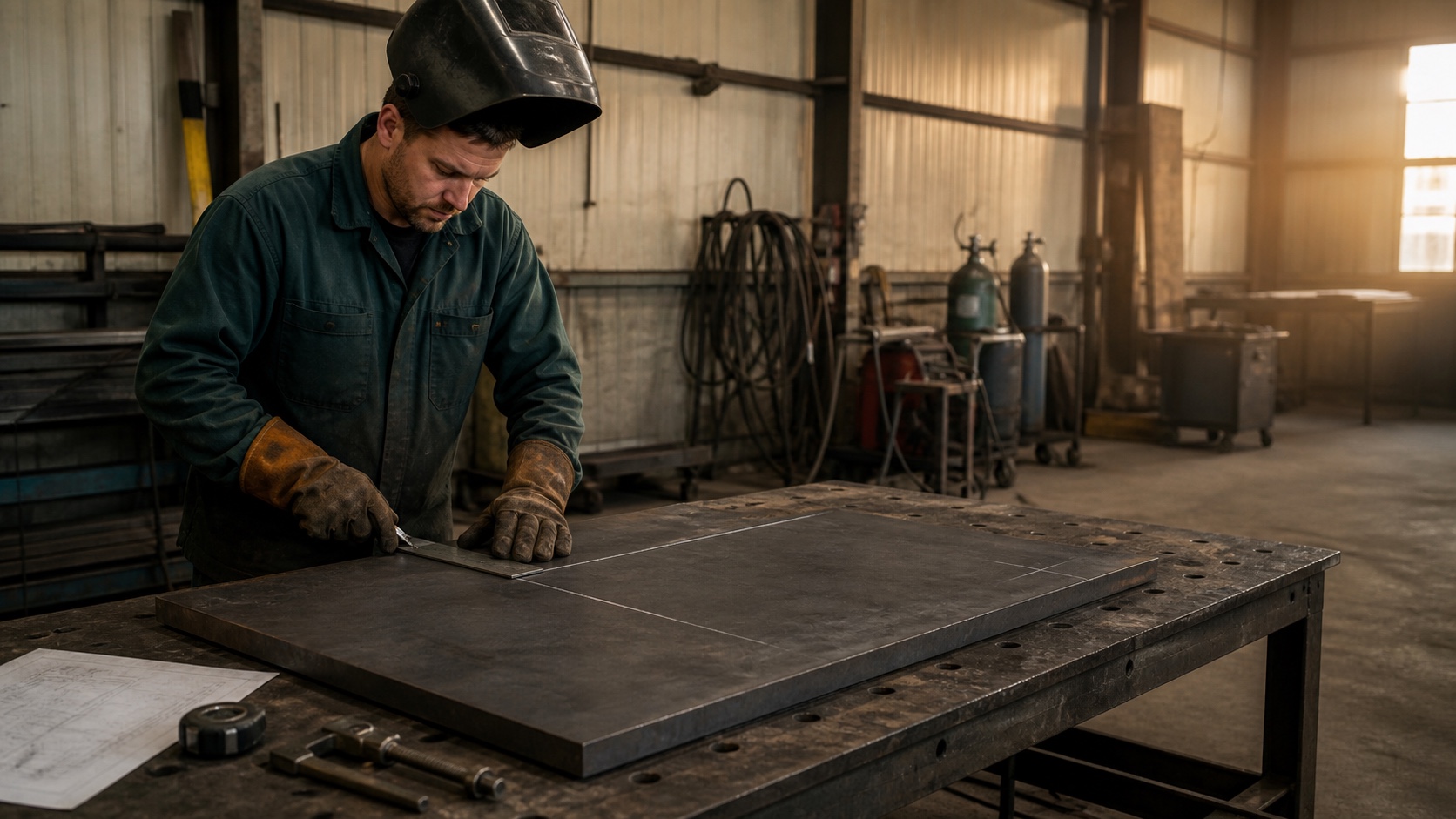
Before the hood drops, before the machine settles into its familiar hum, there is often a pale line across a dark piece of steel.
It might be soapstone pulled along a square. It might be a center punch, a scribe, a wraparound, or a short note beside a joint. To somebody walking past the table, it can look like a few temporary scratches and chalk marks. To the person building the job, those marks are the work beginning to think out loud.
Welding gets photographed at its brightest moment: arc light, sparks, smoke, the finished bead. But much of the craft lives in the quieter stretch before that. A welder studies the drawing, checks the material, finds a reference edge, marks a cut, lays out a centerline, and decides what needs to be true before heat enters the picture.
A mark is a decision made visible
A layout line does not have to be beautiful. It has to mean something. This edge stays. That corner moves. The hole belongs here. The part turns this way. The next tack starts after one more check.
That is why marks on a welding table are more than measurement. They are a small language shared by the drawing, the material, and the people touching the job. Miller describes weld symbols as shorthand for weld type, size, and other processing or finishing information. The marks made on the steel are different from those formal symbols, but they serve a related human purpose: carrying an intention from one stage of the work into the next.
Some marks are for the person holding the soapstone. Others are for the fitter, the saw operator, the welder on the next station, or whoever returns after lunch and needs to understand where the thought left off. A clear line can hold a decision long enough for another set of hands to pick it up.
The pause before the tack
There is a recognizable shop-floor pause when a part is nearly ready. The pieces are on the table. The clamps are close. The welder looks from the drawing to the fit-up, then back again. Maybe the tape comes out one more time. Maybe a square gets flipped to the other side. Nothing dramatic happens, yet the job can change direction in those few seconds.
That pause is not hesitation for its own sake. It is respect for the fact that heat tends to make every earlier decision more expensive. A soapstone line can be wiped away. A part can be rotated. A reference can be checked. Once the joint is tacked and the assembly begins to pull against itself, the conversation changes.
This is also where experience shows up without announcing itself. A veteran may recognize which edge deserves trust, where access will tighten later, or which mark will disappear under a clamp. An apprentice may slow the process down with a question that catches an assumption. Both can improve the job. The useful shop culture is not the one that never checks; it is the one where checking is treated as part of building.
Every shop develops a handwriting
Spend enough time around fabrication and you start recognizing more than welds. You recognize the way people mark steel.
One person makes long, confident lines. Another circles every important point. Somebody writes reminders large enough to survive dust and distance. Somebody else uses the smallest possible tick and knows exactly what it means. There are tidy tables where every tool has a place, and busy tables where the system only becomes visible after you watch the work move for a while.
The variety is part of shop identity, but clarity still matters. Miller’s shop-layout guidance recommends thinking deliberately about space and separating dirtier cutting and grinding work from welding areas. That same principle applies on a smaller scale at the table: give the next operation, and the next person, enough order to see what matters.
Good layout does not need to look like drafting-room art. It needs a reference that can be understood, a mark that survives long enough to do its job, and enough restraint that the important line does not disappear into a storm of chalk.
What the finished weld does not show
A finished assembly hides much of its own making. The soapstone gets brushed away. The temporary tabs come off. The fit-up marks vanish under paint, scale, grinding dust, or the next piece. What remains is the object—and the consequences of the choices that came before it.
That invisibility is one reason fabrication can be misunderstood. People see the final weld and assume the arc was the whole event. Welders know the bead is only one part of a chain: reading, moving, marking, fitting, checking, tacking, controlling, and finishing. The bright moment depends on a lot of quiet ones.
There is pride in that. Not the loud kind that needs every decision noticed, but the steady kind that leaves the part right even after the evidence has been wiped from the table.
The Arc Life question
What mark, symbol, or layout habit instantly tells you who worked on a job before you? Is there a shop-floor shorthand everybody understands—or one you wish people would stop using?
Arc Life exists for the culture around the work: the habits, humor, standards, and stories that live beyond the finished bead. Read more about what Arc Life stands for, or explore the current Arc Life collection.

Leave a Reply