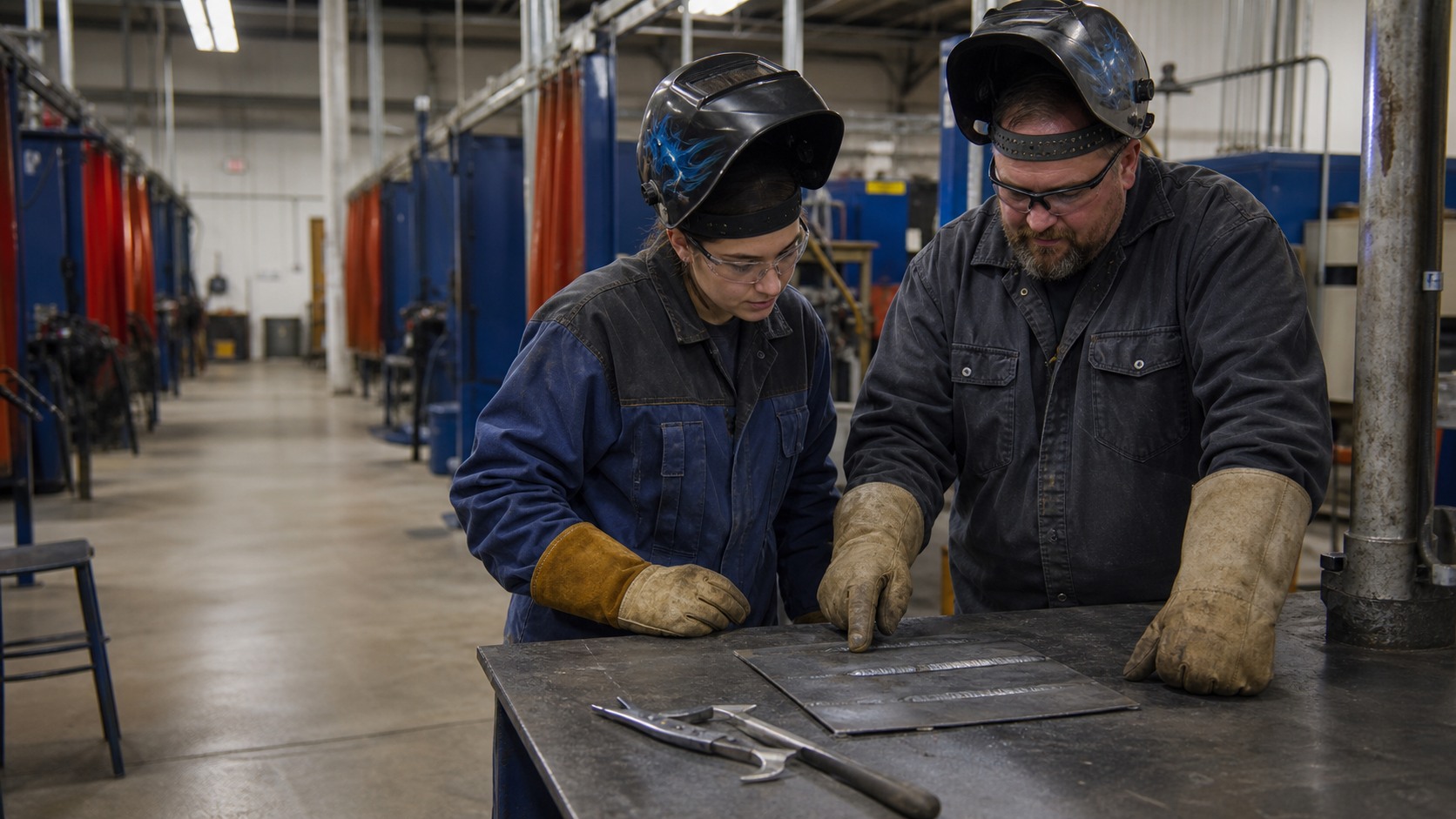
There is a moment many welders recognize before they have the words for it. The hood comes up. The plate is still on the table. Among the starts, stops, wandering edges, and beads that never quite became what the hands intended, one short stretch looks different.
It is not perfect. It may not be ready for a test booth, a drawing, or a job. But for the first time, the person who made it can see that the result was not an accident. Something changed in the hands, the eyes, or the timing. A few inches of metal finally answered back.
That small win matters because welding progress rarely arrives like a movie scene. It arrives in inches.
The breakthrough is usually smaller than it feels
Beginners often expect improvement to look dramatic: yesterday nothing worked, today everything does. The trade is less tidy than that. Progress is usually a collection of small corrections that begin to cooperate. The arc stays where the welder intended. Travel becomes steadier. The bead stops feeling like something being chased and starts feeling like something being guided.
The American Welding Society describes the stringer bead as a foundation for learning how arc length, work angle, travel speed, and the weld pool affect one another. That is a lot of information packed into a very short line of weld. A practice coupon may look simple, but it records attention, repetition, and dozens of choices made in real time.
The first bead a student feels proud of is not proof that the learning is over. It is proof that the learning has become visible.
A good bead changes the way practice feels
Before that first recognizable success, practice can feel like feeding coupons to the booth. The welder makes a run, cleans it, looks at it, and sees only a list of things that went wrong. Repetition without a sign of progress is exhausting.
One better pass changes the bargain. Now there is evidence that another one is possible. The student has something to compare against—not a glossy photograph or somebody else’s highlight reel, but work made by the same hands on the same machine.
That comparison is useful when pride stays honest. One clean section does not make a person finished, and a rough day does not erase everything already learned. Welding confidence is strongest when it is connected to repeatable work, not a single lucky coupon.
Feedback belongs close to the work
Good instruction helps a student understand why the better section happened. In a 2026 AWS Welding Digest article, welding instructor Jared Massic describes evaluating welds with students while the work is still fresh, giving direct feedback, and sending them back to practice with a specific next step. His curriculum also has students revisit the same welds as their skill improves.
That approach respects the reality of the booth. “Do better” is not much of a map. A focused observation can be. It gives the next coupon a purpose and turns criticism into work the student can use.
It also gives experienced welders a chance to pass along something more valuable than a verdict. A veteran does not need a speech to help. Sometimes the most useful contribution is noticing one improvement, naming one next correction, and leaving enough room for the newer welder to own the result.
The trade measures what the hands can actually do
Welding has a way of cutting through vague confidence. The AWS Certified Welder program is performance-based: candidates produce a weld to a Welding Procedure Specification at an accredited test facility, and the work is evaluated against the applicable requirements. The program recognizes that people arrive through different routes—school, apprenticeship, military training, technical college, or on-the-job experience—but the test still comes down to demonstrated skill.
That makes the little victories in training more meaningful, not less. The first improved bead is far from the last standard a welder will face. It is the beginning of a habit: make the work, look honestly, accept useful feedback, adjust, and make it again.
Keep a record of the mile markers
Not every practice plate needs to follow someone home. A photo can do the job. So can a date written on the back of one meaningful coupon, if the school or shop allows it. The point is not to build a shrine to an early weld. It is to keep an honest marker of where the work once stood.
Months later, that rough plate may say more than a polished social post ever could. It shows that steadiness was learned. It reminds a working welder that today’s automatic movement was once awkward and deliberate. It can also make a seasoned person more patient with the student standing at the beginning.
The question for the shop
What do you remember about the first bead you were genuinely proud of? Was it the appearance, the sound, the way the puddle finally made sense, or the fact that an instructor looked at it and told you to do it again?
That answer is part of trade culture. It is how people remember becoming welders—not in one giant leap, but in small stretches of work that finally held together.
Arc Life tells the stories behind the hood: the learning, identity, humor, and pride that make welding more than a job title. You can also explore the current Arc Life collection, built around that shared shop-floor culture.
Sources
- American Welding Society, “How to Make a Quality Shielded Metal Arc Weld”
- American Welding Society, “Designing a Welding Program for Growth, Not Just Grades”
- American Welding Society, Certified Welder Program

Leave a Reply