A portable band saw with a base is worth considering when your jobs genuinely split between cuts where the material sits and repeat work at a bench. The base by itself is not a reason to buy. Before comparing packages, write down two jobs you actually do: one that takes the saw to the stock, and one that brings the stock to the same cutting station. If you can only name one kind of job, buy for that job first.
DOVAMAN describes the B120 as a corded portable saw with a convertible base. Treat it as a two-format tool to evaluate, not as a promise that a portable saw can do everything a dedicated stationary machine does. This guide is based on the manufacturer’s documentation, not a hands-on test.
As an Amazon Associate I earn from qualifying purchases.
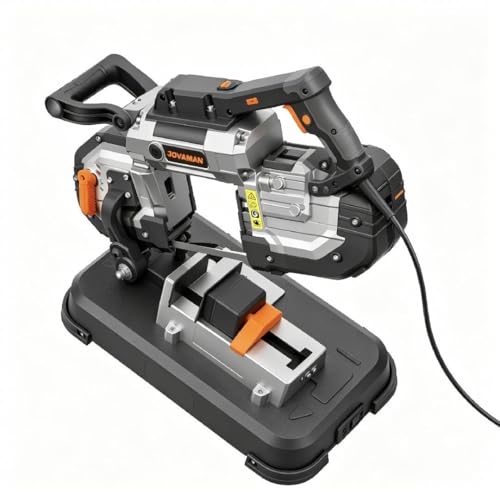
Last update on 2026-11-21 / Affiliate links / Images from Amazon Product Advertising API
Give the base a job before paying for it
Imagine you routinely cut short sections from stock that is already brought to the same bench. A compatible base gives you a stationary format to consider. Now imagine most of your cuts are one-offs on stock that is awkward to bring to a bench. In that case the portable format matters more, and the base may spend most of its time in storage. Either way, make the decision from your real workflow, not from a photo showing both modes.
Use the longest piece you usually handle and sketch the space it would occupy before and after the cut. On a crowded bench, the saw’s footprint is only part of the space you need. Think about room for the workpiece, support for the stock, where the offcuts go, and how much of the bench the setup displaces. Check the manufacturer’s instructions for the actual requirements in the mode you intend to use.
If you already have a suitable stationary saw, compare this purchase against what the portable tool adds on its own. If you need a stationary tool every day and rarely carry the saw anywhere, compare it with a dedicated machine instead. Convertible is an advantage when you use the conversion, not a substitute for knowing which work the tool will do.
Read the manufacturer’s package list separately from the offer
The DOVAMAN B120 product page shows the portable and base-mounted formats. The manufacturer’s manual identifies the saw, a blade, the base, mounting screws, two wrench sizes, and the manual in its unpacking list. That is the manufacturer’s reference package. The Amazon listing advertises two blades, but the manual does not confirm the contents of that specific offer. Before ordering, confirm the total blade count and whether one comes installed.
Verify that the offer names B120 and that its written contents include the base and the parts that go with it. A product photo can illustrate a feature without saying that the pictured accessory is in that particular package. Likewise, a similar title is not enough to conclude that a different listing includes the same pieces. If the text is unclear and the base is the reason you are buying, settle that question before ordering.
Keep a copy of the written model and package details. When the box arrives, compare the model label and packing list with what you ordered. If a listed item is missing, use the documentation and the order record to resolve the discrepancy. Don’t improvise substitute hardware or infer compatibility from the shape of a part.
Check the work, not just the headline capacity
A single capacity figure doesn’t tell you whether a specific section fits in your intended orientation or cut angle. Write down the largest stock you really expect to use, whether the stock is round or rectangular, and the kinds of cuts the job calls for. Check those against the exact manufacturer documentation. If the literature does not establish capacity for your particular setup, treat it as unverified rather than assuming that a maximum applies everywhere.
Make the same distinction when planning for blades. A manufacturer’s material list is not a blade selection chart. Check the correct blade dimensions and intended application in the supporting instructions before buying spares. A tool that fits the space but leaves you guessing about the blade or the exact workpiece size is not yet a complete buying decision.
One useful comparison is to make two columns on paper, one for the bench and one for away-from-bench work. In each column, note how often the job comes up, where the material can be supported, and whether your current tools already cover it. If the base only solves a hypothetical job, that is a weaker reason to buy than a recurring task you can name today.
A quick check before you order
First: does the written offer identify B120, the base, and the hardware you need? Second: is your common stock supported by the manufacturer for the intended format? Third: is there enough usable bench space, or are your cuts mostly away from the bench? Finally: does the corded format fit the work area where you actually expect to use it? Check the machine nameplate and manual rather than inferring power requirements from a marketplace heading.
My buying rule: pick the stock and the work area first, then the package. If the base solves a recurring need and the written offer confirms its contents, the convertible format makes more sense. If the base would mostly sit unused, compare the handheld tools that meet the same documented needs. Check availability on Amazon; no current price, stock, or seller details are assumed here.
For another look at how small shops organize the work around their tools, explore Arc Life.
Leave a Reply