The Magswitch MagJig 150, manufacturer part 8110005, is a switchable magnetic module intended to help locate and secure suitable fabrication fixtures to ferrous steel surfaces. The buying question is not whether the name says “150.” It is whether the manufacturer’s documented force figures, holding orientation, mounting geometry and package count fit the fixture being planned. It is not a personnel-safety device, crane magnet, lifting magnet or substitute for a qualified workholding design.
Magswitch identifies the module as a manually switched magnetic fixture component, with mechanical on/off action and no electrical power connection. On its current product page, the company lists a maximum breakaway value of 133 lb on one-inch steel, alongside a separate 2:1 shear working load of 15 lb. The figures are not interchangeable. A force measured pulling straight away from a thick test plate is not permission to resist the same load sideways on a thin, painted or irregular shop surface.
As an Amazon Associate I earn from qualifying purchases.
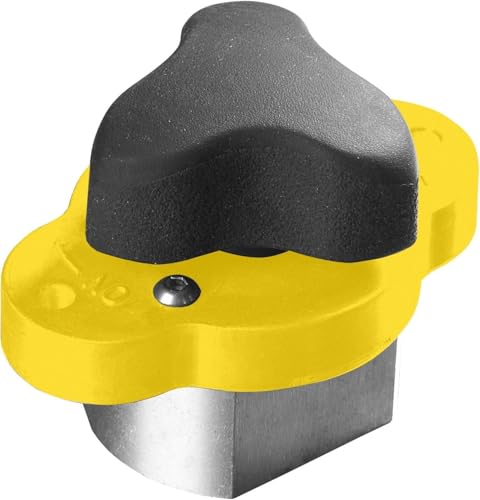
- Powerful 150 lb Magnetic Hold-Down for Large Jigs and Heavy Fixtures: The MagJig 150 delivers strong downward pressure for larger jigs, crosscut sleds, and heavy-duty fixtures. It provides the extra holding force needed for demanding woodworking applications while retaining fast on/off convenience.
- Excellent for Big Sleds, Production Jigs, and Demanding Work: Ideal when you need maximum stability on large or heavy jigs and sleds. The 150 lb model maintains consistent downward pressure even during aggressive cuts or on larger workpieces.
- Instant On/Off – No Clamps, No Fuss: Twist the knob to instantly engage or release the strong magnetic hold. This speed and ease of use dramatically reduces setup time compared to traditional clamping methods.
- Strong, Consistent Pressure Reduces Vibration and Movement: By holding jigs and sleds firmly in place, the MagJig 150 helps reduce vibration and unwanted movement, leading to cleaner cuts and safer operation on table saws and router tables.
- Combine with Other MagJig Sizes for Custom Solutions: Use alone for heavy fixtures or pair with 95 lb or 235 lb models to create highly capable, project-specific modular workholding systems.
Last update on 2026-10-31 / Affiliate links / Images from Amazon Product Advertising API
Maximum breakaway is not a general working-load rating
The most consequential specification is easily misunderstood. Magswitch’s maximum breakaway value depends on the stated steel thickness and the test orientation. Shear—the tendency for a fixture to slide along the steel surface—is a different loading case with its own much lower published working-load figure. Surface condition, cleanliness, geometry, material properties and the fixture’s moment arms also affect a real setup. Do not use the largest number in a product title as a universal engineering allowance.
The module is suited to deliberately engineered steel fixturing where the actual load path and manufacturer instructions have been reviewed. It is not an automatic replacement for mechanical stops, bolted restraints, clamps, guards or locking features required by the process. If the fixture could fall, shift into a worker, expose a moving machine or release a suspended part, use an appropriately rated system designed for that hazard. The MagJig product page does not present this item as a lifting device.
What the single module is designed to do
Magswitch describes a magnetic field that can be mechanically turned on and off, support for flat or round ferrous steel surfaces, a flush-mount standoff and screw-hole provisions for securing the module in a fixture. Those features can be useful when a shop has repeatable positioning needs on a suitable steel work surface. They do not turn nonferrous aluminum or an austenitic stainless table into a dependable magnetic base, and they do not prove capacity on very thin or badly coated steel.
For a welding or fabricating operation, the fixture must also be evaluated for arc access, heat exposure, spatter, edge protection and the process’s prescribed location and restraint requirements. Do not infer heat compatibility or specific placement distances from a retail photograph. Use the product’s actual instructions and the shop’s reviewed fixture design, especially when the work could damage the module or defeat a required guard.
Package distinction: one MagJig versus a two-pack
The exact manufacturer’s single-unit item is part 8110005. Magswitch separately sells a two-pack, which is a different package listing. A photograph showing two modules or an Amazon variation selector is not proof that the selected ASIN ships two. This guide concerns just one exact ASIN, B001B8HMKG, associated with the single-module model 8110005 by the available marketplace identity. Confirm the current Amazon offer’s quantity and model before ordering. Do not rely on cached prices or assumed bundle contents.
- Verify manufacturer Magswitch and exact MagJig 150 part number 8110005.
- Identify the fixture’s magnetic contact surface and whether the material is an appropriate ferrous steel.
- Check the manufacturer’s 133 lb maximum breakaway test condition separately from the 15 lb shear working-load figure; have the fixture designer assess the actual load path.
- Confirm mounting provisions, space, fixture thickness and any needed mechanical stops from the current manufacturer drawing.
- Check whether the offer is one module or the separate two-pack, and whether other mounting hardware is included.
- Verify current seller, warranty, package, shipping and item condition without relying on an old price or stock badge.
A shop-fit example without a false load calculation
Suppose a fabricator wants a removable locating fence for repetitive layout work on a steel table. The magnetic module may be a candidate, but the designer still needs the fence geometry, applied loads, risk of shifting, required accuracy and approved attachment method. A module that pulls strongly straight off a thick plate may behave differently when the force is mostly sideways. The design should not depend on a guessed friction coefficient or an unverified number of modules. Use manufacturer instructions and review the entire fixture as a system.
If the workpiece is aluminum, or the table is a nonmagnetic material, the magnetic concept may not work as intended. If the contact face is coated or rough, the test conditions behind the published maximum force may not apply. If the setup carries safety-critical loads, a verified mechanical restraint or appropriately rated product could be necessary. Those are engineering questions to resolve before committing to a purchase.
What else belongs on the fixture checklist
An efficient fixture also needs a repeatable reference, adequate access to the weld joint, allowance for inspection and a method to avoid building distortion into the part. Purchasing the magnetic module is only one line in the plan. WSP’s fit-up angle and relative-zero guide discusses the difference between a convenient tool reference and a job datum. The WSP parts lookup can help identify equipment and consumables once the exact machine or part is known, but it cannot approve a fixture load case.
For stock and assembly planning, a fixture designer should retain the product’s exact drawing, part number and load assumptions alongside the current work order. A component that is correct for a woodshop sled or a light layout aid may still be unsuitable for a heavy welded assembly or a powered machine. Evaluate the intended exposure and inspection requirements before expecting the same performance across different jobs.
Final buying decision
The MagJig 150 is worth considering when a trained designer needs a mechanically switched magnetic locating element on suitable ferrous steel and can verify the actual loads and mounting arrangement. It should be avoided as a general-purpose lifting magnet, an unreviewed safety restraint or a shortcut around fixture engineering. The manufacturer’s published distinction between maximum breakaway and shear working load is more useful than a single headline force value.
Review the official Magswitch 8110005 specification and available drawings, then check the live Amazon listing linked above for the correct single-unit package. If the Amazon product data is unavailable, the exact-ASIN destination remains only a shopping lead and must not be treated as proof of stock or current package configuration. This article does not claim independent hands-on testing or a universal application approval.
Leave a Reply