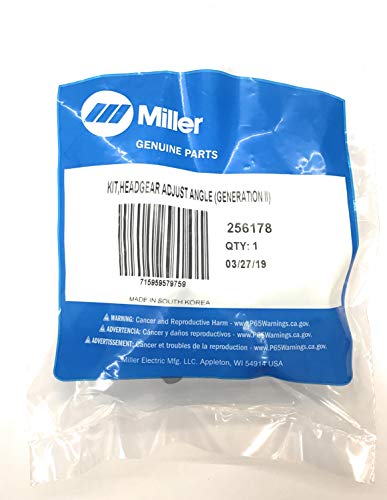
The Miller 256178 headgear kit is angle-adjustment hardware, not a complete replacement headgear assembly. That distinction should lead the order. Identify the helmet and the headgear actually installed, then match the required hardware in the applicable parts list. A helmet that feels loose does not, by itself, establish that this is the correct repair kit.
Arc Weld’s checked item is SKU 256178 – 1 pack, listed as “Kit, Headgear Adjust Angle (Generation II and III).” The product was active with available inventory at the verification. One selling unit is a pack of the kit; this guide does not assume an unverified piece count or promise that the package includes an entire band, ratchet or suspension.
Why the hardware-versus-assembly distinction matters
Miller’s 2025 Accessories and Consumables catalog, available here as a reproduced manufacturer document, lists 256178 as adjustment angle/stop hardware, separately from complete headgear entries. Use that distinction to identify the kind of part, then consult the parts information for the actual helmet and installed headgear. The catalog is not proof of universal fit.
A full assembly and an adjustment kit can appear close together in a retailer’s helmet-accessory category. They solve different ordering needs. Read the part description and number together. A picture showing several small components is not a reliable way to determine which pieces belong to the kit or whether another component is required.
Describe the symptom before selecting the part
Write down what the helmet is doing. Is the concern its resting angle, movement at an attachment point, fit around the head, a damaged band or a missing component? These observations help a supplier locate the relevant parts drawing. They do not establish a diagnosis or guarantee that replacing the angle hardware will correct the problem.
Keep lens performance, battery condition and headgear fit separate. A hardware kit should not be ordered as a general answer to a helmet that is uncomfortable or not functioning as expected. Identify the affected component and follow the manufacturer’s inspection and replacement guidance instead of treating every helmet complaint as a headgear failure.
Confirm the installed headgear—not only the shell name
Record the helmet model and any available identification or revision information. Then identify the headgear that is physically installed. Used equipment, previous repairs and replacement assemblies can leave a helmet with a configuration that differs from the one a buyer expects from the shell name alone.
Arc Weld’s Generation II and III wording is useful catalog context, but it should not replace the model-specific parts list. When the installed generation is uncertain, mark it as unknown and ask for confirmation. Do not turn an informal description such as “the newer Miller headgear” into an exact compatibility statement.
A clear photograph can help explain the question, especially when a component is missing or a number cannot be read. Include the helmet identification and the area of concern. Photographs support identification; they do not independently approve a mixed or modified combination of parts.
What is verified and what remains unknown
- Verified product identity: Miller part 256178, an angle-adjustment hardware kit.
- Verified Arc Weld selling unit: SKU 256178 – 1 pack, not a listing for a complete headgear assembly.
- Verified catalog distinction: the manufacturer lists the adjustment hardware separately from whole-headgear entries.
- Unknown for your helmet: whether this exact kit matches the headgear currently installed until the relevant parts information is checked.
- Unknown package detail: a complete component-by-component contents list was not established from the current Arc Weld description.
An unknown is a purchasing question to resolve, not a specification to fill in from another listing. Ask the supplier to confirm package contents and whether any separately listed pieces are required. Keep the answer with the equipment record so a later reorder does not repeat the same uncertainty.
Replacing a known kit versus assembling an unfamiliar combination
For a documented replacement, compare the existing part number and the applicable drawing. Where previous work is undocumented, first establish whether the assembly is correct. An old installation is not proof that the parts were appropriate or that repeating it is the safe choice.
Do not drill, cut, heat or improvise attachment hardware to make an uncertain combination fit. Do not add an unverified tightening or adjustment procedure to a purchase request. The correct instructions depend on the actual equipment, and a parts buying guide should not substitute for the manufacturer’s service information.
Send a complete ordering question
- Provide the helmet model and available identification details.
- Identify the installed headgear or explain why its generation is uncertain.
- Describe the observed issue without assuming the failed component.
- Provide a readable existing part number or a clear photograph when useful.
- Ask whether 256178 is the correct kit, what the pack contains and which instructions apply.
- Confirm quantity in packs and any separately required components before authorizing the purchase.
Order the exact Arc Weld item
The verified listing is Miller 256178 at Arc Weld Inc.. Check the live page for current availability and fulfillment information. Inventory changes; the earlier stock check is not a shipping promise.
For help organizing the equipment question, use WSP PPE Support and the Find My Part workflow. These resources help collect the information needed to identify a component; they do not expand the kit’s compatibility.
Bottom line: buy 256178 when the documented requirement is the matching angle/stop hardware kit. Buy a complete headgear assembly only when that is the verified requirement. Distinguishing the two before ordering prevents a correct part number from becoming the wrong purchase for the problem.
Featured image: the exact Miller 256178 catalog photograph supplied by Arc Weld Inc. It identifies the listed hardware, not a complete headgear assembly or an approved fit for every Miller helmet.
Leave a Reply