Tag: ER308L

  • Why Stainless Welds Lose Corrosion Resistance

    Washington Alloy 33 Lb. .035 Stainless Steel MIG Wire ER308L for Superior Welds and Corrosion Resistance
    “>Washington Alloy 33 Lb. .035 Stainless Steel MIG Wire ER308L for Superior Welds and Corrosion Resistance

    Stainless steel can lose corrosion resistance after welding when the weld area is overheated, not cleaned properly, or matched with the wrong filler. The base metal may still be stainless, but the weld zone can become more vulnerable to rust staining, pitting, and premature attack.

    Key Takeaways

    • Heat tint is a warning sign, not just a cosmetic issue.
    • Oxide scale can reduce corrosion resistance around the weld bead and heat-affected zone.
    • Filler metal must match the base alloy and service requirement.
    • Contamination from carbon steel tools, grinding dust, or dirty handling can cause surface corrosion.
    • Post-weld cleaning matters as much as weld appearance.

    Why stainless weld corrosion starts

    Stainless steel depends on a passive chromium oxide layer for corrosion resistance. Welding disrupts that layer. If the weld overheats, oxygen reacts with the surface and creates heat tint. That discoloration indicates oxide formation and possible chromium depletion near the surface.

    When chromium is tied up in oxide scale, the surface cannot protect itself as effectively. In corrosive service, that area can fail before the surrounding base metal.

    Common support-level causes

    • Excess heat input: High amperage, slow travel, or poor technique can widen the heat-affected zone and increase tint.
    • Shielding gas issues: Poor coverage can allow oxidation during solidification. Exact gas mix requirements depend on the process and joint. Unknown (Verify).
    • Wrong filler metal: A filler that does not match the base stainless grade can reduce corrosion performance. Verify alloy family before welding.
    • Surface contamination: Oil, chlorides, marking ink, grinding dust, and carbon steel contamination can all start corrosion.
    • Backside oxidation: Root-side oxidation on pipe and tube welds can be a major corrosion point if purge control is poor.

    Troubleshooting support checklist

    1. Confirm the base metal grade from the job traveler, drawing, or MTR. If not available, Unknown (Verify).
    2. Verify the filler specification before production starts.
    3. Check whether the weld shows light straw, blue, purple, or dark heat tint. Darker tint usually means higher oxidation risk.
    4. Inspect for carbon steel contact from wire brushes, clamps, grinders, or handling tables.
    5. Review gas coverage, nozzle condition, and stickout for the process used.
    6. Inspect the root side for purge quality on tubes, pipe, and enclosed joints.
    7. Confirm cleaning procedure after welding.

    Heat tint and cleaning

    Heat tint should be treated as a corrosion-control issue. Removing it helps restore surface performance, but removal method matters. Use only cleaning methods approved for the material and the job. Aggressive grinding can damage the surface and create more contamination.

    If the application requires higher corrosion resistance, pickling and passivation may be specified. Exact chemistry and process requirements are application-dependent. Unknown (Verify).

    Filler verification

    For stainless support work, filler selection must be checked before the weld is made. A mismatch may not show immediately, but it can affect long-term performance in service.

    For general stainless MIG work, the listed ArcWeld product is:

    Washington Alloy 33 Lb. .035 Stainless Steel MIG Wire ER308L for Superior Welds and Corrosion Resistance

    Washington Alloy 33 Lb. .035 Stainless Steel MIG Wire ER308L for Superior Welds and Corrosion Resistance

    Discover the premier choice in welding materials with Washington Alloy 33 lb. Spool MIG Wire. This high-quality stainless steel MIG wire is designed specifically for exceptional performance in various welding applications. With a diameter of .035 inches, this 308L stainless steel wire offers the perfect balance of strength and versatility. Crafted for professional welders and DIY enthusiasts alike, Washington Allo…

    View at Arc Weld Store

    Use the filler only when it matches the job specification and base metal requirements. If the stainless grade or service condition is not confirmed, stop and verify before production welding.

    When corrosion shows up after welding

    If a weld already shows rust staining or early corrosion, check these points in order:

    • Was the base metal truly stainless, and what grade was it?
    • Was the correct filler used?
    • Was there visible heat tint or oxidation?
    • Were tools dedicated to stainless work?
    • Was the weld cleaned and passivated if required?
    • Was the part exposed to chloride-containing cleaners, salt, or process chemicals?

    Support guidance for buyers and maintenance teams

    When corrosion resistance matters, buy and stage stainless wire by verified alloy family, not by wire diameter alone. Keep stainless consumables separated from carbon steel consumables. Label storage clearly. Cross-contamination is a common shop-floor failure mode.

    For repeat jobs, document the base metal grade, filler, shielding gas, cleaning method, and post-weld treatment so the same defect does not repeat.

    Safety notes

    • Use approved PPE for welding, grinding, and chemical cleaning.
    • Do not mix stainless and carbon steel wire brushes or grinding tools unless contamination control is verified.
    • Follow the SDS and the process procedure for any pickling or passivation chemicals.
    • Do not assume weld color is acceptable in corrosion service. Appearance is not proof of performance.

    FAQ

    Does blue or brown discoloration always mean failure?

    No. But it does indicate oxidation and reduced corrosion margin. The service environment decides how serious it is.

    Can I fix stainless weld corrosion by cleaning the bead?

    Sometimes. If the damage is only surface oxidation, cleaning and passivation may help. If the weld metal or base metal has already been attacked, repair may be required. Unknown (Verify).

    Is ER308L always the right filler for stainless?

    No. ER308L is common for some austenitic stainless applications, but filler choice depends on base metal grade and service conditions. Verify the specification before use.

    Why does stainless rust near welds first?

    The weld zone sees heat tint, dilution, and possible contamination. That area often has the weakest passive layer and is the first place corrosion appears.

    Sources Checked

    • Weld Support Parts internal product page for stainless MIG wire
    • Weld Support Parts blog: Best MIG Wire for Stainless Steel (ER308L vs ER309L)

    Related Weld Support Guides

  • Best MIG Wire for Stainless Steel (ER308L vs ER309L)

    Wrong stainless wire shows up fast: sugaring, porosity, ugly wet-out, and corrosion problems later. This page is built for buyersโ€”pick the right wire grade the first time, with verified Amazon ASINs and manufacturer-backed specs.

    Key Takeaways

    • ER308L is the standard match for 304/304L and 308/308L stainless.
    • ER309L is the better choice for stainless-to-mild steel and many repair jobs on unknown stainless.
    • For cleaner beads and better wetting, consider ER308LSi (more silicon).
    • Stainless MIG typically runs best on tri-mixโ€”verify your wire’s datasheet.
    • Buy wire that clearly states AWS A5.9 / ASME SFA-A5.9 on the label.

    Comparison Table

    ModelKey SpecsBest ForAmazon
    Best Welds ER308L (.030 in)AWS A5.9 ER308L; low carbon “L”; solid wire304/308 stainless general workSee links below
    Blue Demon ER308LSi (.030 in)AWS A5.9 ER308LSi; higher Si for bead appearanceCosmetic welds, smoother wettingSee links below
    ER309L stainless MIG wireAWS A5.9 ER309L; dissimilar-metal fillerStainless to mild steel, unknown stainless repairsSee links below

    Table Links

    Best Welds ER308L (.030 in, 2 lb)

    Best Welds Er308L Stainless Steel Welding Wire, .023 In Dia., 4 In Long, 2 Lb Carton – 2 Lb
    • Can also be used for welding types 321 and 347 stainless steels
    • Used for welding types 304, 304L, 308 and 308L stainless steels
    • Very similar to type 308 but has a carbon content held to a max of 0.03% to avoid carbide precipitation

    Last update on 2026-06-05 / Affiliate links / Images from Amazon Product Advertising API

    Blue Demon ER308LSi (.030 in, 30 lb)

    Blue Demon 308LSI X .030 X 30LB Spool stainless steel welding wire
    • ER308LSI produces exceptionally smooth welds for applications that require a good cosmetic appearance
    • This product is used primarily with welding grades 304 and 308
    • AWS A5.9, Welding Current DCEP

    Last update on 2026-06-05 / Affiliate links / Images from Amazon Product Advertising API

    ER309L stainless MIG wire (choose size/spool)

    Washington Alloy 33 Lb. Spool Mig Welding Wire 309L Stainless Steel (.035 X 33 LB.)
    • 33 LB. Spool
    • AWS A5.9 Class ER309L
    • 12″ Spool Size
    • ISO 9001 Certified

    Last update on 2026-06-05 / Affiliate links / Images from Amazon Product Advertising API


    Product Picks (Details)

    Best Welds ER308L (.030 in) โ€” Best for most 304/308 jobs

    If you’re welding common stainless (304/304L, 308/308L), ER308L is the default for a reason: it matches chemistry well and the low carbon helps reduce sensitization-related corrosion.

    What to verify on the label/datasheet

    • AWS classification: ER308L
    • Standard: AWS A5.9 / ASME SFA-A5.9
    • Wire diameter: 0.030 in (0.8 mm)

    Best Welds Er308L Stainless Steel Welding Wire, .023 In Dia., 4 In Long, 2 Lb Carton – 2 Lb
    • Can also be used for welding types 321 and 347 stainless steels
    • Used for welding types 304, 304L, 308 and 308L stainless steels
    • Very similar to type 308 but has a carbon content held to a max of 0.03% to avoid carbide precipitation

    Last update on 2026-06-05 / Affiliate links / Images from Amazon Product Advertising API

    Blue Demon ER308LSi (.030 in) โ€” Best for bead appearance and wetting

    ER308LSi is still a 308L wire, but with more silicon to help the puddle flow and lay down smoother. If you care about bead profile (food equipment, visible rails, shop work), this is often worth it.

    What to verify

    • AWS classification: ER308LSi
    • Standard: AWS A5.9 / ASME SFA-A5.9

    Blue Demon 308LSI X .030 X 30LB Spool stainless steel welding wire
    • ER308LSI produces exceptionally smooth welds for applications that require a good cosmetic appearance
    • This product is used primarily with welding grades 304 and 308
    • AWS A5.9, Welding Current DCEP

    Last update on 2026-06-05 / Affiliate links / Images from Amazon Product Advertising API

    ER309L MIG wire โ€” Best for stainless-to-mild steel and unknown stainless repairs

    Use ER309L when you’re joining stainless to carbon steel, or when the base stainless grade is unknown and you need a more forgiving filler. It’s a common “repair wire” because it handles dilution better.

    What to verify

    • AWS classification: ER309L
    • Standard: AWS A5.9 / ASME SFA-A5.9

    Washington Alloy 33 Lb. Spool Mig Welding Wire 309L Stainless Steel (.035 X 33 LB.)
    • 33 LB. Spool
    • AWS A5.9 Class ER309L
    • 12″ Spool Size
    • ISO 9001 Certified

    Last update on 2026-06-05 / Affiliate links / Images from Amazon Product Advertising API


    Top Pick

    Top Pick for most buyers: ER308L (.030 in) in a spool size that matches your usage. It’s the correct match for the stainless most people are actually welding.


    Buying Guide: How to Choose Stainless MIG Wire

    1. Match the base metal
    • 304/308 โ†’ ER308L
    • 316 โ†’ ER316L
    • Stainless to mild steel โ†’ ER309L
    1. Pick diameter
    • 0.030 in: thinner material, better control
    • 0.035 in: general-purpose shop work
    1. Confirm gas
    • Many stainless solid wires run well on tri-mix can improve arc and wetting.
    1. Check packaging
    • AWS A5.9 marking, sealed spool, clean wire.

    FAQ

    Can I use ER308L on 316 stainless?No. Use ER316L for 316/316L to maintain corrosion resistance.

    Is ER308LSi “better” than ER308L?Not universally. It’s often better for appearance and wetting; ER308L is fine for general work.

    Do I need special rollers/liner for stainless wire?Often yesโ€”stainless is stiffer. Use the right drive rolls and keep the liner clean to prevent feeding issues.

    What polarity for stainless solid MIG wire?Typically DCEPโ€”verify on the spool.

    Safety Notes

    • Stainless welding fumes can contain hexavalent chromium. Use ventilation and a respirator as needed.
    • Wear ANSI Z87.1 eye protection and appropriate gloves/jacket.
    • Keep wire dry and sealed to reduce porosity.

  • MIG Welding Wire Selection Guide 2025 | ER70S-6 vs ER70S-3 Specs

    MIG Welding Wire Selection Guide 2025 | ER70S-6 vs ER70S-3 Specs

    MIG wire selection affects weld quality, spatter levels, and penetration depth. Choosing the right wire depends on base metal composition, surface condition, and shielding gasโ€”not just diameter and tensile strength.

    Common MIG Wire Classifications

    ER70S-6 (Most Common)

    • Deoxidizers: Manganese, silicon
    • Tensile strength: 70,000 PSI minimum
    • Best for: Dirty or rusty steel, single-pass welds, general fabrication
    • Shielding gas: 75/25 Ar/COโ‚‚ or 100% COโ‚‚
    • Spatter level: Moderate

    ER70S-3

    • Deoxidizers: Lower manganese and silicon than ER70S-6
    • Tensile strength: 70,000 PSI minimum
    • Best for: Clean steel, multi-pass welds, automotive sheet metal
    • Shielding gas: 75/25 Ar/COโ‚‚ (100% COโ‚‚ not recommended)
    • Spatter level: Low

    ER308L (Stainless Steel)

    • Composition: 19-21% chromium, 9-11% nickel
    • Best for: 304/304L stainless steel
    • Shielding gas: 90/10 Ar/COโ‚‚ or tri-mix (He/Ar/COโ‚‚)
    • Corrosion resistance: Excellent

    ER316L (Stainless Steel)

    • Composition: 18-20% chromium, 11-14% nickel, 2-3% molybdenum
    • Best for: 316/316L stainless, marine environments, chemical processing
    • Shielding gas: 90/10 Ar/COโ‚‚ or tri-mix
    • Corrosion resistance: Superior (molybdenum addition)

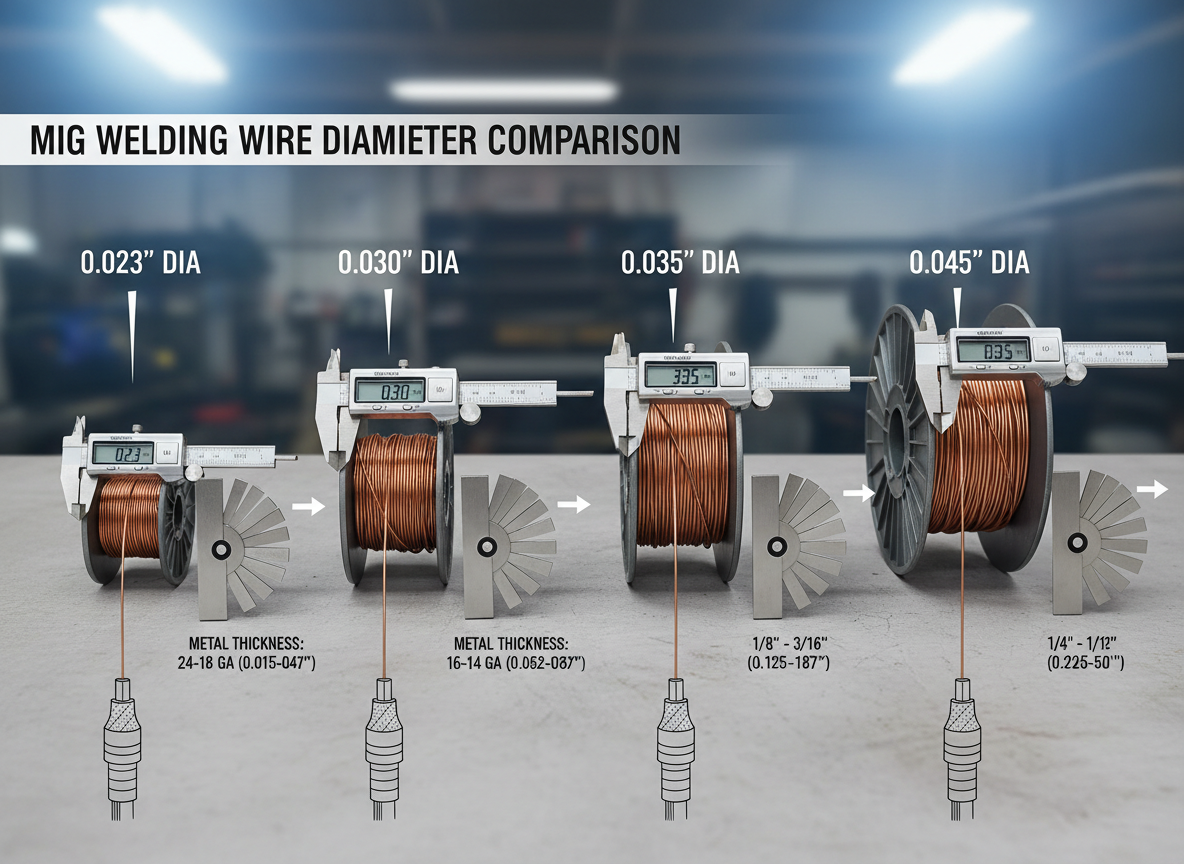
    Wire Diameter Selection

    DiameterAmperage RangeMaterial ThicknessTypical Use
    0.023โ€30-130A24-18 gaugeAutomotive sheet metal, thin tubing
    0.030โ€40-145A18-14 gaugeGeneral fabrication, light structural
    0.035โ€50-180A14 gauge-1/4โ€Most common all-purpose size
    0.045โ€75-250A1/4โ€-1/2โ€Heavy structural, thick plate
    0.052โ€100-300A1/2โ€+Industrial fabrication, heavy equipment

    Rule of thumb: Thinner wire = better control on thin material. Thicker wire = faster deposition on heavy plate.

    Shielding Gas Impact on Wire Performance

    75/25 Argon/COโ‚‚ (C25)

    • Pros: Low spatter, smooth arc, good bead appearance
    • Cons: Higher cost than 100% COโ‚‚
    • Best for: ER70S-3, ER70S-6, stainless steel

    100% COโ‚‚

    • Pros: Deep penetration, low cost
    • Cons: Higher spatter, rougher arc
    • Best for: ER70S-6 on thick steel (not recommended for ER70S-3)

    90/10 Argon/COโ‚‚

    • Pros: Minimal spatter, excellent for stainless
    • Cons: Shallow penetration on carbon steel
    • Best for: ER308L, ER316L stainless wire

    Surface Condition Requirements

    Wire TypeMill ScaleLight RustHeavy RustClean Steel
    ER70S-6โœ“โœ“โœ“โœ“
    ER70S-3โœ—โœ—โœ—โœ“
    ER308Lโœ—โœ—โœ—โœ“
    ER316Lโœ—โœ—โœ—โœ“

    ER70S-6 advantage: Higher deoxidizers clean impurities during welding. ER70S-3 requires clean base metal to avoid porosity.

    AWS Filler Metal Specifications

    AWS A5.18 (Carbon Steel MIG Wire) – Covers ER70S-3, ER70S-6, and other carbon steel wires – Defines chemical composition, tensile strength, and elongation requirements

    AWS A5.9 (Stainless Steel MIG Wire) – Covers ER308L, ER316L, and other stainless wires – Specifies corrosion resistance and ferrite content

    Wire Storage & Handling

    Moisture Contamination – Causes: Porosity, hydrogen cracking – Prevention: Store in sealed containers with desiccant packs – Shelf life: 12 months (carbon steel), 6 months (stainless)

    Wire Feed Issues – Kinked wire = erratic arc and bird-nesting – Solution: Use proper spool tension and liner size

    Liner Compatibility

    Wire DiameterLiner Inside Diameter
    0.023โ€-0.030โ€0.030โ€-0.035โ€
    0.035โ€0.035โ€-0.045โ€
    0.045โ€0.045โ€-0.052โ€
    0.052โ€0.052โ€-0.062โ€

    Oversized liner = wire wander. Undersized liner = excessive friction and burnback.

    Common Mistakes

    Using ER70S-3 on rusty steel
    Low deoxidizers canโ€™t compensate for surface contamination. Result: porosity and weak welds. Use ER70S-6 or clean the base metal.

    Wrong liner size for wire diameter
    0.035โ€ wire in 0.045โ€ liner causes erratic feeding. Match liner to wire diameter within 0.005โ€-0.010โ€.

    Storing stainless wire without moisture protection
    Stainless wire absorbs moisture faster than carbon steel. Always use sealed containers with desiccant.

    Buying Checklist

    • โœ“ Wire classification matches base metal (ER70S-6 for dirty steel, ER70S-3 for clean)
    • โœ“ Diameter suits material thickness and amperage range
    • โœ“ Shielding gas compatible with wire type
    • โœ“ AWS A5.18 or A5.9 certification marked on spool
    • โœ“ Liner size matches wire diameter
    • โœ“ Storage container includes moisture protection
    • โœ“ Spool size fits your machine (2 lb, 10 lb, 33 lb, 44 lb)

  • Watch with Prime Video