• Smith Torch Review: Heavy-Duty Oxy-Fuel

    Oxy-fuel torches are a cornerstone of metalworking, offering unmatched versatility for cutting, brazing, welding, and heating. Among the lineup of trusted tools, the Smith Heavy-Duty Oxy-Fuel Torch stands out for its durability, flow capacity, and performance in high-demand situations. Whether you’re working in structural fabrication, pipeline maintenance, or demolition, Smith’s torches are built to take abuse and keep working.

    Who uses it?
    These torches are commonly used by:

    • Structural welders
    • Pipefitters
    • Maintenance welders
    • Blacksmiths and metal artists
    • Welding instructors and vocational schools

    If you’re dealing with thick metal, long heat cycles, or rough conditions, this torch deserves a close look.


    Types and Variants of Smith Oxy-Fuel Torches

    Smith offers a few key models in their heavy-duty torch line, and knowing the difference matters for your workflow.

    Common Smith Torch Variants

    • SC929 Cutting Torch
      • Mix Type: Classic in-head mixer
      • Cutting Capacity: Up to 8″ with appropriate tip
      • Use: Best for heavy plate cutting or scrap work
      • Compatible Tips: Series SC & SCF
    • WH200A Torch Handle
      • Use: Handles cutting, welding, and brazing attachments
      • Durability: All-brass body with tube-within-a-tube design
      • Compatible with: SC200 cutting attachments and ST602 heating tips
    • ST602 Heating Head
      • Application: Rosebud heating
      • Use: Preheat, bending, stress relief
      • Fuel Use: Acetylene or propane with proper tips

    Each variant is engineered for rugged use with interchangeable tips and attachments, making the Smith line extremely modular and shop-friendly.


    Key Characteristics and Properties

    The Smith heavy-duty torch system is built with materials and design choices that directly benefit the user in tough welding environments.

    Technical Specifications

    • Body Material: Forged brass for strength and longevity
    • Mixing Type: In-torch and in-head mixed
    • Pressure Rating: Works under medium to high-pressure O2 and fuel gas
    • Duty Cycle: Can sustain long heating or cutting periods without overheating
    • Flashback Arrestors: Built-in (in WH200A), adding a layer of protection

    Real-World Benefits

    • Thick Plate Cutting: Up to 8โ€ steel is possible with the SC929 and large tips
    • Preheat & Bending: The MT603 rosebud provides wide, even flame for heat treating
    • Torch Drop Survivability: These brass bodies can survive most โ€œoopsโ€ moments on concrete

    Process Considerations

    The Smith torch isnโ€™t locked into one processโ€”it adapts based on what you bolt onto it. Hereโ€™s how it plays with common oxy-fuel operations:

    Compatible Welding Processes

    • Oxy-Acetylene Cutting (OFC):
      Primary use for structural and scrap cutting; requires precise tip selection and pressure control.
    • Oxy-Acetylene Welding (OAW):
      With a welding/brazing tip attached, the WH200A allows fine control for sheet metal or repair welding.
    • Oxy-Fuel Heating:
      Ideal for preheating weld zones, stress relieving, or metal formingโ€”especially with rosebud attachments.

    Pros and Challenges

    Pros:

    • Modular design allows one handle to do many jobs
    • Tip variety supports diverse materials and thicknesses
    • Robust enough for field work or industrial shop settings

    Challenges:

    • Heavier than medium-duty models
    • Acetylene-only rosebuds can be fuel-limited (consider propane setups for large jobs)
    • Regulator and hose selection must match the duty rating

    Application Use Cases

    Smith torches thrive in heavy-duty work environments. Here’s where they shine:

    • Shipbuilding & Steel Fabrication: Cutting thick plate, prepping heavy beams
    • Pipeline Construction: Field cutting and heating of large-bore pipe
    • Maintenance Welding: General-purpose heating, brazing, and demolition
    • Metal Art & Blacksmithing: Rosebud use for shaping, stress relief, and forging

    The SC929, in particular, is a go-to for scrap yards and demolition crews who need brute force cutting power.


    Best Practices & Pro Tips

    Get the most out of your Smith torch with these field-tested tips:

    • Match Your Tip to the Job: Cutting a 2″ plate with a tip meant for 1/2″ wastes fuel and time. Reference tip charts often.
    • Purge Hoses Before Lighting: Prevent internal mixing of gasesโ€”especially important when switching attachments.
    • Use Proper Tip Cleaning Tools: Donโ€™t jam welding wire or random picks into your tipโ€”use the correct gauge files.
    • Keep Spare O-Rings and Tip Nuts: Threads and seals wear over time; downtime kills productivity.
    • Flashback Arrestors Save Lives: If you’re not using built-ins, add external ones to your setup.
    • Adjust Flame Before Contact: Pre-set neutral flame before touching the workpiece to avoid backfires.

    Conclusion

    The Smith Heavy-Duty Oxy-Fuel Torch isnโ€™t for hobbyistsโ€”itโ€™s a workhorse tool built for serious welders who need dependable performance on thick metal, in tough environments, and across multiple processes. With its modularity, brass construction, and solid safety features, itโ€™s a long-term investment that makes real economic sense for field and industrial welders.

    If your current torch is falling short in heat or durability, stepping up to a Smith system may be the game-changer your setup needs.


    ๐Ÿ’ก Affiliate Disclosure:
    Some links on this page may be affiliate links. If you purchase through them, we may earn a small commission at no extra cost to you. This helps support our work providing honest, experience-based welding content.

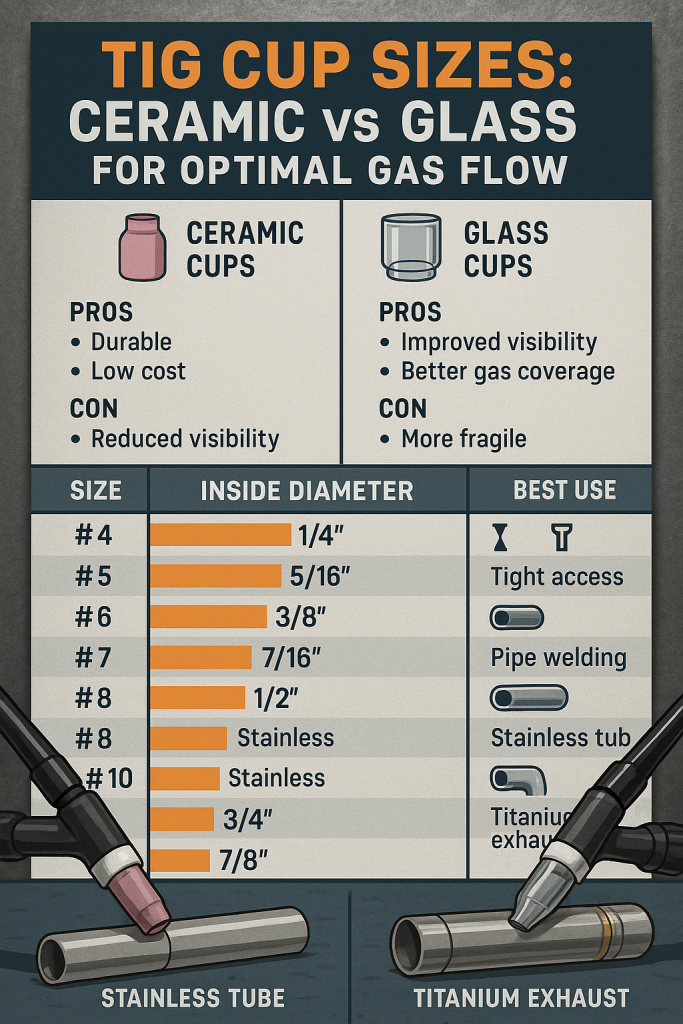
  • TIG Cup Sizes: Choose Right Ceramic or Glass for Optimal Flow

    TIG (GTAW) welding is all about precision, and one often-overlooked component that plays a huge role in weld quality is the TIG cup. Whether you’re using ceramic or glass, choosing the correct cup size directly affects shielding gas flow, arc stability, and weld bead appearance.

    This guide is designed for professional welders, welding students, and metal fabricators who want to understand how to select the best cup for their specific application, whether working with stainless steel pipe or aluminum sheet.


    Types of TIG Cups: Ceramic vs. Glass

    There are two primary types of TIG cups used today:

    1. Ceramic (Alumina) Cups

    • The most common material for TIG cups
    • Durable and resistant to heat
    • Standard for general fabrication work
    • Inexpensive and widely available

    2. Glass (Pyrex) Cups

    • Transparentโ€”great for visibility of the weld puddle
    • Popular with pipe welders and instructors for live arc teaching
    • Fragile compared to ceramic
    • Often used with gas lens setups

    Common TIG Cup Sizes and Applications

    Cup sizes range by number, which corresponds roughly to 1/16โ€ per number unit in inside diameter. Example: Size #6 = 3/8″.

    Here’s a breakdown:

    Cup SizeMaterialBest Use Cases
    #4 (1/4″)Tight access work, very low amperage weldingTight joint access, low-amp precision work, thin sheet metal (e.g., 18โ€“22 gauge stainless or aluminum)
    #5 (5/16″)Thin materials, short weld runsLow to mid-amp welds on light gauge materials, automotive panels, bike frames
    #6 (3/8″)General purpose TIG work, mild steel or aluminumGeneral fabrication on mild steel, aluminum, and stainless; good all-purpose cup for shop work
    #7 (7/16″)Better gas coverage, moderate to high ampsImproved gas coverage for slightly larger welds; good for stainless tube work, aluminum brackets
    #8 (1/2″)Stainless steel pipe, titanium, or reactive metalsPipe welding, stainless tanks, titanium tubingโ€”any application requiring extra shielding gas
    #10โ€“#12Extra gas coverage, large fillets, aerospace jobsReactive metals, large fillet welds, parts needing wider gas shield; often paired with gas lens
    #14+ (1โ€+)High-purity work, exotic metals, walk-the-cup pipe weldingReactive metals, large fillet welds, parts needing wider gas shield, often paired with gas lens

    Key Characteristics to Understand

    1. Shielding Gas Coverage

    • Larger cups distribute argon more broadly and evenly, reducing atmospheric contamination on metals such as stainless steel and titanium.
    • Smaller cups concentrate flowโ€”better for detail work, but risk poor shielding on wide welds.

    2. Gas Lens Compatibility

    • Use gas lens collet bodies with larger or glass cups to improve laminar flow.
    • Allows for extended tungsten stick-out without turbulence or contamination.

    3. Visibility & Puddle Control

    • Glass cups give you complete visibilityโ€”ideal when puddle control is critical.
    • Ceramic cups block your side view, but retain better durability.

    4. Heat Resistance & Durability

    • Ceramic: Superior for high-amp, long-run welding.
    • Glass: Requires careful handling and is susceptible to cracking.

    Process Considerations

    GTAW (TIG Welding)

    • TIG is the only process where cup selection dramatically affects weld quality.
    • High-amperage aluminum welding needs a larger cup to avoid contamination.
    • DC welding of mild steel typically works well with #6 or #7 ceramic cups.

    Welding Equipment Compatibility

    • Make sure your torch head (typically WP-17, WP-20, or WP-9) accepts your chosen cup and collet body.
    • Glass cups often require aftermarket torch kits or stubby gas lens kits.

    Application Use Cases

    Common Projects & Metals:

    • Stainless steel tubing (e.g., food-grade pipe): Use #8+ gas lens glass cup
    • Mild steel fabrication (e.g., brackets, frames): Use #6โ€“#7 ceramic
    • Aluminum TIG (e.g., auto parts): Use larger ceramic cup with high CFH
    • Titanium or exotic alloys (e.g., aerospace, motorsports): Use #12+ glass with gas lens and trailing shield

    Industries That Care About Cup Selection:

    • Aerospace & Motorsport Fabrication
    • Food and Beverage Stainless Systems
    • General Repair Shops and Field Welders
    • Welding Schools & Training Facilities

    Best Practices & Pro Tips

    • Use a gas lens for smoother flow and larger tungsten stick-outโ€”it makes a world of difference with larger cups.
    • Flow rate matters: Larger cups may require 25โ€“35 CFH; too little gas and your weld oxidizes.
    • Donโ€™t overtighten glass cupsโ€”they can shatter under torch heat expansion.
    • For thin aluminum or sheet metal, a #5 or #6 ceramic is usually all you need.
    • Instructing or filming welds? Use Pyrex to help show arc and puddle behavior clearly.

    Safety Note

    Always wear proper shade protection, especially when using glass cups, which do not block stray light like ceramic. The arc is more visible, and that includes UV exposure.


    Conclusion

    Choosing the right TIG cup size and materialโ€”ceramic or glassโ€”can significantly impact gas shielding, arc control, visibility, and ultimately, your weld quality. For general fabrication, stick with ceramic cups in the #6โ€“#8 range. For high-end or instructional work, invest in gas lens setups with glass cups.

    Take time to match your cup to your base metal, joint design, and access requirements. That simple swap could mean the difference between a clean pass and a scrapped weld.


    WeldSupportParts.com may earn a small commission if you purchase recommended welding products through affiliate links provided on this pageโ€”at no additional cost to you.

  • Understanding Flange Types in Piping Systems: A Quick Guide

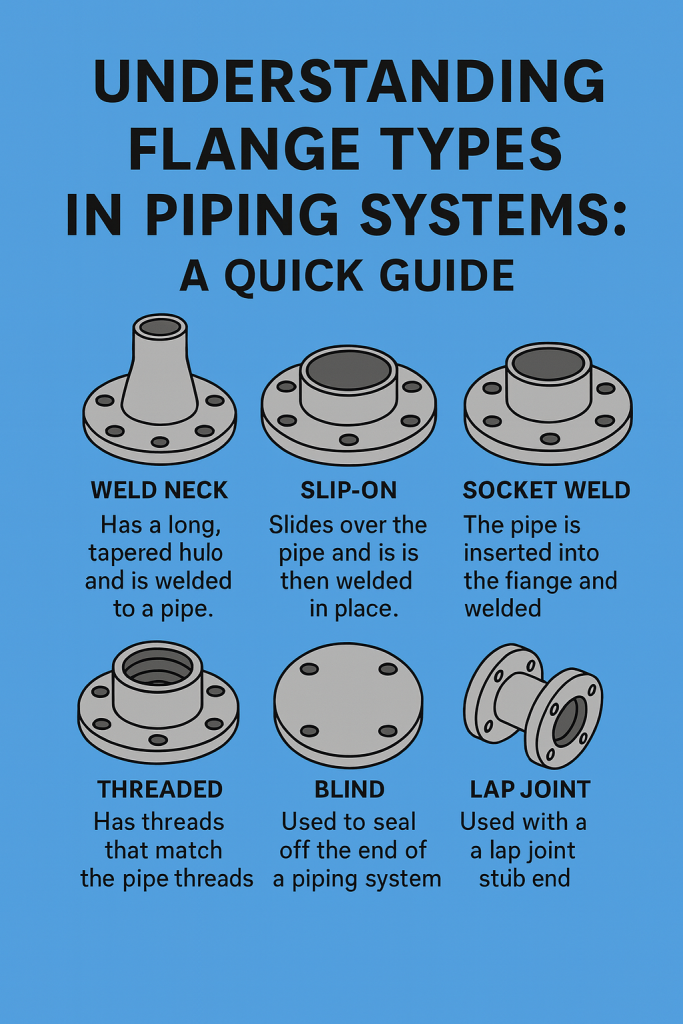
    Flanges are essential components in piping systems, used to connect pipes, valves, pumps, and other equipment. They make assembly, disassembly, and maintenance easier and safer. Depending on the applicationโ€”pressure, temperature, and alignment needsโ€”different flange types are selected. Here’s a breakdown of the most common flange types youโ€™ll encounter in industrial piping.


    1. Weld Neck Flange

    The weld neck flange features a long, tapered hub that’s welded to the pipe. This design provides excellent stress distribution and mechanical strength, especially in high-pressure and high-temperature applications. It’s the go-to option when structural integrity is criticalโ€”common in oil, gas, and power industries.

    • Use Case: Refineries, chemical plants
    • Strengths: High strength, great for critical systems
    • Drawback: Requires skilled welding and is costlier than simpler flanges

    2. Slip-On Flange

    This flange slides over the pipe and is then fillet welded around both the inside and outside to secure it in place. It’s easier to align and install than weld neck flanges but doesn’t provide the same strength.

    • Use Case: Low-pressure water lines or fire protection
    • Strengths: Easy to install, cost-effective
    • Drawback: Less durable under pressure

    3. Socket Weld Flange

    With socket weld flanges, the pipe is inserted into a recessed area of the flange and fillet welded on the outside. This flange type offers strong, leak-proof joints for smaller-diameter high-pressure piping systems.

    • Use Case: Hydraulic systems, steam lines
    • Strengths: Good strength, leak resistance
    • Drawback: Limited to smaller sizes and requires welding

    4. Threaded Flange

    Threaded flanges are screwed onto the pipe rather than welded. This makes them ideal for situations where welding isnโ€™t feasibleโ€”like explosive environments or temporary setups.

    • Use Case: Fuel lines, low-pressure systems
    • Strengths: No welding needed, easy to install
    • Drawback: Only suitable for low-pressure, non-critical applications

    5. Blind Flange

    Blind flanges are solid disks used to close off pipe ends or vessel openings. Since they don’t have a bore, they completely block the flow, making them essential for pressure testing or future pipeline extensions.

    • Use Case: Maintenance access points
    • Strengths: Strong seal, ideal for pressure testing
    • Drawback: High stress under pressure buildup

    6. Lap Joint Flange

    These are used with a stub end, and the flange itself isnโ€™t welded to the pipe. Instead, it slides over the pipe and is free to rotate, making it easy to align bolt holes. They’re ideal for frequent disassembly and limited space.

    • Use Case: Systems requiring regular maintenance or cleaning
    • Strengths: Easy to align and disassemble
    • Drawback: Less structural strength due to two-part assembly

    Other Common Flange Types

    While the six types above cover most industrial needs, there are specialty flanges designed for specific purposes.

    7. Orifice Flange

    These include taps for measuring flow via orifice plates. They are used in systems where precise flow measurement is necessary.

    8. Reducing Flange

    Used to connect pipes of different diameters without needing a separate reducer fitting. Available in weld neck, slip-on, and threaded forms.

    9. Expander Flange

    Used to increase pipe size at a connection point. Think of it as the opposite of a reducing flangeโ€”handy for expanding system capacity.

    10. Specialty Flanges

    This category includes proprietary or custom flanges made to ANSI, ASME, or DIN standards for unique or complex installations.


    Final Thoughts

    Choosing the right flange isnโ€™t just about sizeโ€”itโ€™s about pressure, temperature, ease of maintenance, cost, and long-term reliability. Weld necks and socket welds are built for strength. Slip-ons and threaded flanges are great for speed and simplicity. Blind and lap joints handle system maintenance and flexibility. Know your application and choose wisely.

    Note: This article may contain affiliate links. We may earn a commission if you purchase products through these links, at no extra cost to you.

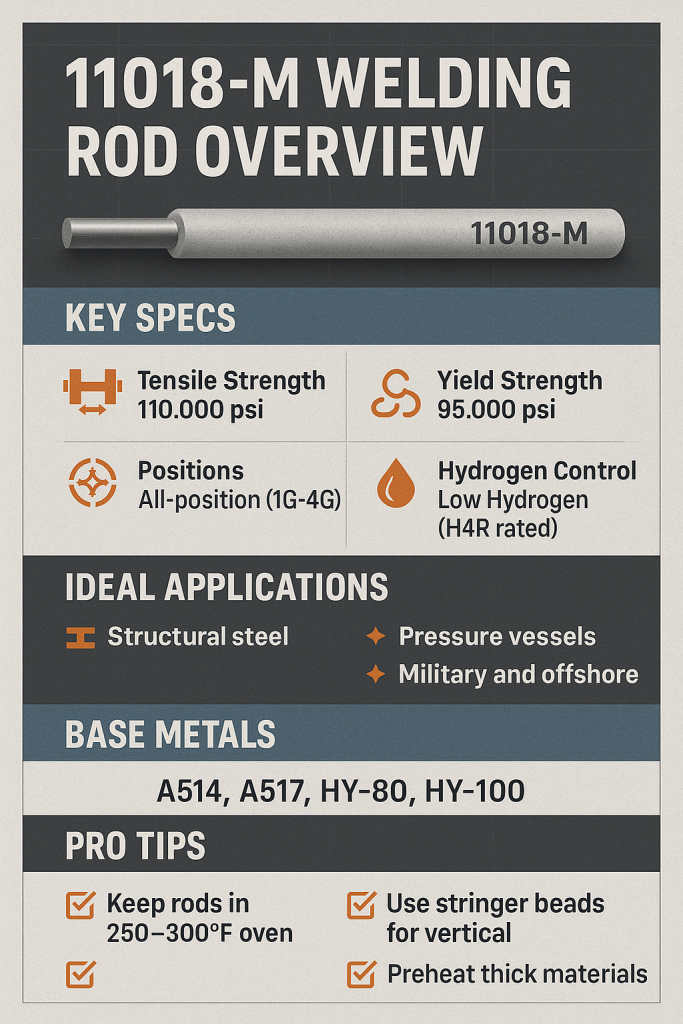
  • Title: Understanding the 11018-M Stick Welding Rod โ€“ Properties, Uses, and Best Practices


    The 11018-M stick welding rod is a low-hydrogen, iron powder-coated electrode used for shielded metal arc welding (SMAW) on high-strength, low-alloy steels. Known for producing strong welds with high impact resistance and excellent mechanical properties, this rod is essential in demanding structural, military, and pressure-vessel applications.

    11018-M electrodes are often chosen by professional welders, fabricators, engineers, and QA inspectors working on critical infrastructure, where weld performance and compliance with code standards (such as AWS D1.1 or ASME IX) are non-negotiable.

    If youโ€™re welding on quenched and tempered steels or need to meet MIL-spec or code requirements, understanding how to use 11018-M electrodes properly is a must.


    Types / Classifications / Variants

    While 11018-M is a specific classification under AWS A5.5 for low-alloy steel electrodes, it comes in several variants based on performance and application needs:

    • E11018-M โ€“ Standard version with high tensile strength (110 ksi), impact toughness, and low hydrogen content. Designed for structural use and pressure vessels.
    • E11018M H4R โ€“ Same rod but tested to retain hydrogen levels below 4 mL/100g of weld metal. “R” indicates moisture resistance.
    • E11018M-1 โ€“ Slightly different chemistry for improved notch toughness at lower temperatures (used in colder environments or offshore applications).

    Key AWS Classification Breakdown (E11018-M):

    • E = Electrode
    • 110 = Minimum tensile strength (110,000 psi)
    • 1 = All-position capable
    • 8 = Low-hydrogen, iron powder coating
    • M = Military grade / CVN impact tested

    Key Characteristics or Properties

    11018-M rods are designed to deliver high mechanical strength and excellent ductility, even in critical joints subjected to stress, vibration, or extreme temperature shifts.

    Technical Specifications:

    • Tensile Strength: 110,000 psi (minimum)
    • Yield Strength: 95,000 psi (approximate)
    • Impact Toughness: โ‰ฅ20 ft-lb at -50ยฐF (varies by spec)
    • Weld Metal Chemistry: Low carbon, alloyed with manganese and nickel
    • Coating Type: Low-hydrogen (EXX18), iron powder added for higher deposition
    • Positions: All-position (flat, horizontal, vertical up, overhead)
    • Amperage Range:
      • 1/8″ rod: 100โ€“160 amps (DCEP)
      • 5/32″ rod: 140โ€“220 amps (DCEP)

    Real-World Example:

    If you’re fabricating a crane boom from ASTM A514 steel, 11018-M is often the go-to rod due to its toughness and strength compatibility.


    Process Considerations

    Welding Process: SMAW (Shielded Metal Arc Welding)

    11018-M is SMAW-only, making it ideal for field work and hard-to-reach weldments. Itโ€™s often used where wire-fed processes are impractical.

    Equipment Compatibility:

    • Requires a DCEN/DCEP-capable stick welder (DCEP recommended).
    • Best results with a constant current (CC) power source.
    • Keep rods in a rod oven at 250โ€“300ยฐF to prevent moisture absorption (low-hydrogen properties depend on this).

    Pros:

    • High-strength weld metal
    • Good impact resistance at low temperatures
    • All-position usability

    Cons:

    • Requires preheat and postheat on some base metals
    • Not suitable for thin or low-strength steels
    • Rod storage and handling are critical

    Application Use Cases

    11018-M is designed for critical structural work that requiresย code compliance and toughness. Itโ€™s not for everyday mild steel jobsโ€”this rod shines in specialized applications.

    Typical Projects and Industries:

    • Bridge and crane fabrication
    • Pressure vessels and piping
    • Military-grade armor steel
    • Offshore platforms
    • Power plant infrastructure
    • High-strength steel repair welding

    Ideal Base Metals:

    • ASTM A514 (T1 Steel)
    • ASTM A517 (Pressure vessel steels)
    • HY-80 and HY-100 naval steels
    • MIL-spec structural alloys

    What makes this rod unique is that it maintains its strengthย while resisting crackingย under high-stress or low-temperature conditions.


    Best Practices & Pro Tips

    Proper usage is critical with 11018-M to avoid weld failures. Here are some proven tips:

    Rod Handling:

    • Store rods in a holding oven (250โ€“300ยฐF) immediately after opening.
    • Rebake if exposed to air for more than 4 hours: 650ยฐF for 1โ€“2 hours.
    • Donโ€™t skip thisโ€”moisture = hydrogen = cracks.

    Welding Technique:

    • Use short arc length and maintain steady travel speed.
    • Avoid weaving on vertical-up stringer beads are preferred.
    • The backstep technique can reduce heat buildup on thinner base metal.

    Joint Preparation:

    • Preheat high-strength steels to 300โ€“400ยฐF to prevent cracking.
    • Use post-weld heat treatment (PWHT) if required by the base metal or code.

    Safety Tip:

    • Due to higher amperage, rods get hotter. Use proper gloves and rod holders to avoid burns when removing stubs.

    Conclusion

    The 11018-M stick welding rod is a high-performance electrode engineered for critical applications involving high-strength steels. It offers welders the mechanical reliability, toughness, and code compliance needed in structural and pressure-bound environments.

    If you’re working on a job that requires CVN-tested welds, high tensile strength, or low hydrogen procedures, this rod belongs in your arsenal. Just make sure you’re handling and storing it properlyโ€”this isnโ€™t a rod you treat casually.


    Some of the links on this page may be affiliate links. If you purchase through them, we may earn a small commission at no additional cost to you. This helps support our work in providing welding guides and reviews.


    Washington Alloy 11018-M 10lbs Welding Stick Electrode (3/32โ€)
    • AWS A5.5 E11018M ASME SFA 5.5 E11018M
    • 10 LB Package – 11018-M
    • 3/32โ€œ Stick Electrode
    • Tensile strength (psi) 120,001
    • Yield strength (psi) 104,001
    Washington Alloy 11018-M 10lbs Welding Stick Electrode (1/8″)
    • AWS A5.5 E11018M ASME SFA 5.5 E11018M
    • 10 LB Package – 11018-M
    • 1/8″ Stick Electrode
    • Tensile strength (psi) 120,000
    • Yield strength (psi) 104,000
    Washington Alloy 11018-M 10lbs Welding Stick Electrode (5/32โ€œ)
    • AWS A5.5 E11018M ASME SFA 5.5 E11018M
    • 10 LB Package – 11018-M
    • 5/32โ€œ Stick Electrode
    • Tensile strength (psi) 120,002
    • Yield strength (psi) 104,002

    Last update on 2026-01-20 / Affiliate links / Images from Amazon Product Advertising API

  • Welding Electrode Holder: Choose the Best for Stick Welding

    Introduction

    When it comes to Stick Welding (SMAW), the welding electrode holder is one of the most essential tools in your setup. Often overlooked compared to machines and rods, the holder is what physically carries the electrode, and your arc stability and control depend on it.

    Whether you’re a pipeline welder, structural fabricator, or welding student, understanding electrode holders and choosing the right one can significantly affect your comfort, productivity, and weld quality. In this article, weโ€™ll break down the types, specs, and selection tips for electrode holders so you can make an informed choice for your next welding project.


    Types of Welding Electrode Holders

    Electrode holders are typically classified by design, amp rating, and insulation type. Here are the main variants:

    1. Clamp Style Electrode Holders

    • Uses a spring-loaded or twist mechanism to clamp the rod.

    • Popular Brands: Tweco, Lincoln, ESAB.

    • Best for: General-purpose SMAW, shop, and fieldwork.

    ย 2. Twist-Grip Electrode Holders

    • Electrodes are inserted and locked in with a twist.

    • Benefit: More secure grip under high amperage.

    • Downside: Slightly slower rod change time.

    • Common in: Industrial and heavy-duty applications.

    ย 3. Insulated Electrode Holders

    • Features high-dielectric, heat-resistant insulation.

    • Ideal for: Safety-critical environments like wet or cramped areas.

    • Tip: Look for thermoset vs. thermoplastic shells.

    ย 4. Open-Head Holders

    • No insulation near the headโ€”often lighter.

    • Use With Caution: Offers less protection from arc flash and heat.

    • Rarely Used: Mostly outdated or specialty use cases.


    Key Characteristics and Technical Specifications

    When selecting a welding electrode holder, match the technical specs to the demands of your job:

    ย Amperage Rating

    • 200โ€“300 Amps: Light to medium-duty applications (farm, hobbyist, light fab).

    • 400โ€“600 Amps: Heavy-duty industrial use (pipelines, shipbuilding, structural steel).

    Example: A 400A holder paired with a 1/8โ€ 7018 rod offers enough headroom for sustained overhead welds without overheating.

    ย Cable Size Compatibility

    • Match the holder to your cable gauge (e.g., 1/0, 2/0).

    • Larger cables offer less resistance and can carry more amperage safely.

    Jaw Type and Angle

    • Look for multi-angle rod positions (e.g., 45ยฐ, 90ยฐ).

    • Enhances reach and comfort in positional welding (especially vertical or overhead).

    Insulation Material

    • Thermoset (Bakelite, Phenolic): Heat and impact-resistant, doesnโ€™t melt.

    • Thermoplastic: Less durable under continuous heat but cheaper.


    Process Considerations

    How Electrode Holders Integrate With SMAW

    • Compatibility: Designed solely for SMAW; not interchangeable with TIG or MIG torches.

    • Cable Lugs: Most holders attach via screw-on or crimp-type connectorsโ€”check your setup.

    • Grounding Matters: A poor-quality holder can cause voltage drop and arc instability.

    • Glove Fit: Consider handle thickness and textureโ€”too slick or bulky can fatigue your grip.

    Pro Tip: If you frequently weld in tight spots, prioritize a holder with a smaller head and high-temperature insulation.


    Application Use Cases

    Common Welding Projects Using Electrode Holders:

    • Pipeline Welding: High-amperage, long duty cycles demand heavy-duty holders.

    • Structural Steelwork: Requires secure grip for vertical and overhead positions.

    • Repair Work in the Field: Insulated, lightweight holders reduce fatigue and increase safety.

    • Educational Settings: Durable, low-cost holders with basic clamp design are ideal.

    Material Compatibility: Electrode holders work with all SMAW-compatible filler metals (e.g., E6011, E7018), but amperage and duty cycle must match the rod’s requirements.


    Best Practices & Pro Tips

    • Always inspect for wear: Loose jaws or burned insulation can lead to dangerous failures.

    • Keep it cool: Let the holder cool between long passes to avoid internal damage.

    • Match rod angles: Choose holders that support the typical angle for your work (flat vs overhead).

    • Use anti-spatter spray: Prevent buildup on the jaws for consistent conductivity.

    • Label your amperage: Mark your holders by their rating if you use more than one in the shop.


    Safety Notes

    • Never use a damaged holderโ€”cracks in insulation can arc through gloves.

    • Donโ€™t lay the holder on grounded metalโ€”can create live connections.

    • Store vertically or hang on an insulated hook to avoid accidental shorting.


    Conclusion

    A welding electrode holder isnโ€™t just a clampโ€”it’s your direct link to the arc. Choosing the right one based on amperage rating, insulation quality, and jaw angle can dramatically improve your welding control and safety.

    If you weld regularly, investing in a high-quality holder that matches your cable and rod needs is a smart move that pays off in arc stability, comfort, and durability.


    Last update on 2026-01-20 / Affiliate links / Images from Amazon Product Advertising API

    300 AMP WELD SKILL ELECTRODE HOLDER
    • 6 Position Jaw Pattern
    • Max: 300 Amp
    • Max: 2/0 Cable
    • Max Electrode Size: 7/32″
    • 10″ Overall Lenght

    Last update on 2026-01-20 / Affiliate links / Images from Amazon Product Advertising API

    Weldmark by Lenco 300 Amp Electrode Holder
    • Accepts up to 2/0 welding cable
    • 1/4″ – max electrode size

    Last update on 2026-01-20 / Affiliate links / Images from Amazon Product Advertising API

    Last update on 2026-01-20 / Affiliate links / Images from Amazon Product Advertising API

    Last update on 2026-01-20 / Affiliate links / Images from Amazon Product Advertising API

    We may earn a small commission from affiliate links at no extra cost to you, which helps support our educational content.

  • Welding Table Setup: Modular Fixturing by Strong Hand

    Check out the Strong Hand Tools Store

    A solid welding table setup is the foundation of quality work in any metal fabrication shop. But in todayโ€™s fast-paced environments, fixed tables and ad hoc clamps donโ€™t cut it anymore, especially when youโ€™re building repeatable or complex assemblies. Thatโ€™s where modular fixturing systems, like those from Strong Hand Tools, come into play.

    Modular welding tables are engineered for flexibility, speed, and accuracy. These setups allow welders to fixture, tack, weld, and inspect parts on the same tableโ€”all while maintaining tight tolerances.

    Whoโ€™s this for?
    If youโ€™re a production welder, custom metal fabricator, robotic welding tech, or industrial engineer setting up jigs, youโ€™ll benefit from learning how modular fixturing works and why Strong Handโ€™s system is one of the most widely used in the industry.


    Types of Modular Welding Table Systems

    Strong Hand Tools offers multiple systems to fit a range of shop needs and budgets. Each variant has its own use case and is built around a precision-ground tabletop with a grid of holes and slotted surfaces for accessories.

    BuildProยฎ Welding Tables

    • Heavy-duty fabrication system
    • 5/8″ or 16 mm hole diameter (metric and imperial)
    • For custom builds, jigs, and high-precision projects
    • Compatible with over 200+ fixturing elements

    Alpha 5/8″ System

    • Premium, fully modular system with hardened tops
    • CNC-machined flatness tolerance (ยฑ0.004″)
    • Suited for aerospace, automation, and robotic welding cells

    Nomadโ„ข Tables

    • Entry-level portable table
    • Ideal for field repairs or small-shop fabricators
    • Folding legs, adjustable height, and built-in clamps
    • Not truly modular, but supports light-duty clamping

    Rhino Cartยฎ Fixturing Station

    • All-in-one mobile cart/table system
    • Includes a 36″ x 24″ tabletop and starter fixturing kit
    • Perfect for shops with space constraints or mobile setups


    Strong Hand Tools Rhino Cart (Table + 66 pc. Fixture Kit)
    • The Rhino Cart all-in-one Mobile Welding Cart puts both roomy tool storage space and a large work
    • Reversible tabletop with nitrided black oxide protective finish for wear, rust, and weld spatter resistance.
    • Steel legs are equipped with four locking casters and leveling feet for mobile or stationary use.
    • Welding Table, 48″ x 30″ , 36″ height, 5/8″ thickness, โˆ…5/8″ hole, 2″ x 2″ grid pattern, 1500 lb. static loading capacity.

    Last update on 2026-01-20 / Affiliate links / Images from Amazon Product Advertising API


    Key Characteristics & Properties

    Precision & Flatness

    • CNC-machined surfaces ensure high repeatability for complex jigs
    • Flatness tolerance is as tight as ยฑ0.004″ over the entire surface (Alpha Series)

    Modular Hole Pattern

    • Tables use grid layouts (e.g., 2″ x 2″ spacing or 50 mm metric) for plug-and-play setups
    • Compatible with V-blocks, risers, stops, clamps, and corner squares

    Load Capacity

    • BuildPro and Alpha tables support over 2,000 lbs
    • Tables are constructed with hardened steel or nitrided surfaces to resist spatter and distortion

    Materials & Coatings

    • Tabletops are made from HRPO steel or nitrided steel (Alpha) to withstand high heat
    • Optional leg leveling kits or casters provide mobility and adjustability

    Process Considerations

    SMAW / Stick Welding

    • Works best with heavy plate or pipe welding
    • Modular stops and risers help fix bulky parts

    GMAW / MIG Welding

    • Clamping and fixturing tools reduce heat distortion during tacking
    • Magnetic clamps and shielding accessories can be added for safety

    GTAW / TIG Welding

    • Requires clean, flat, non-contaminated surfaces
    • Strong Hand nitrided tables resist oxide buildup and heat transfer

    FCAW / Flux-Core Welding

    • Heavy-duty jigs and 3D fixturing arms allow out-of-position welding
    • Ideal for structural or tubular setups in modular frame builds

    Tip: Always ground your welding lead to the table using the dedicated ground slots or pads for clean arc initiation.


    Application Use Cases

    Fabrication Shops

    • Frame welding, brackets, gates, and repeatable weldments
    • Reduce downtime between builds with reusable jigs

    Robotic Welding Cells

    • Alpha 5/8″ system integrates easily with robot bases or rails
    • High accuracy allows robots to follow pre-programmed weld paths

    Schools & Training Labs

    • Rhino Cart or Nomad tables are budget-friendly but still teach fixturing fundamentals

    Aerospace, Automotive, Structural

    • Table risers, V-blocks, and toggle clamps support precision weldment setups
    • Common in fixture-based production, such as chassis or pipe assembly

    Best Practices & Pro Tips

    • Mark your jigs for repeatabilityโ€”use the table’s grid numbering system
    • Pre-fit your parts dry before welding to confirm alignment and clearance
    • Use spring-loaded clamps for fast setups without tool marks
    • Clean the tabletop regularly with a stainless brushโ€”no grinding wheels
    • Store your modular tools in labeled bins or magnetic boards to save time

    Pro Setup: Use angle squares and stop blocks to quickly align corners at 90ยฐ, 45ยฐ, or custom angles without measuring.


    Conclusion

    Strong Handโ€™s modular welding table systems are more than just flat surfacesโ€”they’re productivity machines. Whether youโ€™re running a full-blown fab shop or just starting out, having a modular fixturing setup means tighter tolerances, fewer mistakes, and faster builds.

    Bottom line? If you weld for production or precision, a modular fixturing system like BuildPro or Alpha should be on your shortlist. They make setup smarter, not harder.

    Check out the Strong Hand Tools Store


    Affiliate Disclosure

    Some of the links in this article may be affiliate links, which means we may earn a commission if you purchase through themโ€”at no extra cost to you. Your support helps us continue providing quality welding education.

  • Weathering Steel Electrodes: USA 8018W Explained

    Your go-to guide for welding atmospheric corrosion-resistant steel


    Introduction

    Weathering steel electrodes, especially USA 8018W, are critical tools in structural welding where durability meets the harsh elements. Designed to weld weathering steels like ASTM A588 and A242, these electrodes offer unique properties tailored for outdoor, high-strength applications that require minimal maintenance over decades.

    Whether youโ€™re a structural welder, bridge fabricator, or working in heavy equipment repair, understanding the function and behavior of the 8018W classification can mean the difference between a weld that lasts and one that fails in the field.


    Types and Classifications

    The 8018W designation follows the AWS A5.5 classification for low-hydrogen, iron powder-coated electrodes suited for Shielded Metal Arc Welding (SMAW) of weathering steels.

    Hereโ€™s how it breaks down:

    • โ€œ80โ€ = Minimum tensile strength of 80,000 psi
    • โ€œ1โ€ = All-position usability
    • โ€œ8โ€ = Low-hydrogen coating, iron powder added
    • โ€œWโ€ = Specifically alloyed for weathering steel compatibility

    Related Electrode Variants:

    • E7018 โ€“ General-purpose low-hydrogen rod, not ideal for weathering steel due to mismatched corrosion resistance.
    • E8018-C1/Ni1 โ€“ Low alloy electrodes with better notch toughness at low temperatures, but lacking in atmospheric corrosion compatibility.
    • E8018-W2 โ€“ A less common variant with slightly different alloying for specific weathering grades.

    Use 8018W when matching weathering steel base metals is essential to prevent premature rusting at the weld zone.


    Key Characteristics and Properties

    8018W electrodes are engineered with a blend of nickel, copper, and chromium, matching the alloying elements in weathering steels. These additions promote a stable oxide layerโ€”the patinaโ€”that protects the weld from further corrosion.

    Technical Specs:

    PropertyValue / Description
    Tensile Strengthโ‰ฅ 80,000 psi (550 MPa)
    Yield StrengthTypically โ‰ฅ 67,000 psi (460 MPa)
    Elongationโ‰ฅ 22% in 2 inches
    Impact Toughness (avg)โ‰ฅ 20 ft-lbs @ -20ยฐF (-29ยฐC)
    Coating TypeLow-hydrogen, iron powder
    Typical Alloy AdditionsCu, Ni, Cr
    Storage Requirement<4% moisture, keep in rod oven at 250ยฐF+

    ๐Ÿ’ก Real-World Insight:
    When left unpainted in bridges or sculptures, the weld must weather at the same rate as the surrounding metal. If a standard rod is used, youโ€™ll see rust bleed or cracking at the joint after a few freeze/thaw cycles.


    Process Considerations

    USA 8018W is used exclusively in SMAW (Stick) welding and performs well across all positions, including vertical and overhead.

    Process Notes:

    • Polarity: DCEP (Direct Current Electrode Positive)
    • Amperage Range: ~90โ€“150 A (3/32″ to 1/8″ diameter)
    • Preheat & Interpass: 100โ€“200ยฐF depending on base metal thickness
    • Rod Oven Use: Mandatory โ€“ keep at 250ยฐF to avoid moisture-induced cracking (hydrogen embrittlement)

    Equipment Compatibility:

    • Compatible with any SMAW-capable machine (inverter or transformer)
    • Good arc stability and puddle control, even on aged, weathered base material
    • Can be used with basic clamps and leads; no special feeder systems needed

    Challenges:

    • Storage sensitivity: Moisture pickup leads to serious weld defects
    • Slag coverage: Heavy slag, can mask undercut or porosity if not properly cleaned between passes
    • Arc strikes: Can cause localized corrosion if not properly grounded out

    Application Use Cases

    8018W electrodes are purpose-built for use on structural weathering steel, where long-term atmospheric resistance is a must without the use of paint or coating.

    Industries & Projects:

    • Bridges & overpasses (e.g., Corten steel bridges)
    • Architectural facades with exposed steel elements
    • Railcars and shipping containers
    • Transmission towers
    • Outdoor sculptures and public installations

    Why itโ€™s ideal:

    • Weld metal forms a matching patina with the base metal
    • High mechanical strength for structural loads
    • Resists cracking and hydrogen-induced failure
    • Eliminates the need for painting or regular maintenance

    Best Practices & Pro Tips

    Practical Tips for Welders:

    • Rod Storage: Keep in a 250ยฐF rod oven. Donโ€™t trust rods left out overnight in humid shops.
    • Joint Design: Use backing bars or preheats for thick sections to prevent root cracking.
    • Slag Removal: Use a chipping hammer or needle scaler between passesโ€”slag is tough and can trap inclusions.
    • Arc Strikes: Always grind out stray strikes. Weathering steel will corrode unevenly around them.
    • Weld Appearance: Donโ€™t chase perfect beadsโ€”focus on soundness and coverage, especially on multi-pass welds.

    Pro Insight:
    If youโ€™re welding a Corten beam on a high-visibility project (like sculpture or facade), your 8018W welds will age with the metal and virtually disappear after a few seasons. Just donโ€™t expect that if you use a 7018.


    Conclusion

    USA 8018W electrodes are a specialized but essential choice for welding weathering steel structures. Their ability to match the corrosion resistance and aesthetic of the base metal makes them irreplaceable in applications where appearance and durability both matter.

    If youโ€™re welding outdoors on structural steel thatโ€™s designed to rust intentionally, donโ€™t wing it with a standard rod. Stick with 8018W. It’s the right tool for the job, and your welds will last as long as the steel they’re holding together.

    Washington Alloy 8018-W 10lbs Welding Stick Electrode (1/8″)
    • ANSI/AWS A5.5 E8018- W2 ASME SFA 5.5 E8018- W2
    • 10 LB Package – 8018-W
    • 1/8″ Stick Electrode
    • Tensile Strength (psi) 80,000
    • Yield Strength (psi) 67-80,000

    Last update on 2026-01-20 / Affiliate links / Images from Amazon Product Advertising API

    Note: Some links on this page may be affiliate links. If you click and make a purchase, we may earn a commission at no extra cost to you. We only recommend products we trust and use in the field.

  • Welding Galvanized: Safe Fume Control Tactics

    Introduction

    Welding galvanized steel presents a unique challenge: toxic fumes. The galvanizing process coats steel with a layer of zinc, which vaporizes when exposed to welding temperatures, releasing hazardous zinc oxide gas. Left uncontrolled, these fumes can lead to serious short- and long-term health effects, including metal fume fever and chronic respiratory issues.

    Understanding safe fume control tactics isnโ€™t just about complianceโ€”itโ€™s about protecting your lungs, your team, and the quality of your welds. Whether you’re a structural welder, pipefitter, fabrication shop operator, or welding student, mastering this topic is crucial when working with zinc-coated metals.


    Galvanized Steel and Fume Hazards: What Are You Dealing With?

    Galvanized steel is carbon steel thatโ€™s been hot-dip coated in zinc to resist corrosion. While excellent for long-term durability in outdoor and moist environments, that zinc layer becomes dangerous when melted.

    Zinc fume hazards include:

    • Zinc Oxide (ZnO): Formed when zinc vapor cools in air.
    • Metal Fume Fever: Flu-like symptoms that appear within hours of exposure.
    • Chronic Exposure Risks: Repeated inhalation can cause long-term lung damage and weaken immune function.

    Additional risk factors:

    • Galvanized coatings can include lead, cadmium, or hexavalent chromium, especially in older infrastructure or imported steel.

    Fume Control Tactics: Types & Classifications

    Controlling zinc oxide fumes isnโ€™t a one-size-fits-all fix. Multiple strategies should be combined for safe welding on galvanized materials. Here are the primary categories:

    1. Ventilation Systems

    • Local Exhaust Ventilation (LEV):
      • Fume hoods, extractor arms, or downdraft tables.
      • Ideal for shop environments.
      • Captures fumes at the source before they spread.
    • General Shop Ventilation:
      • Large-scale air movement and filtration.
      • Supports LEV but isnโ€™t effective on its own.

    2. Personal Protective Equipment (PPE)

    • Powered Air-Purifying Respirators (PAPRs):
      • Offer higher protection than disposable masks.
      • Positive airflow prevents fume ingress.
      • Find PAPR Helmets Here
    • Half/Full-Face Respirators:
      • Use P100 or equivalent filters.
      • Must be properly fitted and regularly maintained.
    Miller LPR-100 Gen. II Half Mask Respirator, Nuisance OV Relief M/L – Welding Respirator Mask with Filters – P100 Respirator Mask for Filtrating Particulates & Aerosols – Respirator Under Helmet
    • Enhanced Protection with Nuisance OV Relief Filters: The Miller LPR-100 Gen. II Half Mask Respirator, Nuisance OV Relief M/L includes an added carbon layer feature to reduce nuisance-level organic vapor odors; Our respirator mask with filters helps ensure clean, breathable air for welders working in fume-intensive environments
    • Up to 99.97% Filtration: Upgrade your welding gear with our respirator mask; Strongly resistant to oil, the filters of our respirators help provide reliable filtration of airborne particles, including solid dust, metal fumes and mists
    • Compact Low-Profile Design for Welding Helmets: The slim design of our welding respirator under helmet offers a wide field of vision and fits easily under most welding helmets; Our respirator is designed to help provide full compatibility with your protective eyewear and headgear
    • Ergonomic Half-Mask Respirator for Extended Comfort: Crafted for long welding shifts, our half face respirator features minimal dead air space to reduce heat buildup; It also comes with a large non-return exhaust valve to help minimize user fatigue during high-demand tasks
    • Durable, Medical-Grade Materials: Made with latex- and silicone-free materials, this half mask face respirator is odor-free, hypoallergenic; It is also built to withstand demanding welding environments while providing user comfort and safety

    Last update on 2026-01-20 / Affiliate links / Images from Amazon Product Advertising API

    Miller LPR-100 Gen. II Half Mask Respirator, Nuisance OV Relief S/M – Welding Respirator Mask with Filters – P100 Respirator Mask for Filtrating Particulates & Aerosols – Respirator Under Helmet
    • Enhanced Protection with Nuisance OV Relief Filters: The Miller LPR-100 Gen. II Half Mask Respirator, Nuisance OV Relief S/M includes an added carbon layer feature to reduce nuisance-level organic vapor odors; Our respirator mask with filters helps ensure clean, breathable air for welders working in fume-intensive environments
    • Up to 99.97% Filtration: Upgrade your welding gear with our respirator mask; Strongly resistant to oil, the filters of our respirators help provide reliable filtration of airborne particles, including solid dust, metal fumes and mists
    • Compact Low-Profile Design for Welding Helmets: The slim design of our welding respirator under helmet offers a wide field of vision and fits easily under most welding helmets; Our respirator is designed to help provide full compatibility with your protective eyewear and headgear
    • Ergonomic Half-Mask Respirator for Extended Comfort: Crafted for long welding shifts, our half face respirator features minimal dead air space to reduce heat buildup; It also comes with a large non-return exhaust valve to help minimize user fatigue during high-demand tasks
    • Durable, Medical-Grade Materials: Made with latex- and silicone-free materials, this half mask face respirator is odor-free, hypoallergenic; It is also built to withstand demanding welding environments while providing user comfort and safety

    Last update on 2026-01-20 / Affiliate links / Images from Amazon Product Advertising API

    3. Coating Removal Techniques

    • Mechanical Removal (grinding or sanding):
      • Eliminates zinc coating at the joint area.
      • Reduces fume production but adds prep time.
    • Chemical Stripping:
      • Effective, but may introduce other hazards.
      • Requires strict disposal and PPE practices.

    4. Welding Process Modifications

    • Low-heat welding processes
      • Reduce the vaporization of zinc.
      • Can include pulsed GMAW or GTAW with tight control.

    Key Characteristics and Safety Specs

    Letโ€™s break down why fume control is a non-negotiable when working with galvanized:

    FactorDetails
    Zinc Vaporization Point~ 1650ยฐF (899ยฐC) โ€” much lower than steelโ€™s melting point
    Toxicity Threshold (ZnO)5 mg/mยณ TWA (OSHA limit) โ€” easily exceeded without ventilation
    Fume Production RateIncreases with amperage, travel speed, and preheat
    Affected ProcessesAll fusion welding processes can produce zinc fumes

    Example Scenario:
    A welder using FCAW at 250 amps on a 3/8″ galvanized plate without ventilation can easily exceed safe fume thresholds within minutes. That same weld with LEV and a PAPR drastically reduces the inhaled fume load.


    Process Considerations for Welding Galvanized

    SMAW (Stick Welding):

    • Pros: Portable, doesnโ€™t require shielding gas.
    • Cons: Produces heavy fumes; not ideal without strong ventilation.
    • Tips: Use low-hydrogen electrodes (E7018), clean the joint first, and use a fan or LEV.

    GMAW (MIG):

    • Pros: Cleaner arc, better control with spray or pulsed transfer.
    • Cons: Higher heat input can vaporize more zinc.
    • Tips: Use short-circuit mode or pulsed spray with adequate fume extraction.

    GTAW (TIG):

    • Pros: Precise, low-fume process.
    • Cons: Slower, more prep needed; zinc still poses risks near the arc.
    • Tips: Remove coating at the weld zone, ensure good airflow.

    FCAW:

    • Pros: Great for thick steel and structural work.
    • Cons: Very smokyโ€”generates significant fumes.
    • Tips: Use self-shielded wire with LEV and respirator.

    Common Applications for Galvanized Welding

    Welding galvanized materials is common in industries where corrosion resistance is critical:

    • Construction: Fencing, walkways, structural beams, brackets.
    • Agriculture: Livestock enclosures, irrigation systems.
    • HVAC and Plumbing: Ducting, pipe systems.
    • Automotive and Trailers: Frames, chassis, suspension components.

    Why use it? Zinc prevents rust, extending metal lifespan in outdoor or moist environments, making galvanized a smart choice for long-term infrastructure. But only when fumes are properly managed.


    Best Practices & Pro Tips from the Field

    1. Remove Zinc from Weld Zone Whenever Possible
      • Grind or sand at least 1-2 inches beyond joint lines.
      • Use flap discs for controlled removal without deep gouging.
    2. Always Ventilate at the Arc
      • Keep extractor hoods within 6โ€“10 inches of the arc.
      • Donโ€™t rely solely on room fansโ€”they just push fumes around.
    3. Use Respirators Every Time
      • Even outdoors, a breeze canโ€™t compete with zinc vapor.
      • P100 filters or PAPRs should be standard when welding galvanized.
    4. Mind Your Heat Input
      • Lower amps reduce zinc vaporization.
      • Stitch weld instead of full beads to reduce fume output.
    5. Watch for Metal Fume Fever Symptoms
      • Fatigue, chills, cough, or nausea after welding could indicate overexposure.
      • Rest, hydrate, and seek medical attention if symptoms persist.
    6. Post-Weld Cleaning Helps Too
      • Remove burned zinc residues to prevent toxic smoke during rework or painting.

    Conclusion

    Welding galvanized steel demands more than skillโ€”it requires awareness, preparation, and the right gear. Fume control isnโ€™t optional. Itโ€™s a safety-critical component of every galvanized job. Whether you’re laying beads on a ranch gate or structural bracing in a warehouse, make sure youโ€™re not trading your health for corrosion resistance.

    Key takeaway: If you smell it, you’re breathing it. Use ventilation, PPE, and coating removal techniques in conjunction to stay safe while welding galvanized materials.

  • Decoding Weld Symbols: A Quick Guide to Common Types and Their Meanings

    Weld symbols are the universal language of welding blueprints, and if you’re in the welding trade or fabricating anything structural, knowing how to read them is essential. Whether you’re welding on a shop floor, out in the field, or designing something in CAD, understanding these symbols can save time, eliminate guesswork, and prevent costly mistakes.

    In this guide, we break down the most common weld types and symbols, as illustrated in the image above. We’ll keep it simple and practical so you can identify the weld type, understand its application, and recognize the symbol used on technical drawings.


    1. Fillet Weld

    • Visual: Triangular weld filling the corner of two perpendicular pieces.
    • Symbol: A simple triangle on the reference line.
    • Use: Common in T-joints, lap joints, and corner joints. Found everywhere from structural steel to trailers.

    2. Double Fillet Weld

    • Visual: Fillet welds on both sides of a joint.
    • Symbol: Two triangles, one on each side of the reference line.
    • Use: Used when strength is needed from both sides โ€” think brackets, frames, and reinforced joints.

    3. All-Around Weld

    • Visual: Fillet or groove that wraps completely around a joint.
    • Symbol: A small circle at the junction of the arrow and reference line.
    • Use: Critical for pipe joints or tube frames that require full reinforcement around the entire circumference.

    4. Site Weld

    • Visual: Indicates that the weld is to be done on-site, not in a shop.
    • Symbol: A small flag at the intersection of the arrow and reference line.
    • Use: Helpful for projects where transport, fit-up, or environmental conditions require field welding.

    Groove Welds (Butt Joints)

    These welds are typically used for plates or structural members joined edge to edge.


    5. Full Penetration Single V Butt Weld

    • Visual: One side is beveled like a “V”.
    • Symbol: V symbol with filled root.
    • Use: High-strength welds in thicker material. Ensures complete fusion from top to bottom.

    6. Full Penetration Double V Butt Weld

    • Visual: Both sides are beveled, forming a double-V.
    • Symbol: Two V symbols with filled roots.
    • Use: Preferred for thicker materials where welding from both sides is possible. Reduces distortion.

    7. Full Penetration Double Bevel Butt Weld

    • Visual: Similar to double V but with straight bevels instead of angled.
    • Symbol: Two straight bevel lines.
    • Use: Often used when machining bevels is easier or more practical than creating a V groove.

    Partial Penetration Groove Welds

    Not every job needs full penetration. These partial welds are quicker and cheaper โ€” good for when full strength isnโ€™t necessary.


    8. Partial Penetration Y Weld

    • Visual: One side beveled with limited depth penetration.
    • Symbol: A Y shape.
    • Use: Used in structural work where appearance or load isnโ€™t critical, but strength still matters.

    9. Partial Penetration Half Y Weld

    • Visual: Shallower version of the Y weld.
    • Symbol: Shorter Y symbol.
    • Use: Used in sheet metal or light structural connections where minimal penetration is enough.

    10. Partial Penetration Square Butt Weld

    • Visual: No groove prep; just welded at the seam.
    • Symbol: Straight line with hatching.
    • Use: Thin plates or fast welds where penetration isnโ€™t a concern. Not ideal for high-stress areas.

    11. Full Penetration Square Butt Weld

    • Visual: Clean edge-to-edge joint with full fusion.
    • Symbol: Straight line, no bevel or V.
    • Use: Often used in automation, where edge prep and full pen are possible without beveling.

    Why These Symbols Matter

    Each of these weld symbols tells the welder or fabricator exactly:

    • What type of weld to use
    • Where to place it
    • How it should look (profile, size, and extent)

    Misreading or ignoring these symbols can lead to structural failures, inspection failures, or rework that kills a project timeline and budget.


    Quick Tips for Interpreting Weld Symbols

    • The arrow side of the joint is always the reference point.
    • Symbols below the line apply to the arrow side.
    • Symbols above the line apply to the opposite side.
    • A filled-in symbol usually means full penetration or completed weld.
    • Additional flags, circles, or notes modify the requirement (e.g., all-around, field weld).

    Final Thoughts

    Understanding weld symbols is more than just a box you check for certification โ€” itโ€™s part of what makes you a professional in this trade. Whether you’re running beads in the shop or bidding on a structural contract, knowing the difference between a Y weld and a full-pen V groove is critical.

    Print this chart, study the symbols, and keep it nearby. You’ll move faster on blueprints, communicate better with inspectors, and avoid those “I thought you meant…” moments.

    Affiliate Disclosure: This post may contain affiliate links. We may earn a commission from qualifying purchases โ€” at no cost to you โ€” which helps support the blog and content creation.

  • E70S-6 MIG Welding Wire: A Complete Technical Guide for Welders

    Purchase 70S-6 Mig WIre

    When it comes to MIG welding mild steel, E70S-6 welding wire is a go-to filler metal used across industriesโ€”from structural steelwork to automotive fabrication. Itโ€™s known for its excellent arc stability, high deposition rate, and strong mechanical properties.

    Whether you’re a welder, fabricator, or welding engineer, understanding E70S-6 is critical for making informed decisions about joint strength, weld quality, and process efficiency. In this guide, we break down everything you need to know about this essential wire type.


    Types, Classifications, and Variants

    E70S-6 is part of the AWS A5.18 classification system for solid carbon steel electrodes and rods used in gas metal arc welding (GMAW). Here’s what the designation means:

    • E โ€“ Electrode
    • 70 โ€“ Minimum tensile strength of 70,000 psi
    • S โ€“ Solid wire
    • 6 โ€“ Indicates the wireโ€™s chemical composition and performance characteristics

    Comparison with Other Carbon Steel MIG Wires:

    • E70S-3
      • Lower deoxidizer content
      • Less tolerant of mill scale or rust
      • Cleaner base metals are required
    • E70S-6
      • Higher levels of silicon and manganese
      • Designed for welding over mill scale, light rust, or surface contamination
      • More fluid weld puddle for flatter beads
    • E70C-6M (metal-cored)
      • Similar chemical composition to E70S-6
      • Offers higher deposition rates
      • Requires more expensive equipment and optimized parameters

    Key Characteristics & Properties

    E70S-6 wire stands out for its versatility and weld quality on less-than-perfect base metals. Letโ€™s take a closer look at its technical properties:

    • Tensile Strength: 70,000 psi (minimum)
    • Yield Strength: ~58,000 psi
    • Elongation: ~22% in 2 inches
    • Recommended Shielding Gas:
      • 75/25 Argon/COโ‚‚ for cleaner, more controlled arcs
      • 100% COโ‚‚ for deeper penetration and cost-effectiveness
    • Silicon Content: 0.80โ€“1.15%
    • Manganese Content: 1.40โ€“1.85%
    • Diameter Availability: .023″, .030″, .035″, .045″, and larger for industrial applications

    Real-World Example:
    If you’re welding mild steel tubing for handrails or machinery guards with surface mill scale, E70S-6 will give you a smooth, low-spatter weld bead that requires minimal cleanup.


    Process Considerations

    Compatibility with Welding Processes

    • โœ… GMAW (MIG Welding) โ€“ Primary application
    • โŒ Not suitable for FCAW, GTAW, or SMAW

    Equipment Notes:

    • Compatible with both transformer and inverter-based MIG machines
    • Works well in spray, short-circuit, and globular transfer modes
    • Ideal for semi-automatic or robotic applications

    Pros:

    • High feedability in wire feeders
    • Excellent bead appearance
    • Tolerant to minor surface contaminants

    Cons:

    • Not designed for high-alloy or exotic metals
    • Less effective on dirty or heavily rusted steel than flux-core options
    • Needs shielding gasโ€”canโ€™t be used outdoors without wind protection

    Application Use Cases

    E70S-6 is a workhorse wire used in general fabrication and manufacturing:

    Common Industries:

    • Structural steel erection
    • Heavy equipment repair
    • Shipbuilding
    • Automotive and trailer frame welding
    • Agricultural implement manufacturing

    Compatible Metals:

    • A36 mild steel
    • Hot-rolled steel
    • Low-carbon structural plates and tubing

    Ideal Conditions:

    • When high productivity, flat bead profiles, and minimal post-weld cleanup are important
    • When working with slightly rusty or mill-scaled materials

    Best Practices & Pro Tips

    Hereโ€™s what experienced welders need to keep in mind:

    • Use the Right Gas Mix:
      75/25 Argon/COโ‚‚ delivers cleaner welds; 100% COโ‚‚ increases penetration but increases spatter.
    • Clean Just Enough:
      Though E70S-6 handles light contamination, donโ€™t push itโ€”heavy rust or paint can still cause porosity.
    • Dial in the Voltage and Wire Speed:
      Start with manufacturer specs and fine-tune based on sound and bead shape. A smooth “buzz” sound = optimal settings.
    • Avoid Excess Heat Input:
      Especially when welding thinner material. Use pulsed MIG or short-circuit transfer to avoid burn-through.
    • Watch for Silicon Islands:
      After welding, shiny silicon deposits may form in the weld toe area. These should be ground off before painting or coating.
    • Store Wire Properly:
      E70S-6 is prone to rust if stored in humid conditions. Keep it in sealed containers or use wire feeders with covers.

    Conclusion

    E70S-6 MIG welding wire is the top choice for fabricators and welders dealing with carbon steels that aren’t in pristine condition. Its chemical makeup allows for smooth arcs, flat welds, and strong joints even when base metals have minor mill scale or rust.

    If youโ€™re looking to balance performance, affordability, and ease of use, this wire is probably the right fit for most carbon steel welding jobs.

    Purchase E70S-6 Mig Wire


    Note: Some links on this page may be affiliate links. If you click and purchase, we may earn a commission at no extra cost to you. We only recommend products we use and trust.

Watch with Prime Video