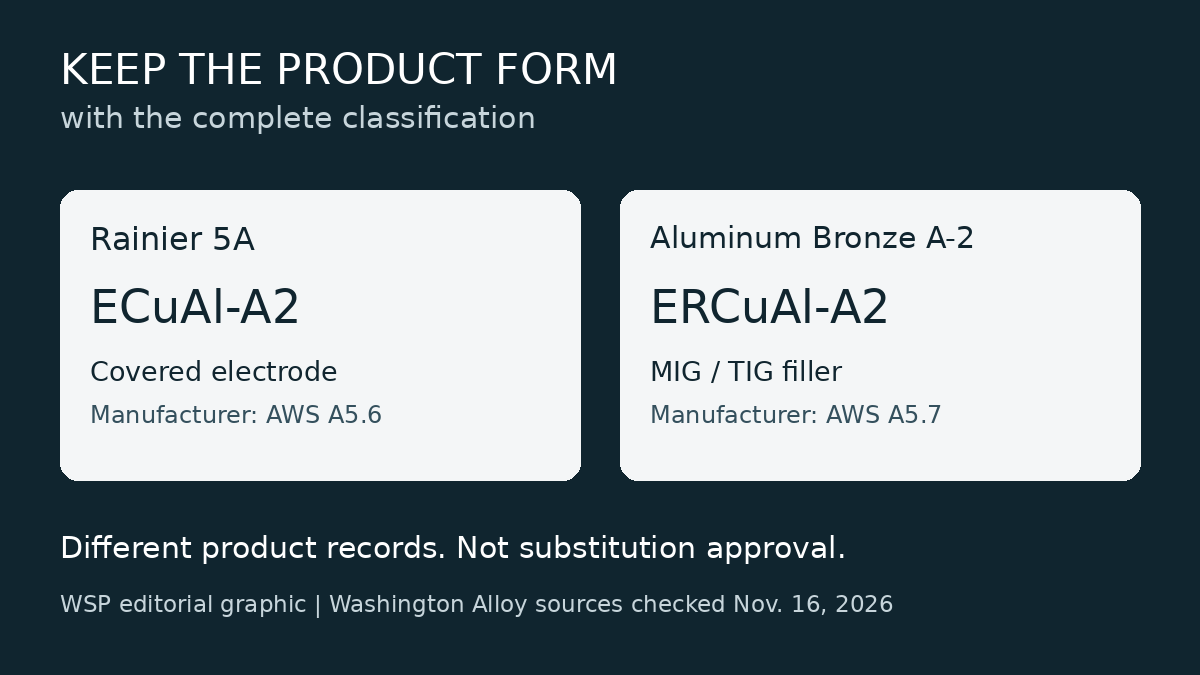
If the purchase request calls for Washington Alloy Rainier 5A, keep ECuAl-A2 covered electrode on the order. Do not shorten it to “aluminum bronze A2 rod.” Washington Alloy identifies Rainier 5A as a flux-coated electrode under AWS A5.6. Its separate Aluminum Bronze A-2 product is MIG/TIG filler under AWS A5.7, classification ERCuAl-A2. The similar names do not establish an interchangeable product or process.
This guide addresses purchasing identity and paperwork, not whether either consumable is approved for a particular repair. It provides no welding settings, procedure qualification, or base-metal compatibility approval.
Separate the two product records
The manufacturer’s Rainier 5A page supplies the covered-electrode identity: Rainier 5A, ECuAl-A2, AWS A5.6. The separate Aluminum Bronze A-2 page supplies the MIG/TIG identity: ERCuAl-A2, AWS A5.7. These are two records to keep separate when requesting a quote, comparing a supplier response, or checking a delivery.
For an already approved Rainier 5A requirement, an offer described only as ERCuAl-A2 wire needs clarification before acceptance. Conversely, a covered-electrode offer does not fulfill a bare-wire or TIG-rod request merely because “A2” appears in both names. Ask the seller to identify the exact offered product rather than correcting the listing by assumption.
Build a quote request that leaves fewer gaps
A useful purchasing request distinguishes what the job already requires from what the seller still needs to confirm. The following is an order-review template, not a recommendation of an unverified diameter or package:
- Manufacturer and trade name: Washington Alloy Rainier 5A, when that exact product is the approved requirement.
- Classification and form: ECuAl-A2 covered electrode; retain the full designation rather than only “bronze rod.”
- Diameter and length: enter the dimensions from the approved purchasing requirement; have the seller confirm the offered dimensions.
- Selling unit: ask for the net contents of each package and the number of packages quoted. Do not equate a carton, a package, and an individual electrode.
- Supplier item number: request the exact code associated with those dimensions and that package, not a generic family code.
- Documentation: state whether the order requires lot-specific certification, a current product data sheet, an SDS, or additional contract documents.
Leave an unresolved field visibly unconfirmed. A quote can be useful while still incomplete; an unknown package size should not quietly become an assumed one. No seller SKU, available inventory, price, or package size has been verified for this article.
Typical certificates are not the delivered lot record
Washington Alloy’s Product Certifications page distinguishes its typical certificate downloads from an actual-certificate search. The actual search asks for a heat number and diameter. It also lists Rainier 5A and Aluminum Bronze-A2 separately among the typical documents.
When lot documentation is required, ask the supplier how the package marking will connect to the certificate supplied with the order. Check that the diameter entered or recorded is the one delivered. A general product document can help identify a family, but it should not be represented as the test record for an unidentified package. No actual heat certificate was retrieved for this guide.
Keep the receiving record practical: photograph or transcribe the package identification for your own records, retain the supplier’s item description, and associate any supplied certificate with that delivery. If the label and paperwork disagree, send the discrepancy back for resolution rather than editing one to match the other.
Use the WSP pages for navigation, not substitution approval
The WSP Alloy Support library helps locate a classification family. The Filler Metal Finder helps organize the selection questions. For this form, use the ECuAl-A2 stick-electrode reference rather than a MIG or TIG page.
That WSP reference currently presents a broad AWS-family heading and says its brand paths are not verified SKU lists. It also keeps the Amazon fallback held pending exact form, package, and marketplace review. Use the exact manufacturer product document for Rainier 5A’s classification; a directory heading or search route is not a second product certification or an in-stock buying offer.
Where this check ends
This purchasing check ends with an accurately identified product and an explicit list of missing order details. It does not select the filler for an unknown alloy, approve a substitution, or establish that a repair is suitable for service. The applicable approved procedure, customer requirements, and qualified technical review remain separate from the ordering task.
The simplest receiving question is: does the delivered product match the complete approved order, including form and documentation, rather than just the words “aluminum bronze”? Resolving that question before releasing the material is the useful purpose of this checklist.
Sources checked November 16, 2026. Manufacturer webpages establish the product identities described above; no current commercial offer, inventory, actual heat certificate, or weld qualification was established.
Leave a Reply