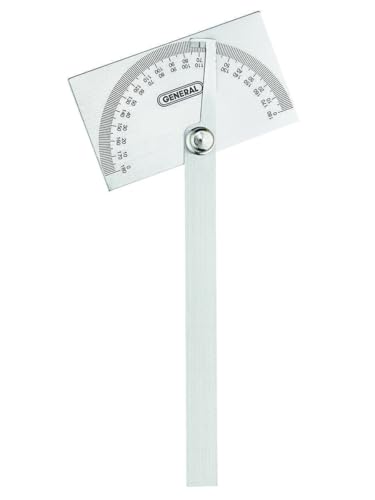
The General Tools 17 square-head protractor is worth considering when the job is to measure or transfer an angle between two accessible surfaces. Before buying, check whether its square head can sit against your reference edge and its six-inch arm can reach the other surface. Those physical contact points matter more than a product photo that simply shows a familiar semicircular scale.
This guide covers the single Square Head / Angle Finder option, Amazon ASIN B00004T7TB. The current General Tools product page links directly to that ASIN. It does not cover the bundled carbide scriber option, a digital angle finder, or a different head style.
As an Amazon Associate I earn from qualifying purchases.

Last update on 2026-11-09 / Affiliate links / Images from Amazon Product Advertising API
What the manufacturer actually specifies
General Tools describes a stainless-steel protractor with a six-inch adjustable arm, a 3-3/8 by 2-inch head, and a 0 to 180-degree scale marked in forward and reverse directions. A knurled thumb nut locks the arm. Its stated purposes include setting bevels, measuring angles and transferring angles. These are the useful specifications to compare with the work, rather than treating the tool as a universal measuring instrument.
The manufacturer does not supply a numeric accuracy tolerance on the product page reviewed for this guide. We therefore do not assign it an accuracy rating or claim that it satisfies a particular inspection requirement. Readable graduations, repeatable contact and an inspection system appropriate to the drawing are separate considerations.
Check the two contact surfaces first
Picture the actual measurement before ordering. One surface must provide a useful reference for the head, while the movable arm reaches the other. A short flange, curved surface, obstruction or crowded assembly can prevent that contact even if the desired angle falls within the marked range. The six-inch arm is a reach dimension, not a promise that every six-inch feature can be measured.
For a fabricated bracket, identify which edges the drawing uses to define the angle. Measuring between convenient outside faces can answer a different question from the specified angle. A burr, weld bead or coating can also become the contact point instead of the intended surface. This is a reason to plan the check, not a recommendation to remove material from a finished part without approval.
A layout aid and an acceptance measurement have different jobs
For a loose layout or comparison task, a mechanical protractor offers a direct way to capture an angle without batteries. For acceptance of a tolerance-controlled part, use the measuring method and calibrated equipment required by the job. Do not convert a plausible reading from this tool into evidence that a weld, fixture or completed assembly meets its drawing.
The forward and reverse scales also deserve attention. Decide which angle the drawing calls for before reading the scale. A useful practice is to record the reference surfaces alongside the result so another person can reproduce the same check. That simple note is more informative than writing an angle value with no indication of where it came from.
Check the purchase option, not just the headline
The offer reviewed showed the Square Head style with the Angle Finder pattern. Other choices on the marketplace page include a bundle with a carbide scriber. Confirm the selected option, quantity and included items again before ordering. This article recommends no substitute and makes no claim that a bundled accessory is required to use the protractor.
The checked listing identified General Tools and a single unit. Price, seller, delivery and stock can change, so the buying box should be treated as a route to the current offer rather than a fixed quote. The Arc Weld catalog check did not find this exact General Tools protractor; that result is not a statement that every angle-measuring tool is absent from the store.
When to choose another measuring method
Choose a different method if the head cannot sit on the intended reference, the arm cannot reach, the job requires a documented accuracy beyond the evidence available here, or the drawing calls for a different kind of measurement. Do not buy a mechanical protractor to solve a thickness, flatness or material-identification problem. A suitable tool begins with the feature being checked.
For welding-related work, keep the drawing, applicable procedure and inspection requirements in charge. A handheld angle reading does not establish filler suitability, joint qualification or safe load capacity. Use the protractor for the limited measurement it can actually make, then keep the other decisions in their proper workflows.
Sources and related resources
Specifications and the exact-product buying link were checked against General Tools’ square-head protractor page. This is a source-based buying guide, not a hands-on product test. For the wider parts lookup workflow, use Weld Support Parts. For stories about the people and habits behind shop work, explore Arc Life.
Leave a Reply