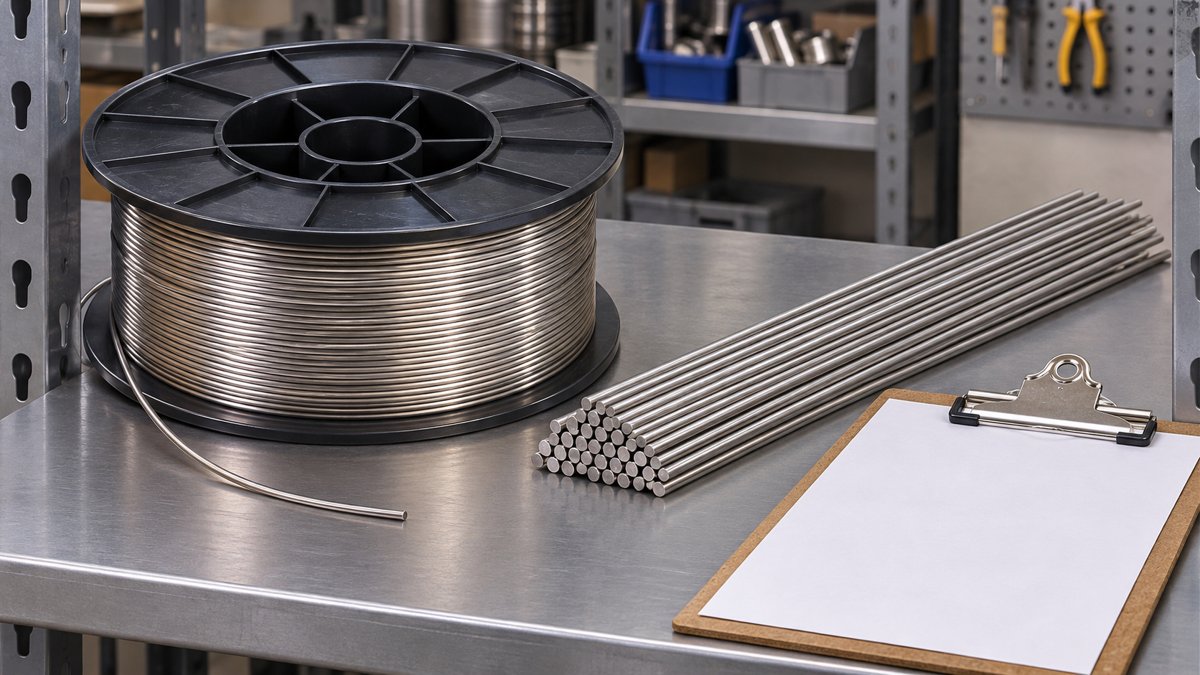
An order for ERNiCrMo-10 is not complete just because the classification matches the welding procedure. Before ordering, confirm the exact manufacturer’s product, its form, the required diameter and the packaging. This matters when a shop purchases bare nickel-alloy filler for a controlled fabrication job: a spool and straight cut lengths are not interchangeable order items.
What ERNiCrMo-10 identifies
Haynes International lists its HASTELLOY C-22 RTW filler metal under AWS A5.14 ERNiCrMo-10 and UNS N06022. The manufacturer’s data sheet identifies it for GMAW and GTAW welding of C-22 alloy. This is product-specific evidence, not permission to substitute it into every nickel-alloy joint. The approved welding procedure, specified base metal and service requirements govern the selection.
The same supplier lists HASTELLOY 622 RTW filler metal under the same AWS classification. Its product description separately discusses overlay and dissimilar applications. That is a useful purchasing distinction: a classification helps identify the family, but it does not establish that the two manufacturers’ products are authorized substitutes for your job. Confirm the product identified by the engineering documents.
Check the physical form before the order leaves the desk
Haynes distinguishes spooled MIG wire, straight TIG lengths, reels and coils in its C-22 RTW product sheet. The size table also has form-specific exceptions. For example, the listed 0.035-inch diameter appears without the MIG-spool exclusion, but the listed 0.125-inch diameter is marked as unavailable in MIG spools. These are manufacturer catalog form indications, not confirmation of present inventory, package weight or a distributor’s offering.
A purchase request that says only ERNiCrMo-10 leaves the supplier to guess which form and size are intended. Ask for the exact order code and selling unit instead. Even if another supplier advertises the same classification, do not infer that it offers the same spool configuration or paperwork.
An order checklist for the parts counter
- Approved filler classification and specified manufacturer/product name.
- Exact form: spool, reel, coil, or straight cut lengths.
- Diameter and units as written on the approved job documentation.
- Required package weight or count, spool or reel format, and exact manufacturer order code.
- Required certificates, heat/lot traceability, and any contract-specific documentation.
- Supplier confirmation of the actual selling unit, availability and delivery before the order is placed.
Avoid ordering by a photo of a spool label or a similar-looking grade alone. The supplier’s quote should agree with the job’s order requirements. If the package is not established, request confirmation rather than choosing the closest displayed option.
Where to look up this classification
The ERNiCrMo-10 MIG lookup is a starting point for identifying the grade, not a verified stock list. The page explicitly holds marketplace product matches pending exact form and package verification. You can also use WSP Alloy Support and the Filler Metal Finder to navigate from your specified classification to supporting resources.
Specification is not procedure approval
The manufacturer’s data and AWS classification are useful order references. They do not establish the correct welding parameters, gas, polarity, joint design, heat treatment or corrosion performance of a finished weld in a particular service. Use the approved WPS and any governing code and engineering requirements. If the job documentation differs from the purchase request, stop and resolve the discrepancy with the responsible person before buying or welding.
The practical takeaway: match what the procedure specifies, then obtain a written quotation for the exact product form and package. A precise order prevents the shop from receiving a technically related filler that cannot be used for the intended work.
Leave a Reply