Tag: welding technique

  • 7018 Rod Sticking: Causes & Solutions

    Introduction

    Welding with 7018 rods can be challenging, especially when they start sticking during operation. This issue not only affects the quality of the weld but also disrupts workflow. Understanding the underlying causes and solutions can help welders achieve more efficient results.

    Key Takeaways

    – 7018 rods are prone to sticking due to improper technique or settings.
    – Correct amperage and angle can reduce sticking.
    – Proper rod storage is crucial for optimal performance.
    – Using the right equipment can significantly improve weld quality.

    Problem / Context

    Sticking occurs when the electrode fuses to the workpiece, interrupting the arc and making it difficult to complete the weld. This is a common issue with 7018 rods, which require precise conditions to function correctly.

    Causes

    Low Amperage

    – Inadequate amperage fails to sustain the arc, causing the rod to stick.

    Incorrect Angle

    – Holding the rod at an incorrect angle reduces arc stability.

    Poor Rod Condition

    – Moisture absorption in 7018 rods can lead to sticking.

    Fixes

    Step 1: Adjust Amperage

    Increase Amperage: Slowly increase amperage until the arc is stable and the rod flows smoothly without sticking.

    Step 2: Correct Angle

    Maintain a 10-15 Degree Angle: Keep the rod at a consistent angle to ensure smooth arc movement.

    Step 3: Ensure Dry Storage

    Proper Storage: Store rods in a dry, sealed container or rod oven to prevent moisture absorption.

    Step 4: Consistent Movement

    Steady Motion: Employ a steady, consistent movement along the weld joint to reduce sticking.

    Product Section

    Washington Alloy 7018 Stick Electrode 5LB Package (7018 1/8″)
    • All-position, Flux coated
    • 70,000 lbs Tensile Strength
    • 5 Lb Package

    Last update on 2026-06-04 / Affiliate links / Images from Amazon Product Advertising API

    Safety Notes

    Eye Protection: Follow ANSI Z87.1 standards for eye protection.
    Welding Codes: Adhere to AWS D1.1 and D1.3 for safe and effective welding practices.

    FAQ

    What amperage should be used for 7018 rods?

    Amperage settings typically range from 90 to 160 amps, depending on the rod diameter. Adjust based on welding parameters and practice.

    How should 7018 rods be stored?

    Store in a temperature-controlled rod oven at 250°F (121°C) to keep them dry and prevent moisture absorption.

    Can rod sticking damage my welding machine?

    Prolonged sticking can overheat and damage your welding machine, so it’s vital to address issues promptly.

    Conclusion / Next Step

    Addressing 7018 rod sticking involves proper technique and equipment adjustments. By implementing these solutions, welders can enhance their welding performance and minimize disruptions. For more tips on stick welding, explore additional resources and comparisons of welding rods like 7018 vs 6011.

  • Arc Control: Why Arc Length Matters in Stick Welding — Overview & Review

    Arc Control: Why Arc Length Matters in Stick Welding — Overview & Review

    Introduction

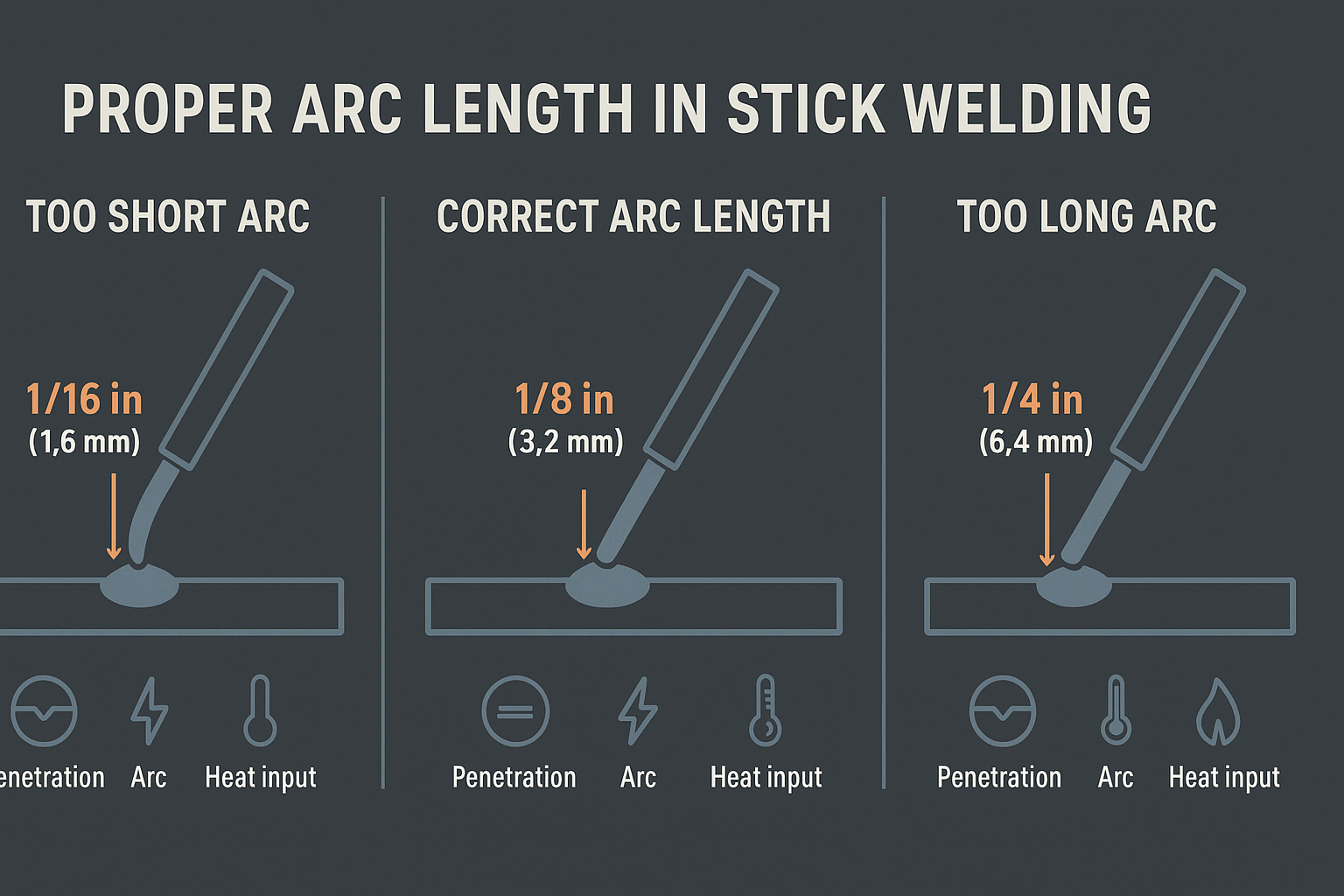
    Arc length is one of the most important variables in stick welding, and this guide—Arc Control: Why Arc Length Matters in Stick Welding—breaks down exactly why. The book explains how arc length influences penetration, bead shape, stability, and overall weld quality. For new welders trying to stop sticking and wandering arcs, and for experienced welders chasing cleaner, more consistent beads, this resource provides straightforward direction.

    Key Features

    This guide focuses entirely on understanding and maintaining proper arc length. Core topics include:

    • How arc length affects heat input and penetration
    • How arc stability changes with electrode angle and travel speed
    • The relationship between arc length, puddle control, and weld bead behavior
    • Visual diagrams that show what “too long” and “too short” arcs look like
    • Simple, actionable tips welders can use immediately

    It’s written in plain language with enough detail to be useful without overwhelming beginners.

    Pros & Cons

    Pros

    • Clear explanations of how arc length affects weld quality
    • Applicable to all experience levels
    • Helpful illustrations and diagrams
    • Strong focus on practical, real-world improvement

    Cons

    • Doesn’t include advanced technical data
    • Could go deeper for welders who already have strong arc control

    Who It’s For

    This guide fits welders who want more consistency and better quality out of their SMAW work. Ideal groups include:

    • Welding students learning fundamentals
    • DIY welders trying to reduce sticking and uneven beads
    • Working welders who want tighter control and repeatable results
    • Anyone who struggles with keeping a steady arc length

    What Makes It Unique

    Most welding books touch on arc length but don’t spend much time on it. This guide focuses specifically on that variable and explains it step-by-step. The visuals help welders understand what they should see, and the practical advice makes it easy to apply on the next weld.

    Buying Tips

    For the best learning experience:

    • Look for editions that include diagrams, photos, or companion videos
    • Choose the latest version if updates are available
    • Make sure you have basic PPE and electrodes on hand so you can practice
    • Pair the guide with a machine that has stable output—helpful when learning arc control

    Conclusion

    Arc Control: Why Arc Length Matters in Stick Welding is a solid resource for anyone wanting stronger, cleaner, and more consistent stick welds. It breaks down arc length in a way that welders can understand and apply immediately. Beginners and seasoned welders alike will find something useful here.

    This article may contain Amazon affiliate links. We may earn a small commission at no extra cost to you.

  • Arc Control Secrets: Stick Welding Tips That Matter

    Arc Control Secrets: Stick Welding Tips That Matter

    Introduction

    Arc Control Secrets: Stick Welding Tips That Matter is a focused guide for welders who want to improve control, stability, and consistency in SMAW (Stick) welding. Arc control directly affects bead shape, penetration, and weld soundness—this book breaks those concepts down and explains how to apply them in real work, not just theory.

    Key Features

    The guide covers the fundamentals of arc stability and then moves into more advanced control techniques. Topics include:

    • Managing arc length for different electrodes
    • Electrode angle and travel speed adjustments
    • How arc force, heat input, and polarity affect bead shape
    • Troubleshooting common issues like sticking, porosity, and wandering arcs
    • Real-world examples that connect each technique to practical shop scenarios

    The layout is straightforward and designed for welders who want actionable steps rather than long explanations.

    Pros & Cons

    Pros

    • Strong focus on arc control—one of the hardest SMAW skills to master
    • Real examples welders will recognize from shop and field work
    • Works for any skill level
    • Clear illustrations and explanations
    • Helps improve consistency, bead appearance, and quality

    Cons

    • Only covers stick welding (SMAW), not MIG/TIG
    • Some techniques may require tools a beginner may not have
    • New welders might feel overwhelmed by the depth in later chapters

    Who It’s For

    This guide fits:

    • Beginners who need to understand how arc length, angle, and motion affect results
    • Intermediate welders trying to tighten up consistency
    • Experienced welders who want to refine technique and improve control in tricky positions
    • Anyone welding structural steel, pipe, fabrication, or artistic work where bead control matters

    What Makes It Different

    Most welding books mention “arc control,” but few explain how to actually master it. This guide centers entirely on that skill. The illustrations and examples make complex ideas usable, and the focus on real welding conditions—heat buildup, position changes, joint access—makes it more practical than typical classroom-style manuals.

    Buying Tips

    Before picking up the guide, consider:

    • Your current SMAW skill level
    • Whether you already have a range of electrodes and amps to practice the techniques
    • If your machine lets you adjust arc force/amps precisely (helpful but not required)
    • Whether you’re focused on structural, repair, or hobby welding

    If improving bead quality, consistency, and control is your goal, this book is a solid addition to your toolbox.

    Conclusion

    Arc Control Secrets: Stick Welding Tips That Matter is a detailed, practical resource for welders who want to improve one of the most difficult parts of SMAW: controlling the arc. The techniques help produce cleaner, stronger, and more repeatable welds. It’s a worthwhile guide for both new welders and experienced pros looking to refine their craft.

    This article may contain Amazon affiliate links. We may earn a small commission at no extra cost to you.

Stream with Amazon Music