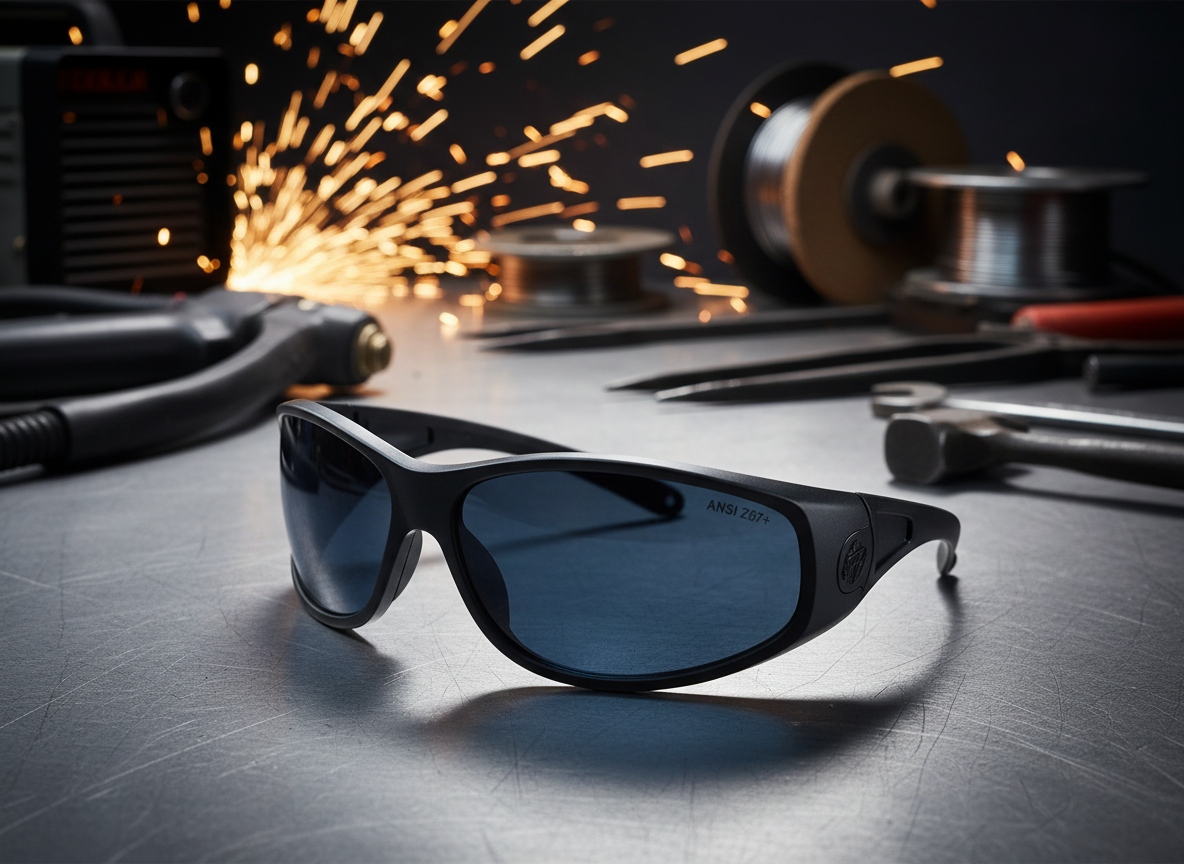
Tag: welding safety glasses

  • Do Welding Helmet Cover Lenses Block UV, or Is the ADF Doing That?

    A clear welding helmet cover lens is mainly a sacrificial protection plate. It protects the auto-darkening filter, fixed shade plate, and viewing area from spatter, grinding dust, scratches, smoke film, and impact wear. The welding filter or auto-darkening filter is the part that must provide the required welding shade and UV/IR protection for arc exposure.

    This matters because a clean cover lens can make the helmet look safer than it really is. A clear cover plate is not a welding shade. Do not weld with only a clear cover lens, and do not assume a scratched or missing cover lens is harmless. If the auto-darkening cartridge is damaged, missing, incorrectly installed, or not marked for welding protection, the helmet should be removed from service.

    For broader helmet selection and shade checks, see the auto-darkening welding helmet buying guide and the welding safety glasses shade and ANSI Z87.1 guide.

    Key Takeaways

    • The ADF or passive welding filter is the primary part responsible for welding shade and UV/IR protection.
    • The clear outside cover lens mainly protects the filter from spatter, dust, scratches, and impact wear.
    • Some clear cover lenses may meet ANSI Z87.1 impact requirements, but that does not make them welding shade filters.
    • Do not weld with a missing, cracked, heat-warped, or heavily scratched cover lens because it can expose the ADF to damage.
    • Do not weld with only a clear cover lens. Use the correct filter shade for the process and amperage.

    Problem / Context

    The common question is whether the clear lens on the outside of a welding helmet blocks UV, or whether the auto-darkening filter does that job. The practical answer is that the welding filter must be treated as the critical UV/IR and shade-control component. The clear cover lens is a replaceable barrier that helps preserve the filter, but it is not a substitute for the filter.

    Most helmet designs use several layers: the helmet shell, the outside clear cover lens, the ADF or fixed shade filter, and often an inside cover lens. Each part has a different job. Confusing these layers can lead to unsafe shortcuts, especially when a cover lens is cracked or the ADF looks expensive to replace.

    Root Causes of Confusion

    Clear lenses may still have safety markings: A clear replacement cover lens may be sold as ANSI Z87.1 compliant for impact protection. That does not mean it has the correct optical density for welding arc radiation.

    ADF lenses protect in light and dark states: Manufacturer manuals commonly state that the auto-darkening cartridge provides UV/IR protection in both light and dark states. The darkening function controls visible brightness and shade comfort, but the UV/IR filter function should not depend only on the lens switching dark.

    The cover lens sits closest to the arc: Because the clear plate faces sparks and spatter first, welders may assume it is the main safety lens. Its real job is to protect the more expensive filter behind it.

    Damaged cover lenses can hide filter problems: A cloudy, pitted, or heat-warped cover lens reduces visibility and can make welders raise their hood, lean into bad positions, or miss a damaged ADF. See the ArcOne S240-10 auto-darkening filter support guide for fit and visibility checks.

    Some helmets cannot be used without cover lenses: Several helmet manuals warn against using the helmet without the inside and outside cover lenses properly installed. Missing cover lenses can allow spatter, heat, and debris to damage the filter cartridge.

    Solution

    1. Confirm the helmet has a proper ADF or passive welding filter installed. A clear cover lens alone is not enough.
    2. Check the helmet and filter markings for ANSI Z87.1 and manufacturer identification.
    3. Confirm the shade range or fixed shade number matches the welding process and amperage.
    4. Inspect the outside cover lens for cracks, spatter pits, smoke film, deep scratches, or heat warping.
    5. Inspect the inside cover lens if the helmet uses one. Replace it if it is cracked, dirty, pitted, or loose.
    6. Use only replacement cover lenses specified by the helmet manufacturer when possible.
    7. Replace the cover lens before visibility drops enough to affect puddle control or sensor performance.
    8. Remove the helmet from service if the ADF cartridge is cracked, loose, delaminated, water-damaged, or not darkening correctly.
    9. Wear safety glasses or goggles under the helmet where grinding, chipping, or flying particle hazards exist.

    Specs / Verification Notes

    Helmet LayerMain JobCan It Replace the ADF?Verification Note
    Outside clear cover lensProtects the welding filter from spatter, dust, scratches, and impact wearNoSize, material, and helmet fit: Unknown (Verify)
    Auto-darkening filterProvides welding shade and UV/IR protection according to the helmet designRequired for ADF helmetsConfirm shade range and ANSI marking
    Passive filter plateProvides fixed welding shade and radiation filteringRequired for passive helmetsConfirm shade number for process and amperage
    Inside cover lensProtects the inside face of the filter from dust, handling damage, and debrisNoHelmet-specific fit: Unknown (Verify)
    Safety glasses under hoodProtects against flying particles when requiredNoConfirm ANSI Z87.1 marking

    Product Section

    Replacement cover lenses are maintenance parts, not shade filters. The example below is a 2 in x 4-1/4 in clear cover lens. Confirm helmet fit, lens size, manufacturer approval, and ANSI marking before use. Compatibility with any specific helmet is Unknown (Verify).

    Forney 56800 Cover Lens, Plastic, 2-Inch-by-4-1/4-Inch, Clear
    • package dimensions :13.208 cm L x 5.588 cm W x 0.254 cm H
    • Product type :TOOLS
    • country of origin:China
    • This are highly durable

    Last update on 2026-06-04 / Affiliate links / Images from Amazon Product Advertising API

    Comparison Table

    QuestionCorrect AnswerShop Mistake to Avoid
    Does the clear cover lens provide welding shade?No. It is not the welding filter.Do not weld through only a clear cover lens.
    Does the ADF provide UV/IR protection?Manufacturer manuals commonly state UV/IR protection is present in light and dark states.Do not keep using a cracked or unverified ADF.
    Can a cracked cover lens be ignored?No. Replace it before welding.Do not let spatter or debris reach the filter cartridge.
    Can any clear lens fit any helmet?No. Size and helmet model matter.Do not force a loose, undersized, or warped cover plate into service.
    Are safety glasses still needed?They may be required for flying particle hazards.Do not rely on the helmet alone during grinding or chipping.

    Related Failure Paths

    ADF does not darken: If the lens stays light, flashes, or responds inconsistently, use the auto-darkening welding helmet not working checklist.

    ADF flickers on TIG: A dirty cover lens or blocked sensor can contribute to flicker on low-current TIG. See why auto-darkening helmets flicker on aluminum TIG.

    Passive versus auto-darkening confusion: Passive helmets and ADF helmets both require proper filter protection, but they work differently. Compare the practical differences in auto-darkening vs passive welding helmets.

    Shade number mismatch: A clear cover lens does not determine whether shade 9, 10, 11, 12, or 13 is correct. Use the process, amperage, and manufacturer chart to select shade. The helmet lens speed, shade range, and standards guide gives broader selection context.

    Safety Notes

    Arc welding emits visible light, ultraviolet radiation, and infrared radiation. Use a welding helmet with the correct filter lens shade for the process and current. OSHA guidance also notes that workers using welding helmets may need safety glasses with side shields or goggles where flying particle hazards exist.

    Do not treat a clear cover plate as UV/IR proof for welding exposure unless the complete helmet, filter, and replacement part are being used exactly as specified by the manufacturer. Even if a clear cover lens has some UV-blocking material property, it is not a substitute for a welding filter shade.

    Stop using the helmet if the filter cartridge is cracked, loose, heat damaged, water damaged, or visibly compromised. Manufacturer warnings commonly state that UV/IR protection may be compromised when the product is damaged.

    FAQ

    Does the clear outside cover lens block UV?

    Do not rely on it as the welding UV/IR protection layer. The cover lens is mainly a protective plate. The ADF or passive welding filter is the critical radiation-filtering component.

    Does an auto-darkening helmet protect from UV before it darkens?

    Manufacturer manuals for auto-darkening helmets commonly state that the ADF protects against UV/IR in both light and dark states. The darkening function controls visible light shade, but the helmet still must be undamaged, properly assembled, and correctly rated.

    Can welding flash happen if the ADF fails to darken?

    Yes. Even when UV/IR filtering is present, a lens that fails to darken can expose the user to excessive visible light and unsafe viewing conditions. Stop welding and troubleshoot the helmet.

    Can a clear cover lens be used for grinding?

    Only if the complete helmet setup is rated and configured for grinding or impact hazards. Grinding mode does not make the helmet a welding shade, and welding mode does not replace safety glasses where flying particles are present.

    How often should cover lenses be replaced?

    Replace them when cracked, soiled, pitted, deeply scratched, heat-warped, loose, or visibility is reduced. Replacement interval depends on welding process, spatter level, grinding exposure, and shop conditions.

    Can aftermarket cover lenses be used?

    Only after verifying size, fit, material, safety marking, and helmet manufacturer guidance. OEM lenses are preferred when the helmet manual specifies exact replacement parts.

    Next Step

    Inspect the helmet in layers: outside cover lens, ADF or passive filter, inside cover lens, shell, headgear, and safety glasses. Replace damaged cover lenses, verify the correct filter shade, and remove the hood from service if the ADF or passive filter is cracked, loose, unmarked, or not working correctly.

    Sources Checked

    • OSHA Eye Protection against Radiant Energy during Welding and Cutting fact sheet: filter lens shade guidance and safety glasses or goggles for flying particle hazards.
    • Lincoln Electric auto-darkening helmet manuals: UV/IR protection in dark and light states, warnings about damaged products, and use of specified cover lenses.
    • 3M Speedglas welding PPE product guide: permanent UV/IR protection references for Speedglas ADF products.
    • Forney 56800 cover lens manufacturer listing: 2 in x 4-1/4 in clear plastic cover lens, impact and spatter protection, ANSI Z87.1 reference, and fit notes.
    • Weld Support Parts: Auto-Darkening Welding Helmet Buying Guide 2025.
    • Weld Support Parts: Welding Safety Glasses Guide 2025.
    • Weld Support Parts: Auto-Darkening Welding Helmet Not Working: Causes and Fixes.
    • Weld Support Parts: ArcOne S240-10 Auto-Darkening Welding Filter Support Guide.
    • Weld Support Parts: Auto-Darkening vs Passive Welding Helmets.
  • Welding Safety Glasses Guide 2025 | Shade Numbers, ANSI Z87.1 & UV Protection

    Welding Safety Glasses Guide 2025 | Shade Numbers, ANSI Z87.1 & UV Protection

    Welding safety glasses protect against UV radiation, infrared light, and impact hazards during grinding and fabrication. Choosing the right glasses depends on process type, shade number, and ANSI Z87.1 certificationโ€”not just lens color.

    ANSI Z87.1 Certification Requirements

    Impact Protection Levels

    Basic Impact (Z87) – Protects against low-velocity impact (1โ€ steel ball at 150 ft/sec) – Suitable for: General shop work, light grinding, non-welding tasks

    High Impact (Z87+) – Protects against high-velocity impact (1/4โ€ steel ball at 150 ft/sec) – Required for: Welding, grinding, chipping, cutting – Marking: โ€œZ87+โ€ stamped on frame and lens

    Side Shield Requirement: – All welding safety glasses must have side shields or wraparound design – Prevents spatter and debris from entering around lens edges

    Shade Number Selection by Process

    ProcessAmperage RangeShade NumberLens Type
    Oxy-fuel cuttingN/A#3-#6Fixed shade
    TIG (GTAW)10-50A#8-#10Fixed or auto-darkening
    TIG (GTAW)50-150A#10-#12Fixed or auto-darkening
    MIG (GMAW)60-160A#10-#12Fixed or auto-darkening
    MIG (GMAW)160-250A#12-#14Fixed or auto-darkening
    Stick (SMAW)60-160A#10-#12Fixed shade
    Stick (SMAW)160-250A#12-#14Fixed shade
    Plasma cutting20-40A#4-#5Fixed shade
    Plasma cutting40-80A#5-#8Fixed shade

    Note: Safety glasses are supplemental protection worn under welding helmets or for indirect arc exposure (helper/observer).

    Lens Types & Technologies

    Fixed Shade Lenses

    • Pros: No batteries, consistent darkness, low cost
    • Cons: Single shade only, must swap lenses for different processes
    • Best for: Dedicated single-process work, backup glasses
    • Cost: $10-$30

    Auto-Darkening Lenses

    • Pros: Adjustable shade range, no lens swapping
    • Cons: Battery replacement, higher cost
    • Shade range: Typically #5-#13
    • Reaction time: 0.0001-0.00004 seconds
    • Best for: Multi-process shops, frequent shade changes
    • Cost: $50-$150

    Passive IR/UV Protection (Clear Lenses)

    • Function: Blocks UV and infrared without visible light darkening
    • Use case: Grinding, fabrication, indirect arc exposure (helper/observer)
    • Shade equivalent: #1.5-#2
    • Best for: Non-welding tasks requiring impact protection

    UV & IR Protection Standards

    UV Protection (200-400nm wavelength): – All welding lenses must block 99.9%+ UV radiation – Permanent damage occurs from unprotected UV exposure (arc eye/welderโ€™s flash)

    Infrared Protection (780nm-1mm wavelength): – Blocks heat radiation from welding arc – Prevents retinal damage and cataracts from prolonged exposure

    Visible Light Transmission: – Shade #3: 14.3% transmission (light tint) – Shade #8: 0.58% transmission (moderate darkness) – Shade #12: 0.0018% transmission (very dark)

    Lens Coatings & Features

    Anti-Fog Coating

    • Purpose: Prevents condensation in humid environments or when wearing respirator
    • Best for: Summer welding, enclosed spaces, respirator use
    • Limitation: Coating wears off after 6-12 months

    Anti-Scratch Coating

    • Purpose: Extends lens life in high-abrasion environments
    • Best for: Grinding, fabrication, production shops
    • Hardness rating: 4-6H pencil hardness (military spec MIL-PRF-32432)

    Polarized Lenses

    • Purpose: Reduces glare from reflective surfaces (polished stainless, aluminum)
    • Best for: TIG welding on reflective materials
    • Limitation: Not necessary for carbon steel or general fabrication

    Frame Styles & Fit

    Wraparound Design

    • Coverage: Maximum side and peripheral protection
    • Best for: Grinding, cutting, high-spatter welding
    • Fit: Snug to face, minimal gap around edges

    Over-the-Glass (OTG) Design

    • Purpose: Fits over prescription eyeglasses
    • Best for: Welders who wear corrective lenses
    • Limitation: Bulkier, may not fit all prescription frame sizes

    Prescription Welding Glasses

    • Purpose: Combines corrective lenses with welding shade
    • Best for: Full-time welders who need vision correction
    • Cost: $150-$400 (requires optometrist fitting)

    When to Wear Safety Glasses vs. Helmet

    Safety Glasses (Supplemental Protection)

    • Grinding, cutting, or fabrication (no arc)
    • Indirect arc exposure (helper/observer 10+ feet from arc)
    • Under welding helmet as secondary protection
    • Oxy-fuel cutting or brazing (low UV output)

    Welding Helmet (Primary Protection)

    • Direct arc exposure (TIG, MIG, stick, flux-core)
    • Primary welder performing arc welding
    • Required for all arc welding processes per OSHA 1910.252

    OSHA Requirement: Safety glasses must be worn under welding helmets in environments with grinding, chipping, or multiple welding stations.

    Common Mistakes

    Using non-certified safety glasses for welding
    Fashion sunglasses or non-Z87+ glasses donโ€™t block UV/IR radiation. Result: arc eye (photokeratitis) and permanent retinal damage. Always verify Z87+ marking.

    Wrong shade number for amperage
    Shade #3 glasses for 150A MIG = retinal burn risk. Shade #12 for oxy-fuel cutting = canโ€™t see work. Match shade to process and amperage.

    Skipping safety glasses under helmet
    Grinding debris or spatter can enter under helmet. OSHA requires safety glasses as secondary protection in multi-hazard environments.

    Buying Checklist

    • โœ“ ANSI Z87+ certification marked on frame and lens
    • โœ“ Shade number matches process and amperage range
    • โœ“ UV/IR protection rated for welding (99.9%+ UV block)
    • โœ“ Side shields or wraparound design for peripheral protection
    • โœ“ Anti-fog coating if working in humid environments
    • โœ“ Anti-scratch coating for grinding/fabrication work
    • โœ“ Comfortable fit (no pressure points, secure without slipping)
    • โœ“ OTG design if wearing prescription glasses

Stream with Amazon Music