Tag: weld quality

  • How to Fix an Unstable TIG Arc from Poor Tungsten Prep

    A wandering TIG arc is often blamed on gas flow, amperage, or the machine. Those issues can matter, but the tungsten electrode is one of the first places to check. A contaminated, poorly ground, or incorrectly shaped tungsten can make the arc drift, split, sputter, or pull away from the joint.

    This guide covers how to identify tungsten-prep problems, what usually causes them, and what to verify before replacing torch parts or changing machine settings.

    Key Takeaways

    • A TIG arc that wanders, flickers, or splits can often be traced to tungsten contamination or poor grind direction.
    • Grinding marks should run lengthwise with the tungsten, not around it.
    • A dipped tungsten should be cut back or re-ground before welding continues.
    • Use a dedicated tungsten grinder or wheel to reduce cross-contamination from steel, aluminum, or abrasive debris.
    • Verify torch setup, gas coverage, and electrode size before assuming the welder is the problem.

    Problem / Context

    An unstable TIG arc can show up as arc wander, inconsistent starting, dirty weld edges, excessive tungsten balling, black peppering near the weld, or a weld puddle that does not stay centered under the electrode.

    These symptoms are common after the tungsten touches the weld puddle, filler rod, work clamp area, or a contaminated bench grinder. The issue may also appear after switching from aluminum to stainless or carbon steel without cleaning the electrode properly.

    Root Causes

    • Contaminated tip: The tungsten touched the puddle, filler wire, base metal, or dirty work surface.
    • Wrong grind direction: Circular grinding marks can encourage the arc to wander around the tip.
    • Shared grinding wheel: A wheel used for steel or aluminum can embed unwanted material into the electrode.
    • Overheated tungsten: Excessive amperage, poor torch cooling, or too small an electrode can damage the tip.
    • Incorrect stickout: Long stickout without enough gas coverage can oxidize the tungsten and destabilize the arc.
    • Loose torch parts: A loose collet, damaged collet body, or poor gas lens seating can create inconsistent current transfer or shielding.

    Solution

    Start by removing any contaminated portion of the tungsten. Do not simply grind over a dipped tip if filler metal or base metal has fused into it. Cut back the contaminated section, then re-grind the electrode.

    • Use a dedicated tungsten grinder or a wheel reserved only for tungsten.
    • Grind lengthwise so the grind lines run from the body of the tungsten toward the point.
    • Keep the electrode centered while grinding to avoid an off-center point.
    • Use a consistent included angle for the job instead of changing tip shape randomly between welds.
    • For DC TIG on steel or stainless, use a pointed or slightly truncated point as required by the procedure.
    • For AC aluminum, follow the machine and tungsten manufacturer guidance for electrode type and tip preparation.

    Specs / Verification Notes

    Item to VerifyWhat to CheckNotes
    Tungsten typeConfirm electrode material and color codeUnknown (Verify)
    Tungsten diameterMatch electrode size to amperage rangeUnknown (Verify)
    Grind directionLengthwise grind marksAvoid circular grind marks
    Grinding wheelDedicated tungsten wheel or sharpenerDo not share with general metal grinding
    Torch partsCollet, collet body, cup, gas lens, back capReplace damaged consumables
    Shielding gasCorrect gas, flow rate, hose condition, leaksUnknown (Verify)

    Product Section

    A tungsten sharpener can help keep grind angle and grind direction more consistent than freehand grinding on a shared bench wheel. Verify compatibility with the rotary tool, tungsten diameters, and wheel size before purchasing.

    3mirrors Tungsten Electrode Sharpener Grinder Head TIG Welding Tool w/Cut-Off Slot Multi-Angle & Offsets, Horizontal Hole, 4 Copper Screw Holes & 2X CNC Mandrel & 5X 25mm Diamond Wheels, ALUMINUM
    • Our Tungsten Electrode Sharpener fits most all Rotary Tools with a 3/4-12 thread, compatible for Black and Decker, Milwaukee, Bosch Dremel and More! (Package No Rotary Tools Included). Product designed by professional 3D CAD, made of T-6061 aluminum alloy, CNC finishing, Durable and Easy to use.
    • ALUMINUM Grinder Head comes with 4 Brass Tungsten Guide Screws: 040″, 1/16″, 3/32″ and 1/8″ (1mm, 1.6mm, 2.4mm, 3.2mm). The guides ensure concentricity and multi-offset. Increase the utilization of the grinding wheel.
    • A tungsten sharpening tool has four angled holes on it for use. 22.5°, 20°, 15° and 10° (45°, 40°, 30°, 20° Tips Angle respectively). Precise control makes Upgraded grinding tools will grind a More perfect tungsten tip angle. All holes are designed to use the same height as the diamond wheel. Needn’t set the height repeatedly, it is very easy to align the diamond wheel and the 2mm slit.
    • This Upgrade version tool adds a Horizontal Hole so that cleaning up tungsten electrodes that have picked up metal during welding easily. The tungsten sharpening tool also has tungsten cut-off port processing. After the tungsten you are using is worn or contaminated, you can use the cut-off port for cutting so that you can use it again. Upgraded Brass Guides & Mandrels are CNC forging, Will have higher accuracy.
    • 3mirrors Tungsten Electrode Sharpener tool is essential for real professionals. Will save you a lot of time and give you precise tips. The open design makes the grinding wheel installation more convenient. Wearing a mask and other protective gear is recommended unless you are grinding in full-sealed space.

    Last update on 2026-06-04 / Affiliate links / Images from Amazon Product Advertising API

    Comparison Table

    MethodBest UseRisk
    Dedicated tungsten sharpenerRepeatable tungsten prepMust verify tool compatibility
    Dedicated bench wheelShop setup with controlled workflowEasy to contaminate if others use it
    Shared grinderEmergency field use onlyHigh contamination risk
    Hand fileMinor cleanup onlySlow and inconsistent for full prep

    Safety Notes

    • Use eye and face protection suitable for grinding and welding. OSHA notes that welding and cutting can expose workers to radiant energy that can injure the eyes.
    • Use the correct welding lens shade for the TIG amperage and work conditions.
    • Control grinding dust, especially when preparing thoriated tungsten. Follow shop safety procedures and applicable SDS guidance.
    • Do not grind tungsten near open containers, flammables, or clean assembly areas where dust contamination is a concern.
    • Follow ANSI Z49.1 safety guidance for welding, cutting, and allied processes where applicable.

    FAQ

    Can a dirty tungsten really make the arc wander?

    Yes. Contamination on the electrode tip can change how the arc starts and where it anchors. A dipped tungsten should be corrected before continuing the weld.

    Should tungsten be ground in a circle or lengthwise?

    Lengthwise grinding is preferred for TIG electrode preparation. The grind marks should run along the tungsten, not around it.

    Can one grinder wheel be used for tungsten and steel?

    It is not recommended. A shared grinding wheel can transfer contaminants into the tungsten and create arc stability problems.

    Why does the tungsten keep balling up on DC TIG?

    Possible causes include wrong polarity, excessive amperage for the electrode size, poor tip prep, contaminated tungsten, or incorrect tungsten type. Verify machine polarity and electrode size first.

    Does a gas lens fix tungsten contamination?

    No. A gas lens can improve shielding coverage in the right setup, but it will not fix a contaminated or poorly ground tungsten.

    Next Step

    If the TIG arc is unstable, remove and inspect the tungsten before changing machine settings. Cut back contamination, re-grind lengthwise on a dedicated wheel or sharpener, then verify torch parts and gas coverage before restarting the weld.

    Sources Checked

    • Amazon product page for 3mirrors Aluminum Tungsten Electrode Sharpener Grinder Head, ASIN B09F9J7GSV
    • OSHA Eye Protection against Radiant Energy during Welding and Cutting fact sheet
    • OSHA Welding, Cutting, and Brazing standards overview
    • AWS welding lens shade safety guidance
    • Diamond Ground Products tungsten electrode guidebook
  • Why Your MIG Weld Has Porosity (and How to Fix It Fast)

    Porosity in MIG welding shows up as pinholes or small voids in the weld bead. It weakens the weld and usually points to shielding gas failure or contamination. This guide breaks down the exact causes and the fastest way to fix it using proper setup and wire selection.

    Key Takeaways

    • Porosity is caused by poor shielding gas coverage or contamination
    • Dirty metal and bad wire are the most common causes
    • Gas flow, nozzle condition, and wire choice fix most issues
    • ER70S-6 wire helps reduce porosity on less clean steel

    What Causes MIG Weld Porosity

    Porosity occurs when atmospheric gases get trapped in the weld pool as it solidifies. In MIG welding, shielding gas is supposed to prevent this. When coverage fails, defects form.

    • Low shielding gas flow
    • Wind or airflow disrupting gas
    • Dirty or oily metal
    • Rusty or contaminated wire
    • Improper stickout or angle
    • Clogged nozzle or diffuser

    How to Fix MIG Porosity

    • Set gas flow to 20–30 CFH (verify for your setup)
    • Keep stickout around 3/8”–1/2”
    • Clean metal to bare steel
    • Check for gas leaks
    • Replace worn nozzle or diffuser
    • Switch to ER70S-6 wire if needed

    Recommended Wire for Reducing Porosity

    Hobart ER70S-6 MIG Welding Wire (.030”)


    Type: Solid MIG wire

    Diameter: .030”

    Material: Mild steel

    Deoxidizers: Higher than ER70S-3

    Specs: Unknown (Verify)

    Hobart H305406-R22 10-Pound ER70S-6 Carbon-Steel Solid Welding Wire, 0.030-Inch
    • Carbon-steel sound, porosity-free welds with powerful deoxidizers for your work with shielding gases.
    • Great for construction work, farm implement fabrication, shaft buildup, tanks, truck bodies and general shop applications with poor fit-up or rusty, oily plates.
    • 10-Pound spool
    • Country of Origin: Made in China

    Last update on 2026-06-03 / Affiliate links / Images from Amazon Product Advertising API


    ER70S-6 wire is more forgiving on dirty steel and helps reduce porosity compared to ER70S-3.

    Gas Flow Setup

    • Typical: 20–30 CFH (verify)
    • Too low = poor coverage
    • Too high = turbulence
    • Avoid drafts when welding

    Wire Comparison

    WireKey DifferenceBest Use
    ER70S-6More deoxidizersDirty steel
    ER70S-3Cleaner arcClean material

    Safety Notes

    Use ANSI Z87.1 compliant eye protection and proper PPE. Ensure ventilation and follow AWS welding safety guidelines.

    FAQ

    Q: Can too much gas cause porosity?
    A: Yes. It can create turbulence and pull in air.

    Q: Does wire matter?
    A: Yes. ER70S-6 is more forgiving on dirty steel.

    Next Step

    Check your gas flow and nozzle first. If needed, switch to ER70S-6 wire and clean your material before welding.

  • Arc Control: Why Arc Length Matters in Stick Welding — Overview & Review

    Arc Control: Why Arc Length Matters in Stick Welding — Overview & Review

    Introduction

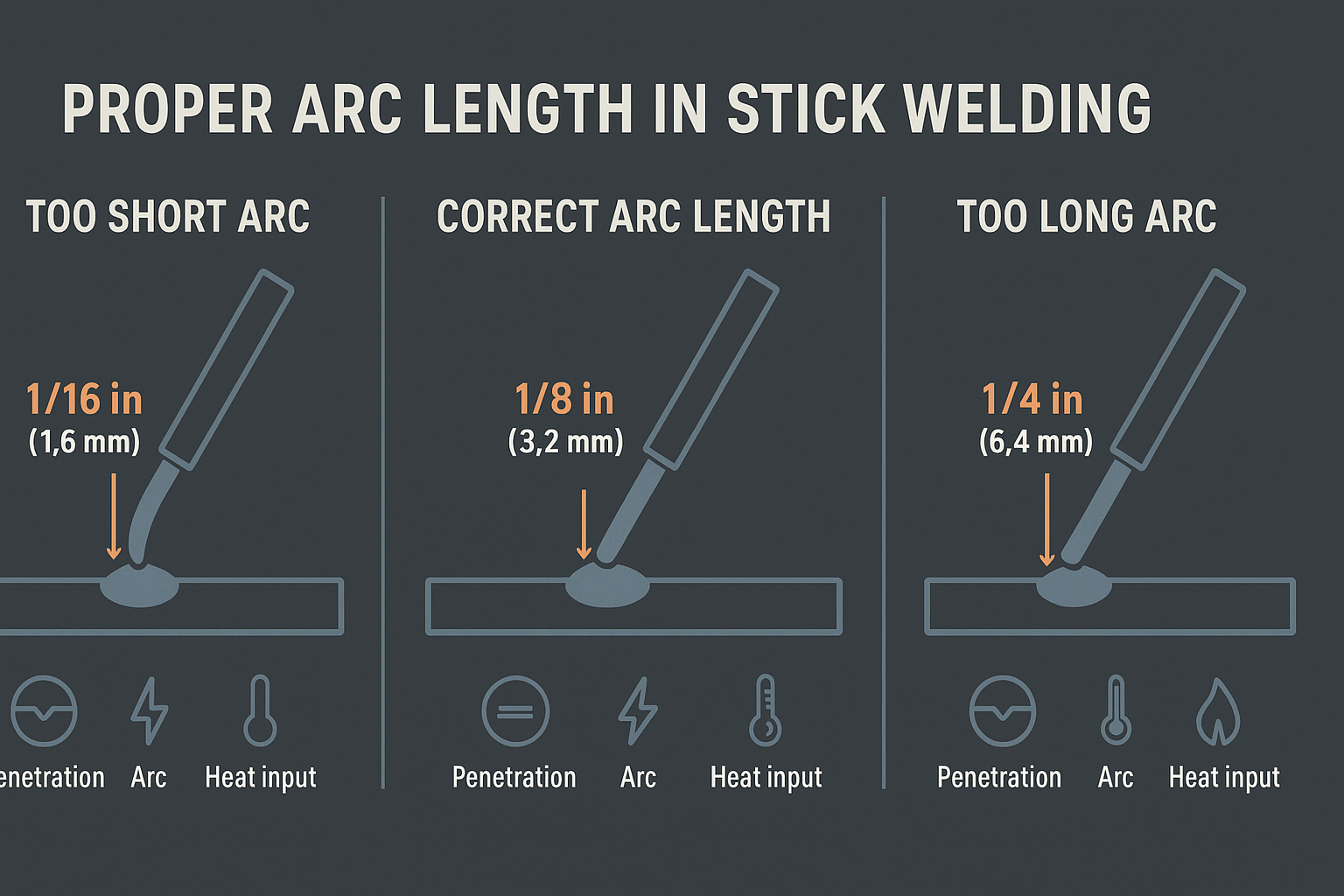
    Arc length is one of the most important variables in stick welding, and this guide—Arc Control: Why Arc Length Matters in Stick Welding—breaks down exactly why. The book explains how arc length influences penetration, bead shape, stability, and overall weld quality. For new welders trying to stop sticking and wandering arcs, and for experienced welders chasing cleaner, more consistent beads, this resource provides straightforward direction.

    Key Features

    This guide focuses entirely on understanding and maintaining proper arc length. Core topics include:

    • How arc length affects heat input and penetration
    • How arc stability changes with electrode angle and travel speed
    • The relationship between arc length, puddle control, and weld bead behavior
    • Visual diagrams that show what “too long” and “too short” arcs look like
    • Simple, actionable tips welders can use immediately

    It’s written in plain language with enough detail to be useful without overwhelming beginners.

    Pros & Cons

    Pros

    • Clear explanations of how arc length affects weld quality
    • Applicable to all experience levels
    • Helpful illustrations and diagrams
    • Strong focus on practical, real-world improvement

    Cons

    • Doesn’t include advanced technical data
    • Could go deeper for welders who already have strong arc control

    Who It’s For

    This guide fits welders who want more consistency and better quality out of their SMAW work. Ideal groups include:

    • Welding students learning fundamentals
    • DIY welders trying to reduce sticking and uneven beads
    • Working welders who want tighter control and repeatable results
    • Anyone who struggles with keeping a steady arc length

    What Makes It Unique

    Most welding books touch on arc length but don’t spend much time on it. This guide focuses specifically on that variable and explains it step-by-step. The visuals help welders understand what they should see, and the practical advice makes it easy to apply on the next weld.

    Buying Tips

    For the best learning experience:

    • Look for editions that include diagrams, photos, or companion videos
    • Choose the latest version if updates are available
    • Make sure you have basic PPE and electrodes on hand so you can practice
    • Pair the guide with a machine that has stable output—helpful when learning arc control

    Conclusion

    Arc Control: Why Arc Length Matters in Stick Welding is a solid resource for anyone wanting stronger, cleaner, and more consistent stick welds. It breaks down arc length in a way that welders can understand and apply immediately. Beginners and seasoned welders alike will find something useful here.

    This article may contain Amazon affiliate links. We may earn a small commission at no extra cost to you.

  • Arc Control Secrets: Stick Welding Tips That Matter

    Arc Control Secrets: Stick Welding Tips That Matter

    Introduction

    Arc Control Secrets: Stick Welding Tips That Matter is a focused guide for welders who want to improve control, stability, and consistency in SMAW (Stick) welding. Arc control directly affects bead shape, penetration, and weld soundness—this book breaks those concepts down and explains how to apply them in real work, not just theory.

    Key Features

    The guide covers the fundamentals of arc stability and then moves into more advanced control techniques. Topics include:

    • Managing arc length for different electrodes
    • Electrode angle and travel speed adjustments
    • How arc force, heat input, and polarity affect bead shape
    • Troubleshooting common issues like sticking, porosity, and wandering arcs
    • Real-world examples that connect each technique to practical shop scenarios

    The layout is straightforward and designed for welders who want actionable steps rather than long explanations.

    Pros & Cons

    Pros

    • Strong focus on arc control—one of the hardest SMAW skills to master
    • Real examples welders will recognize from shop and field work
    • Works for any skill level
    • Clear illustrations and explanations
    • Helps improve consistency, bead appearance, and quality

    Cons

    • Only covers stick welding (SMAW), not MIG/TIG
    • Some techniques may require tools a beginner may not have
    • New welders might feel overwhelmed by the depth in later chapters

    Who It’s For

    This guide fits:

    • Beginners who need to understand how arc length, angle, and motion affect results
    • Intermediate welders trying to tighten up consistency
    • Experienced welders who want to refine technique and improve control in tricky positions
    • Anyone welding structural steel, pipe, fabrication, or artistic work where bead control matters

    What Makes It Different

    Most welding books mention “arc control,” but few explain how to actually master it. This guide centers entirely on that skill. The illustrations and examples make complex ideas usable, and the focus on real welding conditions—heat buildup, position changes, joint access—makes it more practical than typical classroom-style manuals.

    Buying Tips

    Before picking up the guide, consider:

    • Your current SMAW skill level
    • Whether you already have a range of electrodes and amps to practice the techniques
    • If your machine lets you adjust arc force/amps precisely (helpful but not required)
    • Whether you’re focused on structural, repair, or hobby welding

    If improving bead quality, consistency, and control is your goal, this book is a solid addition to your toolbox.

    Conclusion

    Arc Control Secrets: Stick Welding Tips That Matter is a detailed, practical resource for welders who want to improve one of the most difficult parts of SMAW: controlling the arc. The techniques help produce cleaner, stronger, and more repeatable welds. It’s a worthwhile guide for both new welders and experienced pros looking to refine their craft.

    This article may contain Amazon affiliate links. We may earn a small commission at no extra cost to you.

Stream with Amazon Music