Tag: tungsten electrode

  • TIG Tungsten Balling Causes on AC Welding: Aluminum Setup, AC Balance, Amperage, and Electrode Choice

    TIG tungsten balls on AC because the electrode is getting too hot at the tip. A small controlled ball can be normal on older transformer-style AC aluminum welding, especially with pure or zirconiated tungsten. Excessive balling, mushrooming, splitting, wandering arc, or tungsten dropping into the weld usually means the tungsten is overloaded, the AC balance puts too much heat on the electrode, the tungsten diameter is too small, the electrode type is wrong for the machine, or the shielding gas is not protecting the hot tungsten.

    On modern inverter AC TIG machines, a sharp or truncated point is usually preferred over a large ball. If the tungsten balls immediately reduce electrode-positive cleaning action, use a larger tungsten, switch to 2% lanthanated, ceriated, or zirconiated tungsten depending on the machine and procedure, shorten stickout, verify argon coverage, and confirm the torch is not overheating.

    Related TIG checks include why TIG tungsten turns black, TIG porosity troubleshooting, and TIG cup size and gas coverage selection.

    Common Symptoms

    SymptomLikely CauseFirst Check
    Tungsten forms a large ball immediatelyToo much heat on electrode, tungsten too small, wrong AC balanceCheck tungsten diameter and reduce cleaning action
    Ball grows wider than tungsten diameterElectrode overloadedUse larger tungsten or reduce amperage
    Arc wanders around the ballBall too large or contaminated tungstenRegrind to truncated point
    Tungsten splits or spits into puddleOverheating, contamination, wrong tungsten typeReplace electrode and verify AC settings
    Tungsten turns black after weldingPoor post-flow or gas coverage failureCheck argon flow, cup, gas lens, and post-flow

    What Causes Tungsten Balling on AC?

    • Too much electrode-positive time: More cleaning action puts more heat into the tungsten.
    • Tungsten diameter too small: A small electrode cannot carry the selected amperage without melting back.
    • Wrong tungsten for the machine: Pure tungsten balls easily and is mainly associated with older transformer AC machines.
    • Too much amperage: The electrode overheats before the puddle stabilizes.
    • Long tungsten stickout: Poor cooling and weak gas coverage let the tip overheat and oxidize.
    • Contamination: Touching filler, puddle, aluminum oxide, or dirty base metal makes the tip deform.
    • Poor shielding gas: Low flow, high turbulent flow, cracked cup, bad gas lens, or short post-flow damages the hot tungsten.

    Electrode Choice Notes

    For older transformer AC aluminum welding, pure tungsten may naturally form a balled end. Zirconiated tungsten is often used where a balled or rounded end is desired with better contamination resistance. On modern inverter AC machines, lanthanated and ceriated tungstens usually hold a prepared point better and give a more focused arc. Do not assume the same tungsten prep works for every AC TIG machine.

    Tungsten TypeAC BehaviorNotes
    Pure tungstenBalls readilyMostly for transformer AC; lower current capacity
    ZirconiatedRetains rounded/balled end betterGood AC choice where weld contamination is a concern
    LanthanatedHolds point well on inverter ACCommon modern AC/DC TIG choice
    CeriatedGood starts and stable arcOften used for lower-amperage TIG
    ThoriatedLess common for AC aluminum todayRadiation concern; verify shop procedure

    Inspection Steps

    1. Identify the machine type. Transformer AC and inverter AC do not use the same tungsten-prep approach.
    2. Check tungsten diameter. If the ball exceeds the electrode diameter or forms instantly, the electrode may be undersized for amperage.
    3. Check AC balance. Reduce cleaning action if the machine is putting excessive heat into the tungsten.
    4. Check AC frequency if available. Higher frequency focuses the arc but can require a stable prepared tip.
    5. Regrind the tungsten. Use a clean truncated point for inverter AC unless the procedure calls for a ball.
    6. Inspect gas coverage. Check cup size, cracked cup, gas lens condition, argon flow, and post-flow.
    7. Clean aluminum thoroughly. Remove oxide and contamination before welding; do not make the tungsten carry the cleaning burden.
    8. Watch torch heat. A hot air-cooled torch can contribute to consumable and tungsten failure.

    Field Fix vs Proper Fix

    ProblemField FixProper Fix
    Large ball forms instantlyLower amperage and reduce cleaning actionUse correct tungsten diameter and AC balance
    Arc wandersRegrind tungstenUse truncated point and correct AC frequency/balance
    Tungsten spits into weldStop and replace tungstenCorrect overheating, contamination, and tungsten type
    Black tungsten after weldIncrease post-flowRepair gas leaks and replace damaged cup/gas lens
    Repeated balling on aluminumMove to larger tungstenMatch electrode, amperage, machine type, and procedure

    Common Wrong-Part Mistakes

    • Using pure tungsten on an inverter machine when lanthanated or ceriated would hold shape better.
    • Using 1/16 in. tungsten for amperage that needs 3/32 in. or larger.
    • Buying cups, collets, or gas lenses without confirming torch series and tungsten diameter.
    • Trying to fix excessive balling by increasing gas flow until turbulence pulls in air.
    • Using a balled tip because it was common on old transformer machines, even though the inverter setup wants a truncated point.

    Compatibility Notes

    Tungsten choice depends on machine type, AC waveform control, amperage, tungsten diameter, base metal, and procedure. Torch consumables must match the torch family, cup style, collet size, and tungsten diameter. If using WP-17, WP-18, or WP-26 style parts, verify the actual torch body and gas lens setup before ordering.

    Related Failure Paths

    • Arc wandering from a large or contaminated tungsten ball.
    • Black tungsten from poor post-flow or gas leakage.
    • Aluminum porosity from poor cleaning or shielding.
    • Dirty weld starts from contaminated tungsten.
    • Gas lens/cup failure mistaken for tungsten failure.
    • Excess cleaning action overheating the electrode.

    Safety Notes

    • Let tungsten and torch parts cool before handling.
    • Use eye protection when grinding tungsten.
    • Use a dedicated tungsten grinder or wheel to avoid contamination.
    • Follow shop rules for thoriated tungsten handling and dust control.
    • Secure argon cylinders and use ventilation during test welds.

    Sources Checked

    • Miller guidance on AC TIG inverter tungsten selection.
    • CK Worldwide tungsten electrode characteristics guide.
    • CK Worldwide AC TIG aluminum setup notes.
    • Weld Support Parts TIG tungsten discoloration and gas coverage support pages.
    • Weld Support Parts TIG cup size and porosity troubleshooting pages.
  • TIG Tungsten Contamination Troubleshooting: Black Specks, Arc Wander, Dirty Starts, and Re-Grind Checks

    TIG tungsten contamination usually comes from one of five places: the tungsten touched the puddle, the filler rod hit the electrode, shielding gas was interrupted, the tungsten was ground on a dirty wheel, or the torch consumables are leaking or loose. The fix is not to keep welding through it. Stop, cut back or re-grind the contaminated tungsten, verify gas coverage, inspect the collet/gas lens/cup, and test on clean scrap before returning to the part.

    Contaminated tungsten can show up as black specks in the bead, gray or black weld edges, arc wandering, hard starts, sputtering, excessive balling, or a weld puddle that will not stay centered. On critical work, assume the contaminated section of weld may need to be removed and re-welded. Do not treat tungsten inclusions as cosmetic.

    Common Symptoms

    SymptomLikely CauseFirst Check
    Black specks in beadTungsten dipped or flaked into puddleInspect tip under good light
    Arc wanders or splitsDirty grind, off-center point, contaminated tipRe-grind lengthwise on clean wheel
    Gray/black weld surfacePoor shielding, long stickout, post-flow too shortCheck argon flow, leaks, cup, gas lens
    Tungsten balls excessivelyToo much amperage for diameter, wrong polarity/process setupVerify tungsten size, type, current, polarity
    Tungsten slipsWorn collet or collet bodyPull-test electrode after tightening

    Fast Diagnosis Procedure

    1. Stop welding immediately. Do not keep running a bead after dipping the tungsten.
    2. Remove the tungsten. Look for melted filler, dark oxidation, a balled end, cracks, or an off-center point.
    3. Cut back if dipped. If base metal or filler is fused into the tip, cut off the bad section before grinding.
    4. Re-grind lengthwise. Grind marks should run with the electrode, not around it.
    5. Check gas coverage. Verify cylinder valve, regulator, hose leaks, torch O-rings, cup condition, and post-flow.
    6. Inspect torch consumables. Replace cracked cups, loose collets, damaged gas lenses, and worn collet bodies.
    7. Run a scrap test. Use clean scrap, same filler, same amperage, and same torch angle before returning to the job.

    What Wears Out First

    The tungsten tip gets blamed first, but the support parts often cause repeat contamination. A worn collet can let the electrode move. A damaged collet body can create poor current transfer. A clogged or damaged gas lens can disturb shielding gas. A cracked cup can pull air into the weld zone. A loose back cap or damaged rear seal can also create gas problems that look like bad tungsten prep.

    Inspection Steps

    • Tungsten: verify diameter, alloy/color code, grind direction, point symmetry, and contamination at the tip.
    • Collet: confirm it matches the tungsten diameter and grips without over-tightening.
    • Collet body/gas lens: inspect threads, seating face, screen condition, and gas flow path.
    • Cup: check for cracks, spatter, chips, or poor seating.
    • Gas system: confirm argon, hose condition, regulator flow, torch leaks, and post-flow time.
    • Base/filler metal: clean oil, oxide, mill scale, moisture, coating, and grinder residue before blaming the machine.

    Common Wrong-Part Mistakes

    • Buying a collet that does not match tungsten diameter.
    • Using a standard collet body when the cup setup requires a gas lens body.
    • Mixing torch series parts between 9/20 and 17/18/26-style torches.
    • Assuming all cups fit all torch heads.
    • Ordering tungsten by color only without confirming diameter, current type, and application.
    • Replacing tungsten repeatedly while leaving a worn collet body or leaking cup in service.

    Compatibility Notes

    Before ordering TIG support parts, verify torch series, tungsten diameter, cup thread/style, gas lens or standard collet body, back cap length, power connector, cooling type, amperage range, and process polarity. Lincolnโ€™s parts guide identifies TIG torch support items such as tungsten electrodes, collets, collet bodies, gas lens collet bodies, alumina nozzles, back caps, and connection adapters. Match by torch family and consumable system, not by appearance alone.

    Field Fix vs Proper Fix

    ConditionField FixProper Fix
    Dipped tungstenStop and re-grindCut back contaminated section, re-grind, remove affected weld if required
    Dirty grind wheelUse clean side of wheelUse dedicated tungsten grinder or dedicated wheel
    Cracked cupReplace cupInspect full front-end stack for gas leakage
    Worn colletInstall spare colletReplace collet and inspect collet body threads/taper
    Oxidized tungsten after stopIncrease post-flowVerify post-flow setting, torch leak points, and gas purity

    Related Failure Paths

    Safety Notes

    Wear eye, hand, and respiratory protection appropriate for welding and tungsten grinding. Use local extraction when grinding tungsten dust. Allow hot torch parts to cool before handling. If thoriated tungsten is used, follow your employerโ€™s safety procedure and SDS requirements. For code, sanitary, pressure, aerospace, or structural work, follow the applicable WPS and inspection requirements before accepting or repairing a contaminated weld.

  • TIG Torch Slipping Tungsten? Your Collet Body Is Worn (Here’s the Fix)

    Intro

    You’re TIG welding and the tungsten keeps slipping out of the collet. You tighten the back cap, it holds for a few seconds, then slides again. The arc starts inconsistent, the puddle wanders, and your bead looks rough. The problem isn’t the tungstenโ€”it’s a worn collet body that can’t grip anymore.

    Key Takeaways

    • Tungsten slipping is almost always caused by a worn or damaged collet body, not the tungsten itself
    • A collet body wears from repeated insertion and removal of tungsten
    • Replacement collet bodies are cheap ($5โ€“$15) and take 30 seconds to swap
    • Gas coverage improves dramatically with a fresh collet body
    • Keep spares on hand for every torch size you use

    The Problem

    A worn collet body shows up as:

    • Tungsten slides out even when the back cap is tight
    • Inconsistent arc initiation
    • Poor gas coverage (visible oxidation on the weld)
    • Difficulty maintaining arc length
    • Collet body threads are stripped or loose

    The collet is a small tapered sleeve that grips the tungsten. Every time you insert or remove tungsten, the collet compresses and expands. Over hundreds of cycles, the taper wears out. The grip weakens. Eventually, no amount of back cap tightening will hold the tungsten in place.

    Why It Matters

    A slipping tungsten means an unstable arc. Your puddle control suffers. Weld quality drops. On precision work (aerospace, stainless, thin-wall), a wandering arc is a reject. On production runs, it’s rework and lost time. Plus, a loose tungsten can break mid-weld and contaminate your shielding gas.

    The Fix

    1. Disconnect the torch and let it cool. Safety first.
    1. Unscrew the back cap and remove the old collet body.
    1. Inspect the threads. If they’re stripped, you may need a new torch head (rare).
    1. Install the new collet body. Slide it in and hand-tighten the back cap.
    1. Insert tungsten and tighten firmly. The tungsten should not move when you pull on it.
    1. Test the arc. You should see immediate improvement in arc stability and gas coverage.

    Why This Product Solves It

    The TIG Gas Lens Collet Body #17, 18, 26 Torch 2PK (45V27-1/8″) is a direct replacement for standard TIG torches and includes a gas lens design that improves shielding gas flow. The tapered bore is precision-machined to grip tungsten consistently, and the gas lens allows larger tungsten stick-out for better visibility and control. Two-pack means you have a spare.

    Product Link:  Product not found.

    “>
    Product not found.
     

    What to Check Before You Buy

    • Torch series: This fits #17, #18, and #26 torches (most common sizes)
    • Tungsten size: This collet is sized for 1/8″ (3.2mm) tungsten
    • Gas lens compatibility: Confirm your torch head accepts a gas lens (most do)
    • Thread type: Standard collet body threads (verify if you have an older torch)

    Real-World Use

    A TIG fabricator working on stainless tubing noticed poor gas coverage and arc wander. Swapped the collet body. Tungsten stayed put, arc was stable, and the bead came out clean. One collet body lasted 18 months before needing replacement.

    Common Mistakes

    • Tightening the back cap excessively (damages the new collet body)
    • Using the wrong collet size for your tungsten diameter (loose fit)
    • Not replacing the collet body when it’s visibly worn (keeps struggling with slipping)
    • Forgetting to clean the collet body threads before installation (cross-threading)
    • Buying a single collet body instead of keeping spares (downtime when it fails)

    Safety Notes

    Always let the torch cool before handling. Collet bodies get hot during welding. Wear gloves when removing hot components. If tungsten slips during welding, stop immediatelyโ€”a loose electrode can break and contaminate your argon supply.

    Always follow the manufacturer’s instructions and your shop’s safety procedures. If you’re unsure about fitment or ratings, verify before you buy or install.

    Related Reading

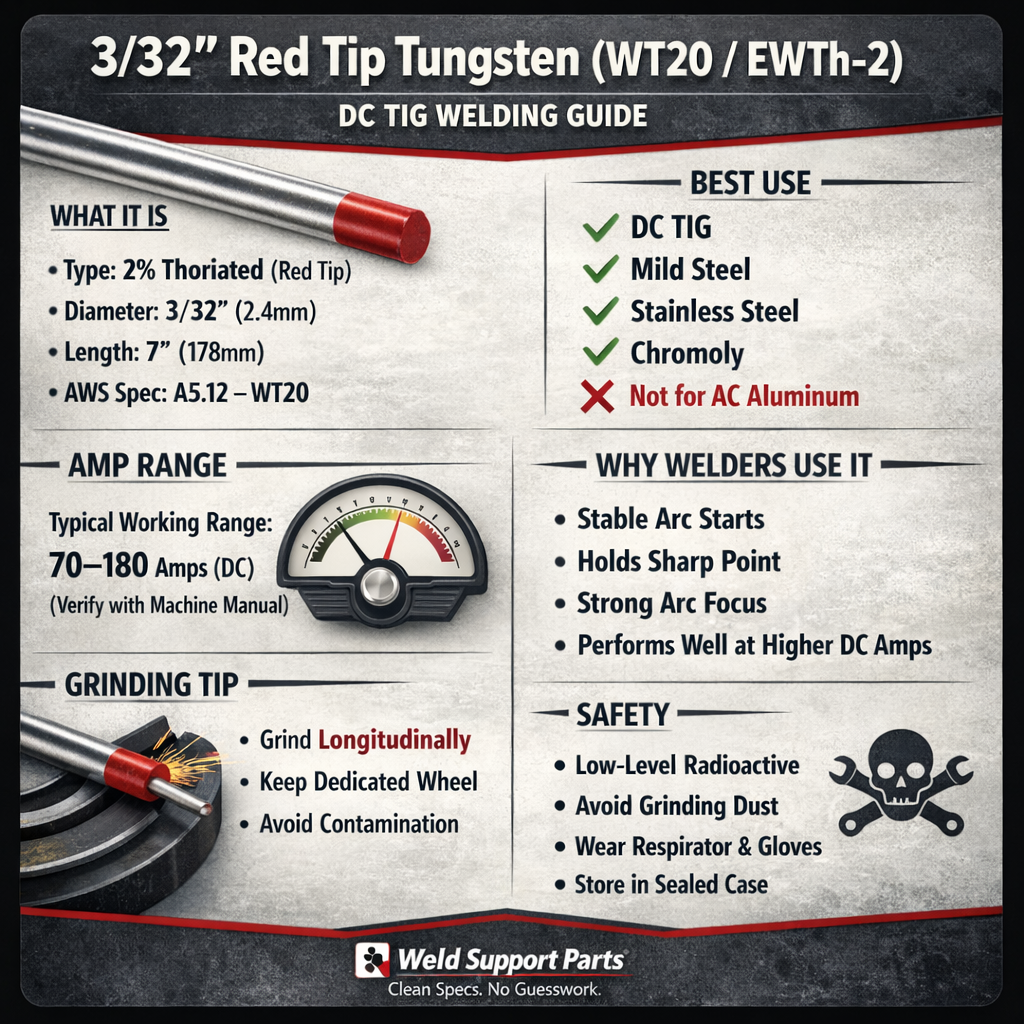
  • TIG Welding Tungsten Electrodes 3/32″ (WT20 Red Tip) โ€“ Specs, Safety & Buying Guide

    TIG Welding Tungsten Electrodes 3/32″ (WT20 Red Tip) โ€“ Specs, Safety & Buying Guide

    Selecting the correct tungsten electrode directly affects arc stability, weld appearance, and electrode life. 3/32″ 2% thoriated (WT20/EWTh-2) is a long-time standard for DC TIG welding on steel and stainless. Hereโ€™s what matters before you buy.


    Key Takeaways

    • 3/32″ (2.4mm) fits most 70โ€“180A DC TIG applications
    • Red tip (2% thoriated) offers stable arc starts and strong arc focus
    • Best for DC welding on steel and stainless
    • Not recommended for AC aluminum
    • Grind longitudinally to maintain arc control

    Where to Buy

    YESWELDER TIG Welding Tungsten Electrode Red Tip 3/32″ x 7″ (Red, WT20/EWTh-2) 10-pk
    • RED TIP: The red band tungsten electrode is a traditional outstanding welding electrode, whose arc is continuous, stable, without spreading and dispersing. As it is not easy to get a round top with thermostability, it performs well in a lifetime.
    • AWS CERTIFIED: AMERICAN Welding Society standard AWS A5.12M/A5.12:2009 conformance
    • UPGRADED PACKAGING: We’ve upgraded from a plastic case to a high-strength, sealed aluminum tube. This airtight design prevents electrode oxidation, ensuring stable arc performance and perfect welds. The innovative dual-open design offers easy access to all electrode lengths, while the rugged, compact build is drop-resistant and portableโ€”ready for your pocket, toolbox, or belt loop
    • PERFECT DESIGN: By checking the color of the outer packaging, you can quickly and easily distinguish the color and model of tungsten electrodes, saving your time and reducing the possibility of errors
    • SPECIFICATION: Diameter: 3/32″; Length: 7″; Quantity: 10pk

    Last update on 2026-05-19 / Affiliate links / Images from Amazon Product Advertising API

    Disclosure: As an Amazon Associate, Weld Support Parts earns from qualifying purchases.


    Why 3/32″ WT20 Is Popular

    Arc Stability

    Thoriated tungsten maintains a sharp point under DC current, producing a focused arc and clean starts.

    Amp Range

    Typical usable range: 70โ€“180A DC (verify with machine manual).
    Works well for:

    • Mild steel
    • Stainless steel
    • Chromoly
    • Field repair work

    Grind Matters

    Always grind lengthwise (not around the circumference).
    Use a dedicated tungsten grinder or clean wheel to prevent contamination.


    Specs

    SpecValue
    Diameter3/32″ (2.4mm)
    Length7″ (178mm)
    ClassificationWT20 / EWTh-2
    Composition2% Thoriated
    ProcessDC TIG
    AC AluminumNot recommended

    Who Should Use This

    Best for:

    • DC TIG welders running steel or stainless
    • Shop and field repair
    • Welding instructors

    Skip if:

    • You weld mostly aluminum (use lanthanated or pure)
    • You prefer non-radioactive options (choose ceriated or lanthanated)

    Safety

    • Thoriated tungsten contains low-level radioactive material
    • Avoid inhaling grinding dust
    • Wear respirator and gloves when sharpening
    • Follow AWS A5.12 classification guidance

    FAQ

    Can I use red tip tungsten on aluminum?
    No. Itโ€™s designed for DC welding.

    Is thoriated tungsten radioactive?
    Yes, at low levels. Safe in use but avoid dust inhalation.

    Whatโ€™s the advantage over ceriated?
    Better performance at higher DC amperage.

    How often should I regrind?
    When arc stability decreases or contamination occurs.


  • Watch with Prime Video