Tag: stainless welding

  • Why Stainless TIG Welds Sugar on the Back Side

    Stainless TIG sugaring is heavy oxidation on the back side of the weld root. It usually happens when the hot root is exposed to oxygen because the purge is missing, weak, contaminated, or removed too soon. This is a narrower alloy-support follow-up to general TIG weld contamination because stainless root oxidation creates its own inspection, cleanup, and corrosion problems.

    Key Takeaways

    • Sugaring is backside oxidation, not normal heat tint.
    • The most common cause is oxygen reaching the stainless root while it is hot.
    • Back purging with argon is the standard fix for full-penetration stainless TIG welds.
    • Too much purge flow can create turbulence and pull air into the purge zone.
    • Heat input, travel speed, fit-up, purge dams, and purge time all affect root color.
    • For stainless work, welding fume controls matter because chromium and nickel exposure must be considered.

    Problem / Context

    A clean stainless TIG bead on the outside can still fail the job if the inside of the tube, pipe, or sheet joint looks black, crusty, or granular. That rough oxidized root is commonly called sugaring. On sanitary, food-grade, chemical, exhaust, brewery, pharmaceutical, and process piping work, the back side of the weld is often just as important as the cap.

    Sugaring is different from surface soot on the face side. For face-side black soot, start with sooty TIG weld troubleshooting. For pinholes or gas pockets in the bead, use the separate TIG porosity checklist.

    Root Causes

    1. No Back Purge on a Full-Penetration Joint

    When stainless steel reaches welding temperature, the unshielded root side reacts with oxygen. If the joint penetrates through the material and the back side is open to air, oxidation can form even when the torch side looks acceptable.

    2. Purge Gas Starts Too Late

    Starting the purge at the same moment as the arc is usually too late. The enclosed volume must be displaced before welding begins. On tube or pipe, that means allowing enough purge time for the inside atmosphere to be replaced with argon before the root gets hot.

    3. Purge Flow Is Too High or Too Low

    Low flow may not displace air. Excessive flow can stir the purge zone and drag oxygen back into the joint area. Use the procedure, purge equipment instructions, and oxygen monitor where required instead of guessing by sound alone.

    4. Poor Dams, Leaky Tape, or Open Ends

    Purge dams, plugs, foil, tape, and end caps must seal well enough to hold a stable argon blanket while still allowing controlled venting. Completely sealed purge cavities can pressurize and disturb the puddle; wide-open cavities waste gas and leave oxygen in the root area.

    5. Excessive Heat Input

    High amperage, slow travel, repeated reheating, or a wide root opening can keep the back side hot long enough to oxidize. Heat control is especially important on thin 304 and 316 stainless tube. If the torch side is also discolored or contaminated, review TIG contamination causes before blaming filler metal.

    6. Torch Shielding Is Being Confused With Back Purging

    A larger TIG cup or gas lens improves face-side shielding, but it does not protect the root side of a closed tube or pipe. Use the correct TIG cup size for the torch side, then treat root purge as a separate gas-coverage problem.

    Solution

    Step 1: Confirm the Joint Actually Needs a Purge

    Full-penetration stainless joints, tube welds, pipe roots, sanitary welds, process piping, and corrosion-critical welds normally need root shielding. Cosmetic stainless sheet welds with no backside exposure may have different acceptance requirements. Verify the job specification, weld procedure, customer requirement, or code before deciding that sugaring is acceptable.

    Step 2: Set Up a Controlled Argon Path

    Introduce argon at one end of the purge zone and vent from the opposite side or high point. The goal is not pressure; the goal is oxygen displacement. Avoid blasting argon straight at the root opening. Diffuse the flow when possible and keep the vent large enough to prevent pressure buildup.

    Step 3: Use Proper Purge Dams or Plugs

    For small tube and exhaust work, silicone purge plugs can make setup more repeatable than loose tape. For pipe, soluble purge paper or dedicated purge dams may be better. Always verify temperature limits, pipe size, chemical compatibility, and cleanup requirements before choosing a dam or plug.

    Step 4: Let the Purge Stabilize Before Welding

    Do not strike the arc immediately after opening the purge valve. Give the purge enough time to displace air from the enclosed area. Critical stainless work may require an oxygen monitor instead of a time estimate.

    Step 5: Keep the Purge Running After the Arc Stops

    The root can still oxidize after the arc ends if the purge is shut off while the weld is hot. Leave the purge on long enough for the root to cool below the point where heavy oxidation forms. The exact time depends on material thickness, heat input, joint design, and procedure requirements.

    Step 6: Reduce Heat Input Before Increasing Gas

    If the root still sugars with a stable purge, check amperage, travel speed, fit-up, root opening, pulse settings, and filler addition. More gas is not always the fix. Excessive purge or torch flow can make shielding worse by creating turbulence.

    Specs / Verification Notes

    Item to VerifyWhy It MattersField Note
    Base alloy304, 304L, 316, 316L, duplex, and nickel alloys may have different procedure requirements.Unknown (Verify)
    Filler metalWrong filler can reduce corrosion performance or fail job requirements.Match WPS or engineered requirement.
    Purge gasArgon is commonly used for stainless TIG back purging.Verify purity and cylinder labeling.
    Purge oxygen levelCritical stainless roots may require measured oxygen levels.Unknown (Verify by procedure).
    Purge dam ratingHeat and material compatibility vary by plug, dam, or paper.Verify manufacturer limits.
    Acceptance criteriaSome work rejects any heavy root oxidation; other work may not.Verify code, customer spec, or WPS.

    Product Section

    For small stainless tube, exhaust, and fabrication work, reusable silicone purge plugs can help create a more controlled argon cavity than improvised tape alone. Confirm the plug size range, temperature rating, venting method, and job requirements before use.

    Strictly Modified High Temperature Silicone Welding Back Purging Plugs 2″ – 2 1/4″ (Set of 2)
    • Easy Installation and Removal. Fitting sleeves can simply be pushed out and transferred to another plug. Since the sleeves are 1/8″ NPT, you have the ability to use different fittings, and increase or decrease the feed/vent sizes. The internal diffuser fitting allows for a smooth, even, non turbulent argon flow into the tube/pipe. This allows for argon to fill the tube/pipe quicker, saving you on gas and time. Internal diffusers are a must when back purging, especially on larger diameter tube/pipe.
    • Fittings Included, (1) 1/8″ NPT Barb Fitting, (2) 1/8″ NPT Sleeves, (1) 1/8″ NPT Diffuser Fitting, and (1) 1/8″ NPT Vent Fitting, Pre-assembled and ready for use.
    • Back Purge Titanium, Stainless Steel, Inconel with little to no set up time
    • Temperature Rating 600 Degrees F
    • Fitment – 2″ Sch 10/40/80 Pipe & 2″-2.25″ Tube

    Last update on 2026-05-19 / Affiliate links / Images from Amazon Product Advertising API

    Comparison Table

    MethodBest UseMain RiskVerification Point
    Silicone purge plugsTube, exhaust, small pipe, repeat shop setupsWrong size or overheatingVerify size and temperature rating.
    Soluble purge paperPipe where the dam must dissolve after weldingPoor seal or moisture sensitivityVerify pipe size and cleanup requirements.
    Foil and tape damTemporary sheet or odd-shape purge boxesLeaks, adhesive failure, trapped pressureInspect vents and seals before welding.
    Copper or aluminum backingFlat sheet or open backside accessMay not replace purge on corrosion-critical workVerify procedure acceptance.
    No purgeOnly when the procedure allows itRoot sugaring and corrosion concernsConfirm with WPS or customer requirement.

    Related Failure Paths

    Safety Notes

    Stainless welding can involve chromium and nickel in welding fumes. OSHA identifies occupational exposure to hexavalent chromium as possible through inhalation of dusts, mists, or fumes containing chromium compounds, and OSHA chromium standards require assessment of potential employee exposure. Use local exhaust, ventilation, respiratory protection when required, eye protection, gloves, and the employerโ€™s written safety procedures.

    Argon purge gas can displace oxygen in confined or poorly ventilated spaces. Never purge inside enclosed spaces without a confined-space plan, atmospheric monitoring where required, and proper supervision. ANSI Z49.1 and AWS safety materials should be used alongside site-specific procedures.

    FAQ

    Is stainless sugaring the same as porosity?

    No. Sugaring is heavy oxidation on the back side of the stainless root. Porosity is trapped gas inside the weld bead. Both can involve shielding problems, but they are different failures.

    Can a larger TIG cup stop backside sugaring?

    Not by itself. A larger cup or gas lens helps shield the torch side. Backside sugaring requires root-side shielding, usually by back purging or an approved backing method.

    Should the purge be turned off as soon as the weld is finished?

    No. Keep the purge running while the root cools. Turning it off too early can oxidize the hot stainless root after the arc stops.

    Can sugaring be brushed away?

    Light surface color and heavy root oxidation are not the same issue. Heavy sugaring may require mechanical removal, repair, or rejection depending on the job specification. Do not assume brushing makes the weld acceptable.

    Does every stainless weld need a purge?

    No. The need depends on penetration, backside exposure, alloy, service environment, inspection requirement, and WPS. Full-penetration stainless tube and pipe are common cases where purging is expected.

    Next Step

    If the stainless root is black or crusty, do not start by increasing amperage or adding filler. First confirm purge coverage, purge time, venting, and oxygen control. Then check heat input, fit-up, and torch-side shielding. For face-side contamination, use the TIG contamination troubleshooting guide before replacing consumables.

    Sources Checked

    • Miller Welds: How to Solve 10 Common TIG Welding Problems; stainless sugaring/backside oxidation and argon back purge guidance.
    • Miller Welds: Pipe Contractor Eliminates Back Purge on Stainless Steel Pipe Welds; shielding gas displacement and oxidation prevention context.
    • OSHA: Hexavalent Chromium Exposure and Controls; chromium exposure assessment and standards overview.
    • OSHA Publication 3373: Hexavalent Chromium; chrome alloys, stainless steel, and welding-related chromium context.
    • AWS Safety and Health Fact Sheet: welding fume exposure assessment, including chromium and nickel focus for stainless welders.
    • Weld Support Parts Blog: TIG contamination, TIG porosity, sooty TIG welds, and TIG cup size support articles.
    • Amazon listing checked for ASIN B07VMZ646H: Strictly Modified High Temperature Silicone Welding Back Purging Plugs 2 inch to 2-1/4 inch.
  • Why Your TIG Weld Is Getting Contaminated (And How to Fix It)

    TIG contamination shows up as a dull, dirty weld, unstable arc, or blackened tungsten. Itโ€™s usually caused by poor shielding, dirty material, or tungsten issues, and it will quickly ruin weld quality if not corrected.

    Key Takeaways

    • Contamination is usually caused by air exposure or dirty surfaces
    • Tungsten condition directly affects arc stability
    • Shielding gas problems are a top cause
    • Cleanliness is critical for TIG welding success

    Whatโ€™s Causing the Problem

    1) Poor Shielding Gas Coverage

    • Gas flow is too low or disrupted
    • Drafts pulling shielding gas away
    • Leaks in hoses or fittings

    2) Dirty Base Material

    • Oil, grease, oxidation, or coatings
    • The aluminum oxide layer was not removed
    • Stainless contamination from improper tools

    3) Contaminated Tungsten

    • Touching the puddle or filler rod
    • Improper grinding direction
    • Using the wrong tungsten type for the job

    4) Incorrect Gas Flow Settings

    • Too low โ†’ inadequate shielding
    • Too high โ†’ turbulence pulling in air

    5) Bad Technique

    • Long arc length exposing the weld to the atmosphere
    • Improper torch angle
    • Inconsistent filler rod feeding

    How to Fix It

    Step 1: Set Proper Gas Flow

    • Typical range: 15โ€“25 CFH (7โ€“12 L/min)
    • Use lower end indoors, higher if needed for coverage

    Step 2: Clean the Material Thoroughly

    • Use a dedicated stainless steel brush for aluminum/stainless steel
    • Remove all oil and grease with acetone
    • Grind or wire brush to clean the metal surface

    Step 3: Prepare Tungsten Correctly

    • Grind longitudinally (not around)
    • Keep a sharp, clean point for DC welding
    • Replace tungsten if contaminated

    Step 4: Check Equipment

    • Inspect gas lines and connections for leaks
    • Clean the nozzle and check the gas lens if installed
    • Ensure proper cup size for coverage

    Step 5: Improve Technique

    • Keep arc length short and consistent
    • Maintain proper torch angle (~10โ€“15ยฐ)
    • Feed the filler rod smoothly without touching the tungsten

    Common Mistakes to Avoid

    • Welding on dirty or oxidized metal
    • Letting tungsten touch the weld puddle
    • Running gas flow too high or too low
    • Using contaminated filler rods
    • Ignoring drafts in the work area

    Best Settings / Guidelines

    ParameterTypical Range
    Gas Flow15โ€“25 CFH (7โ€“12 L/min)
    Arc LengthShort and consistent
    Torch Angle10โ€“15ยฐ
    Tungsten PrepSharp point (DC), clean grind
    Filler RodClean, matched to material

    Always verify with your machine settings and material requirements.

    Safety Notes

    • Wear proper eye protection (ANSI Z87.1) and a welding helmet
    • Avoid breathing shielding gas in confined areas
    • Use proper ventilation when cleaning with solvents
    • Keep gloves clean to prevent contaminating filler rods

    FAQ

    Why does my tungsten turn black?
    This usually indicates poor shielding gas coverage or contamination.

    Can I reuse contaminated tungsten?
    Yes, but it must be re-ground properly before reuse.

    Does gas type matter for contamination?
    Yesโ€”pure argon is standard for TIG and provides proper shielding.

    Why is aluminum more prone to contamination?
    Aluminum forms an oxide layer that must be removed before welding.

    Can drafts really affect TIG welding?
    Yesโ€”even small air movement can disrupt shielding gas.

    Sources Checked

    • American Welding Society
    • Lincoln Electric TIG welding resources
    • Miller Electric application and troubleshooting guides

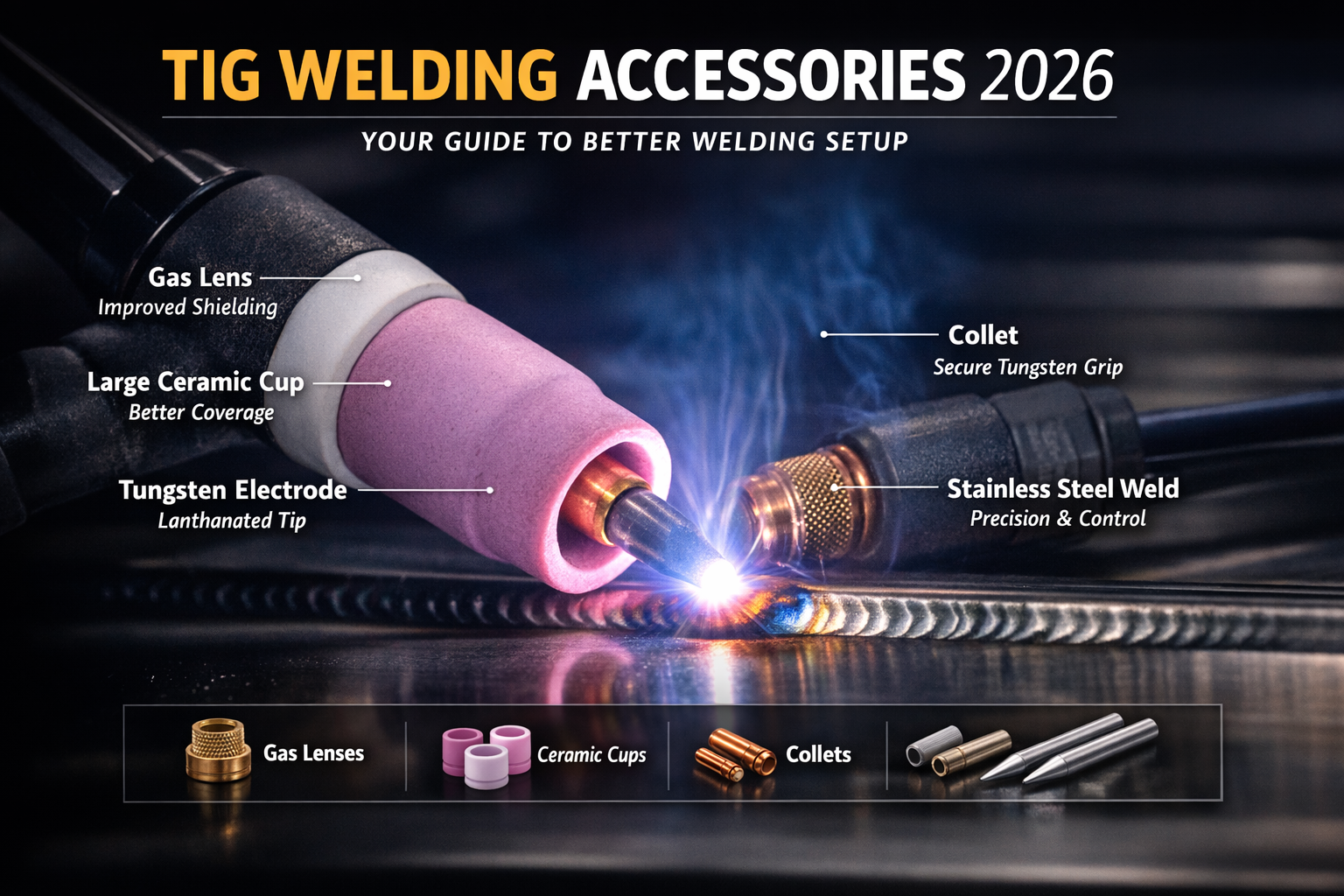
  • TIG Welding Accessories: Choosing the Right Setup for 2026

    TIG Welding Accessories: Choosing the Right Setup for 2026

    Selecting TIG welding accessories can make or break your results. The right setup improves arc stability, shielding coverage, and long-term torch reliabilityโ€”while the wrong parts waste time and money.

    Key Takeaways

    • Match collet, cup, and tungsten size to your torch series
    • Gas lens kits improve shielding and weld quality for most jobs
    • Verify compatibility for 17/18/26 vs. 9/20 series torches
    • Tungsten type and prep matter for steel, stainless, and aluminum
    • Accessory kits offer valueโ€”but confirm genuine components

    Performance & Use

    TIG welding demands tight arc control and consistent shielding gas coverage. Accessories such as gas lens kits and high-quality alumina cups help maintain a stable arc and reduce atmospheric contamination.

    Gas lenses straighten gas flow and allow greater tungsten stick-out without losing coverage. This is especially useful for stainless steel and critical welds where porosity is unacceptable.

    For aluminum, larger cups are common to improve shielding. Pure tungsten was historically used on AC aluminum, but many welders now use 2% lanthanated or other modern blends depending on machine settings. Always verify manufacturer recommendations for your specific power source.


    Durability & Build

    Accessory quality varies significantly. Genuine parts from manufacturers such as CK Worldwide and Weldcraft generally provide better fit and longer service life than low-cost generics.

    Inspect:

    • Cups for cracks or uneven glazing
    • Collets for proper tungsten grip
    • Threads for clean engagement

    Avoid mixing brands unless compatibility is confirmed. Poor fit leads to gas leaks and unstable arcs.


    Power / Specs

    AccessoryTypical RangeNotes
    Collet Size1/16″โ€“1/8″Must match tungsten diameter
    Cup Size#4โ€“#8 (standard), #12+ (large gas lens)Process dependent
    Gas LensStandard or LargeImproves shielding coverage
    Tungsten Type2% Thoriated, 2% Lanthanated, PureMatch material & polarity
    Torch Series17/18/26, 9/20Not interchangeable

    Unknown (Verify):

    • Exact kit contents
    • Part numbers
    • Included accessories
    • Country of origin
    • Warranty details

    Who Itโ€™s For

    Best for welders upgrading from a basic TIG setup, professionals seeking improved arc control, and anyone welding stainless or aluminum where shielding matters.

    Not necessary for shops running MIG or stick only.


    Quick FAQ

    Q: Can I use any collet with my torch?
    No. Torch series and tungsten size must match. 17/18/26 components do not fit 9/20 torches.

    Q: Do gas lens kits fit all torches?
    No. Confirm series and thread type before ordering.

    Q: What tungsten is recommended for stainless?
    2% lanthanated or 2% thoriated are common. Verify based on alloy and polarity.

    Q: Are generic kits reliable?
    Quality varies. Genuine parts are preferred for consistent fit and safety.

    Q: Does cup size affect weld quality?
    Yes. Larger cups improve shielding but require increased gas flow.

    Q: How do I confirm compatibility?
    Reference your torch manual or supplier documentation before purchase.


    Safety Notes

    • Wear ANSI Z87.1 safety glasses when grinding tungsten
    • Use a dedicated tungsten grinding wheel to prevent contamination
    • Provide proper fume extraction when welding stainless
    • Turn off power before changing torch components


Listen with Audible