Washington Alloy 309 MIG Welding Wire, 2 LB Spool, .030" Stainless Steel for High Temp Welding
$58.11
In Stock
View Product
$58.11
In Stock
View Product
If MIG weld spatter is running high, start with the basics: voltage, wire feed speed, shielding gas, stickout, and gun angle. Spatter is usually a setup issue, a consumable issue, or both. Do not chase one setting without checking the full weld setup.
If voltage is too low for the wire feed speed, the wire can stub into the puddle and throw spatter. If wire feed is too high for the voltage, the arc can become harsh and unstable. Make small changes and test one variable at a time.
Poor shielding gas coverage increases spatter and can cause porosity. Check the flow, hose condition, fittings, and nozzle buildup. Clean the nozzle if spatter is restricting gas flow.
Long stickout reduces arc stability and can drive spatter up. Excessive push or drag angle can also disturb shielding and puddle control. Hold the gun angle consistent and keep stickout controlled.
Dirty, rusty, kinked, or poorly driven wire can feed unevenly and create spatter. Inspect the spool, drive rolls, and liner. If feed is surging, the arc will usually show it.
Mill scale, rust, oil, paint, and moisture all increase spatter. Poor fit-up can also make the arc unstable. Clean the joint and verify the gap, root face, and edge condition before welding.
When spatter remains high after setup checks, verify consumables and wire selection for the job. If you are welding stainless or high-temperature service material, the wire choice must match the application and procedure. Unknown (Verify) if your procedure allows the following wire for the joint and material.
Allowed product: Washington Alloy 309 MIG Welding Wire, 2 LB Spool, .030″ Stainless Steel for High Temp Welding Experience superior welding performance with Washington Alloy 2 Lb. Spool Mig Welding Wire 309 Stainless Steel (.030 X 2 LB.). This high-quality 309 mig welding wire is engineered for exceptional strength and durability in a variety of welding projects. The USA 309 wire is specifically designed for welding heat-resistant AISI 309 and other chromium grades of stainless steel. It excels in applications where pre-hea...
ArcWeld shortcode:
Washington Alloy 309 MIG Welding Wire, 2 LB Spool, .030" Stainless Steel for High Temp Welding
This product may be relevant when the job calls for 309 stainless wire. Verify base metal, joint design, shielding gas, polarity, and procedure before use.
Common causes are a change in voltage, wire feed, gas flow, stickout, dirty consumables, or contaminated material. Check the full setup before changing the machine again.
No. Gas flow is one factor. High spatter can still come from poor voltage-to-wire-feed balance, bad angle, long stickout, or worn tips.
Yes. A worn or oversized contact tip can create unstable wire delivery and a rough arc.
Only if the wire is damaged, rusty, or feeding poorly. Otherwise, verify machine settings and shielding gas first.

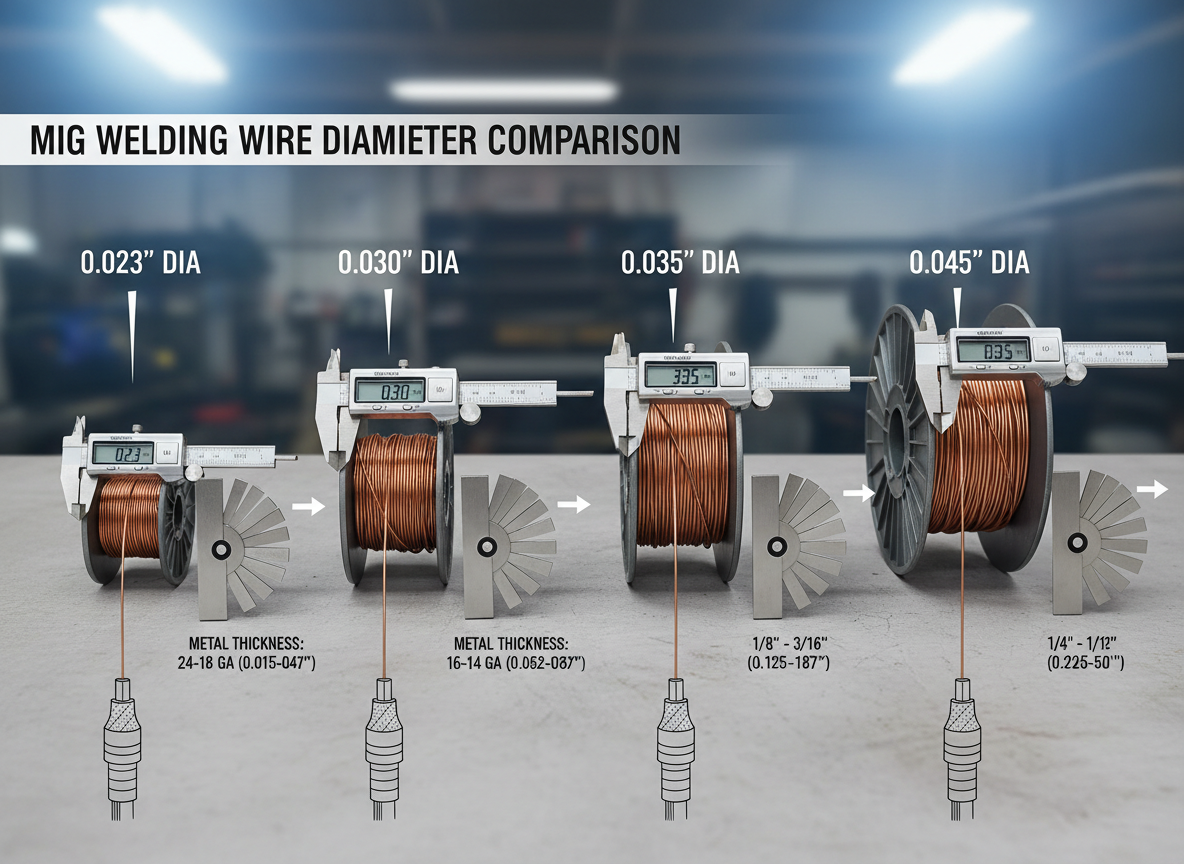
MIG wire selection affects weld quality, spatter levels, and penetration depth. Choosing the right wire depends on base metal composition, surface condition, and shielding gasโnot just diameter and tensile strength.
| Diameter | Amperage Range | Material Thickness | Typical Use |
|---|---|---|---|
| 0.023โ | 30-130A | 24-18 gauge | Automotive sheet metal, thin tubing |
| 0.030โ | 40-145A | 18-14 gauge | General fabrication, light structural |
| 0.035โ | 50-180A | 14 gauge-1/4โ | Most common all-purpose size |
| 0.045โ | 75-250A | 1/4โ-1/2โ | Heavy structural, thick plate |
| 0.052โ | 100-300A | 1/2โ+ | Industrial fabrication, heavy equipment |
Rule of thumb: Thinner wire = better control on thin material. Thicker wire = faster deposition on heavy plate.
| Wire Type | Mill Scale | Light Rust | Heavy Rust | Clean Steel |
|---|---|---|---|---|
| ER70S-6 | โ | โ | โ | โ |
| ER70S-3 | โ | โ | โ | โ |
| ER308L | โ | โ | โ | โ |
| ER316L | โ | โ | โ | โ |
ER70S-6 advantage: Higher deoxidizers clean impurities during welding. ER70S-3 requires clean base metal to avoid porosity.
AWS A5.18 (Carbon Steel MIG Wire) – Covers ER70S-3, ER70S-6, and other carbon steel wires – Defines chemical composition, tensile strength, and elongation requirements
AWS A5.9 (Stainless Steel MIG Wire) – Covers ER308L, ER316L, and other stainless wires – Specifies corrosion resistance and ferrite content
Moisture Contamination – Causes: Porosity, hydrogen cracking – Prevention: Store in sealed containers with desiccant packs – Shelf life: 12 months (carbon steel), 6 months (stainless)
Wire Feed Issues – Kinked wire = erratic arc and bird-nesting – Solution: Use proper spool tension and liner size
Liner Compatibility
| Wire Diameter | Liner Inside Diameter |
|---|---|
| 0.023โ-0.030โ | 0.030โ-0.035โ |
| 0.035โ | 0.035โ-0.045โ |
| 0.045โ | 0.045โ-0.052โ |
| 0.052โ | 0.052โ-0.062โ |
Oversized liner = wire wander. Undersized liner = excessive friction and burnback.
Using ER70S-3 on rusty steel
Low deoxidizers canโt compensate for surface contamination. Result: porosity and weak welds. Use ER70S-6 or clean the base metal.
Wrong liner size for wire diameter
0.035โ wire in 0.045โ liner causes erratic feeding. Match liner to wire diameter within 0.005โ-0.010โ.
Storing stainless wire without moisture protection
Stainless wire absorbs moisture faster than carbon steel. Always use sealed containers with desiccant.