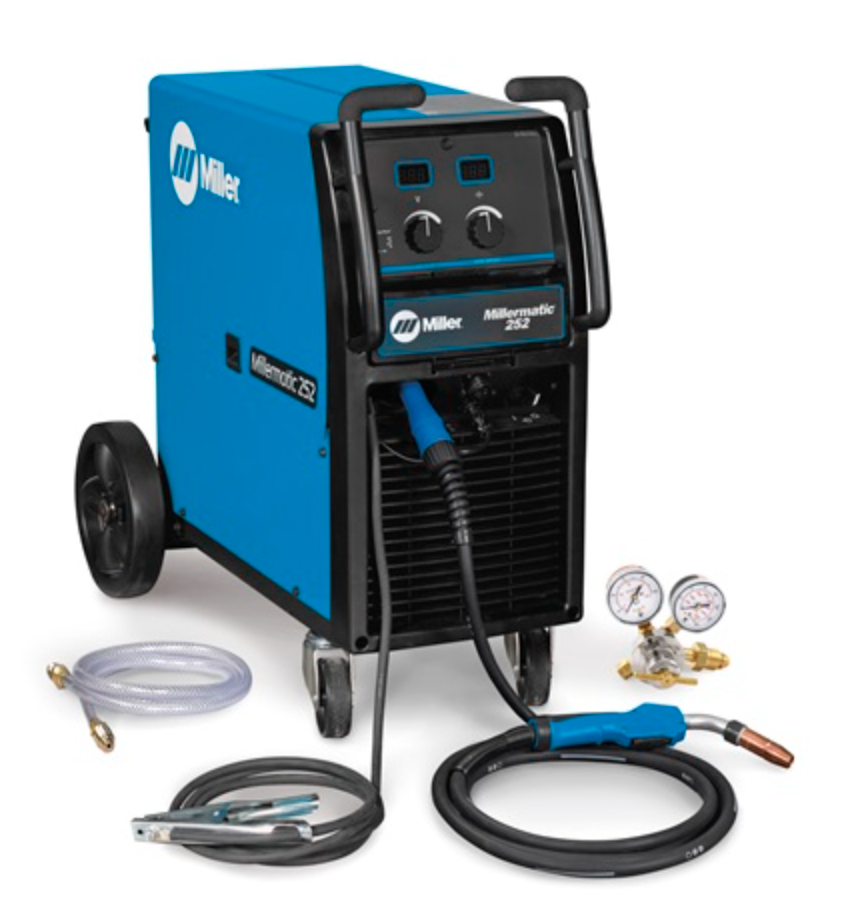
Tag: Millermatic 252

  • Millermatic 252 Wire Feed Troubleshooting and MDX-250 Consumable Compatibility

    If a Millermatic 252 has wire stutter, burnback, birdnesting, poor arc starts, heavy spatter, or drive roll slipping, troubleshoot the complete wire path before replacing electrical parts. The machine is a MIG and flux-cored power source with an integrated wire feeder. The standard package includes a 15 ft, 250 amp MDX-250 MIG gun, .030/.035 in reversible dual-groove drive rolls, extra contact tips, regulator, gas hose, work cable, and running gear. Replacement accuracy depends on confirming the gun series, consumable family, wire size, drive roll style, and whether the machine is being used for solid wire, flux-cored wire, spool gun aluminum, or push-pull aluminum.

    The common wrong-part mistake is assuming all Millermatic 252 guns use the same front-end parts. Older or changed machines may still have an M-25 gun, while current Miller literature lists the MDX-250 with AccuLock MDX consumables as the standard gun. Use the Miller MIG gun selection chart and the Miller MDX-250 gun parts page before ordering tips, nozzles, diffusers, liners, or a replacement gun.

    Common Symptoms

    SymptomLikely CauseQuick Check
    Wire stutters while weldingTip drag, liner restriction, wrong drive roll groove, spool dragRemove contact tip and test feed
    Burnback into contact tipLow wire feed, short stickout, worn tip, wire feed interruptionReplace correct AccuLock MDX tip
    Birdnesting at feederDownstream blockage, overtight drive rolls, kinked gun cableStraighten gun lead and refeed with tip removed
    Drive rolls slipToo little tension or blocked wire pathCheck liner and contact tip before tightening
    Wire shaves or copper dust appearsToo much drive tension or wrong grooveInspect wire after feeder
    Flux-cored wire feeds roughSmooth roll used where knurled roll is neededVerify V-knurled roll kit by wire size
    Aluminum feeding fails through MIG gunWrong gun/process setupVerify spool gun or push-pull setup

    Compatibility Notes

    • Machine: Millermatic 252.
    • Stock numbers: 907321 for 208/240 V model; 907322 for 230/460/575 V model.
    • Processes: MIG (GMAW) and flux-cored (FCAW).
    • Amperage range: 30–300 A.
    • Rated output: 200 A at 24 VDC, 60% duty cycle; 250 A at 26.5 VDC, 40% duty cycle.
    • Wire feed speed: 50–700 ipm.
    • Standard gun: MDX-250, 15 ft, AccuLock MDX consumables, part 1770037.
    • Standard wire setup: .030/.035 in reversible dual-groove drive rolls.
    • Solid/stainless wire range: .023–.045 in.
    • Flux-cored wire range: .030–.045 in.
    • Spool size: 12 in maximum.
    • Optional aluminum guns: Spoolmatic 15A, Spoolmatic 30A, Spoolmate 200, XR-Aluma-Pro Lite, and XR-Aluma-Pro are listed by Miller for this platform.

    For failure paths that overlap across MIG systems, compare this machine-specific guide with MIG wire feed troubleshooting, MIG burnback troubleshooting, and MIG gun liner wear symptoms. For broader machine context, see the Millermatic 252 MIG welder overview.

    Inspection Steps

    1. Disconnect input power before opening the feeder or changing drive rolls.
    2. Confirm the installed gun: MDX-250, MDX-250 AccuLock S, M-25, spool gun, or push-pull gun.
    3. Record wire type and diameter before ordering any tip, liner, or drive roll.
    4. Remove nozzle and contact tip, then jog wire with the gun lead straight.
    5. If feed improves with the tip removed, replace the contact tip and inspect the diffuser/nozzle area.
    6. If feed is still rough, release drive rolls and hand-pull wire through the gun to check liner drag.
    7. Inspect drive rolls for correct groove, worn grooves, packed debris, or wire shaving.
    8. Check spool brake tension. The spool should stop without overrun but should not drag heavily.
    9. Verify polarity and shielding gas for solid wire, flux-cored wire, or aluminum setup.
    10. Make one correction at a time, then test on scrap before returning to production work.

    Test Procedures

    Tip-off feed test: Remove the contact tip and jog wire. Smooth feed with the tip removed points to a worn, undersized, spatter-packed, or overheated tip.

    Liner drag test: With power off and drive rolls open, pull wire through the MDX-250 gun. Heavy pull force, rough movement, or bend-sensitive feeding indicates a dirty, kinked, wrong-size, or incorrectly trimmed liner.

    Drive roll tension test: Feed wire against a soft block while keeping clear of the wire end. The rolls should feed without shaving or flattening wire. Do not compensate for a blocked liner by crushing the wire.

    Flux-cored roll check: Miller lists V-knurled drive roll kits for flux-cored or difficult-to-feed wire. If self-shielded flux-core slips in smooth rolls, verify the correct knurled roll by wire diameter before increasing tension.

    Visual Wear Indicators

    • Contact tip bore is oval, blackened, loose, or packed with spatter.
    • Nozzle has spatter bridging between nozzle, diffuser, and tip.
    • Diffuser threads are damaged or the tip does not seat tightly.
    • Wire has flat spots, copper flakes, or shaving dust near the feeder.
    • Drive roll groove is polished smooth or packed with debris.
    • Gun cable feeds only when nearly straight.
    • Liner end is burred, mushroomed, short, long, or contaminated.
    • Flux-cored wire is crushed from excessive drive roll pressure.

    What To Verify Before Ordering

    • Machine model and stock number: 907321 or 907322.
    • Installed gun model and cable length.
    • Consumable family: AccuLock MDX or AccuLock S.
    • Contact tip size: T-M023, T-M030, T-M035, or T-M045 for standard AccuLock MDX.
    • Nozzle style: N-M1200C, N-M1218C, N-M5800C, N-M5818C, or N-M58XTC.
    • Diffuser: D-M250 for standard AccuLock MDX.
    • Liner length: 10 ft, 12 ft, or 15 ft.
    • Liner size: .023/.025, .030/.035, or .035/.045.
    • Drive roll type: V-groove for solid wire, V-knurled for flux-cored wire, U-groove for aluminum.
    • Spool gun or push-pull gun consumables if welding aluminum.

    Common Wrong-Part Mistakes

    • Buying tips by wire size only without confirming MDX-250 consumable family.
    • Installing M-25 consumables on an MDX-250 gun.
    • Using FasTip, M-Series, or Bernard Centerfire consumables on MDX Series guns.
    • Ordering a 10 ft liner for a 15 ft gun.
    • Using .030/.035 liner with .045 wire under production duty.
    • Using smooth V-groove rolls for flux-cored wire that needs V-knurled rolls.
    • Trying to push aluminum through the standard 15 ft MIG gun instead of verifying spool gun or push-pull configuration.
    • Replacing the feeder motor before proving the gun liner and tip are clear.

    Field Fix vs Proper Fix

    FailureField FixProper Fix
    BurnbackCut wire and replace tipCorrect tip size, liner drag, WFS, stickout, burnback timer, and drive tension
    StutterStraighten gun and remove tipReplace restricted liner or wrong consumables
    BirdnestingCut nest and rethread wireRemove downstream blockage and reset drive roll tension
    Flux-core slipIncrease tension slightlyInstall correct V-knurled roll and verify polarity
    Aluminum feed failureShorten lead and reduce bendsUse verified spool gun or push-pull setup with U-groove rolls

    Safety Notes

    • Disconnect input power before feeder inspection, liner replacement, or drive roll changes.
    • Keep hands clear of drive rolls during feed tests.
    • Do not point the gun at yourself or another person while jogging wire.
    • Wear eye protection when clipping wire or blowing out liners.
    • Let contact tips, nozzles, and diffusers cool before removal.
    • Use ventilation and welding PPE when test welding after repair.

    Sources Checked

    • Miller Millermatic 252 spec sheet, issued April 2024, Index No. DC/12.49.
    • Weld Support Parts Miller MIG gun selection chart.
    • Weld Support Parts Miller MDX-250 gun parts page.
    • Weld Support Parts MIG troubleshooting articles listed above.
  • Millermatic 252 Spool Gun Setup Issues: Spoolmatic 15A/30A Aluminum MIG Troubleshooting

    If a Millermatic 252 will not feed aluminum through the spool gun, has no arc, no gas, birdnesting inside the spool gun, burnback at the tip, or welds with heavy black soot, check the spool gun connection and aluminum setup before blaming the welder. The Millermatic 252 supports direct connection of optional Spoolmate and Spoolmatic spool guns without an added module, but the gun plug, weld cable, gas hose, polarity, shielding gas, wire size, contact tip, spool brake, and gun selector behavior still have to be correct.

    The most common setup failures are simple: the gun trigger plug is not seated, the threaded collar is loose, the weld cable is not connected to the correct output terminal, the spool gun gas hose is not connected to the regulator/flowmeter, the wrong gas is being used, or both the MIG gun and spool gun triggers are being pulled. For aluminum MIG, verify 100% argon shielding gas, clean aluminum wire, correct contact tip size, smooth spool rotation, and a clean workpiece.

    Common Symptoms

    • No wire feed from spool gun: Trigger plug, gun selector logic, spool gun motor, wire jam, tip blockage, or spool brake issue.
    • No arc but wire feeds: Weld cable connection, work clamp, polarity, output setting, or gun connection problem.
    • No gas at spool gun: Empty cylinder, closed valve, wrong hose routing, disconnected gas hose, regulator issue, or blocked gun gas path.
    • Burnback into contact tip: Wire speed too low, contact tip too small, wire drag, wrong stickout, or unstable start.
    • Birdnesting inside spool gun: Spool tension too loose/tight, dirty wire, wrong drive tension, wrong tip, or soft aluminum wire snagging.
    • Black soot on aluminum welds: Poor cleaning, wrong gas, long arc, bad gas coverage, travel issue, or contaminated wire/base metal.
    • Porosity: Loss of argon shielding, dirty aluminum, moisture, wind, leak, or blocked nozzle/diffuser.

    What This Setup Does

    A spool gun moves soft aluminum wire from a small spool mounted in the gun instead of pushing it through the main machine gun cable. This reduces feeding problems with aluminum wire. On the Millermatic 252, the spool gun still needs three working paths: trigger/control connection, weld power connection, and shielding gas connection. If any one path is wrong, the gun may feed but not weld, weld but produce porosity, or fail to feed at all.

    Compatibility Notes

    The Millermatic 252 supports direct connection of optional Spoolmate 200 and Spoolmatic spool guns, and Miller literature notes no extra module is required for those supported spool gun / push-pull gun connections. The owner’s manual connection section specifically covers Spoolmatic 15A and 30A gun hookup. If the gun is not a Spoolmate 200, Spoolmatic 15A, Spoolmatic 30A, or an approved XR push-pull setup, treat compatibility as Unknown (Verify).

    For standard MIG gun parts on the same machine, use the Miller MIG gun selection chart. For Miller MIG support categories, see Miller MIG support. For the machine-family overview, see Millermatic 252 MIG welder features and reviews. For related feed checks, see MIG wire feed issues and MIG consumables.

    Correct Connection Checks

    Connection AreaWhat To CheckFailure Symptom
    Gun trigger plugPlug fully inserted and threaded collar tightenedNo feed, no response, intermittent trigger
    Weld cableRouted through front panel and connected to weld output terminalWire feeds but no arc or weak arc
    Gas hoseConnected to regulator/flowmeterNo gas, porosity, black soot
    Shielding gas100% argon for aluminum MIGContamination, soot, porosity
    Work clampClean, tight connection to work or tableErratic arc, no arc, popping
    Gun front endCorrect tip, clean nozzle, proper stickoutBurnback, poor starts, porosity

    Important Two-Gun Behavior

    The Millermatic 252 can have two welding guns connected at the same time, but only one gun should be used at a time. If both triggers are pulled at the same time, weld output and the wire-feed motor are disabled. If the spool gun suddenly seems dead, make sure the main MIG gun trigger is not being pressed, hung up, or stored in a way that closes the trigger.

    Spool Gun Feed Problems

    • Check the contact tip: Aluminum expands with heat. A tight, damaged, or wrong-size tip can cause burnback and feed stoppage.
    • Check the spool brake: Too tight causes drag. Too loose causes overrun and tangled wire.
    • Check drive tension: Too much tension deforms soft aluminum wire. Too little tension slips.
    • Check wire condition: Oxidized, dirty, kinked, or loosely wound aluminum wire feeds poorly.
    • Check gun angle: Sharp bends near the gun body and poor cable handling can increase feed drag.
    • Check wire size: Tip, drive roll, and machine settings must match the aluminum wire diameter.

    Aluminum Weld Quality Problems

    When the spool gun feeds but the weld looks dirty, start with cleaning and gas coverage. Aluminum oxide, oil, marker, moisture, saw lubricant, and handling contamination can all create porosity or soot. Use a stainless brush dedicated to aluminum, remove oxide in the weld zone, and keep 100% argon coverage stable at the puddle. Do not weld aluminum with C25 or CO2 shielding gas.

    Setup Issue Diagnosis Table

    ProblemLikely CauseFirst Fix
    Spool gun does nothingTrigger plug loose or wrong gunSeat plug and tighten collar
    Wire feeds but no arcWeld cable/work clamp problemCheck output cable and work lead
    Wire feeds but no gasGas hose not routed to regulatorConnect gas hose and verify flow
    Wire burns backTip/wire speed/stickout issueInstall correct tip and adjust feed
    Wire tangles in gunSpool tension or drive tension wrongReset spool brake and drive pressure
    Porosity on aluminumDirty base metal or poor argon coverageClean metal and check gas flow
    Machine disables outputBoth gun triggers pulledRelease unused gun trigger

    What To Verify Before Ordering Parts

    • Exact spool gun model: Spoolmate 200, Spoolmatic 15A, Spoolmatic 30A, or other.
    • Gun serial/part number and barrel style.
    • Wire diameter and alloy.
    • Contact tip size and tip series.
    • Nozzle and diffuser condition.
    • Trigger plug condition and threaded collar.
    • Weld cable lug and gas hose fittings.
    • Whether the gun is direct-connect or requires a control not used on this setup.

    Common Wrong-Part Mistakes

    • Ordering consumables for the main MDX-250 or M-25 MIG gun instead of the spool gun.
    • Assuming every Miller spool gun uses the same tip, nozzle, and diffuser.
    • Using steel MIG settings and C25 gas for aluminum spool gun welding.
    • Replacing the machine gas valve before checking the separate spool gun gas hose routing.
    • Overtightening drive tension until soft aluminum wire is flattened.
    • Ignoring the main gun trigger while diagnosing a “dead” spool gun.

    Field Fix vs Proper Fix

    Field fix: Reseat the trigger plug, tighten the collar, confirm the weld cable and gas hose are connected, install a clean correct-size tip, back off excessive spool tension, and test on clean aluminum with argon.

    Proper fix: Verify the exact spool gun model, replace worn spool gun consumables with the correct series, repair damaged trigger/gas/power leads, confirm argon flow at the gun, clean the aluminum correctly, and document the wire alloy, wire size, voltage, wire speed, and gas flow that produce a sound weld.

    Safety Notes

    • Disconnect input power before internal machine service.
    • Secure shielding gas cylinders upright.
    • Wear eye protection when clipping aluminum wire.
    • Keep hands clear of drive rolls and spool gun feed parts while testing.
    • Use ventilation; aluminum welding can still produce hazardous fumes, especially on coated or contaminated material.
    • Do not weld unknown aluminum castings or coated material without identifying contamination and fume hazards.
  • Millermatic 252 vs Millermatic 255: Major Differences, Pulse MIG Capability, and Shop Use Comparison

    The Millermatic 252 and Millermatic 255 are both high-capacity Miller MIG welders designed for fabrication and production work, but they use very different platforms. The 252 is a traditional transformer-based machine focused on conventional MIG welding performance, while the 255 is a newer inverter platform with pulsed MIG capability, digital controls, and lower overall weight.

    Quick Comparison

    FeatureMillermatic 252Millermatic 255
    PlatformTransformerInverter
    ProcessesMIG / Flux CoreMIG / Pulsed MIG / Flux Core
    Pulse MIGNoYes
    Weight~205 lb~84 lb
    Input Power208/230V or multi-voltage versions208–240V Auto-Line
    Duty Cycle250A @ 40%230A @ 60%
    ControlsTraditional knobsDigital LCD + Auto-Set Elite
    Best UseProduction steel fabricationMixed-material and aluminum fabrication

    What Changes Most Between the 252 and 255

    The biggest difference is pulsed MIG capability. The Millermatic 255 includes pulse settings that help reduce heat input, lower spatter, improve aluminum weld appearance, and make thin material easier to control.

    The Millermatic 252 remains a very strong conventional MIG platform with excellent spray transfer performance on steel, especially in production environments.

    Arc Characteristics

    Millermatic 252

    • Smooth transformer arc
    • Excellent spray transfer performance
    • Strong performance on thicker steel
    • Very forgiving machine setup
    • Common in industrial fabrication shops

    Millermatic 255

    • More responsive inverter arc
    • Pulse MIG reduces spatter
    • Better thin aluminum control
    • Digital tuning capability
    • Lower overall machine weight

    Aluminum Welding Differences

    The Millermatic 252 can weld aluminum effectively using a spool gun, especially on thicker material. However, the 255 performs better overall on thinner aluminum because pulse MIG reduces burn-through risk and lowers heat input.

    For cosmetic aluminum fabrication, intermittent production, or mixed-material shops, the 255 is usually easier to dial in.

    Weight and Portability

    The 252 is significantly heavier because of its transformer design. It is commonly treated as a permanent shop machine.

    The 255 is much lighter and easier to move between fabrication areas or job sites.

    Common Consumable Verification Mistakes

    • Ordering M-Series consumables for MDX guns
    • Not verifying diffuser style
    • Wrong liner diameter for wire size
    • Incorrect drive rolls for aluminum wire
    • Assuming spool gun compatibility without checking connector configuration

    What To Verify Before Ordering Parts

    • Gun model
    • Connector type
    • Wire diameter
    • Drive roll style
    • Diffuser type
    • Contact tip series
    • Spool gun compatibility

    Which Machine Makes More Sense?

    Choose the Millermatic 252 if:

    • You mainly weld steel
    • You want a proven transformer machine
    • You prioritize production welding
    • You prefer simpler controls
    • You commonly run spray transfer

    Choose the Millermatic 255 if:

    • You weld aluminum regularly
    • You want pulse MIG capability
    • You move machines frequently
    • You want digital setup controls
    • You want lower spatter and cleaner starts

    Bottom Line

    The Millermatic 252 remains one of the most respected transformer MIG welders for steel fabrication and production environments. The Millermatic 255 adds modern inverter technology, pulse MIG capability, and improved aluminum performance while dramatically reducing machine weight.

    For heavy steel production, many shops still prefer the 252. For mixed-material fabrication and modern welding flexibility, the 255 is usually the more capable overall platform.

  • Millermatic 252 MIG Welder – Top Features & Reviews

    Millermatic 252 MIG Welder – Top Features & Reviews

    A Deep Dive into the Millermatic 252 MIG Welder

    Millermatic 252 is a robust, high-performance MIG welding machine from Miller Electric Mfg. LLC, engineered for advanced metal fabrication, industrial applications, and production welding environments. Designed with both power and precision in mind, it’s a go-to solution for professional welders, fabricators, engineers, and technical schools.

    Whether on a shop floor or in a teaching lab, the Millermatic 252 MIG Welder stands out for its excellent arc performance, dependable output, and intelligent usability features that support high-quality welds across diverse metals and applications.


     Models and Variants of the Millermatic 252

    The Millermatic 252 is a specific model within the MIG (GMAW) category of Miller welders. Unlike some series with multiple sub-models, the 252 doesn’t come in dramatically different variants but is available with customizable options and accessories. Here’s what’s important to know:

    • Standard Package
      Includes the Millermatic 252 power source, MDX-250 MIG gun (15 ft.), work cable with clamp, Argon mix regulator and hose, and .030/.035 reversible drive rolls.

    • Optional Accessories
      While the core unit remains unchanged, users can customize functionality with:

      • Spoolmatic® 30A Spool Gun Compatibility for aluminum
      • Dual Cylinder Rack & Gun Cable Holder for better mobility

    These added accessories help tailor the Millermatic 252 setup to suit specific materials (like aluminum) or shop configurations.


    Key Features and Specifications

    Specifications Overview:

    Specification Detail
    Input Voltage 208/230 V, 60 Hz, 1-Phase
    Amperage Range 30–300 Amps
    Rated Output 200 A @ 28 VDC, 60% Duty Cycle
    Wire Speed 50–700 IPM
    Weldable Material Thickness 22 ga. to 1/2 in. Mild Steel
    Dimensions (HxWxD) 30 in. x 19 in. x 40-1/2 in.
    Weight 207 lbs. (without cylinder or accessories)
    Compatible Wire Diameter .023–.045 in. (Solid Wire)
    Spool Gun Ready Yes (with optional kit)
    Drive Roll System Industrial 4-Roll Drive System
    Certifications CSA certified for United States and Canada

    Key Features and Their Benefits:

    • Auto-Set™ Feature
      Automatically adjusts wire feed speed and voltage for accurate, clean welds. Minimizes setup time and reduces the risk of operator error—ideal for students or beginners in fabrication environments.

    • 4-Roll Wire Drive System
      Ensures smooth, consistent wire feeding, reducing the chances of bird-nesting, especially on long welding runs.

    • Spool Gun Compatibility
      The Millermatic 252 is compatible with a Spoolmatic 30A Spool Gun, making it highly versatile for both aluminum and steel welding.

    • Large Digital Display
      Clear, precise voltage and wire-feed settings enhance visibility and repeatability.

    • Industrial Build Quality
      At over 200 pounds and equipped with a durable steel cabinet, the unit is optimized for heavy-duty, long-duration use—not weekend hobby welding.


    Usage & Compatibility

    The MillerMatic 252 is a Gas Metal Arc Welding (GMAW/MIG) machine that also supports Flux-Cored Arc Welding (FCAW) processes.

    Compatible Welding Processes:

    • GMAW (MIG) – Best for welding carbon steel, stainless steel, and aluminum using inert shielding gases.
    • FCAW – Uses semi- or fully self-shielded wire, suitable for outdoor and heavy-material applications.

    Note: It does not support SMAW (Stick) or GTAW (TIG) directly—this is a dedicated MIG/FCAW machine.

    Pros:

    • Reliable and controlled arc for heavy-gauge material.
    • High-duty cycle suitable for production environments.
    • Easy to learn and operate—great for vocational training centers.

    Cons:

    • Heavy and less portable without a cart.
    • Single-phase use only—no three-phase option.
    • Not ideal for ultra-thin gauge or cosmetic TIG-like welds.

    Common Applications

    The versatility and power of the Millermatic 252 make it ideal across a range of professional welding use cases:

    • Heavy Fabrication & Structural Work
      Welds 1/2-inch steel in a single pass—perfect for trailers, structural beams, metal staircases, and infrastructure projects.

    • Automotive & Farm Equipment Repair
      With a wire speed control up to 700 IPM, users can dial in precise settings for welding frames, axle housings, mower decks, and more.

    • Manufacturing & Production Lines
      High duty cycle (200A @ 60%) keeps workflow continuous in high-volume environments.

    • Aluminum Fabrication
      With a compatible spool gun, shops can efficiently handle aluminum toolboxes, marine parts, and custom metal work.

    • Educational Institutions
      Auto-Set and teaching-friendly controls make it an excellent tool for instructors guiding students through hands-on training.


    Tips & Best Practices

    Setup Tips:

    • Use correct drive rolls for your wire type (.023 to .045).
    • Ensure the shielding gas nozzle is clean and not obstructed.
    • Use CO₂ or a 75/25 argon mix for mild steel; 100% argon for aluminum.

    Maintenance Notes:

    • Clean the wire drive system regularly to prevent build-up.
    • Check the liner and replace if feeding is irregular.
    • Secure all ground connections to avoid arc inconsistency.

    Common Issues & Fixes:

    • Wire burnback at tip? Check for improper voltage/wire speed ratio.
    • Uneven arc or splatter? May result from a dirty contact tip or an incorrect gas mix.
    • Inconsistent feeding? Adjust the tension on the drive rolls one increment at a time.

    🧠 Conclusion

    The Millermatic 252 MIG Welder is a high-performance, industry-proven machine designed for serious welders who need reliability, adaptability

    Miller Millermatic 252 Electric MIG Welder, Wheeled, 208/230VAC (907321)
    • Occupational Health & Safety
    • Country of Manifacturer: United States
    • Manufacturer: Miller Electric
    • Wheeled mounted portability

    Last update on 2026-06-04 / Affiliate links / Images from Amazon Product Advertising API

Try Amazon Prime Free