Tag: metal cutting

  • Why an Exothermic Cutting Rod Will Not Stay Lit

    An exothermic cutting rod that starts and then dies usually has one of four problems: weak oxygen delivery, poor electrical ignition contact, the wrong rod setup, or contaminated cutting conditions. This is a troubleshooting-focused follow-up to selecting the right slice rod for exothermic cutting, but it focuses on ignition failure instead of rod selection alone.

    Key Takeaways

    • Exothermic rods need a stable oxygen stream after ignition; a spark alone will not keep the rod burning.
    • Low oxygen pressure, restricted fittings, damaged hose, or a partly closed cylinder valve can make the rod sputter out.
    • Poor striker contact, weak battery leads, bad clamp contact, or a dirty striker plate can prevent reliable starts.
    • Rod diameter, rod type, torch collet, and oxygen equipment must match the cutting system.
    • Oil, grease, oxygen misuse, poor ventilation, and uncontrolled sparks create serious safety hazards.
    • If rod specifications are unknown, stop and verify the manufacturerโ€™s instructions before increasing pressure.

    Problem / Context

    Exothermic cutting is used when conventional oxy-fuel or plasma cutting is slow, impractical, or unable to pierce the material. Common field uses include seized pins, scrap plate, castings, stainless, nonferrous material, heavy maintenance work, and demolition cutting. The process depends on oxygen flowing through or around a consumable rod after ignition. When oxygen delivery or ignition contact is weak, the rod may flash, hiss, sputter, or go dark before the cut begins.

    Do not confuse this failure with a plasma cutter failing to sever plate. For air-plasma symptoms, use plasma cutter not cutting through troubleshooting. For standard oxy-fuel torch setup and kit selection, the related oxy-fuel cutting outfit guide is a better starting point.

    Root Causes

    1. Oxygen Flow Is Too Low

    The rod can ignite from the striker but fail to continue burning if oxygen flow is not strong enough to sustain the reaction. Possible causes include an empty or low oxygen cylinder, undersized regulator, closed valve, kinked hose, restricted fitting, clogged torch passage, or an oxygen setting below the manufacturerโ€™s requirement.

    2. Oxygen Delivery Is Unstable

    A rod that burns for a moment and then pulses or dies may be seeing unstable oxygen delivery. Check for leaking connections, damaged hose, poor regulator response, loose fittings, or debris in the oxygen path. Cylinder status control also matters in shared shops; cylinder tank status tags can help prevent a partly used or empty cylinder from being mistaken for a ready cylinder.

    3. Battery or Striker Contact Is Weak

    Many exothermic cutting systems use a battery and striker plate to start the rod. Weak battery charge, corroded clamps, loose cable lugs, a dirty striker plate, painted work contact, or a poor ground path can make ignition unreliable. The rod may spark but never reach a stable start.

    4. Rod, Collet, or Torch Size Does Not Match

    Exothermic cutting rods are sold in different diameters, lengths, coatings, and system families. A rod that does not seat correctly in the torch, collet, or oxygen passage can leak oxygen, block oxygen, or burn back toward the torch. Never assume a rod from one brand or diameter fits another torch without checking the manufacturerโ€™s part numbers and torch instructions.

    5. Rod End Is Wet, Dirty, Crushed, or Damaged

    Damaged rod ends can restrict oxygen flow or prevent a clean ignition point. Moisture, heavy rust, dirt, oil, crushed ends, or broken coating can all create erratic starting. Store rods dry and protected. Discard any rod that is damaged beyond the manufacturerโ€™s acceptable condition.

    6. The Operator Is Starting Too Far From the Work

    After the rod lights, it must be moved into a practical cutting position quickly and safely. Holding the lit rod too far from the material wastes heat and oxygen. For piercing, the rod must be handled according to the system instructions so molten material has a path out of the hole and does not blow back toward the operator.

    7. The Material Is Coated, Wet, or Packed With Slag

    Paint, grease, concrete contamination, wet scale, heavy rust, or packed slag can make starts inconsistent and increase fume and fire risk. Clean the start area when possible. If the work produces heavy smoke, confirm ventilation and source capture; the related welding fume extractor troubleshooting guide covers airflow problems that can also affect cutting work areas.

    Solution

    Step 1: Stop Adjusting and Verify the System

    Before increasing oxygen pressure, confirm the torch model, rod diameter, rod type, collet size, hose rating, regulator range, and manufacturer procedure. Exothermic cutting systems are not all interchangeable. Unknown settings should be treated as Unknown (Verify), not estimated by trial and error.

    Step 2: Confirm Oxygen Supply and Regulator Function

    Check that the oxygen cylinder is secured upright, the valve is opened according to the supplierโ€™s instructions, the regulator is oxygen-rated, and the delivery pressure is within the cutting systemโ€™s published range. If the regulator creeps, leaks, or drops sharply during flow, remove the system from service and inspect or replace the faulty equipment.

    Step 3: Inspect Hose, Fittings, and Torch Passages

    Look for kinks, crushed hose, burned hose, loose fittings, damaged threads, blocked passages, or contaminated connectors. Do not use oil, grease, pipe dope, or unapproved sealants on oxygen fittings. Oxygen equipment must remain clean and compatible with oxygen service.

    Step 4: Check Battery, Leads, and Striker Plate

    Clean the striker plate and clamp contact points. Confirm tight battery clamps and sound cable insulation. Replace damaged leads before use. If the rod only sparks weakly or starts inconsistently, solve the electrical contact problem before assuming the rod is defective.

    Step 5: Fit the Rod Correctly

    Seat the rod according to the torch instructions. Confirm that the collet grips the rod, the oxygen passage is not blocked, and the torch end is protected from burnback. Do not force an oversized rod into a smaller torch or use a loose rod that can leak around the holder.

    Step 6: Start on Clean Material When Possible

    Remove loose scale, wet debris, grease, and heavy coatings from the starting point. For unknown coatings, assume fumes may be hazardous until identified. Use ventilation, fire watch, and respiratory protection when required by the job hazard assessment.

    Step 7: Re-Test With One Change at a Time

    After inspection, test the system by changing only one variable at a time: oxygen supply, striker contact, rod condition, rod size, or workpiece preparation. Randomly changing several settings makes the real failure harder to identify and can create unsafe pressure or ignition conditions.

    Specs / Verification Notes

    Item to VerifyWhy It MattersField Note
    Rod diameterUse the the manufacturer’s settings only.Unknown (Verify)
    Rod lengthAffects reach, burn time, and operator control.Unknown (Verify)
    Rod coatingFlux-coated and uncoated rods may start and cut differently.Unknown (Verify)
    Oxygen pressureToo low can extinguish the rod; too high can create unsafe or unstable cutting.Must be oxygen-rated and capable of the required flow.
    Regulator ratingMust be oxygen-rated and capable of required flow.Verify label and range.
    Hose conditionRestrictions or leaks reduce oxygen delivery.Inspect before each use.
    Battery conditionWeak current causes poor ignition.Verify charge and clamp contact.
    Work coatingPaint, oil, galvanizing, or unknown coatings can create fume and fire hazards.Identify before cutting.

    Product Section

    Replacement cutting rods should be matched to the exact exothermic cutting system, rod diameter, rod length, coating type, and job requirement. The verified Amazon listing below is for Arcair SLICE exothermic cutting rods. Confirm the part number and fitment before ordering.

    Last update on 2026-06-05 / Affiliate links / Images from Amazon Product Advertising API

    Comparison Table

    SymptomLikely CauseCheck FirstDo Not Do
    Rod sparks but will not lightWeak striker contact or weak batteryBattery charge, clamps, striker plateDo not increase oxygen blindly.
    Rod lights then diesLow oxygen flow or blocked passageCylinder, regulator, hose, torchDo not bypass regulator limits.
    Rod burns back toward torchWrong fit, poor seating, or incorrect rodCollet, rod size, torch instructionsDo not keep using a loose rod.
    Cut starts then plugs with slagPoor angle, slow movement, trapped molten metalCutting angle and exit pathDo not stand in the blowback path.
    Heavy smoke and flare-upsCoatings, oil, grease, or contaminated workSurface prep and ventilationDo not cut unknown coatings without controls.

    Related Failure Paths

    Safety Notes

    Exothermic cutting uses oxygen and produces intense heat, sparks, molten metal, slag, smoke, and fire exposure. Follow the cutting system manual, employer procedure, hot-work permit requirements, and site fire-watch rules. Keep combustible materials out of the work area and shield nearby personnel from sparks and molten metal.

    OSHA 1910.253 covers oxygen-fuel gas welding and cutting requirements, including cylinder handling and oxygen equipment precautions. OSHA construction rules in 1926.350 also address gas welding and cutting cylinder handling. ANSI Z49.1 covers safety in welding, cutting, and allied processes, including personnel protection, ventilation, fire prevention, and confined-space precautions.

    Never use oil or grease on oxygen equipment. Never use oxygen as compressed air. Do not cut sealed containers, drums, tanks, or unknown vessels unless they have been properly cleaned, tested, and approved for hot work by a qualified procedure. Use eye and face protection, gloves, flame-resistant clothing, hearing protection, ventilation, and respiratory protection as required by the hazard assessment.

    FAQ

    Why does my exothermic cutting rod spark but not start?

    The most likely causes are weak battery contact, a dirty striker plate, poor clamp connection, low oxygen flow, or a damaged rod end. Check ignition contact and oxygen delivery before replacing the torch.

    Can low oxygen make a slice rod go out?

    Yes. The ignition spark starts the rod, but oxygen sustains the exothermic reaction. Low flow, a blocked passage, a leaking fitting, or an undersized regulator can make the rod die quickly.

    Can oxygen pressure be increased until the rod works?

    No. Use the manufacturerโ€™s published pressure and flow requirements. Increasing oxygen without verifying the system can create unstable cutting, equipment damage, burnback, or a serious fire hazard.

    Do exothermic rods work without electricity?

    Some systems use electrical ignition to start the rod, then oxygen sustains the cut. System details vary by brand and torch design. Verify the exact starting method in the manufacturerโ€™s instructions.

    Are exothermic rods interchangeable between torch brands?

    Not automatically. Rod diameter, length, coating, torch collet, oxygen passage, and safety design must match. Treat cross-brand fitment as Unknown (Verify) unless the manufacturer or supplier confirms compatibility.

    Next Step

    If the rod will not stay lit, start with oxygen supply, hose restrictions, regulator function, striker contact, and rod fitment. Then inspect rod condition and workpiece contamination. If the rod size or coating is uncertain, compare it against the slice rod selection guide before ordering replacement rods or changing the procedure.

    Sources Checked

    • Weld Support Parts Blog: How to Select the Right Slice Rod for Exothermic Cutting.
    • Weld Support Parts Blog: Plasma Cutter Not Cutting Through: Causes and Fixes.
    • Weld Support Parts Blog: Miller HBA-30510 Review & Guide.
    • Weld Support Parts Blog: Welding Fume Extractor Not Pulling Smoke: Causes and Fixes.
    • Weld Support Parts Blog: Cylinder Tank Status Tags Review & Buying Guide.
    • ESAB Arcair brand page: Arcair exothermic cutting and SLICE cutting systems context.
    • Broco Rankin Prime-Cut Cutting Rods product page: rod size families and exothermic cutting context.
    • Airgas Broco 31618/PC-20 listing: Broco rod temperature and cutting-material context.
    • OSHA 1910.253: Oxygen-fuel gas welding and cutting.
    • OSHA 1926.350: Gas welding and cutting.
    • ANSI Z49.1 / AWS safety in welding, cutting, and allied processes reference.
    • Amazon listing checked for ASIN B001HWEFQ0: Slice Exothermic Cutting Rods.
  • Plasma Cutter Not Cutting Through: Causes and Fixes

    A plasma cutter that fails to cut through material typically indicates issues with air supply, consumables, or machine setup. This problem reduces cut quality, increases dross, and can damage the torch if ignored. Diagnosing the root cause quickly restores performance and prevents unnecessary wear.

    Key Takeaways

    • Insufficient air pressure is a leading cause of poor cutting performance
    • Worn consumables reduce arc energy and cut penetration
    • Incorrect amperage settings limit cutting capability
    • Slow or inconsistent travel speed affects cut-through
    • Moisture in air supply degrades plasma arc quality

    Problem / Context

    Plasma cutting relies on a high-temperature ionized gas stream to melt and eject metal. When any part of the systemโ€”air supply, power, or consumablesโ€”is compromised, the arc loses effectiveness. This results in incomplete cuts, excessive slag, or arc instability.

    Root Causes

    • Low air pressure: insufficient airflow reduces arc force
    • Moisture contamination: water in air disrupts plasma stability
    • Worn consumables: degraded electrodes and nozzles reduce performance
    • Incorrect amperage: not matched to material thickness
    • Slow travel speed: excessive heat buildup without full penetration
    • Poor ground connection: unstable arc behavior

    Solution / Explanation

    • Verify air pressure meets machine specifications
    • Install air dryers or filters to remove moisture
    • Replace consumables regularly based on wear
    • Adjust amperage according to material thickness
    • Maintain consistent travel speed during cutting
    • Ensure clean and secure ground clamp connection

    Specs / Verification Notes

    • Air Pressure: Unknown (Verify per machine manual)
    • Amperage Range: Machine dependent
    • Consumable Life: Usage dependent
    • Cut Thickness Capacity: Unknown (Verify)
    • Air Quality Requirement: Dry, oil-free air

    Comparison Table

    CauseSymptomImpactFix
    Low Air PressureWeak arcNo full cut-throughIncrease pressure
    Worn ConsumablesWide arcPoor cut qualityReplace parts
    Moisture in AirArc sputteringInconsistent cutsDry air supply
    Low AmperageSlow cuttingIncomplete penetrationIncrease output

    Safety Notes

    Follow ANSI Z49.1 safety standards for plasma cutting. Ensure proper grounding and use appropriate PPE including eye protection and gloves. Never operate a plasma cutter with damaged consumables or unstable air supply.

    FAQ

    Why is my plasma cutter not cutting all the way through?

    This is usually caused by low air pressure, worn consumables, or incorrect amperage settings.

    Can bad air quality affect plasma cutting?

    Yes. Moisture or oil in the air supply disrupts the plasma arc and reduces cutting efficiency.

    How often should consumables be replaced?

    Replacement depends on usage and material, but worn consumables should be changed as soon as cut quality declines.

    Next Step

    Check air supply quality and consumable condition before the next cut. Adjust settings based on material thickness and confirm stable operation on scrap material.

    Sources Checked

    • ANSI Z49.1 Safety in Welding and Cutting
    • Plasma cutter manufacturer’s operation manuals
    • AWS cutting process references (general guidance)
  • Plasma Cutter Wonโ€™t Pierce Metal: Causes and Fixes

    A plasma cutter that fails to pierce metal will produce arc instability, excessive spatter, or no full penetration. This issue is typically related to air supply, consumable wear, or incorrect setup parameters. Identifying the restriction point in the system is critical for restoring proper cut initiation.

    Key Takeaways

    • Insufficient air pressure is a leading cause of failed pierce
    • Worn consumables disrupt arc focus and energy transfer
    • Incorrect amperage or travel setup prevents full penetration
    • Material thickness must match machine capability

    Problem / Context

    Plasma cutting relies on a high-velocity ionized gas stream to melt and eject metal. When the system cannot pierce, the arc may start but fail to transfer enough energy into the material. This results in surface gouging instead of a full cut-through.

    Root Causes

    • Low air pressure or flow: weak arc and poor metal ejection
    • Moisture in air supply: destabilizes plasma arc
    • Worn electrode or nozzle: reduces arc concentration
    • Incorrect amperage setting: insufficient heat input
    • Excessive stand-off distance: arc loses intensity before contact
    • Material too thick: exceeds machine rating

    Solution / Explanation

    • Verify air compressor output meets cutter requirements (pressure and CFM)
    • Install a moisture separator or dryer to remove water contamination
    • Inspect and replace consumables if wear is visible
    • Set amperage appropriate to material thickness
    • Maintain correct torch height during pierce and cut
    • Confirm material thickness is within rated capacity

    Specs / Verification Notes

    • Air Pressure Requirement: Unknown (Verify)
    • Air Flow (CFM): Unknown (Verify)
    • Amperage Range: Machine dependent
    • Maximum Pierce Thickness: Unknown (Verify)
    • Consumable Type: Model-specific

    Comparison Table

    IssueSymptomCorrection
    Low Air PressureWeak arc, no penetrationIncrease PSI/CFM
    Worn ConsumablesWide arc, spatterReplace electrode/nozzle
    Moisture in AirArc instabilityAdd dryer/filter
    Incorrect SettingsIncomplete pierceAdjust amperage

    Safety Notes

    Follow ANSI Z49.1 for safe cutting practices. Ensure proper ventilation and use appropriate eye and face protection rated for plasma cutting. Disconnect power before servicing consumables or air systems.

    FAQ

    Why wonโ€™t my plasma cutter pierce thick steel?

    The material may exceed the machineโ€™s rated pierce capacity or settings may be too low.

    Does air pressure affect piercing?

    Yes. Low pressure reduces arc force and prevents molten metal from being expelled.

    How often should consumables be replaced?

    Replace when wear is visible or cut quality declines. Frequency depends on usage and material.

    Next Step

    Check air supply and inspect consumables before the next cut. Correct setup and maintenance resolve most piercing failures without equipment changes.

    Sources Checked

    • ANSI Z49.1 Safety in Welding and Cutting
    • Plasma cutter manufacturer manuals (general reference)
    • Air compressor and filtration guidelines
  • Plasma Cutter Buying Guide 2025 | Duty Cycle, Cut Capacity & Air Requirements

    Plasma Cutter Buying Guide 2025 | Duty Cycle, Cut Capacity & Air Requirements

    Plasma cutters use ionized gas to cut conductive metals. Choosing the right cutter depends on material thickness, duty cycle, air supply, and cut quality requirementsโ€”not just amperage rating.

    Key Specifications Explained

    Amperage Rating & Cut Capacity

    AmperageRecommended CutMaximum CutTypical Material
    20-30A1/8โ€-3/16โ€1/4โ€Sheet metal, auto body, HVAC
    40-50A1/4โ€-3/8โ€1/2โ€Light fabrication, farm repair
    60-80A3/8โ€-1/2โ€3/4โ€General fabrication, structural steel
    85-100A1/2โ€-3/4โ€1โ€Heavy fabrication, thick plate

    Recommended cut = Clean cut with minimal dross (slag on bottom edge)
    Maximum cut = Severance cut (rough edge, heavy cleanup required)

    Rule of thumb: Buy 20-30% more amperage than your typical material thickness for clean cuts and longer consumable life.

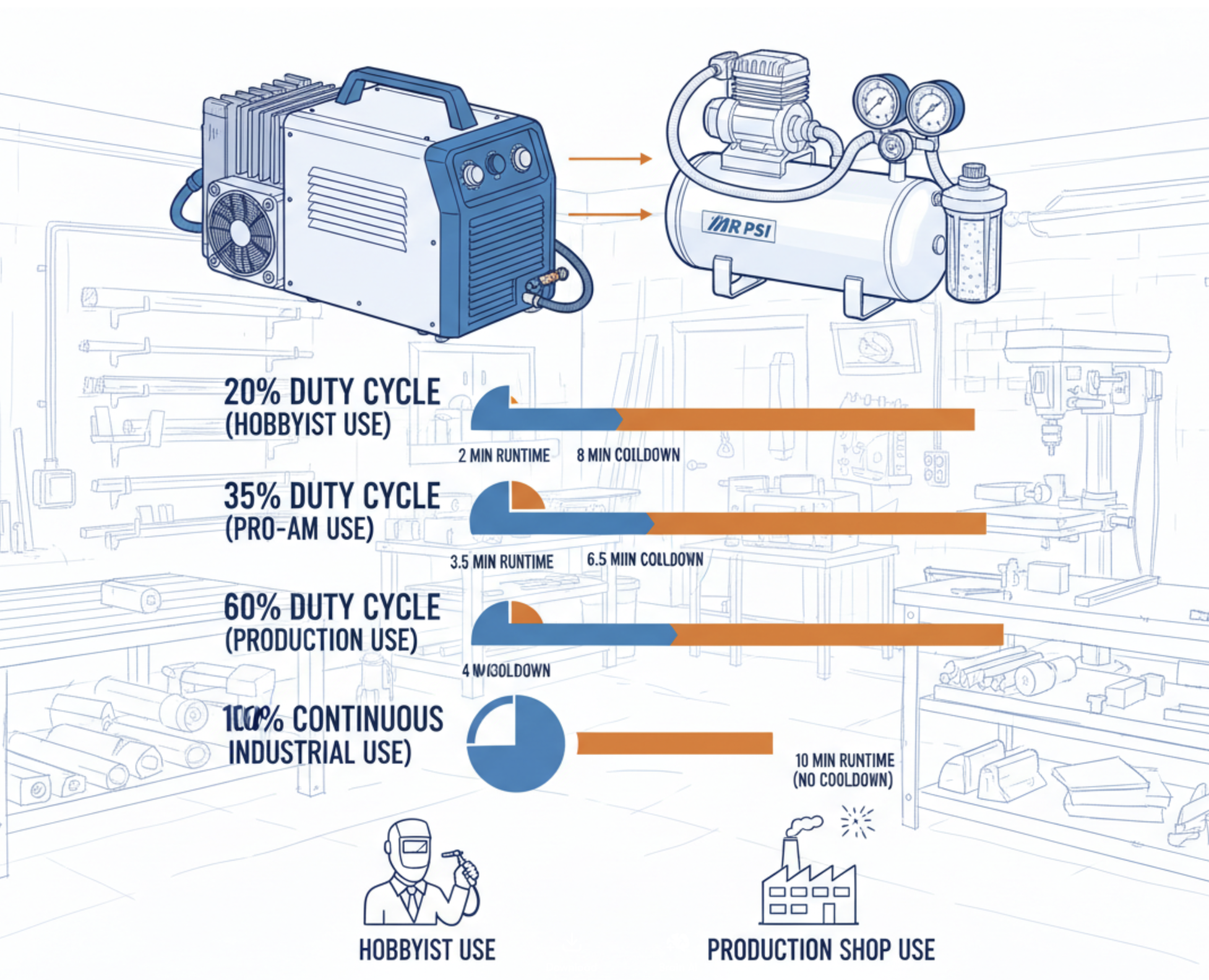
    Duty Cycle

    Definition: Percentage of 10-minute period the machine can run at rated amperage before requiring cooldown.

    Duty CycleRuntime @ Max AmpsCooldownUse Case
    20%2 min8 minHobbyist, occasional use
    35%3.5 min6.5 minLight fabrication, DIY
    60%6 min4 minProduction shop, frequent use
    100%10 min0 minIndustrial, continuous operation

    Example: 50A cutter with 35% duty cycle can run 3.5 minutes at 50A, then must cool 6.5 minutes.
    At lower amperage: Duty cycle increases (50A cutter at 30A may have 60-80% duty cycle).

    Air Supply Requirements

    Compressed Air Specs:Pressure: 60-90 PSI (4-6 bar) – Flow rate: 4-8 CFM @ 90 PSI (varies by amperage) – Quality: Clean, dry, oil-free

    Compressor Sizing:

    Plasma AmperageMinimum CFM @ 90 PSIRecommended Tank Size
    20-30A4 CFM20 gallon
    40-50A5 CFM30 gallon
    60-80A6 CFM60 gallon
    85-100A8 CFM80 gallon

    Air quality issues: – Moisture = premature consumable failure and poor cut quality – Oil contamination = torch tip clogging – Solution: Install inline air dryer/filter between compressor and plasma cutter

    Input Power Requirements

    120V Plasma Cutters:Amperage range: 12-40A – Cut capacity: Up to 3/8โ€ recommended, 1/2โ€ maximum – Advantage: Portable, runs on standard outlets – Limitation: Lower duty cycle, reduced cut speed

    240V Plasma Cutters:Amperage range: 40-100A+ – Cut capacity: 1/2โ€-1โ€+ recommended – Advantage: Higher duty cycle, faster cutting, thicker material – Requirement: Dedicated 240V circuit (30-50A breaker)

    Dual Voltage (120V/240V): – Runs on both voltages with reduced performance on 120V – Example: 50A on 240V, 30A on 120V – Best for: Portable use + shop capability

    Cut Quality Factors

    Pilot Arc vs. Contact Start

    Pilot Arc (High-Frequency Start): – Arc initiates without touching workpiece – Pros: Cuts expanded metal, grating, rusty/painted steel – Cons: Higher cost, can interfere with electronics – Best for: Versatile cutting, field work

    Contact Start (Scratch Start): – Requires torch tip contact with workpiece to start arc – Pros: Lower cost, no electronic interference – Cons: Cannot cut expanded metal or start on edge – Best for: Budget cutters, clean flat plate

    Inverter vs. Transformer Technology

    Inverter-Based:Weight: 10-40 lbs (portable) – Efficiency: High (lower power consumption) – Duty cycle: Typically higher (35-60%) – Cost: Moderate to high – Best for: Modern shops, portability required

    Transformer-Based:Weight: 80-200 lbs (stationary) – Efficiency: Lower (higher power draw) – Duty cycle: Often 100% (industrial use) – Cost: Higher upfront, lower long-term maintenance – Best for: Heavy industrial, continuous operation

    Consumable Costs & Life

    Consumable Components

    PartFunctionTypical LifeCost per Set
    ElectrodeConducts current to arc1-3 hours cutting time$3-$8
    Nozzle (tip)Focuses plasma stream1-3 hours cutting time$2-$5
    Swirl ringStabilizes gas flow5-10 hours$1-$3
    Shield cupProtects nozzle10-20 hours$2-$5

    Consumable life factors: – Amperage setting (higher amps = shorter life) – Air quality (moisture/oil reduces life 50%+) – Arc-on time (duty cycle) – Proper technique (perpendicular torch angle, correct standoff)

    Annual consumable cost estimate: – Hobbyist (20 hours/year): $50-$100 – Light fabrication (100 hours/year): $250-$500 – Production shop (500+ hours/year): $1,500-$3,000

    Material Compatibility

    MaterialPlasma CutNotes
    Mild steelโœ“Best cut quality, minimal dross
    Stainless steelโœ“Clean cuts, some dross on thick sections
    Aluminumโœ“Requires higher amperage than steel (30% thicker capacity)
    Copperโœ“High thermal conductivity = slower cut speed
    Brassโœ“Similar to copper, produces toxic fumes (ventilation required)
    Cast ironโœ“Brittle, may crack from rapid heating
    Galvanized steelโœ“Toxic zinc fumes (ventilation mandatory)

    Cannot cut: Non-conductive materials (wood, plastic, concrete, glass)

    Torch Styles & Ergonomics

    Hand Torch (Standard)

    • Cable length: 10-25 feet
    • Weight: 1-3 lbs
    • Best for: Freehand cutting, portability
    • Limitation: Less precise than machine torch

    Machine Torch (CNC-Compatible)

    • Mounting: Designed for CNC table or track system
    • Standoff: Adjustable height control for consistent cut quality
    • Best for: Automated cutting, production runs
    • Cost: $200-$800 (in addition to hand torch)

    Ergonomic Features

    • Trigger lock: Reduces hand fatigue during long cuts
    • Swivel head: Prevents cable twist, improves maneuverability
    • Insulated grip: Protects from heat during extended use

    Common Mistakes

    Undersizing amperage for material thickness
    40A cutter on 1/2โ€ steel = slow, rough cuts and rapid consumable wear. Size cutter 20-30% above typical thickness for clean cuts.

    Using contaminated air supply
    Moisture and oil in compressed air destroy consumables in 10-20% of normal life. Always use inline air dryer/filter.

    Running at maximum amperage continuously
    Exceeds duty cycle, triggers thermal shutdown. Run at 70-80% of rated amperage for longer duty cycle and consumable life.

    Buying Checklist

    • โœ“ Amperage rating 20-30% above typical material thickness
    • โœ“ Duty cycle matches usage frequency (35%+ for regular use)
    • โœ“ Input voltage compatible with available power (120V or 240V)
    • โœ“ Pilot arc start for versatile cutting (expanded metal, rusty steel)
    • โœ“ Inverter technology for portability and efficiency
    • โœ“ Compressor meets CFM and PSI requirements
    • โœ“ Air dryer/filter included or purchased separately
    • โœ“ Consumable availability and cost verified

Read with Kindle Unlimited