Tag: metal cleaning

  • Shark 4.5″ Stainless Steel Knotted Wire Wheel: Heavy-Duty Surface Prep for Angle Grinders

    Rust, scale, and mill scale don’t disappear on their own. Before you strike an arc, your base metal needs to be cleanโ€”and a quality wire wheel is the fastest way to get there. The Shark 4.5″ stainless steel knotted wire wheel is built for aggressive cleaning on angle grinders, removing rust and surface contaminants without damaging the underlying metal.

    What Makes This Wire Wheel Stand Out

    The Shark 13981 is a workhorse consumable:

    • Stainless Steel Construction โ€” Resists corrosion and lasts longer than carbon steel alternatives
    • Knotted Design โ€” Twisted knots provide aggressive cutting action while maintaining control
    • 5/8″-11 Arbor โ€” Fits standard 4.5″ angle grinder chuck (most common size)
    • 0.020″ Gauge Wire โ€” Heavy-duty diameter for deep rust and scale removal
    • 4.5″ Diameter โ€” Compact enough for tight spaces; large enough for efficient coverage

    This is the wheel you reach for when you need results, not a gentle touch.

    Who Should Buy This Wheel

    This wheel is ideal for:

    • Fabrication shops prepping structural steel before welding
    • Restoration and repair welders removing rust from old equipment and machinery
    • Pipeline and heavy equipment crews cleaning large surfaces before joining
    • Maintenance technicians deburring and conditioning metal edges
    • DIY welders and hobbyists who want a durable, multi-use surface prep tool

    Last update on 2026-04-16 / Affiliate links / Images from Amazon Product Advertising API

    Performance & Use

    What to Compare Before You Buy

    • Wire Material โ€” Stainless steel (this model) vs. carbon steel; stainless lasts longer but costs more
    • Knot Type โ€” Knotted (aggressive) vs. crimped (gentler); choose based on your surface finish target
    • Wire Gauge โ€” 0.020″ (heavy-duty) vs. 0.016″ (medium); thicker wire cuts faster but can leave marks
    • Arbor Size โ€” Confirm your grinder chuck is 5/8″-11; some older grinders use different threads
    • Speed Rating โ€” Most 4.5″ wheels are rated for 8,500โ€“13,000 RPM; check your grinder’s max speed

    Comparable Amazon Picks (Optional)

    Installation & Safety

    Mounting a wire wheel correctly prevents accidents:

    1. Unplug your grinder โ€” Always de-energize before changing wheels
    1. Remove the guard โ€” Most grinders have a quick-release guard
    1. Loosen the arbor nut โ€” Use the grinder’s wrench; turn counterclockwise
    1. Slide off the old wheel โ€” Keep the arbor washer in place
    1. Install the new wheel โ€” Align the center hole with the arbor; slide on smoothly
    1. Tighten the arbor nut โ€” Snug firmly but don’t over-torque; hand-tight plus 1/4 turn is usually correct
    1. Reinstall the guard โ€” Ensure it covers the wheel’s upper half
    1. Test-run at low speed โ€” Let it spin for 10 seconds before full power

    Critical Safety Note: Never operate a wire wheel without the guard in place. Knotted wheels can catch and throw debris or your hand if contact occurs.

    Performance Characteristics

    The Shark knotted wheel excels at:

    • Rust removal โ€” Strips surface rust in 2โ€“3 passes on mild steel
    • Scale and mill scale โ€” Removes factory oxide layer before welding
    • Deburring โ€” Smooths sharp edges after cutting or grinding
    • Weld prep โ€” Cleans HAZ (heat-affected zone) before re-welding
    • Paint and coating removal โ€” Aggressive enough for light paint stripping

    Expected lifespan: 20โ€“40 hours of active use before the knots flatten and cutting action diminishes. Lifespan varies with surface hardness and grinder speed.

    Maintenance & Storage

    Extend your wheel’s life:

    • Clean after use โ€” Tap the wheel gently to dislodge embedded metal particles
    • Store dry โ€” Moisture promotes rust, even on stainless steel
    • Check for cracks โ€” Inspect the wheel before each use; discard if you see radial cracks
    • Avoid prolonged contact โ€” Don’t let the wheel sit against the workpiece; use short, controlled passes

    Comparison: Knotted vs. Crimped Wire Wheels

    FeatureKnottedCrimped
    Cutting PowerAggressive; fast removalModerate; controlled
    Surface FinishRougher; leaves marksSmoother; more refined
    Best ForHeavy rust, scale, deburringLight cleaning, finishing
    Lifespan20โ€“40 hours30โ€“50 hours
    Cost$12โ€“$20$10โ€“$18

    For pre-weld prep, knotted wheels (like the Shark) are the standard choice.

    Safety Reminders

    • Always wear a face shield rated for grinding (ANSI Z87.1)
    • Use hearing protection; angle grinders exceed 85 dB
    • Wear cut-resistant gloves; never let loose clothing near the spinning wheel
    • Keep bystanders clear of the work area
    • Check your grinder’s maximum RPM; don’t exceed the wheel’s rating
  • How to Prep Metal for Welding (Step-by-Step Guide)

    How to Prep Metal for Welding (Step-by-Step Guide)

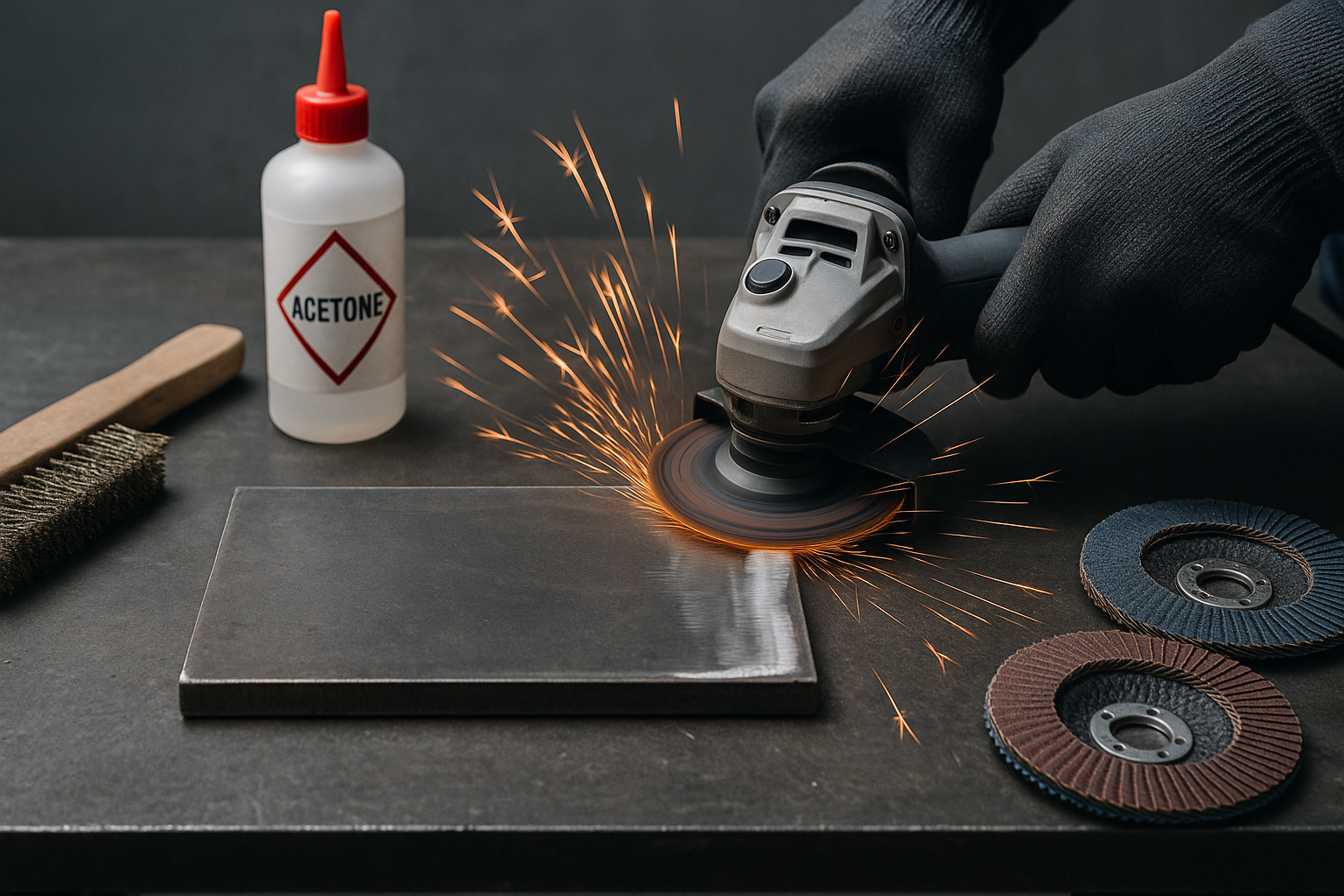
    Proper metal prep is the difference between a clean, strong weld and fighting porosity, inclusions, and arc instability. This guide breaks down exactly how to clean, grind, degrease, and fit-up steel, stainless, and aluminum so you can weld with fewer defects and less rework.


    Key Takeaways

    • Clean metal = fewer porosity and arc-start issues. Remove mill scale, rust, paint, oil, and coatings.
    • Use the right abrasives: flap discs for beveling, hard wheels for aggressive cleaning, and stainless-only tools for stainless.
    • Fit-up accuracy determines distortion control and penetration.
    • Always check safety: ANSI Z87.1 eye protection, proper ventilation, and PPE.
    • Improper prep is one of the Top 3 causes of weld failure per AWS D1.1 commentary.

    Where to Buy (Tools for Metal Prep)

    Arc Weld Store:

    40-grit flap discs โ€” Heavy removal

    Weldcote 10668 Flap Discs C-Prime Ceramic 4.5" 40 Grit XL 7/8" Arbor 10 Pack T27 13300 RPM

    “>
    Weldcote 10668 Flap Discs C-Prime Ceramic 4.5" 40 Grit XL 7/8" Arbor 10 Pack T27 13300 RPM

    Weldcote 10668 Flap Discs C-Prime Ceramic 4.5" 40 Grit XL 7/8" Arbor 10 Pack T27 13300 RPM

    $86.84

    In Stock

    View Product

    80-grit flap discs โ€” Finishing before weld

    Weldcote 10670 XL Flap Discs - C-Prime Ceramic 4.5" 80 Grit 7/8" Arbor - 10 Pack

    “>
    Weldcote 10670 XL Flap Discs - C-Prime Ceramic 4.5" 80 Grit 7/8" Arbor - 10 Pack

    Weldcote 10670 XL Flap Discs – C-Prime Ceramic 4.5" 80 Grit 7/8" Arbor – 10 Pack

    $76.93

    In Stock

    View Product

    Amazon (options):

    Affiliate Disclosure: As an Amazon Associate, we earn from qualifying purchases.


    How to Prep Metal for Welding

    1. Identify the Material

    Different materials need different prep steps.

    Carbon Steel

    • Remove mill scale (blue/black surface).
    • Grind out rust, paint, coatings, and galvanizing.
    • Bevel edges for thicker plate (ยผ in / 6 mm and up).

    Stainless Steel

    • Use stainless-dedicated wheels only (never shared with carbon steel).
    • Remove heat tint and oxide layers.
    • Clean surface oils with acetone before welding.

    Aluminum

    • Remove oxide layer mechanically (stainless brush).
    • Degrease with acetone or alcohol.
    • Wire-brush immediately before welding โ€” oxide reforms in minutes.

    2. Remove Coatings, Rust, and Mill Scale

    Tools that work:

    • Flap disc (40โ€“60 grit)
    • Hard grinding wheel
    • Wire wheel (for light rust)
    • Needle scaler (heavy rust or slag)

    Remove down to bright, shiny metal. For carbon steel, AWS D1.1 recommends removing contaminants within 1 inch (25 mm) of the weld area.


    3. Degrease and Clean

    Oil, cutting fluid, and shop grime cause porosity.

    • Use acetone or denatured alcohol.
    • Avoid oily solvents like WD-40.
    • Wipe until the rag stays clean.

    Tip: Do solvent cleaning before grinding (to avoid driving oil into the pores) and again after to remove grinding dust.


    4. Fix Edges, Bevels, and Gaps

    Fit-up sets the stage for the entire weld.

    • Bevel: 30โ€“37.5ยฐ for structural steel (AWS standard).
    • Root opening: 1/16โ€“1/8 in. depending on joint.
    • Remove burrs for full penetration.
    • Tack weld at opposite ends to reduce movement.

    5. Clean Again Before Welding

    Right before striking an arc:

    • Blow off dust
    • Wipe with acetone (stainless + aluminum)
    • Ensure the joint is dry โ€” moisture = hydrogen

    Safety Notes

    • Wear ANSI Z87.1 eye protection and face shield when grinding.
    • Use gloves, FR clothing, and hearing protection.
    • Avoid grinding galvanized steel โ€” zinc fumes require strong ventilation or removal + respirator (P100).
    • Keep flammables away โ€” grinding sparks can exceed 1,800ยฐF.
    • Ensure proper fume extraction for stainless to reduce hex-chrome exposure.

    FAQ

    Do I have to remove all mill scale?

    For critical welds (per AWS D1.1), yes. For hobby MIG on light steel, partial removal can work, but expect spatter and inconsistent penetration.

    Can I weld through paint?

    Not recommended. Most paints give off toxic fumes and produce porosity.

    How clean does aluminum need to be?

    Extremely clean. Oxide melts at ~3,700ยฐF; aluminum melts at ~1,200ยฐF. Thatโ€™s why aluminum requires brushing + solvent cleaning.

    Why do my welds have porosity even after grinding?

    Usually oil contamination or moisture. Try degreasing and pre-heating to ~150โ€“200ยฐF.


    Sources Checked

    • AWS D1.1 Structural Welding Code โ€“ Steel
    • Miller, Lincoln, ESAB abrasive and prep guides
    • ANSI Z87.1 PPE requirements
Stream with Amazon Music