Tag: fume extractor

  • Welding Fume Extractor Not Pulling Smoke: Causes and Fixes

    A welding fume extractor that fails to pull smoke effectively exposes operators to hazardous fumes and reduces overall shop safety. Poor suction is typically caused by airflow restriction, filter saturation, or incorrect positioning. Diagnosing the airflow path is critical to restoring proper extraction performance.

    Key Takeaways

    • Clogged filters are the most common cause of weak suction
    • Improper hood positioning reduces capture efficiency
    • Airflow restrictions limit extraction performance
    • Undersized systems struggle with high-fume processes
    • Routine maintenance prevents most extraction failures

    Problem / Context

    Fume extraction systems are designed to capture and remove airborne contaminants at the source. When suction drops, fumes remain in the breathing zone, increasing exposure risk. This issue is often gradual and may go unnoticed until visible smoke buildup occurs.

    Root Causes

    • Clogged filters: saturated media reducing airflow
    • Blocked ducting: debris or buildup restricting flow
    • Poor hood placement: positioned too far from the arc
    • Leaks in system: air loss reducing suction at the source
    • Undersized extractor: insufficient CFM for application
    • Fan or motor wear: reduced airflow performance

    Solution / Explanation

    • Replace or clean filters according to manufacturer guidelines
    • Inspect ducting for obstructions and remove debris
    • Position extraction hood as close to the weld arc as possible
    • Check system for air leaks and seal connections
    • Verify extractor capacity matches welding process requirements
    • Inspect fan and motor performance for wear or failure

    Specs / Verification Notes

    • Airflow Capacity (CFM): Unknown (Verify per unit)
    • Filter Type: HEPA or multi-stage (application dependent)
    • Duct Diameter: System dependent
    • Capture Velocity: Unknown (Verify)
    • Process Type: MIG, TIG, Stick, Flux-Cored (fume levels vary)

    Product Option

    ArcOne S240-10 Horizontal Single Auto-Darkening Filter for Welding, 2 x 4, Shade 10
    • Two independent sensors, High Definition clear view technology
    • 5.25 square inches of active viewing area
    • Switching speed of 0.5 milliseconds
    • Water and dust resistant
    • Dark to light state delay of 0.2 seconds

    Last update on 2026-05-19 / Affiliate links / Images from Amazon Product Advertising API

    Comparison Table

    IssueSymptomImpactFix
    Clogged FilterWeak suctionPoor air qualityReplace filter
    Blocked DuctReduced airflowFume buildupClear obstruction
    Poor Hood PlacementSmoke not capturedOperator exposureReposition hood
    Undersized UnitConstant smokeIneffective extractionUpgrade system

    Safety Notes

    Follow ANSI Z49.1 and OSHA ventilation standards for welding environments. Always verify proper airflow before welding. Use respiratory protection if extraction is insufficient.

    FAQ

    Why is my fume extractor not pulling smoke?

    This is usually caused by clogged filters, airflow restrictions, or improper hood placement.

    How often should filters be replaced?

    Filter replacement depends on usage, but should be done when airflow noticeably decreases.

    Does hood position affect performance?

    Yes. The hood must be positioned close to the arc to effectively capture fumes.

    Next Step

    Inspect filters and airflow path before the next weld. Adjust hood position and confirm suction strength using a visible smoke test.

    Sources Checked

    • ANSI Z49.1 Safety in Welding and Cutting
    • OSHA ventilation guidelines
    • Fume extraction system manufacturer documentation
  • Welding Fume Extractors: Essential Safety for Modern Shops

    Welding Fume Extractors: Essential Safety for Modern Shops

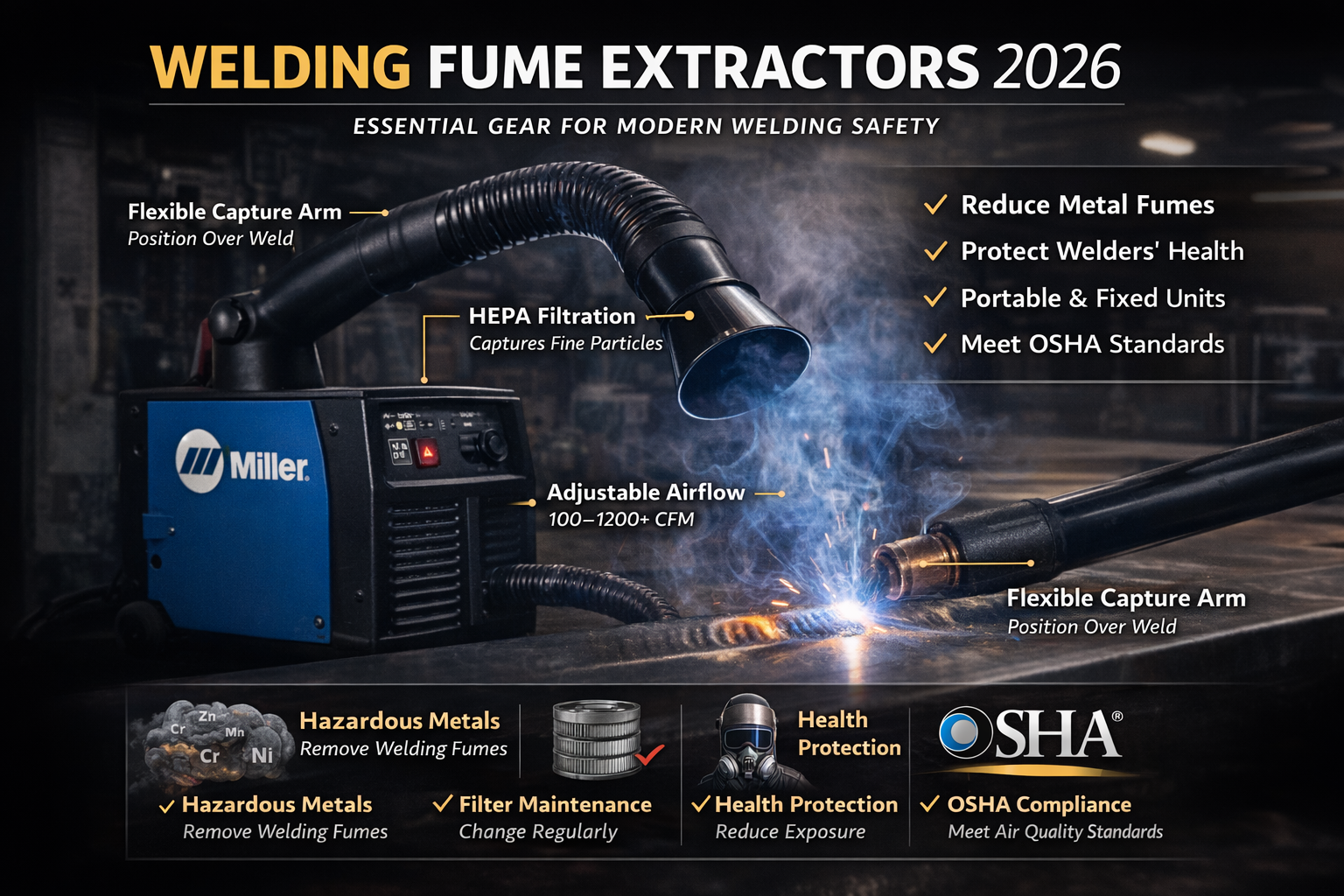
    Welding fumes contain hazardous metal particulates that can accumulate quickly in enclosed spaces. A properly sized fume extractor protects welders, improves air quality, and supports OSHA compliance.


    Key Takeaways

    • Fume extractors reduce airborne exposure to hazardous metals
    • Portable and fixed systems serve different shop sizes
    • Airflow (CFM) and filter type determine effectiveness
    • HEPA or specialty filters are required for fine particle capture
    • OSHA standards require indoor fume control

    Performance & Use

    Welding fume extractors use powered airflow and filtration systems to capture smoke at the source. Capture arms should be positioned near the arc without disrupting shielding gas.

    Portable units work well for single stations or field fabrication. Fixed systems integrate into production environments with multiple welders.

    Effectiveness depends on:

    • Correct airflow rating (CFM)
    • Proper hood placement
    • Regular filter maintenance

    Without maintenance, extraction systems lose efficiency rapidly.


    Durability & Build

    Industrial units from manufacturers such as Miller Electric, Lincoln Electric, and FumeVac are designed for daily shop use.

    Look for:

    • Metal housings
    • Accessible filter compartments
    • Clearly rated airflow
    • Documented filter efficiency

    Lower-cost units may lack sufficient static pressure or true HEPA filtration. Verify technical specifications before purchase.


    Power / Specs

    FeatureTypical RangeNotes
    Airflow (CFM)100โ€“1200+Must match shop size
    Filter TypeHEPA or specialtyRequired for fine particles
    PortabilityPortable or fixedApplication dependent
    Power Source120V / 240VVerify plug compatibility
    Noise Level60โ€“80 dBShop environment consideration

    Unknown (Verify):

    • Filter efficiency rating
    • Replacement filter cost
    • Warranty coverage
    • Fire protection features

    Who Itโ€™s For

    Essential for shops welding stainless steel, galvanized material, aluminum, or running high production indoors.

    Less critical for outdoor-only operations with natural ventilation.


    Quick FAQ

    Q: Are fume extractors required?
    OSHA requires employers to control welding fume exposure indoors. Local codes may vary.

    Q: Can one portable unit cover an entire shop?
    No. Portable units are designed for single workstations.

    Q: How often should filters be changed?
    Depends on usage. Follow manufacturer guidelines and inspect regularly.

    Q: Can I use a shop vacuum instead?
    No. Standard shop vacs are not designed for welding fumes or fine metal particulates.

    Q: Which metals produce the most hazardous fumes?
    Stainless steel (chromium, nickel) and galvanized steel (zinc) present higher risks.

    Q: Where do I verify filter specs?
    Consult manufacturer datasheets and compliance documentation.


    Safety Notes

    • Always use fume extraction when welding indoors
    • Wear a properly fitted P100 respirator when welding stainless or galvanized
    • Do not bypass safety interlocks
    • Maintain fire watch procedures; overloaded filters can ignite
Watch with Prime Video