Tag: field welding

  • Miller Gas Engine Drive Selection Guide: Bobcat 265 vs Trailblazer 330 vs Big Blue 400 Pro

    Choose a Miller gas engine drive by the weld process, amperage demand, auxiliary generator load, and jobsite mobility requirement. For most service trucks, farm repair, field stick work, light MIG/flux-core with a feeder, and portable generator use, the Bobcat 265 is the practical starting point. Move to the Trailblazer 330 when the work needs stronger arc control, 330 amp output, TIG, gouging capability, wire feeder control, Excel power, or better performance while welding and running tools. Move beyond gas-drive selection and into Big Blue 400 Pro territory when the job requires 400 amp diesel-class output, long duty cycles, pipe, structural, fleet, gouging, or industrial site work. Do not select by model name alone. Verify fuel type, weld output, CC/CV process support, feeder requirements, auxiliary wattage, remote control needs, truck space, exhaust clearance, and the exact Miller stock number before ordering parts or accessories.

    Fast Selection Table

    Machine FamilyBest FitKey Verification PointDo Not Assume
    Miller Bobcat 265General field repair, stick, DC TIG, MIG/FCAW with feeder, generator useGas vs LP model, ArcReach option, battery charge option, Air Pak variantThat every Bobcat has the same fuel system or accessory package
    Miller Trailblazer 330Higher-output field welding, better arc control, TIG, wire feeder work, gougingBase, EFI, Excel Power, WIC, battery charge, polarity reversing optionsThat every Trailblazer includes Excel Power or EFI
    Miller Big Blue 400 ProHeavy field construction, pipe, industrial repair, carbon arc gouging, fleet useDiesel engine version, ArcReach package, feeder and remote compatibilityThat Big Blue is a gas-drive replacement for a Bobcat or Trailblazer

    What This Machine Class Does

    A Miller engine drive combines a welding power source and jobsite generator in one truck- or trailer-mounted unit. The selection issue is not only amperage. You are also choosing between generator capacity, engine type, duty cycle, arc characteristics, field repair access, wire feeder support, carbon arc gouging capability, and the accessories that must match the exact machine package.

    Model Family Notes

    The Miller Electric Arc Machine Support page lists multiple engine-driven Miller support families including Bluestar, Bobcat 230, Bobcat 265, Bobcat 200 Air Pak, and Trailblazer 330 variants. Use that page as the internal machine-family index before narrowing down parts or accessory support.

    The Bobcat 265 family is the common service-truck choice where the operator needs DC welding output and generator power without stepping into a larger industrial diesel platform. Confirm whether the unit is Kohler/Rehlko, Vanguard, LP, ArcReach, battery charge, electric fuel pump, or Air Pak before ordering covers, fuel-related items, remotes, or support parts.

    The Trailblazer 330 family is the better fit when arc performance matters more than lowest machine cost. It supports Stick, MIG with feeder, flux-cored with feeder, DC TIG, air carbon arc cutting/gouging, and plasma cutting/gouging with optional Spectrum models. The Trailblazer line has multiple packages, so verify EFI, Excel Power, WIC, battery charge/crank assist, and polarity reversing before matching accessories.

    The Big Blue 400 Pro class should be treated as a diesel industrial engine-drive selection, not a direct gas-drive replacement. Use it when the work requires heavier output, industrial duty cycle, larger gouging capacity, long runtime expectations, and fleet/jobsite durability.

    What To Verify Before Ordering

    • Exact Miller model family and stock number
    • Fuel type: gasoline, LP, or diesel
    • Engine brand and service package
    • CC/CV weld output support
    • Stick, TIG, MIG, FCAW, plasma, or gouging process needs
    • Wire feeder type and control method
    • ArcReach, WIC, Excel Power, battery charge, or polarity reversing options
    • Auxiliary generator wattage required while welding
    • Truck bed, trailer, exhaust, cover, and running gear clearance
    • Serial number and rating label before ordering maintenance or electrical parts

    Common Wrong-Selection Mistakes

    The most common mistake is buying by amperage only. A 265-amp engine drive may be enough for field stick and feeder work, but not enough for heavier gouging or high-output production repair. The second mistake is assuming that all Trailblazer 330 units have EFI, Excel Power, or battery charge. The third mistake is confusing gas-drive portability with diesel-drive industrial duty cycle. The fourth mistake is ordering accessories from the model name instead of the exact Miller stock number.

    Related Support Paths

    If the engine drive will run a MIG or flux-cored feeder, also verify gun, liner, drive roll, contact tip, and feeder compatibility through Miller arc machine support and the related Miller MIG equipment support navigation on Weld Support Parts. For gouging work, review carbon arc torch support such as Arc Air K4000 torch breakdown. For smaller stick-machine comparison, the Miller Thunderbolt 210 support page helps separate shop stick power-source needs from engine-drive field needs. For compact engine-drive reference, see Miller Blue Star 185 support.

    Field Fix vs Proper Fix

    A field workaround is acceptable for confirming a setup problem: reduce load, disconnect high-starting-watt tools, switch to the correct process mode, confirm feeder control, and test weld output at a known setting. The proper fix is to match the machine package to the work: correct fuel type, correct output class, correct feeder interface, correct generator load rating, and correct service parts from the serial number and rating label.

    Safety Notes

    Engine drives produce exhaust, hot surfaces, electrical output, rotating engine components, arc radiation, fumes, and fire risk. Do not operate inside enclosed spaces. Keep exhaust clear of personnel, doors, and air intakes. Follow the Miller owner’s manual, jobsite lockout procedures, fuel handling rules, and welding PPE requirements. Verify grounding, cable condition, receptacle ratings, and load limits before using auxiliary power.

    Replacement Notes

    Before replacing an older Miller gas drive, record the old model, stock number, serial number, engine type, fuel type, output needs, feeder setup, remote control, truck mounting footprint, and the tools powered from the generator. Replacement confidence comes from matching the work pattern, not simply buying the newest machine in the same color.

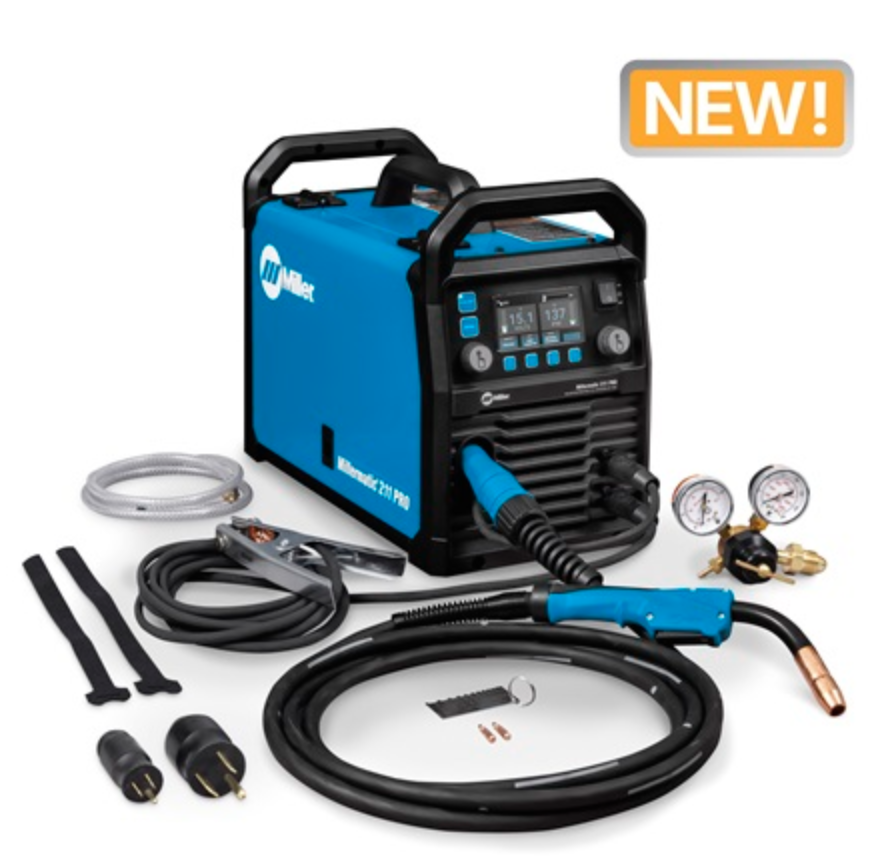
  • Millermatic 211 Pro MIG Welder | Powerful & Portable

    Millermatic 211 Pro MIG Welder | Powerful & Portable


    Model: Millermatic® 211 Pro

    ⚠️ Note for Readers: This post may contain affiliate links. If you purchase through them, we may earn a small commission at no cost to you. Thank you for supporting our site.


    Introduction

    The Miller Electric Millermatic 211 Pro is a compact, professional-grade MIG (GMAW) welder designed for use across a wide spectrum of metal fabrication tasks. Built with both portability and welding performance in mind, it’s an evolution of one of Miller’s most popular mid-range welders, optimized for ease-of-use, multi-voltage operation, and superior arc quality.

    This machine occupies a sweet spot for professional fabricators, maintenance personnel, students, field technicians, and DIY welders demanding industrial performance in a lightweight package. With its ability to run on both 120V and 240V input power, the Millermatic 211 Pro is suited for everything from shop settings to on-site jobs.


    Types / Variants / Models

    At the time of writing, Miller Electric lists only the Millermatic 211 Pro as a standalone model—this is a streamlined iteration of the previous Millermatic 211 (non-“Pro”) model.

    While there’s no fleet of variants under the “211 Pro” name, it’s useful to differentiate:

    • Millermatic® 211 Pro (Current Model)

      • Updated UI and design
      • Simplified interface with precision adjustment
      • New industrial-grade drive system
    • Millermatic® 211 (Legacy Models)

      • Auto-Set™ technology (not present in the “Pro”)
      • Slightly different interface and control system

    The “Pro” version is aimed more at professionals who prefer manual voltage and wire feed control over automated settings like Auto-Set™ found in consumer models.


    Key Features or Specifications

    Here’s a breakdown of the critical specs and design features that define the Millermatic 211 Pro:

    Power Source

    • Multi-voltage input: 120V or 240V
    • MVP™ (Multi-Voltage Plug): Adapts to varying job site power supplies
      Benefit: Maximum portability without sacrificing performance

    Output Amperage Range

    • 120V Input: 30–150 A
    • 240V Input: 30–230 A
      Benefit: Wide amperage range accommodates thin-gauge to thick materials (24 ga to 3/8″ in a single pass)

    Duty Cycle

    • 240V: 40% @ 150A
    • 120V: 20% @ 115A
      Benefit: Practical for extended use at medium output; improves productivity with adequate cooling time

    Machine Dimensions & Weight

    • Height: 12.5 in
    • Width: 11.25 in
    • Depth: 20.5 in
    • Net Weight: 38 lbs
      Benefit: Extremely portable for a welder with this power class

    Wire Compatibility

    • Wire sizes supported:
      • Solid wire: 0.023–0.035 in
      • Flux-cored wire: 0.030–0.045 in
        Benefit: Flexible enough for both MIG and FCAW applications

    Build & Durability

    • Industrial-grade cast aluminum drive system
    • Integrated spool gun control for aluminum welding
      Benefit: Long operational life and compatibility with spool guns like the Spoolmate™ 100

    Certifications

    • CSA-certified
    • IP23S-rated for rugged environments
      Benefit: Meets key safety and durability standards expected in professional use environments

    Usage & Compatibility

    Supported Welding Processes

    • GMAW (MIG)
    • FCAW (Flux-Cored Arc Welding)
      (Not compatible with SMAW or GTAW)

    Welder Compatibility

    • Ready out of the box for MIG and flux-cored processes
    • Compatible with accessories such as the Spoolmate™ 100 spool gun for aluminum
    • Works with standard MIG consumables and drive rolls

    User Experience Highlights

    • Manual controls: No Auto-Set™, requires knowledge of voltage/wire speed chart
    • Digital voltage and wire feed readouts: Ensures consistency and ease of setup
    • Smooth arc starts with minimal spatter: Reduces need for post-weld cleanup

    Pros

    • Lightweight and portable
    • Excellent arc characteristics
    • Dual-voltage capability
    • Ideal for aluminum with a compatible spool gun

    Cons

    • No Auto-Set™ feature may require a learning curve for beginners
    • Slightly more expensive than entry-level models

    Common Applications

    The Millermatic 211 Pro has been widely adopted across various use cases due to its ability to weld a broad range of materials and manage differing material thicknesses effectively.

    Industries and Job Types

    • Automotive repair & fabrication
    • Farm and ranch maintenance
    • General metal fabrication
    • Field/portable welding
    • Light industrial manufacturing
    • Technical education programs

    Material Compatibility

    • Mild steel, stainless steel, aluminum (with spool gun)
    • Welds steel thicknesses from 24-gauge to 3/8 in in a single pass

    Why It’s Ideal

    • Its power-to-weight ratio makes it perfect for mobile fabricators
    • Dual-voltage input means it works equally well in workshops and field settings
    • Designed for performance in demanding environments with consistent weld quality

    Tips & Best Practices

    To get the most from your Millermatic 211 Pro, consider these tips:

    Setup Tips

    • Use the included setup chart for voltage/wire feed references based on material type and thickness
    • Ensure correct polarity depending on weld wire type (e.g., reverse polarity for solid wire with shielding gas, straight polarity for flux-core)

    Welding Practices

    • Use clean, properly prepared material for stronger welds
    • Maintain a steady travel speed to avoid undercut or poor penetration

    Maintenance Recommendations

    • Clean drive rolls and liner regularly to avoid feed issues
    • Store indoors if possible—while IP23S rated, prolonged moisture exposure affects electronics
    • Blow out dust and debris periodically with dry compressed air

    Troubleshooting

    • Welds sputter? Check wire speed and contact tip size
    • No arc? Confirm ground clamp connection, spool gun toggle, and trigger circuit
    • Wire feeding erratically? Check for liner wear or incorrect tension on feed rolls

    Conclusion

    The Miller Electric Millermatic 211 Pro delivers professional-grade performance in a compact and portable MIG welder. Designed with structural repair

    Check out the Miller store!

Read with Kindle Unlimited