Tag: fabrication tools

  • Flap Disc Edge Wear Troubleshooting

    Flap Disc Edge Wear Troubleshooting

    Flap disc edge wear usually happens when the grinder angle is too steep, pressure is excessive, the wrong disc type is being used, or the operator is grinding primarily on the disc edge instead of the face. Premature edge wear reduces abrasive life, creates uneven grinding performance, increases heat buildup, and can damage both the workpiece and grinder.

    Common Symptoms

    • Outer edge of the flap disc wears much faster than the center.
    • Grinding becomes uneven or difficult to control.
    • Disc cuts aggressively at first but loses performance quickly.
    • Visible flap tearing or uneven flap separation.
    • Increased vibration during grinding.
    • Excessive heat discoloration on the workpiece.

    Likely Causes

    • Grinding angle too steep: Excessive angle concentrates force on the outer edge of the disc.
    • Too much pressure: Heavy force overheats and overloads the abrasive flaps.
    • Incorrect flap disc style: Type 27 and Type 29 discs perform differently depending on grinding angle and application.
    • Wrong grit selection: Coarse grits used for finishing work can wear unevenly.
    • Improper grinder RPM: Overspeeding increases edge stress and heat generation.
    • Using the edge like a grinding wheel: Flap discs are designed primarily for face contact, not aggressive edge digging.

    Inspection Steps

    1. Inspect flap wear pattern across the full disc face.
    2. Verify grinder RPM matches the flap disc rating.
    3. Check grinding angle during operation.
    4. Inspect for excessive heat discoloration or flap glazing.
    5. Verify correct flap disc style and grit for the application.
    6. Inspect grinder spindle and backing flange condition.

    Visual Wear Indicators

    • Outer edge worn down faster than the center.
    • Missing or torn abrasive flaps.
    • Glazed abrasive surface from overheating.
    • Uneven flap height around the disc.
    • Discoloration from excessive grinding heat.

    Common Wrong-Part Mistakes

    • Using Type 27 discs where Type 29 geometry is more appropriate.
    • Running flap discs above rated RPM.
    • Using coarse grinding discs for fine finishing applications.
    • Using worn backing flanges that create disc instability.

    Field Fix vs Proper Fix

    Field fix: Reduce grinding pressure, flatten the grinder angle slightly, and rotate the disc contact area more evenly. Proper fix: Select the correct flap disc geometry, grit, RPM range, and grinder setup for the application while correcting operator technique issues.

    Ignored Failure Consequences

    Ignoring uneven edge wear reduces abrasive life, increases grinding cost, creates inconsistent surface finish quality, overheats the workpiece, and increases vibration-related grinder wear.

    Safety Notes

    Always follow abrasive RPM ratings and grinder compatibility requirements. Use face shields, gloves, hearing protection, and safety glasses when grinding. Never use damaged or delaminating flap discs.

    Sources Checked

    • Norton abrasive solutions catalog
    • Weiler abrasive catalog
    • Lincoln welding accessories catalog
  • Grinding Wheel Wobble Causes and Troubleshooting

    Grinding Wheel Wobble Causes and Troubleshooting

    A grinding wheel that wobbles during operation is usually caused by damaged flanges, incorrect wheel mounting, bent spindles, worn bearings, improper wheel storage, or using the wrong wheel for the grinder. Even minor wheel runout can reduce grinding accuracy, overload bearings, increase vibration, and create a dangerous wheel failure risk at operating RPM.

    Common Symptoms

    • Visible side-to-side wheel movement during rotation.
    • Vibration through the grinder body or handle.
    • Uneven grinding marks or gouging.
    • Premature edge wear on flap discs or grinding wheels.
    • Difficulty maintaining straight cuts.
    • Excessive operator fatigue from vibration.

    Likely Causes

    • Improper wheel mounting: Dirt, burrs, or metal debris trapped behind the wheel prevent proper seating.
    • Damaged mounting flanges: Bent or worn flanges create uneven clamping pressure.
    • Bent spindle shaft: Impact damage from dropped grinders commonly bends spindle assemblies.
    • Worn grinder bearings: Bearing play allows oscillation under load.
    • Wheel damage: Cracked, warped, moisture-damaged, or expired wheels may not rotate true.
    • Incorrect wheel selection: Oversized or incompatible wheels create instability and imbalance.

    Inspection Steps

    1. Disconnect grinder power before inspection.
    2. Remove the wheel and clean both flange surfaces completely.
    3. Inspect the abrasive wheel for cracks, chips, or uneven wear.
    4. Check spindle runout manually while rotating the shaft slowly.
    5. Verify wheel RPM rating exceeds grinder RPM.
    6. Inspect arbor fitment and mounting hardware compatibility.

    Common Wrong-Part Mistakes

    • Installing wheels with incorrect arbor sizes.
    • Running cut-off wheels sideways as grinding wheels.
    • Using missing or incorrect flange washers.
    • Using moisture-damaged abrasive wheels from poor storage.

    Field Fix vs Proper Fix

    Field fix: Remove and remount the wheel correctly, clean flange surfaces, and replace visibly damaged abrasives. Proper fix: Replace bent spindles, worn bearings, damaged flanges, or incorrect wheel assemblies. Persistent wobble should never be ignored on high-speed grinders.

    Ignored Failure Consequences

    Operating with a wobbling grinding wheel increases the chance of wheel breakage, grinder damage, poor surface finish, operator fatigue, and severe injury from abrasive wheel fragmentation.

    Safety Notes

    Always follow abrasive RPM ratings and mounting instructions. Never use cracked wheels. Use face shields, gloves, hearing protection, and safety glasses when troubleshooting grinders and abrasive equipment.

    Sources Checked

    • Norton welding abrasive solutions catalog
    • Weiler abrasive and surface conditioning catalog
    • Lincoln Electric welding accessories catalog
  • Plasma Cutter Not Cutting Through: Causes and Fixes

    A plasma cutter that fails to cut through material typically indicates issues with air supply, consumables, or machine setup. This problem reduces cut quality, increases dross, and can damage the torch if ignored. Diagnosing the root cause quickly restores performance and prevents unnecessary wear.

    Key Takeaways

    • Insufficient air pressure is a leading cause of poor cutting performance
    • Worn consumables reduce arc energy and cut penetration
    • Incorrect amperage settings limit cutting capability
    • Slow or inconsistent travel speed affects cut-through
    • Moisture in air supply degrades plasma arc quality

    Problem / Context

    Plasma cutting relies on a high-temperature ionized gas stream to melt and eject metal. When any part of the systemโ€”air supply, power, or consumablesโ€”is compromised, the arc loses effectiveness. This results in incomplete cuts, excessive slag, or arc instability.

    Root Causes

    • Low air pressure: insufficient airflow reduces arc force
    • Moisture contamination: water in air disrupts plasma stability
    • Worn consumables: degraded electrodes and nozzles reduce performance
    • Incorrect amperage: not matched to material thickness
    • Slow travel speed: excessive heat buildup without full penetration
    • Poor ground connection: unstable arc behavior

    Solution / Explanation

    • Verify air pressure meets machine specifications
    • Install air dryers or filters to remove moisture
    • Replace consumables regularly based on wear
    • Adjust amperage according to material thickness
    • Maintain consistent travel speed during cutting
    • Ensure clean and secure ground clamp connection

    Specs / Verification Notes

    • Air Pressure: Unknown (Verify per machine manual)
    • Amperage Range: Machine dependent
    • Consumable Life: Usage dependent
    • Cut Thickness Capacity: Unknown (Verify)
    • Air Quality Requirement: Dry, oil-free air

    Comparison Table

    CauseSymptomImpactFix
    Low Air PressureWeak arcNo full cut-throughIncrease pressure
    Worn ConsumablesWide arcPoor cut qualityReplace parts
    Moisture in AirArc sputteringInconsistent cutsDry air supply
    Low AmperageSlow cuttingIncomplete penetrationIncrease output

    Safety Notes

    Follow ANSI Z49.1 safety standards for plasma cutting. Ensure proper grounding and use appropriate PPE including eye protection and gloves. Never operate a plasma cutter with damaged consumables or unstable air supply.

    FAQ

    Why is my plasma cutter not cutting all the way through?

    This is usually caused by low air pressure, worn consumables, or incorrect amperage settings.

    Can bad air quality affect plasma cutting?

    Yes. Moisture or oil in the air supply disrupts the plasma arc and reduces cutting efficiency.

    How often should consumables be replaced?

    Replacement depends on usage and material, but worn consumables should be changed as soon as cut quality declines.

    Next Step

    Check air supply quality and consumable condition before the next cut. Adjust settings based on material thickness and confirm stable operation on scrap material.

    Sources Checked

    • ANSI Z49.1 Safety in Welding and Cutting
    • Plasma cutter manufacturer’s operation manuals
    • AWS cutting process references (general guidance)
  • Plasma Cutter Wonโ€™t Pierce Metal: Causes and Fixes

    A plasma cutter that fails to pierce metal will produce arc instability, excessive spatter, or no full penetration. This issue is typically related to air supply, consumable wear, or incorrect setup parameters. Identifying the restriction point in the system is critical for restoring proper cut initiation.

    Key Takeaways

    • Insufficient air pressure is a leading cause of failed pierce
    • Worn consumables disrupt arc focus and energy transfer
    • Incorrect amperage or travel setup prevents full penetration
    • Material thickness must match machine capability

    Problem / Context

    Plasma cutting relies on a high-velocity ionized gas stream to melt and eject metal. When the system cannot pierce, the arc may start but fail to transfer enough energy into the material. This results in surface gouging instead of a full cut-through.

    Root Causes

    • Low air pressure or flow: weak arc and poor metal ejection
    • Moisture in air supply: destabilizes plasma arc
    • Worn electrode or nozzle: reduces arc concentration
    • Incorrect amperage setting: insufficient heat input
    • Excessive stand-off distance: arc loses intensity before contact
    • Material too thick: exceeds machine rating

    Solution / Explanation

    • Verify air compressor output meets cutter requirements (pressure and CFM)
    • Install a moisture separator or dryer to remove water contamination
    • Inspect and replace consumables if wear is visible
    • Set amperage appropriate to material thickness
    • Maintain correct torch height during pierce and cut
    • Confirm material thickness is within rated capacity

    Specs / Verification Notes

    • Air Pressure Requirement: Unknown (Verify)
    • Air Flow (CFM): Unknown (Verify)
    • Amperage Range: Machine dependent
    • Maximum Pierce Thickness: Unknown (Verify)
    • Consumable Type: Model-specific

    Comparison Table

    IssueSymptomCorrection
    Low Air PressureWeak arc, no penetrationIncrease PSI/CFM
    Worn ConsumablesWide arc, spatterReplace electrode/nozzle
    Moisture in AirArc instabilityAdd dryer/filter
    Incorrect SettingsIncomplete pierceAdjust amperage

    Safety Notes

    Follow ANSI Z49.1 for safe cutting practices. Ensure proper ventilation and use appropriate eye and face protection rated for plasma cutting. Disconnect power before servicing consumables or air systems.

    FAQ

    Why wonโ€™t my plasma cutter pierce thick steel?

    The material may exceed the machineโ€™s rated pierce capacity or settings may be too low.

    Does air pressure affect piercing?

    Yes. Low pressure reduces arc force and prevents molten metal from being expelled.

    How often should consumables be replaced?

    Replace when wear is visible or cut quality declines. Frequency depends on usage and material.

    Next Step

    Check air supply and inspect consumables before the next cut. Correct setup and maintenance resolve most piercing failures without equipment changes.

    Sources Checked

    • ANSI Z49.1 Safety in Welding and Cutting
    • Plasma cutter manufacturer manuals (general reference)
    • Air compressor and filtration guidelines
  • Electric Needle Scaler for Rust & Slag: When It’s the Right Tool and How to Use It

    Electric Needle Scaler for Rust & Slag: When It’s the Right Tool and How to Use It

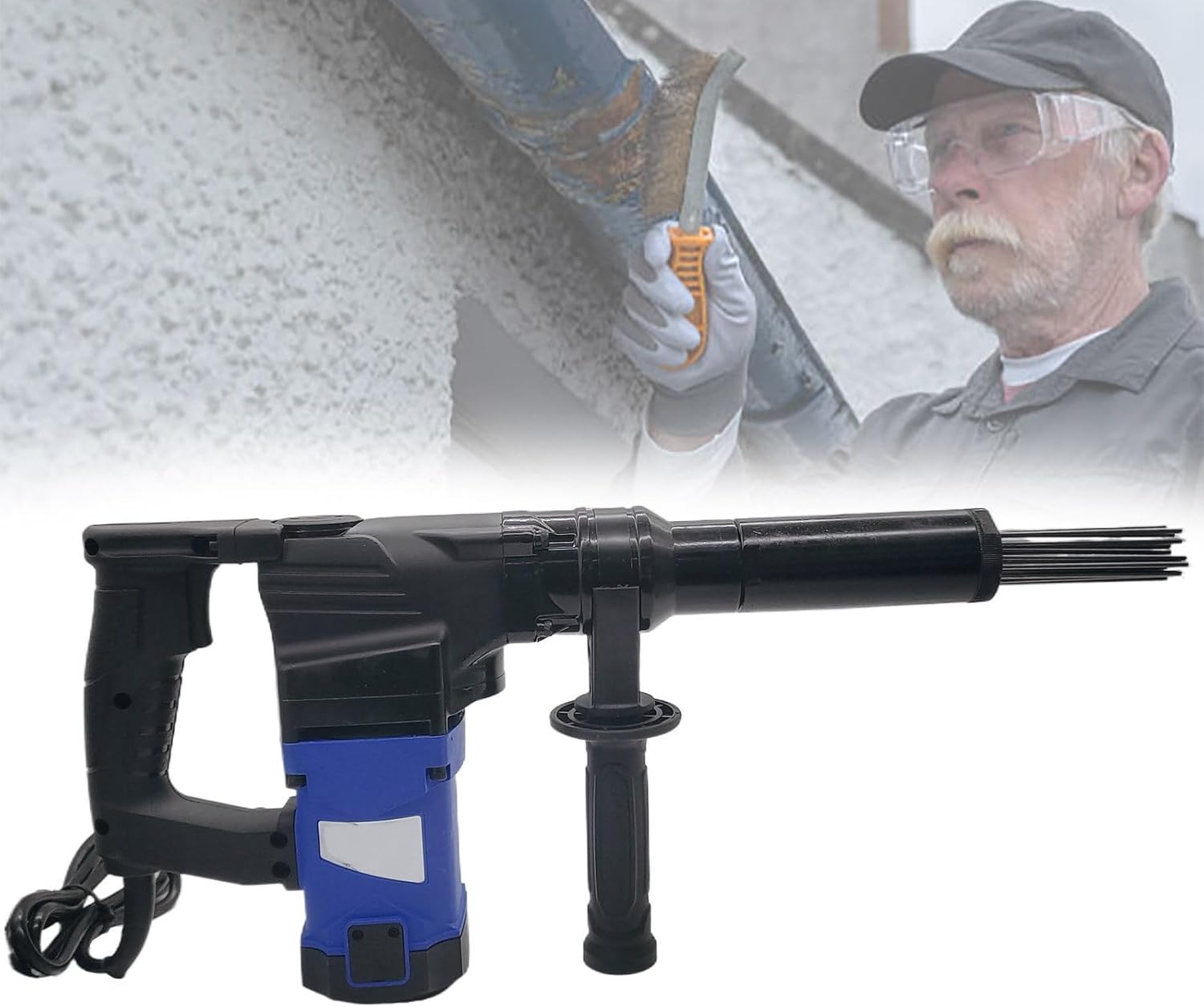
    Intro: Grinding and chipping slag by hand takes time and wears out your wrists. An electric needle scalerโ€”like this 1100W Beachtiful modelโ€”removes rust, scale, and light slag fast without the dust cloud of a grinder. Learn when to reach for it, how to set it up safely, and what to watch for on the job.

    Key Takeaways

    • 1100W electric needle scaler removes rust, scale, and light slag quickly
    • Handheld design fits tight spaces and curved surfaces better than angle grinders
    • Lower dust and noise than grinding; reduces respiratory exposure on repetitive jobs
    • Ideal for prep work before welding, paint removal, and surface cleaning
    • Requires proper PPE and ventilation; not a substitute for full respiratory protection

    Beachtiful Electric Needle Scaler, 1100W Handheld Needle Derusting Electric Jet Chisels, for Metalworks, Rust, Weld & Paint Remover, Screw,Nut,Boat,Deck
    • ใ€High Performanceใ€‘Electric needle scaler using high-end copper wire motor and key components, it has good electrical safety and long service life, The streamlined and lengthened front air duct is matched with a compact crankcase to increase the effective working depth.
    • ใ€Easy to Replaceใ€‘Handheld electric needle derusting tool the rust-removing steel needle is easy to replace, and the daily maintenance is more convenient, available to meet the needs of different use environments.
    • ใ€Use Quicklyใ€‘Electric rust remover front handle is easy to disassemble and assemble, and can be quickly fixed at any position in front, making the more comfortable.
    • ใ€Small Sizeใ€‘The streamlined slender front duct and compact crankcase can handle various small corners efficiently and flexibly.
    • ใ€Wide Scope of Applicationใ€‘Needle scaler attachment is suitable for relatively harsh working environments such as shipbuilding, construction, and foundry industries. It can effectively remove deposits such as various coatings, rust, and welding slag.

    Last update on 2026-06-04 / Affiliate links / Images from Amazon Product Advertising API

    Performance & Use

    The Beachtiful 1100W needle scaler delivers rapid-fire impacts (up to 3,000 strokes per minute) that chip away rust, mill scale, and light slag without overheating the base metal. The compact handheld design lets you work in tight corners, around welds, and on curved surfaces where an angle grinder would be awkward or unsafe.

    What to compare before you buy

    • Power and stroke rate: 1100W with ~3,000 strokes/min is mid-range; verify against your shop’s duty cycle needs
    • Noise level: Electric needle scalers run quieter than grinders (~90 dB) but still require hearing protection
    • Dust generation: Produces less dust than grinding but still requires local exhaust or respiratory PPE
    • Grip and weight: Handheld design (~5โ€“7 lbs typical); test for comfort during extended use
    • Corded vs. cordless: This model is corded; verify power outlet access on your job site

    Comparable Amazon picks (optional)

    Durability & Build

    Heavy-duty steel housing and tungsten carbide needle tips resist wear and impact damage. The motor is sealed to reduce dust ingestion. Replaceable needle cartridges extend tool life and keep costs down on high-volume prep jobs. Vibration dampening in the handle reduces fatigue on longer shifts.

    Who It’s For

    • Fabrication shops doing high-volume prep work before welding or painting
    • Maintenance crews removing rust and scale from structural steel or equipment
    • Welding instructors teaching surface prep techniques in controlled environments
    • Field crews working in tight spaces where grinders are impractical or unsafe
    • Painters and coaters prepping surfaces before application

    Quick FAQ

    Q: Can I use this instead of a grinder?
    A: For light rust and scale, yes. For heavy mill scale or thick coatings, a grinder is faster. Use both as needed.

    Q: Does it create a lot of dust?
    A: Less than grinding, but still requires ventilation or respiratory PPE. Use in well-ventilated areas.

    Q: How long do the needle tips last?
    A: Typically 20โ€“40 hours of continuous use; replacements are inexpensive and widely available.

    Q: Is it safe for aluminum?
    A: Yes, but use light pressure to avoid gouging soft aluminum surfaces.

    Q: What’s the noise level?
    A: ~90 dB; hearing protection is required for extended use.

    Safety Notes

    • Always wear safety glasses and hearing protection (ANSI S3.19 rated)
    • Use respiratory PPE (N95 minimum; P100 for heavy scale work) in poorly ventilated areas
    • Inspect needle cartridge for damage before each use; replace if bent or broken
    • Keep work area well-ventilated to manage dust and fumes
    • Follow OSHA guidelines for dust exposure limits (PEL: 5 mg/mยณ for general dust)
    • Never operate with wet hands or in wet conditions

    Where to Buy

    Shop verified ASINs on Amazon with affiliate links:

  • Beachtiful Electric Needle Scaler (1100W): When Itโ€™s the Right Tool for Slag, Rust, and Coating Removal

    Beachtiful Electric Needle Scaler (1100W): When Itโ€™s the Right Tool for Slag, Rust, and Coating Removal

    Needle scalers are not โ€œfinish tools.โ€ Theyโ€™re for aggressive removal of weld slag, rust, and stubborn coatings where a flap disc, wire wheel, or scraper is slowโ€”or where youโ€™re trying to get into irregular surfaces and corners.

    This post covers what to verify before buying the Beachtiful Electric Needle Scaler (1100W), where it fits in a welding workflow, and what it will not do (so you donโ€™t buy it expecting grinder-like results).

    Beachtiful Electric Needle Scaler, 1100W Handheld Needle Derusting Electric Jet Chisels, for Metalworks, Rust, Weld & Paint Remover, Screw,Nut,Boat,Deck
    • ใ€High Performanceใ€‘Electric needle scaler using high-end copper wire motor and key components, it has good electrical safety and long service life, The streamlined and lengthened front air duct is matched with a compact crankcase to increase the effective working depth.
    • ใ€Easy to Replaceใ€‘Handheld electric needle derusting tool the rust-removing steel needle is easy to replace, and the daily maintenance is more convenient, available to meet the needs of different use environments.
    • ใ€Use Quicklyใ€‘Electric rust remover front handle is easy to disassemble and assemble, and can be quickly fixed at any position in front, making the more comfortable.
    • ใ€Small Sizeใ€‘The streamlined slender front duct and compact crankcase can handle various small corners efficiently and flexibly.
    • ใ€Wide Scope of Applicationใ€‘Needle scaler attachment is suitable for relatively harsh working environments such as shipbuilding, construction, and foundry industries. It can effectively remove deposits such as various coatings, rust, and welding slag.

    Last update on 2026-06-04 / Affiliate links / Images from Amazon Product Advertising API

    What a needle scaler is best at

    A needle scaler uses a bundle of moving needles to โ€œchipโ€ at surface contamination. In welding/fab work, itโ€™s typically used for:

    • Slag removal after certain processes (especially where slag is heavy or access is awkward)
    • Rust and coating removal during repair prep
    • Cleaning irregular surfaces where a disc canโ€™t sit flat

    Itโ€™s not a replacement for final surface conditioning. Most jobs still need a follow-up pass (wire wheel, flap disc, sanding) depending on your finish requirements.

    Performance & Use

    What to compare before you buy

    • Power and duty expectations: The listing states โ€œ1100Wโ€ in the title; verify the electrical requirements and whether it matches your shop power.
    • Needle replacement availability: Confirm replacement needle sets are easy to source (Unknown (Verify) unless clearly listed).
    • Vibration and control: Needle scalers can be fatiguing. Look for grip/handle design that supports two-hand control.
    • Access vs grinder: If you mainly need flat-surface blending, a flap disc may be faster. If you need corners/irregular surfaces, the scaler can win.
    • Noise and debris management: Plan for hearing protection and eye/face protection. Debris can eject unpredictably.

    Comparable Amazon picks (optional)

    Where this fits in a welding workflow

    A practical sequence (common repair/fab reality):

    1. Gross removal: needle scaler for heavy slag/rust/coating
    2. Refine: wire wheel or flap disc to smooth and prep for weld/paint
    3. Final prep: wipe/clean per your coating or weld procedure requirements (process-specific)

    Safety notes worth taking seriously

    • Eye/face protection is non-negotiable. Needle scalers throw sharp debris. Use at least safety glasses; a face shield is often the better call.
    • Hearing protection: These tools are loud in real use.
    • Gloves and sleeves: Helps with vibration and protects from sharp chips.
    • Check what youโ€™re removing. If youโ€™re stripping unknown coatings, treat dust as hazardous until verified otherwise.

    Who should buy this

    Good fit if you:

    • Do repair work where rust/coatings are common.
    • Need a tool that can clean irregular surfaces faster than discs alone.

    Skip if you:

    • Mostly do clean new fab where a flap disc/wire wheel already covers your prep needs.
    • Expect a needle scaler to leave a โ€œready-to-paintโ€ finish without follow-up.

    Where to buy (verified)

    Beachtiful Electric Needle Scaler, 1100W Handheld Rust Remover (listing title as shown in search results)
    Verified ASIN: B0D5CTDVBG
    Amazon verification URL: https://www.amazon.com/Beachtiful-Electric-Handheld-Derusting-Metalworks/dp/B0D5CTDVBG?tag=weldsupport-20

  • Plasma Cutter Buying Guide 2025 | Duty Cycle, Cut Capacity & Air Requirements

    Plasma Cutter Buying Guide 2025 | Duty Cycle, Cut Capacity & Air Requirements

    Plasma cutters use ionized gas to cut conductive metals. Choosing the right cutter depends on material thickness, duty cycle, air supply, and cut quality requirementsโ€”not just amperage rating.

    Key Specifications Explained

    Amperage Rating & Cut Capacity

    AmperageRecommended CutMaximum CutTypical Material
    20-30A1/8โ€-3/16โ€1/4โ€Sheet metal, auto body, HVAC
    40-50A1/4โ€-3/8โ€1/2โ€Light fabrication, farm repair
    60-80A3/8โ€-1/2โ€3/4โ€General fabrication, structural steel
    85-100A1/2โ€-3/4โ€1โ€Heavy fabrication, thick plate

    Recommended cut = Clean cut with minimal dross (slag on bottom edge)
    Maximum cut = Severance cut (rough edge, heavy cleanup required)

    Rule of thumb: Buy 20-30% more amperage than your typical material thickness for clean cuts and longer consumable life.

    Duty Cycle

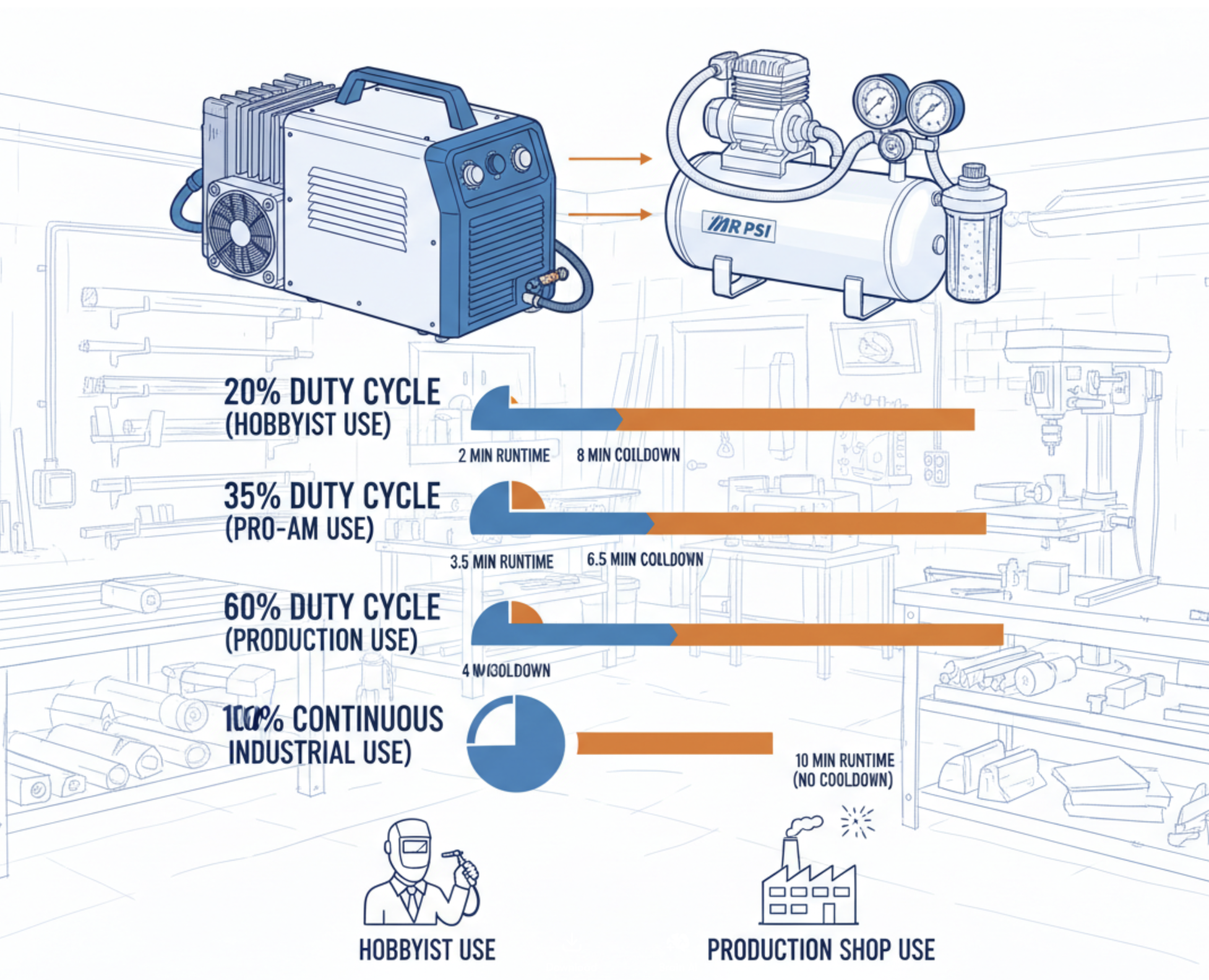
    Definition: Percentage of 10-minute period the machine can run at rated amperage before requiring cooldown.

    Duty CycleRuntime @ Max AmpsCooldownUse Case
    20%2 min8 minHobbyist, occasional use
    35%3.5 min6.5 minLight fabrication, DIY
    60%6 min4 minProduction shop, frequent use
    100%10 min0 minIndustrial, continuous operation

    Example: 50A cutter with 35% duty cycle can run 3.5 minutes at 50A, then must cool 6.5 minutes.
    At lower amperage: Duty cycle increases (50A cutter at 30A may have 60-80% duty cycle).

    Air Supply Requirements

    Compressed Air Specs:Pressure: 60-90 PSI (4-6 bar) – Flow rate: 4-8 CFM @ 90 PSI (varies by amperage) – Quality: Clean, dry, oil-free

    Compressor Sizing:

    Plasma AmperageMinimum CFM @ 90 PSIRecommended Tank Size
    20-30A4 CFM20 gallon
    40-50A5 CFM30 gallon
    60-80A6 CFM60 gallon
    85-100A8 CFM80 gallon

    Air quality issues: – Moisture = premature consumable failure and poor cut quality – Oil contamination = torch tip clogging – Solution: Install inline air dryer/filter between compressor and plasma cutter

    Input Power Requirements

    120V Plasma Cutters:Amperage range: 12-40A – Cut capacity: Up to 3/8โ€ recommended, 1/2โ€ maximum – Advantage: Portable, runs on standard outlets – Limitation: Lower duty cycle, reduced cut speed

    240V Plasma Cutters:Amperage range: 40-100A+ – Cut capacity: 1/2โ€-1โ€+ recommended – Advantage: Higher duty cycle, faster cutting, thicker material – Requirement: Dedicated 240V circuit (30-50A breaker)

    Dual Voltage (120V/240V): – Runs on both voltages with reduced performance on 120V – Example: 50A on 240V, 30A on 120V – Best for: Portable use + shop capability

    Cut Quality Factors

    Pilot Arc vs. Contact Start

    Pilot Arc (High-Frequency Start): – Arc initiates without touching workpiece – Pros: Cuts expanded metal, grating, rusty/painted steel – Cons: Higher cost, can interfere with electronics – Best for: Versatile cutting, field work

    Contact Start (Scratch Start): – Requires torch tip contact with workpiece to start arc – Pros: Lower cost, no electronic interference – Cons: Cannot cut expanded metal or start on edge – Best for: Budget cutters, clean flat plate

    Inverter vs. Transformer Technology

    Inverter-Based:Weight: 10-40 lbs (portable) – Efficiency: High (lower power consumption) – Duty cycle: Typically higher (35-60%) – Cost: Moderate to high – Best for: Modern shops, portability required

    Transformer-Based:Weight: 80-200 lbs (stationary) – Efficiency: Lower (higher power draw) – Duty cycle: Often 100% (industrial use) – Cost: Higher upfront, lower long-term maintenance – Best for: Heavy industrial, continuous operation

    Consumable Costs & Life

    Consumable Components

    PartFunctionTypical LifeCost per Set
    ElectrodeConducts current to arc1-3 hours cutting time$3-$8
    Nozzle (tip)Focuses plasma stream1-3 hours cutting time$2-$5
    Swirl ringStabilizes gas flow5-10 hours$1-$3
    Shield cupProtects nozzle10-20 hours$2-$5

    Consumable life factors: – Amperage setting (higher amps = shorter life) – Air quality (moisture/oil reduces life 50%+) – Arc-on time (duty cycle) – Proper technique (perpendicular torch angle, correct standoff)

    Annual consumable cost estimate: – Hobbyist (20 hours/year): $50-$100 – Light fabrication (100 hours/year): $250-$500 – Production shop (500+ hours/year): $1,500-$3,000

    Material Compatibility

    MaterialPlasma CutNotes
    Mild steelโœ“Best cut quality, minimal dross
    Stainless steelโœ“Clean cuts, some dross on thick sections
    Aluminumโœ“Requires higher amperage than steel (30% thicker capacity)
    Copperโœ“High thermal conductivity = slower cut speed
    Brassโœ“Similar to copper, produces toxic fumes (ventilation required)
    Cast ironโœ“Brittle, may crack from rapid heating
    Galvanized steelโœ“Toxic zinc fumes (ventilation mandatory)

    Cannot cut: Non-conductive materials (wood, plastic, concrete, glass)

    Torch Styles & Ergonomics

    Hand Torch (Standard)

    • Cable length: 10-25 feet
    • Weight: 1-3 lbs
    • Best for: Freehand cutting, portability
    • Limitation: Less precise than machine torch

    Machine Torch (CNC-Compatible)

    • Mounting: Designed for CNC table or track system
    • Standoff: Adjustable height control for consistent cut quality
    • Best for: Automated cutting, production runs
    • Cost: $200-$800 (in addition to hand torch)

    Ergonomic Features

    • Trigger lock: Reduces hand fatigue during long cuts
    • Swivel head: Prevents cable twist, improves maneuverability
    • Insulated grip: Protects from heat during extended use

    Common Mistakes

    Undersizing amperage for material thickness
    40A cutter on 1/2โ€ steel = slow, rough cuts and rapid consumable wear. Size cutter 20-30% above typical thickness for clean cuts.

    Using contaminated air supply
    Moisture and oil in compressed air destroy consumables in 10-20% of normal life. Always use inline air dryer/filter.

    Running at maximum amperage continuously
    Exceeds duty cycle, triggers thermal shutdown. Run at 70-80% of rated amperage for longer duty cycle and consumable life.

    Buying Checklist

    • โœ“ Amperage rating 20-30% above typical material thickness
    • โœ“ Duty cycle matches usage frequency (35%+ for regular use)
    • โœ“ Input voltage compatible with available power (120V or 240V)
    • โœ“ Pilot arc start for versatile cutting (expanded metal, rusty steel)
    • โœ“ Inverter technology for portability and efficiency
    • โœ“ Compressor meets CFM and PSI requirements
    • โœ“ Air dryer/filter included or purchased separately
    • โœ“ Consumable availability and cost verified

  • Victor 0381-1621 ST900FC Torch Assembly: Review & Buying Guide

    Victor 0381-1621 ST900FC Torch Assembly: Review & Buying Guide

    Victorโ€™s ST900FC is a workhorse torch handle for oxy-fuel cutting and heating. Itโ€™s the current flow-control version of the classic 100-series design, built for reliability in fabrication shops, maintenance departments, and field repair work. This guide covers specs, performance details, and selection notes for welders and fabricators.


    Key Takeaways

    • Heavy-duty Victor 0381-1621 torch assembly
    • Part of Victorโ€™s ST900FC line with built-in Flash-Guardยฎ check valves
    • Compatible with standard Victor cutting attachments (CA1350, CA2460 series, etc.)
    • Brass body, high-flow valves, rugged construction for shop or field use
    • Solid choice for oxy-fuel cutting, gouging, and preheat/heating work

    What the ST900FC Solves

    1. Flashback protection

    Built-in Flash-Guardยฎ check valves help meet OSHA/ANSI recommendations for flashback prevention.

    2. Consistent flow control

    High-flow needle valves allow smoother oxygen/fuel metering than older economy torch bodies.

    3. Shop-grade durability

    Brass body and metal valve assemblies handle frequent usage, heat cycling, and impacts better than light-duty consumer torches.


    Specs (per manufacturer data)

    • Model: Victor ST900FC
    • Part Number: 0381-1621
    • Body Material: Brass
    • Valves: High-flow needle valves
    • Safety: Integrated Flash-Guardยฎ check valves
    • Fuel Compatibility: Oxy-acetylene (primary), oxygen/propane with proper tips
    • Use Case: Cutting, heating, light gouging (with appropriate equipment)

    Unknown specs: Overall length, maximum pressure ratings, included tip(s), packaging weight.
    Verify: Victor spec sheet, ESAB/Victor product catalog, distributor listings.


    Performance Notes

    • Smooth oxygen/fuel adjustment for precise flame shaping
    • Stable during sustained cutting and heating
    • Good ergonomics and heat dissipation for extended shop use
    • Works well with Victorโ€™s 000โ€“6 cutting tips for mild steel plate
    • For propane use, ensure propane-rated tips are installed

    Where to Buy

    ArcWeld Store (preferred):

    Amazon

    VictorยฎVanGuardโ„ข ST 900FC Series 21″ Heavy Duty Straight Cutting Torch with 90 deg head angle
    • For heavy and medium duty industrial applications
    • Gas type to be used with this system is an fuel gas type, 5 PSIG and above
    • Built-in patented flashback arrestors
    • Reverse flow check valves for added safety
    • Hose connections are 9/16 to 18 inches unless noted

    Last update on 2026-06-04 / Affiliate links / Images from Amazon Product Advertising API


    Disclosure: This article contains affiliate links. As an Amazon Associate, I earn from qualifying purchases.


    Comparison Table

    ModelKey SpecsBest For
    Victor ST900FC (0381-1621)Brass body, Flash-Guard check valves, high-flow valvesOxy-fuel cutting & heating

    Safety Notes (ANSI/AWS References)

    • Use flashback arrestors or check valves per ANSI Z49.1 and OSHA 1910.253.
    • Open oxygen valves slowly to avoid pressure shock.
    • Purge hoses before lighting the torch.
    • Wear Z87.1-rated eye/face protection.
    • Use fuel-specific tips โ€” propane tips differ from acetylene tips.

    FAQ

    Does the ST900FC include a cutting attachment?
    Yes, because this is a one piece torch. Most boxed assemblies include only the torch handle. Cutting attachments are typically sold separately.

    Is it compatible with my existing Victor tips?
    Yes โ€” when used with the correct Victor cutting attachment. It uses 1 Series tips.

    Can I run propane?
    Yes. Use propane-rated cutting/heating tips and proper hose ratings.

    Is this considered a heavy-duty torch?
    Yes. The ST900FC is in Victorโ€™s heavy-duty line.

  • Drillco 350N29 Mechanics-Length Drill Bit Set: Review & Buying Guide

    Drillco 350N29 Mechanics-Length Drill Bit Set: Review & Buying Guide

    A dependable bit set matters when you’re drilling mild steel, stainless, aluminum, or shop-grade alloys. The Drillco 350N29 is a 29-piece high-speed steel (HSS) mechanics-length set designed for fabrication and repair work where standard length bits tend to walk or flex. This guide breaks down what youโ€™re getting, how it performs, and whether it belongs in a welding/fabrication shop.


    Key Takeaways

    • 29-piece mechanics-length set covering 1/16โ€“1/2 in. in 1/64 increments
    • HSS construction with a 135ยฐ split point (per manufacturer spec) reduces walking on steel and stainless
    • Mechanics length = shorter, stronger, less flex vs. jobber length
    • Durable steel index case with clear sizing
    • Strong general-purpose set for welders, fabricators, and maintenance crews

    What This Bit Set Solves

    Mechanics-length bits solve three common shop issues:

    1. Bit walk on steel

    The 135ยฐ split point helps seat the bit fast. No punching required on lighter gauge material.

    2. Excessive flex

    Shorter length reduces chatter and breakage when drilling structural steel, brackets, and plate.

    3. Inconsistent sizing

    Full 1/64 increments fill the gaps that most budget sets skipโ€”important for bolt-hole accuracy.


    Performance & Build Notes

    • Material: High-speed steel (HSS)
    • Angle: 135ยฐ split point (manufacturer specification; improves center-starting)
    • Length: Mechanics length (shorter than jobber, stronger in handheld drilling)
    • Case: Metal indexed box with positive stops
    • Best applications: Mild steel, stainless, aluminum, cast, general shop drilling
    • Limitations: Not cobaltโ€”under heavy stainless production use, cobalt will outlast it

    Where to Buy

    ArcWeld Store:

    Amazon:

    Drillco 350N Series Nitro 29 Piece High-Speed Steel Mechanics Length Drill Bit Set, Black and Gold Oxide Finish, Round with Flats Shank, Spiral Flute, 135 Degrees Split Point, 1/16″ – 1/2″ in 1/64″ increments
    • High-speed steel tools are good for most general purpose applications, offering a combination of hardness and toughness for wear resistance
    • Gold oxide is a thinner oxide surface treatment than black oxide typically used to identify cobalt steel tools; performance is similar to uncoated tools
    • These round shank tools have flats ground onto three sides to reduce slippage of the bit when used in drill chucks
    • When run in a counterclockwise direction (right-hand cut) spiral fluted tools evacuate chips up and out of the cut to reduce clogging
    • 29 screw machine length drill bits ranging in size from 1/16″ to 1/2″ in 1/64″ increments

    Last update on 2026-06-04 / Affiliate links / Images from Amazon Product Advertising API

    Disclosure: This article contains affiliate links. As an Amazon Associate, I earn from qualifying purchases.


    Comparison Table

    ModelKey SpecsBest For
    Drillco 350N2929-pc, HSS, 135ยฐ split point, 1/16โ€“1/2″Fabrication, maintenance, general metal drilling

    Is the Drillco 350N29 Worth It?

    If youโ€™re drilling metal regularly and need reliable sizes, the 350N29 sits in a sweet spot:

    • Stronger than jobber length
    • More accurate than 13-pc economy sets
    • Affordable compared to cobalt machinist sets

    For general welding/fabrication work, itโ€™s a solid long-term shop set.


    Safety Notes (AWS/ANSI References)

    • Use ANSI-rated eye protection (ANSI Z87.1).
    • Secure workpieces with clamps per AWS fabrication guidelines.
    • Keep drill speed appropriate to HSS: reduce RPM on stainless and thicker plate to prevent overheating.
    • Use cutting fluid on steel to extend bit life.

    FAQ

    Does this set include cobalt?
    No. Itโ€™s HSS only. For heavy stainless or repetitive production drilling, consider cobalt.

    Are the bits replaceable individually?
    Drillco sells single bits; availability varies by vendor.

    Will these work in a drill press?
    Yes. Mechanics-length bits are stable and reduce wander.

    Do they handle stainless?
    Yesโ€”within reason. Use slower RPM and cutting oil.


    Sources Checked

    • Drillco manufacturer catalog (spec confirmation)
    • Amazon product listing (ASIN B00GPA7E9O)
    • ArcWeld Store listing
    • AWS/ANSI PPE and fabrication guidance (Z87.1)

  • Strong Hand Tools MET11 Mini MagTab Review (2025)

    Strong Hand Tools MET11 Mini MagTab Review (2025)

    The Strong Hand Tools MET11 Mini MagTab is one of those small, under-$20 fixtures that ends up earning a permanent place on the bench. Itโ€™s a compact magnetic clamp designed for holding tabs, flat bar, flanges, and small brackets square during tack welding. For layout, light fab, and repeated parts alignment, the Mini MagTab solves a real problem: securing small pieces accurately without bulky clamps.


    Key Takeaways

    • Holds small brackets, tabs, and flat bar square during fit-up.
    • Compact design fits places larger magnets canโ€™t.
    • Adjustable V-shaped face for tubing and irregular parts.
    • Replaceable pads extend service life.
    • Ideal for TIG and MIG layout work where speed and accuracy matter.

    What the Mini MagTab Solves

    Regular welding magnets struggle with:

    • Small parts
    • Tight spaces
    • Consistent 90ยฐ alignment
    • Thin materials that shift under clamp pressure

    The MET11 addresses these issues by combining a precision 90ยฐ face, a pivoting V-block, and a low-profile body that doesnโ€™t fight you during tack welding. Itโ€™s built for repetitive work and small-part fabrication โ€” handrails, brackets, gussets, race-car tabs, control-arm brackets, or anything where placement accuracy matters.


    Features & Build

    Body: Steel housing with replaceable pads
    Magnet Type: Permanent magnet
    Faces: 90ยฐ fixed face + adjustable V-face
    Adjustment: Slotted hardware for micro-alignment
    Applications: Brackets, tabs, 1/2″โ€“1-1/2″ tube, flat bar, sheet fab
    Heat Considerations: As with all magnetic fixtures, avoid excessive heat exposure; remove before completing full welds.


    Performance in the Shop

    The MET11 shines when:

    • Holding two small parts at 90ยฐ
    • Aligning tabs on round tube
    • Keeping parts from drifting while tacking
    • Doing repetitive work where speed matters

    The magnet strength is balanced โ€” strong enough to hold parts reliably, but not so aggressive that it โ€œsnapsโ€ pieces out of alignment.


    Best Use Cases

    • Tube-frame tabs
    • Brackets on square or round tube
    • Jigging small assemblies
    • Motorcycle fabrication
    • Sheet metal fit-ups
    • Fixture work on limited-space tables

    Where to Buy

    Strong Hand Tools, MagTab 2.0, Adjustable Magnetic Tab Holder, 6 x Replaceable Magnets, Knurled Knob, Slotted Bracket, Adjustable Magnetic V-Pad Base, Magnetic Tack Welding Tool, MET11
    • 6 replaceable magnets for 3x STRONGER magnetic holding force than the Standard MagTab
    • Magnetic pull force from 22 ~ 44 lb. (10 ~ 20 kg) based on flat surface with the two larger magnets
    • Knurled knob provides comfrotable and easy grip
    • Slot on hte bracket for workpiece alignment
    • Dim: 4.5โ€ณ x 2.6โ€ณ x 2โ€ณ

    Last update on 2026-06-04 / Affiliate links / Images from Amazon Product Advertising API


    Comparison Table

    FeatureStrong Hand MET11 Mini MagTabStandard Magnet Square
    SizeCompact, fits small partsBulky for small fab
    AlignmentPrecise 90ยฐ + adjustable VFixed 90ยฐ only
    PadsReplaceableUsually not replaceable
    Tube SupportYes (V-block)Limited
    Best ForTabs, brackets, tube workGeneral layout

    Safety Notes

    • Keep magnets away from high heat; prolonged exposure can weaken magnetic force.
    • Do not rely on magnets for load-bearing support โ€” use mechanical clamping when welding beyond tacking.
    • Maintain clean surfaces; metal dust reduces holding strength.
    • Always follow ANSI Z49.1 welding safety guidelines.

    FAQ

    Can the Mini MagTab hold heavy parts?
    Itโ€™s designed for small and medium-light parts. For thicker brackets, pair it with a mechanical clamp.

    Can it be used on stainless or aluminum?
    The magnet wonโ€™t stick directly to non-ferrous metals, but it can support steel fixtures that hold stainless/aluminum parts in place.

    Does the heat from TIG arcs damage it?
    Prolonged heat will weaken any magnet. Remove the MagTab after tack welding.

    Are the pads useful long term?
    Yes โ€” the replaceable pads extend life and keep the faces accurate.


    Sources Checked

    • Strong Hand Tools product materials
    • Manufacturer datasheets

Read with Kindle Unlimited