Tag: ER70S-6

  • E71T-GS .030 (Gasless) vs ER70S-6 .023 (Solid) for Sheet Metal: What to Use and Why

    If youโ€™re welding thin sheet metal, wire choice matters more than most people think. E71T-GS .030 (self-shielded flux-core, โ€œgaslessโ€) can run without a bottle and will tolerate less-than-perfect conditions, but it typically runs hotter, makes more spatter, and leaves slag you must remove. ER70S-6 .023 (solid wire) with 75/25 Ar/CO2 (C25) is usually the cleaner, easier path for thin steel when you can control wind and have shielding gas.

    This guide compares E71T-GS .030 vs ER70S-6 .023 specifically for thin mild steel sheet metal (typical auto/body panels, light fab, brackets, patch panels), and gives practical setup and technique notes you can apply on a 120V or small 240V MIG.

    Key takeaways

    • Best overall for sheet metal: ER70S-6 .023 + C25 (cleaner bead, less spatter, no slag).
    • Best when you canโ€™t use gas (wind/outdoors/field): E71T-GS .030 can work, but expect more cleanup and a narrower โ€œsweet spotโ€ on thin material.
    • If you run E71T-GS on thin sheet: use DCEN polarity (electrode negative) as recommended by manufacturers to help reduce burn-through risk.
    • Technique beats settings on thin steel: short stitch welds, skip welding, tight fit-up, and heat control matter more than chasing a perfect chart.

    What these wires are (and what the numbers actually mean)

    ER70S-6 .023 (solid wire)

    • Process: GMAW (MIG) short-circuit transfer on sheet metal.
    • Shielding gas: typically 75% Argon / 25% CO2 (C25) for a stable short-circuit arc and reduced spatter.
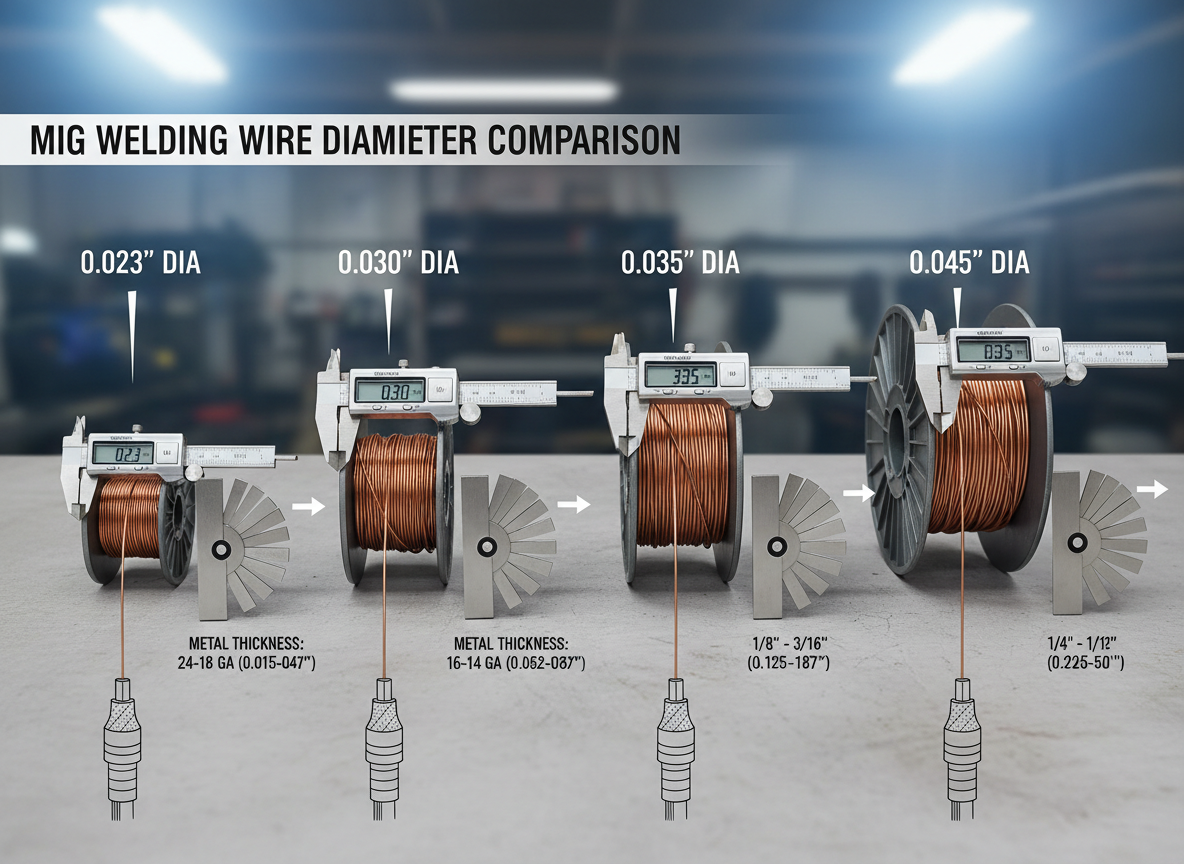
    • Why itโ€™s common on thin steel: smaller diameter wire (.023) supports lower amperage and smoother control on 22โ€“16 ga.

    E71T-GS .030 (self-shielded flux-core)

    • Process: FCAW-S (flux-cored arc welding, self-shielded).
    • Shielding gas: none (the flux provides shielding).
    • โ€œGSโ€ reality: generally positioned as single-pass and light fabrication/repair; not the same intent as structural self-shielded wires used for code work.
    • Thin metal note: manufacturers explicitly position 71T-GS as usable on thin gauge materials, but it still tends to be less forgiving cosmetically than solid wire.

    Head-to-head: which is better on sheet metal?

    1) Heat control and burn-through risk

    ER70S-6 .023 usually wins on thin sheet because you can run lower wire feed speeds and keep the puddle small. With C25, short-circuit transfer is predictable and easier to โ€œtack-tack-tackโ€ without piling heat.

    E71T-GS .030 can be run on thin material, but it often feels more aggressive. The arc is typically harsher, and because youโ€™re dealing with slag and more spatter, you can end up spending more time cleaning and reworking thin edges.

    Practical takeaway: if youโ€™re patching 22โ€“18 ga, solid .023 is the default choice when gas is available.

    2) Cleanup and finish work

    • ER70S-6: no slag. Youโ€™ll still have some spatter depending on machine and technique, but cleanup is usually minimal.
    • E71T-GS: slag is part of the process. On a thin sheet where youโ€™re doing many short stitches, slag removal becomes a real-time cost.

    If the part will be painted, solid wire is typically faster end-to-end.

    3) Wind and outdoor welding

    This is where E71T-GS earns its keep. If youโ€™re outside and wind is killing your gas coverage, flux-core can keep you welding.

    Tradeoff: youโ€™re paying for that convenience with more spatter/cleanup and generally fewer โ€œprettyโ€ beads on the thin sheet.

    4) Dirty/galvanized sheet

    Flux-core wires are often chosen when the steel isnโ€™t perfectly clean. That said, galvanized welding has serious fume hazards and should be approached with proper ventilation/respiratory protection and surface prep.

    Practical takeaway: both wires prefer clean metal. If you must weld through light contamination, ER70S-6 is known for deoxidizers, but you should still clean to bright metal on thin sheet whenever possible.

    Quick comparison table (sheet metal focus)

    CategoryER70S-6 .023 + C25E71T-GS .030 (gasless)
    Best use on sheetIndoor/controlled conditionsOutdoor/windy/no gas
    Bead appearanceTypically smootherTypically rougher
    SpatterLower (with good setup)Higher
    SlagNoneYes
    Burn-through controlEasierMore technique-sensitive
    Speed on thin sheetGood (stitch/skip)Often slower due to cleanup
    Equipment needsGas bottle/regulatorNo gas

    Setup: polarity, gas, and consumables

    ER70S-6 .023 setup checklist

    • Polarity: DCEP (electrode positive) for solid wire MIG.
    • Gas: C25 is the common baseline for short-circuit on mild steel.
    • Drive rolls: V-groove for solid wire.
    • Contact tip: match wire diameter (.023 tip).
    • Stickout: keep it consistent (shorter stickout generally helps arc stability on thin work).

    E71T-GS .030 setup checklist

    • Polarity: DCEN (electrode negative) is commonly recommended by manufacturers for E71T-GS and is specifically called out as helping minimize burn-through risk on thin sheet.
    • Drive rolls: knurled rolls are typical for flux-core.
    • Contact tip: match wire diameter (.030 tip).
    • No gas: confirm your machine is set for flux-core mode if it has a selector.

    Technique that matters most on thin sheet (regardless of wire)

    Use stitch welding, not long beads

    On sheet metal, long continuous welds are the fastest way to warp panels and blow holes. Instead:

    1. Tack every 1โ€“2 in. (25โ€“50 mm) to lock fit-up.
    1. Stitch 1/2 in. (12 mm) or less.
    1. Skip around to spread heat.
    1. Let it cool, then connect stitches.

    Fit-up and backing are your cheat codes

    • Tight gap = easier control.
    • Copper backing bars/spoons help absorb heat and support the puddle.
    • Clamp the work to prevent panel movement.

    Push vs drag

    • Solid wire MIG on sheet: many welders prefer a slight push angle for visibility and puddle control.
    • Self-shielded flux-core: often runs better with a slight drag angle. If you push it like solid wire, it can get messy fast.

    When Iโ€™d pick each wire (simple decision rule)

    Choose ER70S-6 .023 when:

    • Youโ€™re welding 18โ€“22 ga mild steel indoors.
    • Appearance matters (auto patch panels, visible brackets).
    • You want minimal cleanup and faster paint prep.

    Choose E71T-GS .030 when:

    • Youโ€™re outside or in wind and gas coverage is unreliable.
    • You need a quick repair and cleanup/appearance is secondary.
    • You donโ€™t have a bottle/regulator available.

    Common problems and fixes

    Burn-through

    • Drop voltage one tap (or reduce volts).
    • Increase travel speed.
    • Shorten stitch length.
    • Use backing (copper spoon).
    • For E71T-GS: confirm DCEN polarity.

    Excess spatter (especially with E71T-GS)

    • Check stickout and keep it consistent.
    • Reduce wire feed slightly if the arc is harsh.
    • Clean the base metal better than you think you need to.

    Porosity

    • Solid wire: check gas flow, leaks, and drafts.
    • Flux-core: protect from wind; verify correct polarity and technique (drag angle, proper stickout).

    Safety notes (donโ€™t skip this on sheet metal)

    • Fumes: Welding on painted, oily, or galvanized sheet can generate hazardous fumes. Use local exhaust ventilation and appropriate respiratory protection.
    • Fire risk: Thin sheet work often happens near interiors, undercoating, seam sealer, or shop debris. Keep a fire watch and have an extinguisher ready.
    • Eye/skin protection: Short-circuit MIG and flux-core still produce intense UV.

    Bottom line

    For most sheet metal work, ER70S-6 .023 with C25 is the cleaner, more controllable setup with less cleanup and less frustration. E71T-GS .030 is a practical โ€œno gasโ€ option when conditions force your hand, but itโ€™s usually a compromise on thin panelsโ€”especially if you care about finish quality.

    If you tell me your exact thickness (22/20/18/16 ga) and your welder model, I can tighten this into a settings-first guide with a small parameter table and a troubleshooting flow.

  • MIG Welding Wire Selection Guide 2025 | ER70S-6 vs ER70S-3 Specs

    MIG Welding Wire Selection Guide 2025 | ER70S-6 vs ER70S-3 Specs

    MIG wire selection affects weld quality, spatter levels, and penetration depth. Choosing the right wire depends on base metal composition, surface condition, and shielding gasโ€”not just diameter and tensile strength.

    Common MIG Wire Classifications

    ER70S-6 (Most Common)

    • Deoxidizers: Manganese, silicon
    • Tensile strength: 70,000 PSI minimum
    • Best for: Dirty or rusty steel, single-pass welds, general fabrication
    • Shielding gas: 75/25 Ar/COโ‚‚ or 100% COโ‚‚
    • Spatter level: Moderate

    ER70S-3

    • Deoxidizers: Lower manganese and silicon than ER70S-6
    • Tensile strength: 70,000 PSI minimum
    • Best for: Clean steel, multi-pass welds, automotive sheet metal
    • Shielding gas: 75/25 Ar/COโ‚‚ (100% COโ‚‚ not recommended)
    • Spatter level: Low

    ER308L (Stainless Steel)

    • Composition: 19-21% chromium, 9-11% nickel
    • Best for: 304/304L stainless steel
    • Shielding gas: 90/10 Ar/COโ‚‚ or tri-mix (He/Ar/COโ‚‚)
    • Corrosion resistance: Excellent

    ER316L (Stainless Steel)

    • Composition: 18-20% chromium, 11-14% nickel, 2-3% molybdenum
    • Best for: 316/316L stainless, marine environments, chemical processing
    • Shielding gas: 90/10 Ar/COโ‚‚ or tri-mix
    • Corrosion resistance: Superior (molybdenum addition)

    Wire Diameter Selection

    DiameterAmperage RangeMaterial ThicknessTypical Use
    0.023โ€30-130A24-18 gaugeAutomotive sheet metal, thin tubing
    0.030โ€40-145A18-14 gaugeGeneral fabrication, light structural
    0.035โ€50-180A14 gauge-1/4โ€Most common all-purpose size
    0.045โ€75-250A1/4โ€-1/2โ€Heavy structural, thick plate
    0.052โ€100-300A1/2โ€+Industrial fabrication, heavy equipment

    Rule of thumb: Thinner wire = better control on thin material. Thicker wire = faster deposition on heavy plate.

    Shielding Gas Impact on Wire Performance

    75/25 Argon/COโ‚‚ (C25)

    • Pros: Low spatter, smooth arc, good bead appearance
    • Cons: Higher cost than 100% COโ‚‚
    • Best for: ER70S-3, ER70S-6, stainless steel

    100% COโ‚‚

    • Pros: Deep penetration, low cost
    • Cons: Higher spatter, rougher arc
    • Best for: ER70S-6 on thick steel (not recommended for ER70S-3)

    90/10 Argon/COโ‚‚

    • Pros: Minimal spatter, excellent for stainless
    • Cons: Shallow penetration on carbon steel
    • Best for: ER308L, ER316L stainless wire

    Surface Condition Requirements

    Wire TypeMill ScaleLight RustHeavy RustClean Steel
    ER70S-6โœ“โœ“โœ“โœ“
    ER70S-3โœ—โœ—โœ—โœ“
    ER308Lโœ—โœ—โœ—โœ“
    ER316Lโœ—โœ—โœ—โœ“

    ER70S-6 advantage: Higher deoxidizers clean impurities during welding. ER70S-3 requires clean base metal to avoid porosity.

    AWS Filler Metal Specifications

    AWS A5.18 (Carbon Steel MIG Wire) – Covers ER70S-3, ER70S-6, and other carbon steel wires – Defines chemical composition, tensile strength, and elongation requirements

    AWS A5.9 (Stainless Steel MIG Wire) – Covers ER308L, ER316L, and other stainless wires – Specifies corrosion resistance and ferrite content

    Wire Storage & Handling

    Moisture Contamination – Causes: Porosity, hydrogen cracking – Prevention: Store in sealed containers with desiccant packs – Shelf life: 12 months (carbon steel), 6 months (stainless)

    Wire Feed Issues – Kinked wire = erratic arc and bird-nesting – Solution: Use proper spool tension and liner size

    Liner Compatibility

    Wire DiameterLiner Inside Diameter
    0.023โ€-0.030โ€0.030โ€-0.035โ€
    0.035โ€0.035โ€-0.045โ€
    0.045โ€0.045โ€-0.052โ€
    0.052โ€0.052โ€-0.062โ€

    Oversized liner = wire wander. Undersized liner = excessive friction and burnback.

    Common Mistakes

    Using ER70S-3 on rusty steel
    Low deoxidizers canโ€™t compensate for surface contamination. Result: porosity and weak welds. Use ER70S-6 or clean the base metal.

    Wrong liner size for wire diameter
    0.035โ€ wire in 0.045โ€ liner causes erratic feeding. Match liner to wire diameter within 0.005โ€-0.010โ€.

    Storing stainless wire without moisture protection
    Stainless wire absorbs moisture faster than carbon steel. Always use sealed containers with desiccant.

    Buying Checklist

    • โœ“ Wire classification matches base metal (ER70S-6 for dirty steel, ER70S-3 for clean)
    • โœ“ Diameter suits material thickness and amperage range
    • โœ“ Shielding gas compatible with wire type
    • โœ“ AWS A5.18 or A5.9 certification marked on spool
    • โœ“ Liner size matches wire diameter
    • โœ“ Storage container includes moisture protection
    • โœ“ Spool size fits your machine (2 lb, 10 lb, 33 lb, 44 lb)

Try Amazon Prime Free