Tag: ER70S-3

  • ER70S-3 MIG / GMAW Filler Metal: Filler Metal Finder Notes

    ER70S-3 MIG / GMAW Filler Metal: Filler Metal Finder Notes

    ER70S-3 MIG / GMAW Filler Metal

    ER70S-3 MIG / GMAW filler metal is a general-purpose solid wire used on clean carbon steel fabrication. It is typically treated as a starting point for selection, not a final approval for production welding. Before ordering wire or loading a feeder, verify the WPS, code requirements, base metal grade, joint condition, shielding gas, and the manufacturer data sheet.

    Key Takeaways

    • ER70S-3 is a solid MIG/GMAW wire for clean mild steel and carbon steel.
    • Use it as a selection starting point, not as proof of WPS compliance.
    • Lower deoxidizer content means surface condition matters more.
    • Confirm wire diameter, shielding gas, and procedure limits before welding.
    • If the joint has rust, mill scale, or contamination, verify whether a different wire or cleaning method is required.

    What to Check Before You Order

    For ER70S-3, the key question is not just whether the wire matches the material family. It is whether the job condition matches the wireโ€™s intended use. This wire is presented on the WSP filler metal page as a general-purpose option for clean carbon steel fabrication. That means fit-up, cleaning, and procedure control matter.

    Inspect: Base metal type, surface contamination, joint prep, and required weld procedure. Check whether the job uses carbon steel that is clean enough for a general-purpose solid wire. Review the applicable code or spec if the job is code-controlled.

    Verify: The WPS, wire classification, shielding gas, polarity, and diameter. The source page lists ER70S-3 under AWS A5.18, but the job still needs procedure-level verification. If any detail is unclear, record it as Unknown (Verify) rather than assuming it will work.

    Check: The filler metal page and the filler metal finder page together as selection tools. Use them to narrow choices, then confirm with the manufacturer data sheet and internal welding requirements before purchase.

    Troubleshooting Support

    If weld quality is inconsistent, do not start by changing only parameters. Start by checking the basics.

    Issue: Excess spatter or unstable arc

    • Check: Shielding gas setup, stickout, contact tip condition, and drive roll tension.
    • Inspect: Wire feed path for drag, liner wear, and contamination.
    • Verify: That the wire diameter matches the feeder setup and procedure. Unknown (Verify) if the feeder has been reconfigured since the last job.

    Issue: Porosity

    • Check: Base metal cleanliness, gas coverage, and leaks in hoses or fittings.
    • Inspect: Rust, oil, moisture, paint, or mill scale on the joint.
    • Verify: Whether the material condition is suitable for ER70S-3 or if the procedure calls for different cleaning or filler selection.

    Issue: Poor wetting or inconsistent bead shape

    • Check: Voltage, wire feed speed, travel speed, and torch angle.
    • Inspect: Joint gap and part fit-up.
    • Verify: That the welding parameters align with the approved WPS. Do not assume a setting that worked on one job is valid for another.

    Filler Metal Finder Notes

    The WSP filler metal finder page is useful when you need to narrow a wire choice from process and base metal information. It should be treated as a selection starting point only. It does not replace the WPS or manufacturer data sheet.

    Use the finder page to confirm the wire family for MIG / GMAW applications and then compare it against the job requirements. For ER70S-3, the practical question is whether the base metal is clean enough and whether the procedure allows this general-purpose wire. If the service condition is critical, high restraint, or code governed, verify all requirements before release to production.

    ER70S-3 MIG / GMAW filler metal page

    WSP filler metal finder

    How to Use This Wire Correctly

    ER70S-3 is generally used on clean carbon steel where a solid wire is appropriate. The practical checks are simple, but they need to be done in order.

    1. Check the job requirements. Confirm the WPS, material grade, and service conditions.
    2. Inspect the joint. Remove oil, moisture, and loose contamination. Unknown (Verify) if surface cleanliness is acceptable without further prep.
    3. Verify the machine setup. Confirm polarity, drive rolls, liner, tip size, and shielding gas.
    4. Run a test weld. Evaluate bead shape, fusion, and spatter before production welding.
    5. Document results. If the weld is intended for a controlled job, keep the settings and observations with the job record.

    Safety Notes

    • Use proper ventilation or local exhaust when welding.
    • Wear the required eye, hand, and body protection for MIG welding.
    • Keep shielding gas cylinders secured and fittings leak-checked.
    • Do not weld without verifying the base material and procedure requirements.
    • If the metal condition is unknown, stop and verify before proceeding.

    FAQ

    Is ER70S-3 a general-purpose MIG wire?
    Yes, it is presented as a general-purpose solid MIG/GMAW wire for clean carbon steel fabrication. That does not mean it is approved for every job. Verify the WPS and base metal first.

    Can I use ER70S-3 on rusty or dirty steel?
    Not as a default assumption. Lower deoxidizer content means the joint condition matters more. Inspect the surface and verify whether additional cleaning or a different filler is required.

    Does the WSP page replace the manufacturer data sheet?
    No. Use the WSP page and the filler metal finder as selection tools only. Verify the final choice with the manufacturer data sheet and the project requirements.

    What should I verify before buying wire?
    Check the classification, diameter, shielding gas requirement, WPS, base material, and service conditions. If any item is unclear, mark it as Unknown (Verify).

    Sources Checked

    This draft is intended for welders, fabricators, maintenance buyers, and welding support teams who need a practical starting point for filler metal selection. Final responsibility for procedure compliance remains with the user and the governing welding documentation.

    Disclosure: As an Amazon Associate, Weld Support Parts may earn from qualifying purchases.

  • MIG Welding Wire Selection Guide 2025 | ER70S-6 vs ER70S-3 Specs

    MIG Welding Wire Selection Guide 2025 | ER70S-6 vs ER70S-3 Specs

    MIG wire selection affects weld quality, spatter levels, and penetration depth. Choosing the right wire depends on base metal composition, surface condition, and shielding gasโ€”not just diameter and tensile strength.

    Common MIG Wire Classifications

    ER70S-6 (Most Common)

    • Deoxidizers: Manganese, silicon
    • Tensile strength: 70,000 PSI minimum
    • Best for: Dirty or rusty steel, single-pass welds, general fabrication
    • Shielding gas: 75/25 Ar/COโ‚‚ or 100% COโ‚‚
    • Spatter level: Moderate

    ER70S-3

    • Deoxidizers: Lower manganese and silicon than ER70S-6
    • Tensile strength: 70,000 PSI minimum
    • Best for: Clean steel, multi-pass welds, automotive sheet metal
    • Shielding gas: 75/25 Ar/COโ‚‚ (100% COโ‚‚ not recommended)
    • Spatter level: Low

    ER308L (Stainless Steel)

    • Composition: 19-21% chromium, 9-11% nickel
    • Best for: 304/304L stainless steel
    • Shielding gas: 90/10 Ar/COโ‚‚ or tri-mix (He/Ar/COโ‚‚)
    • Corrosion resistance: Excellent

    ER316L (Stainless Steel)

    • Composition: 18-20% chromium, 11-14% nickel, 2-3% molybdenum
    • Best for: 316/316L stainless, marine environments, chemical processing
    • Shielding gas: 90/10 Ar/COโ‚‚ or tri-mix
    • Corrosion resistance: Superior (molybdenum addition)

    Wire Diameter Selection

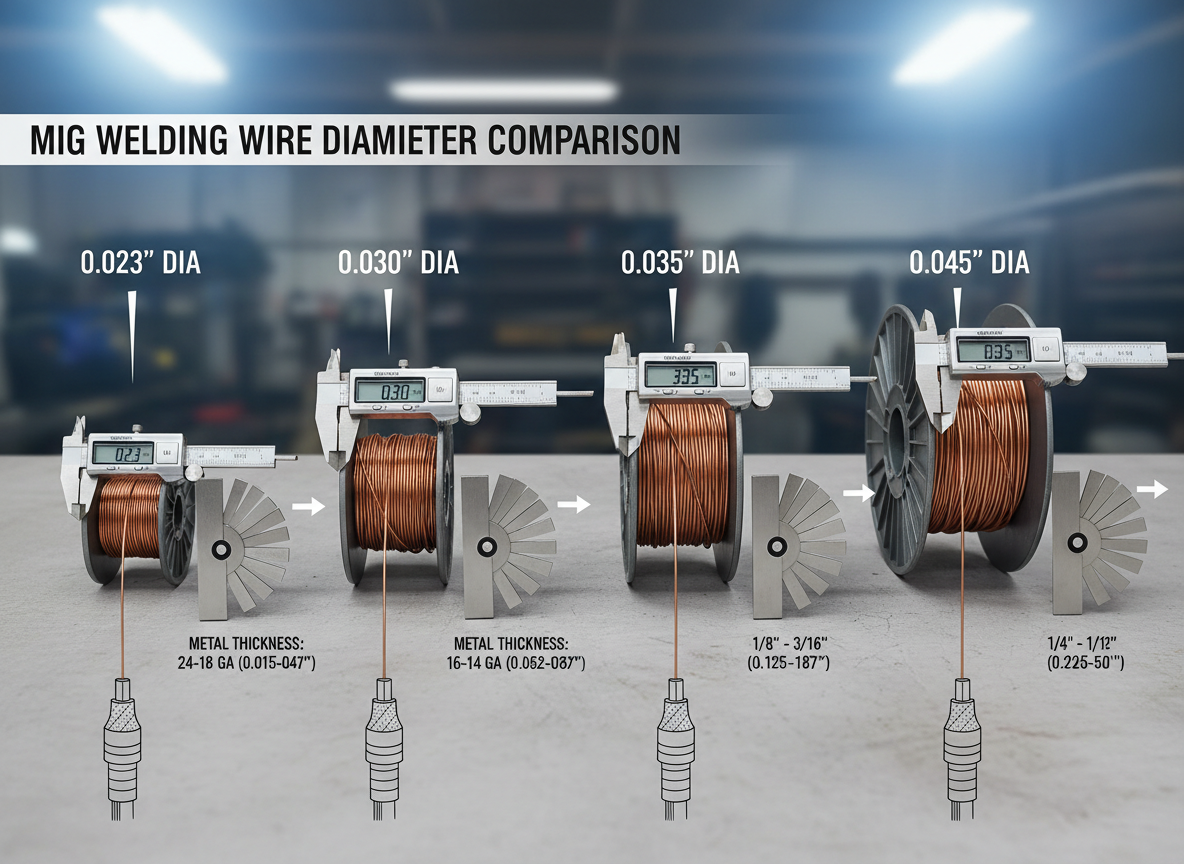
    DiameterAmperage RangeMaterial ThicknessTypical Use
    0.023โ€30-130A24-18 gaugeAutomotive sheet metal, thin tubing
    0.030โ€40-145A18-14 gaugeGeneral fabrication, light structural
    0.035โ€50-180A14 gauge-1/4โ€Most common all-purpose size
    0.045โ€75-250A1/4โ€-1/2โ€Heavy structural, thick plate
    0.052โ€100-300A1/2โ€+Industrial fabrication, heavy equipment

    Rule of thumb: Thinner wire = better control on thin material. Thicker wire = faster deposition on heavy plate.

    Shielding Gas Impact on Wire Performance

    75/25 Argon/COโ‚‚ (C25)

    • Pros: Low spatter, smooth arc, good bead appearance
    • Cons: Higher cost than 100% COโ‚‚
    • Best for: ER70S-3, ER70S-6, stainless steel

    100% COโ‚‚

    • Pros: Deep penetration, low cost
    • Cons: Higher spatter, rougher arc
    • Best for: ER70S-6 on thick steel (not recommended for ER70S-3)

    90/10 Argon/COโ‚‚

    • Pros: Minimal spatter, excellent for stainless
    • Cons: Shallow penetration on carbon steel
    • Best for: ER308L, ER316L stainless wire

    Surface Condition Requirements

    Wire TypeMill ScaleLight RustHeavy RustClean Steel
    ER70S-6โœ“โœ“โœ“โœ“
    ER70S-3โœ—โœ—โœ—โœ“
    ER308Lโœ—โœ—โœ—โœ“
    ER316Lโœ—โœ—โœ—โœ“

    ER70S-6 advantage: Higher deoxidizers clean impurities during welding. ER70S-3 requires clean base metal to avoid porosity.

    AWS Filler Metal Specifications

    AWS A5.18 (Carbon Steel MIG Wire) – Covers ER70S-3, ER70S-6, and other carbon steel wires – Defines chemical composition, tensile strength, and elongation requirements

    AWS A5.9 (Stainless Steel MIG Wire) – Covers ER308L, ER316L, and other stainless wires – Specifies corrosion resistance and ferrite content

    Wire Storage & Handling

    Moisture Contamination – Causes: Porosity, hydrogen cracking – Prevention: Store in sealed containers with desiccant packs – Shelf life: 12 months (carbon steel), 6 months (stainless)

    Wire Feed Issues – Kinked wire = erratic arc and bird-nesting – Solution: Use proper spool tension and liner size

    Liner Compatibility

    Wire DiameterLiner Inside Diameter
    0.023โ€-0.030โ€0.030โ€-0.035โ€
    0.035โ€0.035โ€-0.045โ€
    0.045โ€0.045โ€-0.052โ€
    0.052โ€0.052โ€-0.062โ€

    Oversized liner = wire wander. Undersized liner = excessive friction and burnback.

    Common Mistakes

    Using ER70S-3 on rusty steel
    Low deoxidizers canโ€™t compensate for surface contamination. Result: porosity and weak welds. Use ER70S-6 or clean the base metal.

    Wrong liner size for wire diameter
    0.035โ€ wire in 0.045โ€ liner causes erratic feeding. Match liner to wire diameter within 0.005โ€-0.010โ€.

    Storing stainless wire without moisture protection
    Stainless wire absorbs moisture faster than carbon steel. Always use sealed containers with desiccant.

    Buying Checklist

    • โœ“ Wire classification matches base metal (ER70S-6 for dirty steel, ER70S-3 for clean)
    • โœ“ Diameter suits material thickness and amperage range
    • โœ“ Shielding gas compatible with wire type
    • โœ“ AWS A5.18 or A5.9 certification marked on spool
    • โœ“ Liner size matches wire diameter
    • โœ“ Storage container includes moisture protection
    • โœ“ Spool size fits your machine (2 lb, 10 lb, 33 lb, 44 lb)

Read with Kindle Unlimited