7018 Rod Sticking During Restarts: Causes and Fixes
When a 7018 rod sticks during restarts, the usual problem is not the rod alone. It is usually a combination of a cold restart, heavy crater slag, poor restart prep, arc length too short, low amperage, weak work lead contact, or damp low-hydrogen electrodes. A 7018 electrode needs a clean restart point and enough current to re-establish the arc without burying the rod tip into frozen slag or unmelted metal.
Common Symptoms
Rod freezes to the crater as soon as the arc is struck.
Restart piles up instead of tying into the previous bead.
Slag traps at the restart toe or centerline.
Arc starts, flashes, then goes out.
Electrode end turns black or balls over after repeated sticking.
Likely Causes
Amperage too low: 7018 is a low-hydrogen, iron-powder electrode with medium penetration. If the current is low, the restart area will not wet in quickly.
Restart not cleaned: 7018 slag must be chipped and brushed before welding over it. Even a thin glassy film can hold the rod off the base metal and create inclusion.
Arc length too tight: Dragging the rod hard into the crater can extinguish the arc and freeze the electrode.
Wrong polarity or weak output: Standard E7018 is commonly run AC or DCEP depending on rod and machine. Wrong polarity, undersized leads, poor clamp contact, or long extension cords can make restarts sluggish.
Moisture exposure: Low-hydrogen rods that have been left open too long may restart poorly and increase hydrogen cracking risk on critical work.
Inspection Steps
Chip the crater completely and wire brush until the restart point is metallic, not dull gray slag.
Check the work clamp on clean steel, not paint, rust, mill scale, or a loose table slot.
Verify rod diameter and amperage. A 1/8 in. 7018 commonly runs around the 90–140 amp range depending on brand, position, and joint.
Confirm polarity required by the actual electrode container.
Inspect the rod end. If flux is broken back unevenly, restrike on scrap or break the end clean before restarting.
Restart Technique
Start slightly ahead of the crater, establish the arc, then move back into the crater long enough to remelt the end of the previous bead. After the puddle wets into both sides, continue forward. Do not start directly in a slag pocket. Do not stab the rod into the crater. Keep a short but live arc and watch the puddle edge, not the arc flare.
Field Fix vs Proper Fix
Field fix: turn amperage up 5–10 amps, clean the crater harder, and restrike on scrap before the restart. Proper fix: correct polarity, clamp contact, rod storage, joint prep, and restart technique. On code work, grind defective restarts out instead of burying them.
Safety Notes
Stuck electrodes are live electrical faults. Do not twist a stuck rod loose with bare gloves or exposed skin near grounded work. Break the electrode free safely, inspect the holder, and replace damaged stubs. Use proper welding PPE and ventilation.
7018 rod moisture contamination is a low-hydrogen failure, not just a storage inconvenience. Damp E7018 electrodes can cause porosity, rough arc starts, excessive spatter, slag trouble, underbead cracking risk, and welds that fail inspection even when the bead looks acceptable. If 7018 rods have been left open in humidity, stored in a toolbox, rained on, or mixed with high-moisture rods, treat them as suspect before welding structural, code, pressure, lifting, or restrained joints.
The fast field decision is simple: use fresh rods from a sealed container for critical work, keep opened low-hydrogen rods in a rod oven, and do not assume a warm shop shelf or sealed plastic tube restores low-hydrogen condition. If rods are wet, oily, rusty, chipped, or unknown, discard them for critical work. Reconditioning must follow electrode manufacturer and code requirements, not a torch, microwave, job box, truck dash, or improvised heater.
Hydrogen/moisture in coating or contaminated joint
Use fresh oven-held rods and clean base metal
Rod sticks on starts
Damp coating, low amperage, poor restart prep
Try known-dry rod at correct amperage
Rough unstable arc
Moisture-altered coating
Compare sealed rods against suspect rods
Excess spatter
Damp coating or wrong arc length/amperage
Check rod storage and machine settings
Slag acts glassy or irregular
Flux coating condition problem
Inspect coating for chips, cracks, dampness
Delayed cracking
Hydrogen in restrained/high-strength weld
Stop using exposed rods for critical work
Why Moisture Matters on 7018
E7018 is designed as a low-hydrogen electrode. Its coating must stay dry so the weld deposit stays low in diffusible hydrogen. When the coating absorbs moisture, hydrogen can enter the weld metal and heat-affected zone. That matters most on thicker steel, high-strength steel, cold material, restrained joints, hardenable base metal, repair welds, and code work where hydrogen cracking risk must be controlled.
Quick Checks
Package condition: Use rods from intact hermetically sealed or manufacturer-approved packaging for critical work.
Exposure history: If the rod exposure time is unknown, treat it as Unknown (Verify), not acceptable.
Surface condition: Reject rods with cracked, chipped, swollen, oily, rusty, or soft coatings.
Storage oven: Opened 7018 should be stored in a holding oven at the manufacturer/code-required temperature.
Comparison test: Strike a fresh dry rod and a suspect rod on clean scrap. Rough arc, spatter, sticking, or porosity points to rod condition.
Job requirement: If the weld is structural or code-controlled, follow WPS, AWS code, and electrode manufacturer instructions.
Inspection Steps
Identify the electrode. Confirm E7018, E7018-1, E7018 H4R, E7018M, or other exact classification and brand.
Check the container. Confirm whether the package was sealed, vacuum packed, damaged, or previously opened.
Verify exposure time. Record how long rods were outside the oven and the shop humidity/rain exposure.
Inspect the coating. Look for cracks, chips, powdering, swelling, discoloration, oil, rust, or soft flux.
Separate suspect rods. Do not mix them back into the dry low-hydrogen oven inventory.
Check the rod oven. Verify temperature with a reliable thermometer, not just the dial setting.
Confirm rebake rules. Use the electrode manufacturer and job code. Do not invent a rebake schedule.
Run a controlled test only for noncritical screening. Test beads cannot prove low-hydrogen compliance.
Document disposition. Mark rods as fresh, oven-held, rebaked per procedure, downgraded to noncritical use, or discarded.
Storage and Reconditioning Notes
Low-hydrogen electrodes commonly require storage in a holding oven after opening. Manufacturer guidance often places low-hydrogen holding ovens in the 225–300°F range, but the exact temperature and exposure limits depend on electrode class, moisture-resistant suffix, manufacturer, and code. Some exposed rods may be rebaked one time under controlled conditions. Rods that became wet, oil-contaminated, cracked, or physically damaged should not be trusted for critical welds.
Field Fix vs Proper Fix
Condition
Field Fix
Proper Fix
Opened rods sat out overnight
Use fresh sealed rods for critical work
Follow manufacturer/code rebake or discard rule
Rods exposed to rain
Remove from low-hydrogen stock
Discard for code/critical work unless procedure permits otherwise
Rod sticks and spatters
Check amperage and try fresh rod
Correct storage, oven temp, and rod handling
No rod oven available
Use sealed rods only as opened
Add approved holding oven and exposure log
Mixed 6010 and 7018 in one warm box
Separate immediately
Store low-hydrogen rods separately at required temperature
Common Wrong-Part and Wrong-Process Mistakes
Using damp 7018 on restrained structural joints because the bead still looks smooth.
Storing 6010/6011 cellulosic rods in the same oven as 7018 low-hydrogen rods.
Believing sealed plastic tubes equal a code-compliant rod oven.
Rebaking rods without confirming the electrode classification and manufacturer rule.
Using exposed 7018 for pressure, lifting, structural, or code welds without WPS approval.
Blaming amperage for sticking when the rod coating is damp or damaged.
What To Verify Before Welding
Electrode classification and brand.
Whether the package was factory sealed or already opened.
Rod oven temperature and calibration status.
Maximum allowed exposure time from the WPS/code/manufacturer.
Whether rebake is allowed and exact rebake schedule.
Base metal strength, thickness, restraint, preheat, and hydrogen-cracking risk.
Whether the job permits reconditioned rods or requires fresh sealed/oven-held electrodes.
Related Failure Paths
Porosity from hydrogen/moisture contamination.
Rod sticking from damp coating and unstable starts.
Delayed hydrogen cracking in restrained or high-strength welds.
Slag irregularity from damaged coating.
Arc instability from wrong current, poor ground, or wet rods.
Failed inspection from undocumented electrode exposure control.
Safety Notes
Do not use wet or unknown 7018 rods for critical welds.
Do not heat rods with open flame, torches, microwaves, or uncontrolled shop heaters.
Use rod ovens according to manufacturer instructions and electrical safety requirements.
Use ventilation and keep your head out of welding fumes.
Follow the WPS, AWS code, engineer, or inspector requirement when low-hydrogen control is specified.
Sources Checked
Lincoln Electric low-hydrogen electrode storage and redrying guidance.
ESAB low-hydrogen electrode storage and redrying guidance.
Weld Support Parts 7018 sticking, 6010 vs 7018, rod oven, and 7018 electrode pages.
Welding with 7018 rods can be challenging, especially when they start sticking during operation. This issue not only affects the quality of the weld but also disrupts workflow. Understanding the underlying causes and solutions can help welders achieve more efficient results.
Key Takeaways
– 7018 rods are prone to sticking due to improper technique or settings.
– Correct amperage and angle can reduce sticking.
– Proper rod storage is crucial for optimal performance.
– Using the right equipment can significantly improve weld quality.
Problem / Context
Sticking occurs when the electrode fuses to the workpiece, interrupting the arc and making it difficult to complete the weld. This is a common issue with 7018 rods, which require precise conditions to function correctly.
Causes
Low Amperage
– Inadequate amperage fails to sustain the arc, causing the rod to stick.
Incorrect Angle
– Holding the rod at an incorrect angle reduces arc stability.
Poor Rod Condition
– Moisture absorption in 7018 rods can lead to sticking.
Fixes
Step 1: Adjust Amperage
– Increase Amperage: Slowly increase amperage until the arc is stable and the rod flows smoothly without sticking.
Step 2: Correct Angle
– Maintain a 10-15 Degree Angle: Keep the rod at a consistent angle to ensure smooth arc movement.
Step 3: Ensure Dry Storage
– Proper Storage: Store rods in a dry, sealed container or rod oven to prevent moisture absorption.
Step 4: Consistent Movement
– Steady Motion: Employ a steady, consistent movement along the weld joint to reduce sticking.
Product Section
No products found.
Safety Notes
– Eye Protection: Follow ANSI Z87.1 standards for eye protection.
– Welding Codes: Adhere to AWS D1.1 and D1.3 for safe and effective welding practices.
FAQ
What amperage should be used for 7018 rods?
Amperage settings typically range from 90 to 160 amps, depending on the rod diameter. Adjust based on welding parameters and practice.
How should 7018 rods be stored?
Store in a temperature-controlled rod oven at 250°F (121°C) to keep them dry and prevent moisture absorption.
Can rod sticking damage my welding machine?
Prolonged sticking can overheat and damage your welding machine, so it’s vital to address issues promptly.
Conclusion / Next Step
Addressing 7018 rod sticking involves proper technique and equipment adjustments. By implementing these solutions, welders can enhance their welding performance and minimize disruptions. For more tips on stick welding, explore additional resources and comparisons of welding rods like 7018 vs 6011.
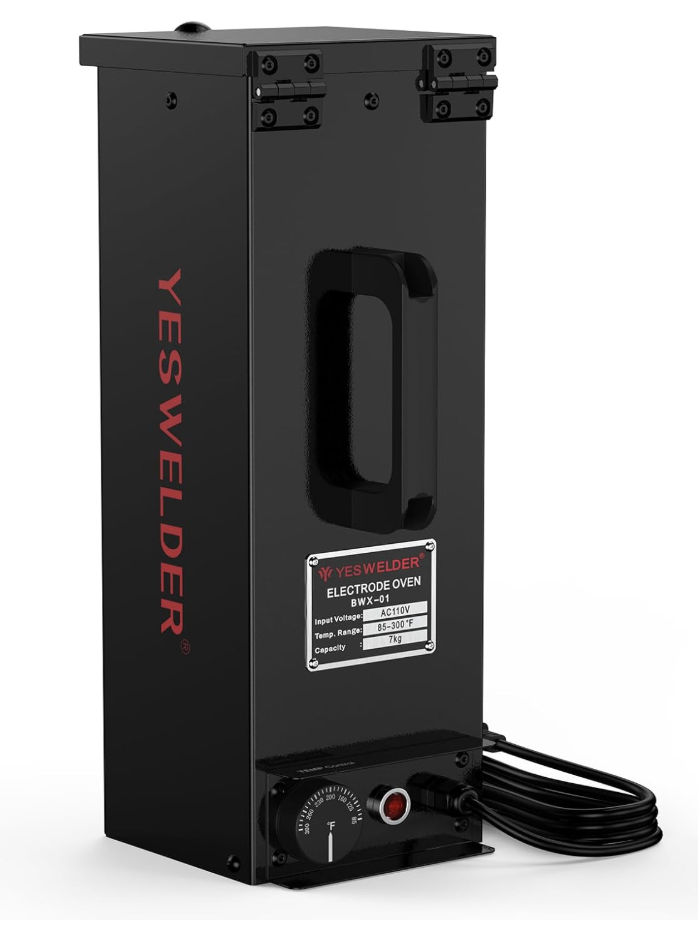
YESWELDER’s BWX-01 110 V rod oven protects stick electrodes from moisture pickup — a common cause of porosity and hydrogen cracking. With a 15 lb capacity and adjustable thermostat, it’s built for portable field work and shop maintenance alike.
Key Takeaways
Voltage: 110 V AC power
Temperature range: 85 °F – 300 °F adjustable
Capacity: Holds up to 15 lb of 15-in. or shorter rods
Weight: Under 8 lb (portable aluminum housing)
Purpose: Keeps low-hydrogen and general electrodes moisture-free
Performance and Use
The BWX-01 maintains a steady internal temperature to prevent flux moisture absorption — critical for E7018 and other low-hydrogen rods. Its insulated canister warms evenly, reducing hydrogen-induced cracking and maintaining clean arc starts. The light weight and side handle make it easy to move between stations or field sites.
Ideal for welding schools, fabrication shops, and on-site pipe or structural crews needing reliable storage between weld passes.
In-Box / Not Included
Included:
BWX-01 rod oven
Power cord (110 V plug)
Adjustable temperature control
Not Included:
Rods/electrodes
Extension cord
Applications
Stick welding rod storage (E7018, E6010, E6011, etc.)
Follow AWS A5.1 and A5.5 storage guidelines for low-hydrogen electrodes. Keep oven on a stable, dry surface and disconnect power before moving. Do not exceed 300 °F to prevent flux degradation.
FAQ
Q: Can it handle 7018 rods? Yes — that’s its main purpose. It maintains low hydrogen levels for 7018 and similar electrodes.
Q: Is the temperature controlled automatically? It’s manual via dial control, allowing fine adjustment between 85 °F – 300 °F.
Q: How many rods fit inside? Roughly 10-15 lb depending on diameter and length (up to 15 in.).
We may earn a commission on purchases made through our links, at no extra cost to you.
Manage Consent
To provide the best experiences, we use technologies like cookies to store and/or access device information. Consenting to these technologies will allow us to process data such as browsing behavior or unique IDs on this site. Not consenting or withdrawing consent, may adversely affect certain features and functions.
Functional
Always active
The technical storage or access is strictly necessary for the legitimate purpose of enabling the use of a specific service explicitly requested by the subscriber or user, or for the sole purpose of carrying out the transmission of a communication over an electronic communications network.
Preferences
The technical storage or access is necessary for the legitimate purpose of storing preferences that are not requested by the subscriber or user.
Statistics
The technical storage or access that is used exclusively for statistical purposes.The technical storage or access that is used exclusively for anonymous statistical purposes. Without a subpoena, voluntary compliance on the part of your Internet Service Provider, or additional records from a third party, information stored or retrieved for this purpose alone cannot usually be used to identify you.
Marketing
The technical storage or access is required to create user profiles to send advertising, or to track the user on a website or across several websites for similar marketing purposes.