Tag: duty cycle

  • MIG Gun Neck Overheating Causes: Contact Tip, Diffuser, Duty Cycle, and Cable Problems

    A MIG gun neck overheats when heat cannot leave the front end fast enough or when electrical resistance builds at the contact tip, diffuser, neck, cable, or work return. The most common causes are welding above the gunโ€™s duty cycle, a loose contact tip or diffuser, spatter-packed nozzle, wrong contact tip size, worn liner causing wire drag, poor work clamp contact, excessive stickout changes, or using a light-duty gun on high-amperage work. Treat neck overheating as a warning. If ignored, it can melt insulators, damage the neck, loosen consumables, burn back wire, and create erratic arc behavior.

    Common Symptoms

    SymptomLikely CauseFirst Check
    Neck too hot to handle quicklyGun over duty cycleCompare weld amperage and duty cycle rating
    Tip keeps looseningHeat cycling or wrong/loose diffuserInspect threads and tighten cold
    Burnback at contact tipTip overheating or wire feed dragReplace tip and check liner/feed path
    Nozzle discolors or spatter sticks heavilyGas/nozzle restriction or too much heat at front endClean nozzle and diffuser ports
    Arc stutters after several inchesHeat-related tip resistance or feed restrictionInstall correct tip and test feed straight
    Handle or cable gets hot tooUnderrated gun, loose power connection, or bad cableStop welding and inspect connections

    What This Part Does

    The MIG gun neck carries welding current forward, supports the diffuser/nozzle assembly, positions the contact tip, and directs shielding gas to the weld. In air-cooled guns, the neck and front-end consumables shed heat through the metal mass, shielding gas flow, and pause time between welds. In water-cooled guns, coolant removes heat from the torch body and neck area.

    Main Causes of MIG Gun Neck Overheating

    • Gun is underrated for the job: A 150A or 200A air-cooled gun will overheat faster on long welds, high wire feed speed, spray transfer, or heavy flux-cored work.
    • Duty cycle exceeded: A gun rated at 60% duty cycle is not intended for continuous welding at rated amperage.
    • Loose contact tip: Loose threads increase electrical resistance and heat at the tip/diffuser joint.
    • Loose or damaged diffuser: Poor current transfer at the diffuser or neck threads concentrates heat.
    • Wrong contact tip size: An oversized tip causes unstable current transfer; an undersized or blocked tip increases drag and burnback.
    • Spatter-packed nozzle: Restricted gas flow and radiant heat buildup raise front-end temperature.
    • Dirty or kinked liner: Wire drag makes the arc burn back and overheats the tip and neck area.
    • Poor work clamp path: Bad return contact increases arc instability and can make the operator raise settings unnecessarily.
    • Long stickout abuse: Excessive stickout can force higher settings or create an unstable arc, both adding heat.
    • Wrong consumable family: Mixing nozzles, tips, diffusers, or insulators from different systems can create poor seating and heat transfer.

    What Wears Out First

    The contact tip usually fails first. It carries current and guides wire at the hottest point of the gun. Once the bore is worn, the wire no longer transfers current consistently. The arc becomes unstable, burnback increases, and the neck absorbs more heat.

    The diffuser and insulator are next. Spatter, loose threads, damaged seats, or heat cycling can weaken the gas path and current path. If the diffuser does not seat tightly against the neck, the gun may overheat even with a new contact tip.

    Inspection Steps

    1. Stop welding and allow the gun to cool.
    2. Remove the nozzle and inspect for spatter buildup, discoloration, and blocked gas flow.
    3. Remove the contact tip. Check for oval wear, burnback, spatter, loose threads, or wrong wire size.
    4. Inspect the diffuser for blocked gas holes, damaged threads, cracks, and poor seating.
    5. Check the neck insulation and nozzle insulator for melting, cracking, or carbon tracking.
    6. Lay the cable straight and jog wire. Uneven feeding points to liner, drive roll, or spool drag issues.
    7. Check the work clamp on clean bare metal.
    8. Compare the welding amperage and arc-on time to the gunโ€™s rated duty cycle.

    Test Procedure

    1. Install a new contact tip that matches the wire diameter.
    2. Clean or replace the nozzle if spatter is heavy.
    3. Confirm the diffuser is tight, correct, and not heat damaged.
    4. Verify the liner size and wire feed path.
    5. Clamp to clean metal close to the weld.
    6. Run a short bead at normal settings.
    7. If the neck overheats quickly again, reduce amperage/arc-on time or switch to a higher-rated gun.
    8. If the handle, cable, or connector gets hot, stop and inspect for loose power connections or cable damage.

    Compatibility Notes

    Order front-end parts by the actual gun and consumable system, not only by the welder model. A Miller MDX-100, Miller MDX-250 AccuLock S, Miller MDX-250 AccuLock MDX, Bernard Centerfire, Tweco-style, or Lincoln Magnum-style gun can use different tips, diffusers, nozzles, and insulators. Mixing systems can create poor seating, unstable current transfer, and overheating.

    For Miller gun lookup, start with the Miller MIG Gun Selection Chart. For MDX replacement paths, check Miller MDX-100 Gun Parts, Miller MDX-250 AccuLock S Gun Parts, and Miller MDX-250 AccuLock MDX Gun Parts. For general replacement categories, use MIG Contact Tips and MIG Liners.

    Common Wrong-Part Mistakes

    • Using a contact tip that fits the thread but does not match the diffuser system.
    • Replacing the tip but leaving a heat-damaged diffuser in place.
    • Installing a nozzle without the correct insulator or seat.
    • Using light-duty consumables on high-amperage spray or flux-cored welding.
    • Ordering by machine model instead of gun model, cable length, wire size, and consumable family.
    • Using a longer gun cable with the wrong liner, causing feed drag and burnback.

    Field Fix vs Proper Fix

    A field fix is to replace the contact tip, clean the nozzle, tighten the diffuser, reduce arc-on time, and let the gun cool between welds.

    The proper fix is to identify why the neck is getting hot. Verify gun amperage rating, duty cycle, consumable fit, liner condition, work return, and front-end seating. If production requires long high-amperage welds, upgrade to a heavier air-cooled gun or the correct water-cooled setup instead of burning up light-duty consumables.

    Related Failure Paths

    • Burnback into contact tip
    • Loose diffuser threads
    • Nozzle spatter buildup
    • Melted neck insulator
    • Wire feed surging from liner drag
    • Poor ground causing unstable arc
    • Underrated MIG gun for amperage

    Safety Notes

    Do not touch hot gun parts barehanded. Disconnect input power before servicing internal gun or feeder components. Keep fingers out of drive rolls while jogging wire. Stop welding if the gun handle, connector, or cable becomes hot, if insulation is melting, or if arcing is visible at the neck or power connection. Replace damaged gun parts before returning the welder to service.

  • Plasma Cutter Buying Guide 2025 | Duty Cycle, Cut Capacity & Air Requirements

    Plasma Cutter Buying Guide 2025 | Duty Cycle, Cut Capacity & Air Requirements

    Plasma cutters use ionized gas to cut conductive metals. Choosing the right cutter depends on material thickness, duty cycle, air supply, and cut quality requirementsโ€”not just amperage rating.

    Key Specifications Explained

    Amperage Rating & Cut Capacity

    AmperageRecommended CutMaximum CutTypical Material
    20-30A1/8โ€-3/16โ€1/4โ€Sheet metal, auto body, HVAC
    40-50A1/4โ€-3/8โ€1/2โ€Light fabrication, farm repair
    60-80A3/8โ€-1/2โ€3/4โ€General fabrication, structural steel
    85-100A1/2โ€-3/4โ€1โ€Heavy fabrication, thick plate

    Recommended cut = Clean cut with minimal dross (slag on bottom edge)
    Maximum cut = Severance cut (rough edge, heavy cleanup required)

    Rule of thumb: Buy 20-30% more amperage than your typical material thickness for clean cuts and longer consumable life.

    Duty Cycle

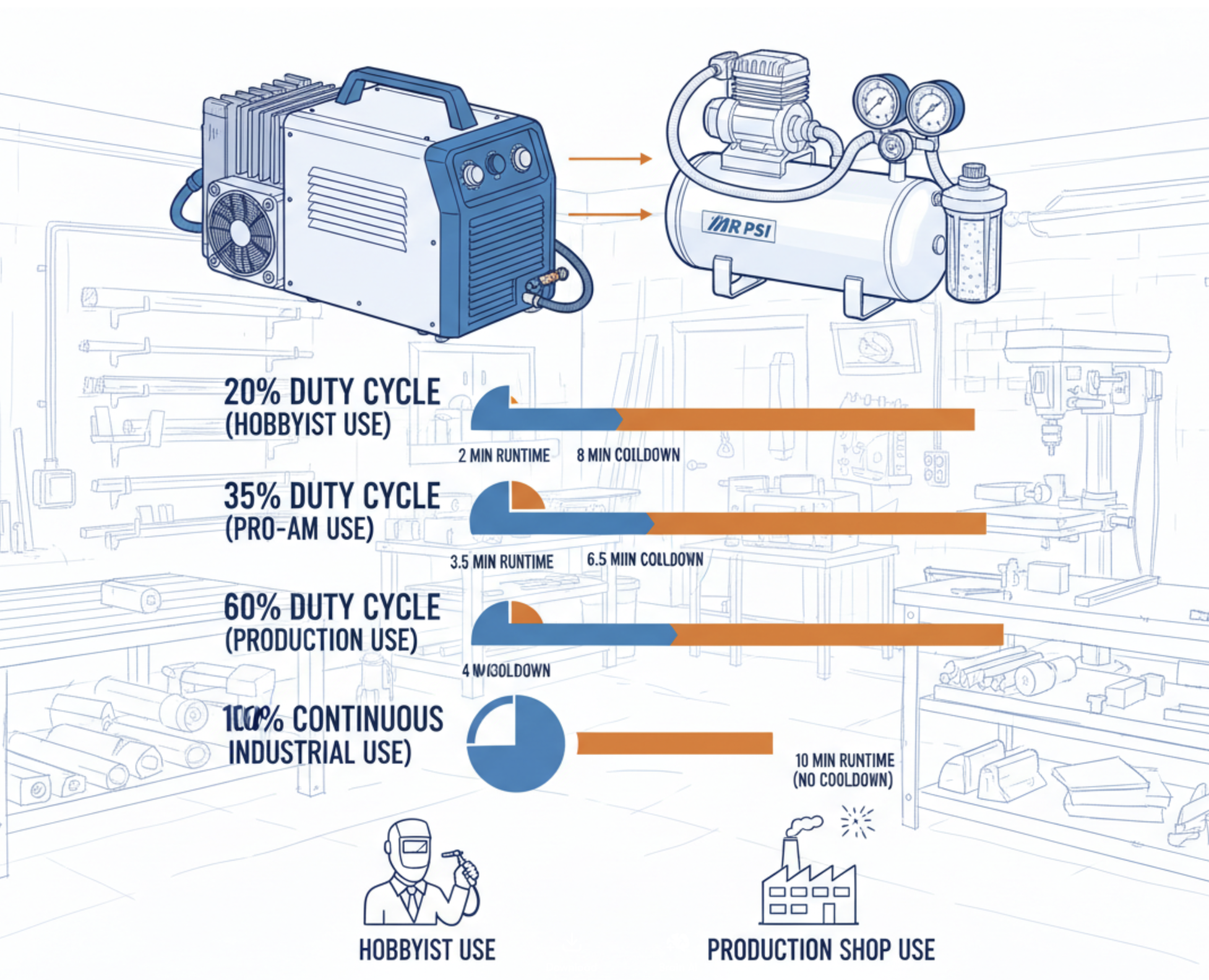
    Definition: Percentage of 10-minute period the machine can run at rated amperage before requiring cooldown.

    Duty CycleRuntime @ Max AmpsCooldownUse Case
    20%2 min8 minHobbyist, occasional use
    35%3.5 min6.5 minLight fabrication, DIY
    60%6 min4 minProduction shop, frequent use
    100%10 min0 minIndustrial, continuous operation

    Example: 50A cutter with 35% duty cycle can run 3.5 minutes at 50A, then must cool 6.5 minutes.
    At lower amperage: Duty cycle increases (50A cutter at 30A may have 60-80% duty cycle).

    Air Supply Requirements

    Compressed Air Specs:Pressure: 60-90 PSI (4-6 bar) – Flow rate: 4-8 CFM @ 90 PSI (varies by amperage) – Quality: Clean, dry, oil-free

    Compressor Sizing:

    Plasma AmperageMinimum CFM @ 90 PSIRecommended Tank Size
    20-30A4 CFM20 gallon
    40-50A5 CFM30 gallon
    60-80A6 CFM60 gallon
    85-100A8 CFM80 gallon

    Air quality issues: – Moisture = premature consumable failure and poor cut quality – Oil contamination = torch tip clogging – Solution: Install inline air dryer/filter between compressor and plasma cutter

    Input Power Requirements

    120V Plasma Cutters:Amperage range: 12-40A – Cut capacity: Up to 3/8โ€ recommended, 1/2โ€ maximum – Advantage: Portable, runs on standard outlets – Limitation: Lower duty cycle, reduced cut speed

    240V Plasma Cutters:Amperage range: 40-100A+ – Cut capacity: 1/2โ€-1โ€+ recommended – Advantage: Higher duty cycle, faster cutting, thicker material – Requirement: Dedicated 240V circuit (30-50A breaker)

    Dual Voltage (120V/240V): – Runs on both voltages with reduced performance on 120V – Example: 50A on 240V, 30A on 120V – Best for: Portable use + shop capability

    Cut Quality Factors

    Pilot Arc vs. Contact Start

    Pilot Arc (High-Frequency Start): – Arc initiates without touching workpiece – Pros: Cuts expanded metal, grating, rusty/painted steel – Cons: Higher cost, can interfere with electronics – Best for: Versatile cutting, field work

    Contact Start (Scratch Start): – Requires torch tip contact with workpiece to start arc – Pros: Lower cost, no electronic interference – Cons: Cannot cut expanded metal or start on edge – Best for: Budget cutters, clean flat plate

    Inverter vs. Transformer Technology

    Inverter-Based:Weight: 10-40 lbs (portable) – Efficiency: High (lower power consumption) – Duty cycle: Typically higher (35-60%) – Cost: Moderate to high – Best for: Modern shops, portability required

    Transformer-Based:Weight: 80-200 lbs (stationary) – Efficiency: Lower (higher power draw) – Duty cycle: Often 100% (industrial use) – Cost: Higher upfront, lower long-term maintenance – Best for: Heavy industrial, continuous operation

    Consumable Costs & Life

    Consumable Components

    PartFunctionTypical LifeCost per Set
    ElectrodeConducts current to arc1-3 hours cutting time$3-$8
    Nozzle (tip)Focuses plasma stream1-3 hours cutting time$2-$5
    Swirl ringStabilizes gas flow5-10 hours$1-$3
    Shield cupProtects nozzle10-20 hours$2-$5

    Consumable life factors: – Amperage setting (higher amps = shorter life) – Air quality (moisture/oil reduces life 50%+) – Arc-on time (duty cycle) – Proper technique (perpendicular torch angle, correct standoff)

    Annual consumable cost estimate: – Hobbyist (20 hours/year): $50-$100 – Light fabrication (100 hours/year): $250-$500 – Production shop (500+ hours/year): $1,500-$3,000

    Material Compatibility

    MaterialPlasma CutNotes
    Mild steelโœ“Best cut quality, minimal dross
    Stainless steelโœ“Clean cuts, some dross on thick sections
    Aluminumโœ“Requires higher amperage than steel (30% thicker capacity)
    Copperโœ“High thermal conductivity = slower cut speed
    Brassโœ“Similar to copper, produces toxic fumes (ventilation required)
    Cast ironโœ“Brittle, may crack from rapid heating
    Galvanized steelโœ“Toxic zinc fumes (ventilation mandatory)

    Cannot cut: Non-conductive materials (wood, plastic, concrete, glass)

    Torch Styles & Ergonomics

    Hand Torch (Standard)

    • Cable length: 10-25 feet
    • Weight: 1-3 lbs
    • Best for: Freehand cutting, portability
    • Limitation: Less precise than machine torch

    Machine Torch (CNC-Compatible)

    • Mounting: Designed for CNC table or track system
    • Standoff: Adjustable height control for consistent cut quality
    • Best for: Automated cutting, production runs
    • Cost: $200-$800 (in addition to hand torch)

    Ergonomic Features

    • Trigger lock: Reduces hand fatigue during long cuts
    • Swivel head: Prevents cable twist, improves maneuverability
    • Insulated grip: Protects from heat during extended use

    Common Mistakes

    Undersizing amperage for material thickness
    40A cutter on 1/2โ€ steel = slow, rough cuts and rapid consumable wear. Size cutter 20-30% above typical thickness for clean cuts.

    Using contaminated air supply
    Moisture and oil in compressed air destroy consumables in 10-20% of normal life. Always use inline air dryer/filter.

    Running at maximum amperage continuously
    Exceeds duty cycle, triggers thermal shutdown. Run at 70-80% of rated amperage for longer duty cycle and consumable life.

    Buying Checklist

    • โœ“ Amperage rating 20-30% above typical material thickness
    • โœ“ Duty cycle matches usage frequency (35%+ for regular use)
    • โœ“ Input voltage compatible with available power (120V or 240V)
    • โœ“ Pilot arc start for versatile cutting (expanded metal, rusty steel)
    • โœ“ Inverter technology for portability and efficiency
    • โœ“ Compressor meets CFM and PSI requirements
    • โœ“ Air dryer/filter included or purchased separately
    • โœ“ Consumable availability and cost verified

Try Amazon Prime Free