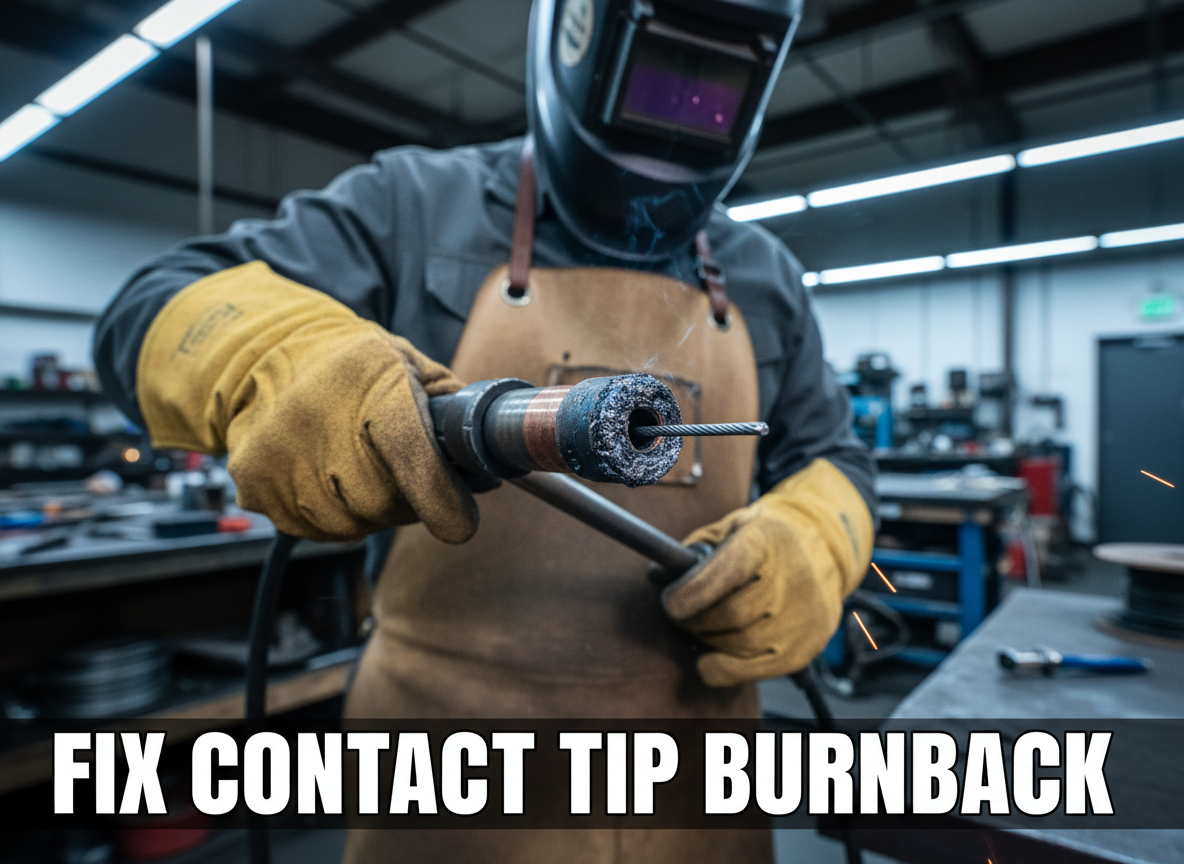
Tag: burnback

  • How to Fix MIG Contact Tip Burnback: Diagnosis & Solutions

    How to Fix MIG Contact Tip Burnback: Diagnosis & Solutions

    Your MIG wire is burning back and fusing to the contact tip, stopping your weld cold. This happens when the wire arcs at the tip instead of at the workpieceโ€”a sign of poor contact, dirty metal, or feeding issues. Fix it in 10 minutes with the right diagnosis.

    Key Takeaways

    • Contact tip burnback stops the arc and wastes time; most fixes are free or under $30
    • Root causes: dirty contact tip, poor base metal prep, wire feed tension, or loose electrical connections
    • Quick fix: clean the tip, prep your metal, check wire tension, and verify electrical connections
    • Prevent burnback: replace tips every 50โ€“100 hours of welding, use fresh wire, and keep the gun cable straight

    Quick Diagnosis

    What You’ll See:

    • Wire sticks to the contact tip instead of feeding smoothly
    • Arc won’t start or cuts out mid-weld
    • Tip glows red or shows visible discoloration
    • Wire may be bent or balled up inside the tip

    Most Likely Causes (Ranked by Frequency):

    1. Dirty or worn contact tip (most common)
    2. Rusty or mill-scale base metal (prevents good arc start)
    3. Wire feed tension too tight or too loose
    4. Loose electrical connections (gun, ground clamp, or machine)
    5. Bent gun cable or kinked liner (restricts wire flow)

    Safety Notes

    • PPE:ย Wear ANSI Z87.1-rated helmet (down), welding gloves, and long sleeves. Contact tip burnback can cause sudden arc flare.
    • Ventilation:ย MIG welding produces fume; ensure adequate shop ventilation or use a fume extractor per ANSI Z49.1.
    • Electrical:ย Disconnect the machine or switch to standby before removing the tip or inspecting the gun.
    • Hot Tip:ย Contact tips retain heat; let cool for 30 seconds before touching.

    Step-by-Step Troubleshooting

    Step 1: Inspect the Contact Tip (Free)

    • Remove the nozzle and diffuser from the gun.
    • Look inside the tip opening. If you see spatter, discoloration, or a balled-up wire, the tip is dirty or worn.
    • Why:ย Spatter buildup reduces contact between the wire and tip, causing arcing instead of feeding.
    • Fix:ย Use a small wire brush or a contact tip cleaner to scrub the inside of the tip. If the opening is enlarged or pitted, replace the tip (see Step 5).

    Step 2: Check Your Base Metal (Free)

    • Inspect the area where you’re welding. Look for rust, mill scale (gray/black oxide), or paint.
    • Why:ย Dirty metal prevents good electrical contact, forcing the wire to arc at the tip instead of the workpiece.
    • Fix:ย Use a wire brush, flap disc, or grinder to clean the weld area to bare metal. Wipe away dust.

    Step 3: Verify Wire Feed Tension (Free)

    • Locate the wire drive roll tension knob on your machine (usually on the side of the feeder).
    • Loosen it slightly, then tighten until you feel light resistance when pushing the wire by hand.
    • Why:ย Too much tension deforms the wire and causes slipping; too little causes the wire to slip in the rolls, starving the arc.
    • Fix:ย Adjust to a gentle gripโ€”the wire should feed smoothly without binding.

    Step 4: Check Electrical Connections (Free)

    • Verify the ground clamp is clamped directly to clean, bare metal on the workpiece.
    • Check that the gun cable is plugged firmly into the machine.
    • Inspect the gun trigger connection for corrosion or looseness.
    • Why:ย Loose connections increase resistance, weakening the arc and causing burnback.
    • Fix:ย Clean corroded connections with a wire brush and re-tighten.

    Step 5: Inspect the Gun Cable and Liner (Free to $30)

    • Straighten the gun cable. If it’s kinked or coiled, it restricts wire flow.
    • Look inside the cable for a white or clear plastic liner. If it’s cracked, burnt, or clogged, the wire binds.
    • Why:ย A damaged liner creates friction, slowing the wire and causing it to arc at the tip.
    • Fix:ย If the cable is kinked, straighten it. If the liner is damaged, replace the gun cable or just the liner (see Step 6).

    Step 6: Replace the Contact Tip and Liner (if needed) ($20โ€“$50)

    • If the tip is pitted, enlarged, or won’t clean, replace it with a new one matching your wire size (0.035″, 0.8mm, etc.).
    • If the liner is clogged or damaged, replace it too.
    • Why:ย A worn tip has poor contact; a clogged liner starves the arc.
    • Fix:ย Install new consumables and test.

    Fix Options (Ranked)

    1. Adjustment (Free)ย โ€” Clean the tip, prep the metal, adjust wire tension, and check electrical connections.
    2. Consumable Change (~$20โ€“$50)ย โ€” Replace the contact tip and/or liner if they’re worn or clogged.
    3. Gun Cable Replacement (~$50โ€“$150)ย โ€” If the cable is kinked or the liner is damaged beyond cleaning.
    4. Machine Check (~$100+)ย โ€” If burnback persists after all above steps, the machine’s wire feeder or power supply may need service.

    Recommended Fix: Contact Tip Replacement Kit

    If you’ve cleaned the tip and it still won’t work, or if you’re welding regularly, a multi-pack of contact tips ensures you always have a fresh tip on hand. Worn tips are the #1 cause of burnback; replacing them every 50โ€“100 hours of welding prevents the problem before it starts.

    Why It Works:

    • New copper tips have perfect contact geometry, ensuring smooth wire feed and strong arc start.
    • High-quality copper resists spatter buildup and heat damage longer than worn tips.
    • A 30-pack gives you backups, so you’re never stuck mid-job.

    When to Use It:

    • Your tip is pitted, enlarged, or won’t clean.
    • You weld more than 10 hours per week.
    • You want to prevent burnback before it happens.

    When NOT to Use It:

    • If the problem is dirty metal or loose electrical connections (fix those first).
    • If the gun cable is kinked (straighten or replace the cable first).

    What to Check Before Buying:

    • Match the tip size to your wire (0.035″, 0.8mm, etc.).
    • Confirm compatibility with your gun type (15AK, 24KD, MB15, etc.).
    • Verify the tip is copper, not steel (copper conducts better).
    • Check reviews for spatter resistance and durability.
    TimelyDu Mig Welder Tips 30-Pack .035โ€ 0.9mm Welding Tips Contact Tip for Mig Welding Gun Welding Torch MIG Gun Replacement,Welding Accessories, Copper (.035โ€ tips)
    • 1. Package Includes 30 Premium Quality .035โ€ ๏ผˆร˜0.9mm๏ผ‰welding Tips.
    • 2.Premium Contact Tips โ€“ Compatible with Lincoln, Tweco, Binzel, and Similar Mini MIG Gun Styles.
    • 3. Made of high-quality copper, this welding contact tip offers excellent conductivity, high temperature resistance, and wear resistance, ensuring long-lasting performance.
    • 4.Thread๏ผšM6ร—1.0thd.
    • 5.If you have any questions, feel free to get in touch. We’re here to offer service and help you out in any way we can!

    Last update on 2026-03-30 / Affiliate links / Images from Amazon Product Advertising API

    Comparable Options

    If you prefer a smaller pack or different wire size:

    Common Mistakes

    • Using a worn tip and hoping it works.ย A pitted tip won’t conduct current evenly; replace it.
    • Not cleaning the base metal.ย Rust and mill scale block the arc; always prep the metal first.
    • Over-tightening wire feed tension.ย This deforms soft wire (especially aluminum) and causes slipping.
    • Ignoring a kinked gun cable.ย A bent cable restricts wire flow just as much as a clogged liner.
    • Blaming the machine when the problem is the tip.ย 90% of burnback is a dirty or worn tip; check it first.

    FAQ

    Q: Can I clean a burnt contact tip and reuse it? A: Yes, if it’s just spatter. Use a contact tip cleaner or small wire brush. If the opening is enlarged or pitted, replace itโ€”a worn tip won’t conduct properly.

    Q: How often should I replace my contact tip? A: Every 50โ€“100 hours of welding, or sooner if you see spatter buildup or burnback. Frequent welders replace tips monthly.

    Q: Why does my wire burn back even after I cleaned the tip? A: Check your base metal (is it rusty?), wire feed tension (is it too tight?), and electrical connections (is the ground clamp clean?). Burnback is rarely just the tip.

    Q: Can a kinked gun cable cause burnback? A: Yes. A bent cable restricts wire flow, starving the arc. Straighten the cable or replace it if it’s cracked.

    Q: What’s the difference between burnback and wire sticking? A: Burnback is when the wire fuses to the tip (arc at the tip, not the workpiece). Wire sticking is when the wire jams in the tip but hasn’t melted. Both have similar causes: dirty tip, poor prep, or feeding issues.

    Next Steps

    1. Clean your contact tip and base metalย โ€” most burnback stops here.
    2. Check wire feed tension and electrical connectionsย โ€” free fixes that work 80% of the time.
    3. Replace the tip if it’s pitted or wornย โ€” use the kit above for a reliable spare.
    4. Explore related guides:

    For more welding fixes and gear options, see our full resource page: https://blog.weldsupportparts.com/links/

  • Why Does My MIG Wire Feed Stutter? (Fast Fix in 10 Minutes)

    If your MIG wire feed feels jittery, surging, or โ€œstutteringโ€ mid-bead, treat it as a feed-path problem first, not a voltage/WFS tuning problem. In most cases, the arc is only โ€œacting upโ€ because the wire is not moving smoothly through the gun.

    This guide gives you a symptom-first diagnosis and a one-variable-at-a-time fix you can run in under 10 minutes.


    Where to Buy (Quick Fix Parts)

    Most โ€œstuttering wire feedโ€ problems come from wire drag (liner/tip) or inconsistent push (drive rolls/spool tension). These are the first parts to inspect and replace.

    Most likely failed components

    • MIG gun linerย (kinked, dirty, rust dust, worn): creates drag โ†’ wire surges and the arc pops
    • Contact tipย (wrong size, worn, spatter-restricted): wire sticks/slips โ†’ inconsistent arc
    • Drive rolls / tension setupย (wrong groove, too tight/loose): wire slips or deforms โ†’ feed pulses

    Top Pick (Primary Fix)

    Mig Welding Liner 42-3035-15 Tweco #1/#2 & Lincoln 250L 030-035″ 15′ Replaceme (1 pc)
    • Premium quality Lincoln Tweco style MIG wire liner 42-3035-15 (0.030″-0.035″) 15-ft long for Lincoln Tweco MIG welding guns
    • Lincoln 42 series liner is used in Lincoln Magnum 200A or Tweco #2 series MIG welding guns
    • You get One (1) 42-3035-15 (0.030″-0.035″) 15-ft liner at this price. FREE SHIPPING WITHIN THE U.S.
    • Please refer to part breakdown chart for other available consumable torch parts. Quality MIG wires are also avaiable. We do combined shipping.

    Last update on 2026-03-30 / Affiliate links / Images from Amazon Product Advertising API

    Disclosure: As an Amazon Associate, I earn from qualifying purchases.

    Backup / Consumable Option

    Mig Welding gun accessory 0.035″ kit for Lincoln Magnum 100L or Tweco Mini/#1 Mig gun: 20pcs Contact Tips 11-35 0.035″ + 2pcs gas nozzles 21-50 1/2″ + 2pcs gas diffusers 35-50
    • Mig Welding gun accessory 0.035″ kit with contact tip,gas nozzle,gas diffuser for Lincoln Magnum 100L & Tweco Mini/#1.
    • Including:20pcs mig welding Contact Tips 11-35 0.035″ + 2pcs gas nozzles 21-50 1/2″ + 2pcs gas diffusers 35-50
    • Fits for Tweco Mini/#1 and Lincoln Magnum 100L K530 series Mig welding guns

    Last update on 2026-03-30 / Affiliate links / Images from Amazon Product Advertising API


    Key Takeaways

    • Stuttering wire feed is usually friction: liner, tip, or a tight/kinked gun lead.
    • Do not chase settings first. Fix the wire path before touching voltage/WFS.
    • If itโ€™s not fixed in 2โ€“3 minutes, replace the consumable (tip/liner) and move on.
    • Wrong drive-roll groove or tensionย can mimic electrical problems.
    • Keep the gun leadย as straight as possibleย while troubleshooting.

    H2: Symptoms (Fast Diagnosis)

    • Wire feed feelsย pulsingย instead of smooth
    • Arcย pops / sputtersย even with โ€œnormalโ€ settings
    • Wire speed changes when youย move the gun lead
    • Drive rollsย slipย (you hear it or see dust/shavings)
    • Wireย burns backย or the tip gets hot fast
    • You get intermittentย birdnestingย at the feeder

    H2: Root Causes (Mapped to Symptoms)

    • Stutter gets worse when the lead is bentย โ†’ liner drag, kinked lead, liner packed with debris
    • Popping + inconsistent arc lengthย โ†’ contact tip restriction, wrong tip size, worn tip bore
    • Drive rolls chatter/slipย โ†’ tension wrong, wrong groove, dirty/worn rolls
    • Wire shavings at feederย โ†’ tension too high, wrong groove, soft wire getting crushed
    • Random surging at start of weldย โ†’ spool brake too tight/loose, wire not paying off smoothly

    Quick Fix (Do This First)

    Before you touch settings, do this sequence:

    1. Kill powerย and remove the nozzle.
    2. Clip the wireย at the contact tip, pull the wire back a few inches, then re-feed.
    3. Straighten the gun leadย (no tight loops).
    4. Swap the contact tipย (fastest โ€œknown-goodโ€ test).
    5. If it still stutters:ย replace the liner.

    Include ONLY if you have a VERIFIED ASIN:

    Mig Welding Liner 42-3035-15 Tweco #1/#2 & Lincoln 250L 030-035″ 15′ Replaceme (1 pc)
    • Premium quality Lincoln Tweco style MIG wire liner 42-3035-15 (0.030″-0.035″) 15-ft long for Lincoln Tweco MIG welding guns
    • Lincoln 42 series liner is used in Lincoln Magnum 200A or Tweco #2 series MIG welding guns
    • You get One (1) 42-3035-15 (0.030″-0.035″) 15-ft liner at this price. FREE SHIPPING WITHIN THE U.S.
    • Please refer to part breakdown chart for other available consumable torch parts. Quality MIG wires are also avaiable. We do combined shipping.

    Last update on 2026-03-30 / Affiliate links / Images from Amazon Product Advertising API


    H2: Step-by-Step Fix

    1. Confirm the wire/tip match
      • Tip size must match wire diameter (example:ย .030 wire = .030 tip).
      • If youโ€™re unsure:ย Unknown (Verify)ย โ€” check your wire spool label and your tip packaging.
    2. Check the gun lead routing
      • Lay the lead outย as straight as possible.
      • If the stutter disappears when straight, youโ€™ve confirmedย dragย (liner/tip), not settings.
    3. Set drive-roll tension correctly (quick test)
      • Start low, increase until the wire feeds without slipping.
      • If you can pinch the wire at the gun and the rolls keep pushing hard enough to birdnest instantly, tension is likelyย too high.
    4. Verify the correct drive-roll groove
      • Many rolls are dual-groove. Wrong groove = slip or wire deformation.
      • Flux-core vs solid can also require different roll style (varies by machine;ย Unknown (Verify)).
    5. Replace the contact tip
      • If the wire is sticking, arcing inside the tip, or the bore is worn, youโ€™ll get surging.
    6. Replace the liner
      • If the liner is dirty, kinked, rusted, or worn, it will create intermittent drag that feels exactly like โ€œbad settings.โ€
    7. Only now: fine-tune WFS/voltage
      • Once feed is smooth, adjust for arc sound and bead profile.

    H2: Parts That Actually Fix This

    Liner

    Replace if:

    • Feed changes when you move the lead
    • You see rust dust, wire shavings, or the liner feels โ€œgrittyโ€
    • The lead has been kinked or crushed

    Adjust/clean if:

    • You recently changed wire and suspect contamination
    • The liner is new and the issue started after a setup change

    Contact tips

    Replace if:

    • Wire sticks intermittently
    • Tip is spatter-packed or the bore is visibly worn
    • You changed wire diameter and didnโ€™t change the tip

    Drive rolls

    Replace/repair if:

    • Rolls are worn smooth, chipped, or packed with debris
    • You see consistent slipping even with correct tension

    Diffuser / nozzle (if relevant)

    Replace/clean if:

    • Spatter blocks gas flow and overheats the tip area
    • Nozzle is distorted and wonโ€™t seat correctly

    Replace vs Adjust (Fast Decision Table)

    ProblemAdjust FirstReplace
    Stutter changes when you bend/straighten the leadStraighten lead, reduce sharp bendsLiner
    Drive rolls slip or chatterReduce/increase tension, confirm correct grooveDrive rolls (if worn)
    Wire sticks/pops at the arcConfirm tip size matches wireContact tip

    Copy table

    Rule: If not fixed in 2โ€“3 minutes โ†’ replace the consumable.


    H2: Prevention Tips

    • Keep wire spoolsย clean and coveredย (dust + rust = liner drag).
    • Avoid tight loops in the gun lead during welding and storage.
    • Replace contact tips proactively when arc stability drops (interval =ย Unknown; depends on duty cycle, wire type, and technique).
    • If you run dirty environments, consider a routine: inspect tip + blow out/clean liner on a schedule (interval =ย Unknown (Verify)).

    Safety note: When troubleshooting, wear proper PPE: welding helmet rated to ANSI Z87.1, welding gloves, and ensure adequate ventilationโ€”especially when removing spatter and running test beads.


    H2: FAQ

    Why does my MIG wire feed stutter only at the start of the weld?

    Common causes are wire payoff/spool brake issues, a slightly restricted tip, or the wire not seated smoothly through the inlet/liner. Straighten the lead and do the quick tip swap first.

    Can a bad contact tip cause wire feed surging?

    Yes. If the wire drags or sticks in the tip (wrong size, spatter restriction, worn bore), the feeder pushes, slips, then pushes againโ€”felt as surging.

    Should I increase drive-roll tension to stop stuttering?

    Not as a first move. Too much tension can crush soft wire, create shavings, and make the problem worse. Fix drag first (tip/liner/lead routing), then set tension to the minimum that feeds reliably.

    Is stuttering wire feed an electrical problem?

    Sometimes, but most of the time itโ€™s mechanical friction in the feed path. Prove the wire path is smooth before chasing electrical faults.


    Internal Linking (Related WSP Guides)

Read with Kindle Unlimited