Tag: arc stability

  • Title: Worn MIG Contact Tips Causing Porosity? Here’s the Fix

    Intro

    Your MIG welds look porous. You’ve checked your gas flow, cleaned the base metal, and verified your settings—but the problem persists. The culprit is often sitting right at the end of your gun: a worn contact tip. A damaged or burnt-back contact tip disrupts the electrical arc and wire feed, creating weak welds and wasted material. This guide walks you through diagnosis and replacement in under 10 minutes.

    Key Takeaways

    • Worn contact tips cause porosity, spatter, and inconsistent arc
    • Burnback happens when the tip overheats from improper voltage/wire speed ratio or poor contact
    • Replace tips every 50–100 hours of welding or when you see damage
    • Always match wire size to tip size (e.g., .035″ wire = .035″ tip)
    • Stock replacement tips on hand to avoid downtime

    The Problem

    A contact tip is a small copper tube that carries current to your wire. Over time, it erodes from heat and electrical wear. When the tip is damaged or burnt back, several things go wrong:

    • Poor electrical contact: The wire doesn’t seat properly, creating resistance and weak arc initiation.
    • Inconsistent wire feed: A damaged tip can catch or bind the wire, causing feed stutters.
    • Arc instability: The arc becomes erratic, leading to porosity and spatter.
    • Weld quality drops: Porosity, lack of fusion, and surface defects become common.

    You’ll notice:

    • Spatter clustering around the weld
    • Dull, unstable arc
    • Wire feed hesitation or grinding sounds
    • Visible burnback or erosion on the tip itself

    Why It Matters

    A bad weld costs money. Porosity weakens the joint, spatter wastes time cleaning, and rework eats into your schedule. In structural or pressure-vessel work, porosity can fail inspection. Replacing a $2–5 contact tip takes 2 minutes and prevents hours of rework.

    The Fix

    1. Power down the welder and wait 30 seconds.
    2. Unscrew the contact tip from the gun nozzle (usually hand-tight or one-quarter turn with a wrench).
    3. Inspect the old tip for burnback, erosion, or debris.
    4. Clean the gun nozzle with a wire brush to remove spatter buildup.
    5. Install the new tip, hand-tight. Don’t over-tighten.
    6. Test the wire feed before welding—pull the trigger briefly to confirm smooth feed.
    7. Strike a test bead on scrap to verify arc stability.

    Why This Product Solves It

    The S19391-1 Lincoln Style Contact Tip .035 – Arc Weld by Masterweld Pack of (25) is a direct replacement for Lincoln-style MIG guns. It’s made from high-quality copper, ensuring reliable electrical conductivity and durability. At .035″ bore, it matches the most common MIG wire size. A pack of 25 means you’ll always have spares on hand, eliminating downtime from tip searches.

    Product Link: S19391-1 Lincoln Style Contact Tip .035 - Arc Weld by Masterweld Pack of (25)

    ” target=”_blank” rel=”noreferrer noopener”>
    S19391-1 Lincoln Style Contact Tip .035 - Arc Weld by Masterweld Pack of (25)

    S19391-1 Lincoln Style Contact Tip .035 – Arc Weld by Masterweld Pack of (25)

    $30.75

    In Stock

    View Product

    What to Check Before You Buy

    • Wire size: Confirm your wire diameter (.023″, .030″, .035″, .045″). Tip size must match.
    • Gun compatibility: Lincoln-style guns (most common). If unsure, check your gun nameplate or contact ArcWeld support.
    • Thread pitch: Most tips are standard, but some older guns differ. Verify fitment before ordering.

    Real-World Use

    A fabrication shop running 8-hour shifts was seeing porosity in every third weld. The operator had replaced the liner and checked gas—but hadn’t changed the contact tip in 3 months. After swapping in fresh tips, arc stability returned immediately, and porosity dropped to near zero. Cost: $3 per tip. Downtime saved: 2 hours per week.

    Common Mistakes

    • Using the wrong tip size: A .045″ tip won’t work with .035″ wire. Confirm before installing.
    • Over-tightening the tip: Hand-tight is correct. Over-tightening can crack the nozzle.
    • Not cleaning the nozzle: Spatter buildup around the tip restricts gas flow and causes porosity.
    • Ignoring the liner: A worn liner can damage a new tip. If tips fail quickly, check the liner next.
    • Skipping the test bead: Always verify arc and feed before production welding.

    Safety Notes

    Always follow the manufacturer’s instructions and your shop’s safety procedures. If you’re unsure about fitment or ratings, verify before you buy or install.

    Related Reading

  • TIG Torch Slipping Tungsten? Your Collet Body Is Worn (Here’s the Fix)

    Intro

    You’re TIG welding and the tungsten keeps slipping out of the collet. You tighten the back cap, it holds for a few seconds, then slides again. The arc starts inconsistent, the puddle wanders, and your bead looks rough. The problem isn’t the tungsten—it’s a worn collet body that can’t grip anymore.

    Key Takeaways

    • Tungsten slipping is almost always caused by a worn or damaged collet body, not the tungsten itself
    • A collet body wears from repeated insertion and removal of tungsten
    • Replacement collet bodies are cheap ($5–$15) and take 30 seconds to swap
    • Gas coverage improves dramatically with a fresh collet body
    • Keep spares on hand for every torch size you use

    The Problem

    A worn collet body shows up as:

    • Tungsten slides out even when the back cap is tight
    • Inconsistent arc initiation
    • Poor gas coverage (visible oxidation on the weld)
    • Difficulty maintaining arc length
    • Collet body threads are stripped or loose

    The collet is a small tapered sleeve that grips the tungsten. Every time you insert or remove tungsten, the collet compresses and expands. Over hundreds of cycles, the taper wears out. The grip weakens. Eventually, no amount of back cap tightening will hold the tungsten in place.

    Why It Matters

    A slipping tungsten means an unstable arc. Your puddle control suffers. Weld quality drops. On precision work (aerospace, stainless, thin-wall), a wandering arc is a reject. On production runs, it’s rework and lost time. Plus, a loose tungsten can break mid-weld and contaminate your shielding gas.

    The Fix

    1. Disconnect the torch and let it cool. Safety first.
    1. Unscrew the back cap and remove the old collet body.
    1. Inspect the threads. If they’re stripped, you may need a new torch head (rare).
    1. Install the new collet body. Slide it in and hand-tighten the back cap.
    1. Insert tungsten and tighten firmly. The tungsten should not move when you pull on it.
    1. Test the arc. You should see immediate improvement in arc stability and gas coverage.

    Why This Product Solves It

    The TIG Gas Lens Collet Body #17, 18, 26 Torch 2PK (45V27-1/8″) is a direct replacement for standard TIG torches and includes a gas lens design that improves shielding gas flow. The tapered bore is precision-machined to grip tungsten consistently, and the gas lens allows larger tungsten stick-out for better visibility and control. Two-pack means you have a spare.

    Product Link:  Product not found.

    “>
    Product not found.
     

    What to Check Before You Buy

    • Torch series: This fits #17, #18, and #26 torches (most common sizes)
    • Tungsten size: This collet is sized for 1/8″ (3.2mm) tungsten
    • Gas lens compatibility: Confirm your torch head accepts a gas lens (most do)
    • Thread type: Standard collet body threads (verify if you have an older torch)

    Real-World Use

    A TIG fabricator working on stainless tubing noticed poor gas coverage and arc wander. Swapped the collet body. Tungsten stayed put, arc was stable, and the bead came out clean. One collet body lasted 18 months before needing replacement.

    Common Mistakes

    • Tightening the back cap excessively (damages the new collet body)
    • Using the wrong collet size for your tungsten diameter (loose fit)
    • Not replacing the collet body when it’s visibly worn (keeps struggling with slipping)
    • Forgetting to clean the collet body threads before installation (cross-threading)
    • Buying a single collet body instead of keeping spares (downtime when it fails)

    Safety Notes

    Always let the torch cool before handling. Collet bodies get hot during welding. Wear gloves when removing hot components. If tungsten slips during welding, stop immediately—a loose electrode can break and contaminate your argon supply.

    Always follow the manufacturer’s instructions and your shop’s safety procedures. If you’re unsure about fitment or ratings, verify before you buy or install.

    Related Reading

  • TIG Gas Lens Cups Cracking? Replace Them Before Porosity Hits

    Intro

    Your TIG welds are starting to show porosity or inconsistent gas coverage. You’ve checked your argon flow, regulator pressure, and torch angle. Everything checks out—except the welds still look rough.

    The problem might be hiding in plain sight: a cracked or worn gas lens cup.

    A damaged gas lens cup disrupts shielding gas flow, allowing air to contaminate the weld pool. Even a hairline crack can cause porosity that ruins structural welds. Unlike contact tips, gas lens cups get less attention—but they’re just as critical.

    Key Takeaways

    • Cracked or worn gas lens cups allow air into the shielding gas stream
    • Porosity, discoloration, and rough beads are signs of gas coverage failure
    • Gas lens cups wear faster with high amperage or prolonged duty cycles
    • Replacement is quick and inexpensive—$2–$8 per cup
    • Proper fitment requires matching your torch size and collet type

    The Problem

    A gas lens cup (also called a ceramic cup or nozzle) sits at the end of your TIG torch and directs shielding gas around the weld pool. Over time, thermal cycling and spatter impact cause:

    • Cracks: Hairline fractures that let air seep in
    • Erosion: The ceramic wears thin, reducing gas flow efficiency
    • Discoloration: Brown or white deposits indicate heat stress and gas leakage
    • Porosity: Air contamination creates gas pockets in the weld

    A cracked cup might look minor, but even a 1mm hairline fracture is enough to ruin a structural weld.

    Why It Matters

    Porosity from a bad gas lens cup is expensive:

    • Rework: Cutting out and re-welding porosity costs hours of labor
    • Inspection failures: Radiographic or ultrasonic testing will reject porosity
    • Safety risk: Porosity weakens the joint and can cause failure under load
    • Material waste: Scrap parts and wasted filler material
    • Reputation: Failed welds on customer parts damage trust

    A $5 replacement cup prevents all of this.

    The Fix

    Replace your gas lens cup as part of routine torch maintenance:

    1. Stop the welder and let the torch cool (5–10 minutes for high-amperage work)
    2. Unscrew the nozzle from the torch head (usually hand-tight or with a small wrench)
    3. Remove the collet body (the small metal piece holding the cup)
    4. Slide out the old cup and inspect the collet body for damage
    5. Install the new cup (check the size: 3/8″, 7/16″, 1/2″, etc.)
    6. Re-assemble: Collet body → new cup → nozzle
    7. Hand-tighten and resume welding

    Total time: 3–5 minutes.

    Why This Product Solves It

    The CK TIG Gas Lens Collet Body (available in multiple sizes) is a precision replacement for standard TIG torches (#17, #18, #26). It includes the collet body and gas lens cup assembly, ensuring proper gas flow and consistent shielding.

    Key benefits:

    • Precision fit: Engineered for standard torch sizes
    • Improved gas coverage: Larger diameter design provides better shielding gas distribution
    • Durability: Quality ceramic resists thermal cracking
    • Compatibility: Works with most standard TIG torches
    • Affordable: Packs of 2 cover extended service intervals

    Replace every 100–200 hours of welding or immediately if you see porosity or discoloration.

    What to Check Before You Buy

    • Torch size: Standard torches are #17, #18, or #26 (small torches are #9, #20, #24W, #25)
    • Cup size: Available in 3/8″ (3/32″), 7/16″ (1/8″), 1/2″ (5/32″), and larger
    • Collet type: Standard collet body vs. gas saver (gas saver is more efficient but less common)
    • Fitment: Unknown (Verify) — confirm your torch model and cup size before ordering

    Real-World Use

    A stainless steel fabrication shop doing heavy TIG work at 150–200 amps noticed porosity on every other weld. They replaced the gas lens cup and the porosity disappeared. The old cup had a hairline crack invisible to the naked eye. Now they replace cups every 150 hours as preventive maintenance.

    Common Mistakes

    • Ignoring discoloration: Brown or white staining on the cup is a sign of gas leakage—replace it immediately
    • Wrong cup size: Installing a 3/8″ cup on a 1/2″ collet body leaves gaps and allows air in
    • Over-tightening the nozzle: Hand-tight is enough; over-tightening can crack the cup
    • Not cleaning the torch head: Spatter and oxidation on the torch head can interfere with gas flow—clean it when you replace the cup
    • Waiting for complete failure: Replace cups at the first sign of porosity, not after multiple failed welds

    Safety Notes

    • Always wear ANSI Z87.1-rated safety glasses or a helmet when welding
    • Let the torch cool for 5–10 minutes before removing the cup—ceramic cups retain heat and can cause burns
    • Ensure proper ventilation; TIG welding produces fumes that require respiratory protection (OSHA guidelines)
    • Never touch the cup or nozzle immediately after welding

    Always follow the manufacturer’s instructions and your shop’s safety procedures. If you’re unsure about fitment or ratings, verify before you buy or install.

    Where to Buy

    Available at ArcWeld.store (stock and shipping: Unknown – verify)

  • Worn MIG Contact Tips Causing Porosity? Here’s the Fix

    Intro

    Your MIG welds are coming out porous, weak, or with inconsistent penetration. You’ve checked your gas flow, wire speed, and voltage—everything looks right. The culprit? A worn contact tip.

    A degraded contact tip creates poor electrical contact with the wire, causing arc instability and incomplete fusion. This is one of the most overlooked failure points in MIG welding, and it’s costing you time and rework.

    Key Takeaways

    • Worn contact tips cause porosity, spatter buildup, and weak welds
    • Signs: Pitting, erosion, or a loose fit on the wire
    • Replace every 50–100 hours of welding or when you notice performance drop
    • Proper fitment matters: match your wire size (.023″, .030″, .035″, .045″)
    • Quality replacement tips prevent downtime and improve weld quality

    The Problem

    A contact tip is a consumable that wears with every pass. As current flows through it to the wire, the tip gradually erodes and pits. When it gets too worn, it can’t maintain consistent electrical contact, causing:

    • Arc instability: Erratic arc behavior, spatter, and poor fusion
    • Porosity: Gas pockets trapped in the weld due to arc interruption
    • Weak beads: Inconsistent penetration and bead profile
    • Spatter buildup: Excess spatter around the nozzle area

    Most shops don’t replace tips until they fail completely—by then, you’ve already scrapped parts.

    Why It Matters

    Worn contact tips don’t just make bad welds; they cost money:

    • Rework: Porosity and weak fusion mean cutting out bad sections and re-welding
    • Downtime: Troubleshooting a worn tip wastes 30 minutes to hours
    • Material waste: Scrap parts and wasted filler material add up fast
    • Safety: Weak welds on structural or pressure-bearing work are a liability

    A $5–$15 contact tip replacement takes 2 minutes and prevents all of this.

    The Fix

    Replace your contact tip as part of routine maintenance:

    1. Stop the welder and let it cool for 30 seconds
    2. Unscrew the nozzle (usually 1/2″ or 5/8″ wrench)
    3. Remove the old tip by hand or with a tip puller
    4. Install the new tip hand-tight, then snug with the nozzle
    5. Re-install the nozzle and resume welding

    That’s it. Total time: under 2 minutes.

    Why This Product Solves It

    The Bernard AccuLock S Contact Tip is a direct replacement for Miller AccuLock S guns (MDX-100, MDX-250, and compatible systems). It maintains precise electrical contact with the wire, delivering stable arc and consistent penetration.

    Key benefits:

    • Exact fitment: Engineered for AccuLock S guns—no guessing
    • Reliable contact: Precision-molded for tight wire fit and stable arc
    • Affordable: Pack of 10 tips covers months of welding
    • Compatible: Works with .030″, .035″, and .045″ wire (check your size)

    Replace every 50–100 hours or when you notice spatter or porosity. Preventive replacement beats troubleshooting a failed tip mid-job.

    What to Check Before You Buy

    • Your gun type: This is for Miller AccuLock S guns (MDX-100, MDX-250). If you use a Lincoln, ESAB, or Tweco gun, you need a different tip
    • Wire size: Available in .030″, .035″, and .045″—match your setup
    • Quantity: Pack of 10 is standard; one tip lasts 50–100 hours depending on duty cycle
    • Fitment: Unknown (Verify) — confirm your gun model before ordering

    Real-World Use

    A fabrication shop running steady MIG work replaces contact tips every 2–3 weeks. One worn tip caused 4 hours of rework on a structural assembly before they realized the problem. Now they replace tips every 50 hours as preventive maintenance. No more porosity, no more downtime.

    Common Mistakes

    • Waiting too long to replace: Worn tips degrade weld quality for days before failing completely
    • Wrong size: Installing a .035″ tip in a .045″ gun (or vice versa) causes loose fit and arc instability
    • Not cleaning the nozzle: Spatter buildup on the nozzle can also cause arc issues—clean it when you replace the tip
    • Over-tightening: Hand-tight is enough; over-tightening can crack the tip
    • Ignoring porosity: If you see porosity, replace the tip immediately—it’s the first thing to check

    Safety Notes

    • Always wear ANSI Z87.1-rated safety glasses or a helmet when welding
    • Let the gun cool for 30 seconds before removing the nozzle—contact tips can retain heat
    • Ensure proper ventilation; MIG welding produces fumes that require respiratory protection (OSHA guidelines)
    • Never touch the tip or nozzle immediately after welding—they will cause burns

    Always follow the manufacturer’s instructions and your shop’s safety procedures. If you’re unsure about fitment or ratings, verify before you buy or install.

    Where to Buy

    Available at ArcWeld.store (stock and shipping: Unknown – verify)

  • Arc Control Secrets: Stick Welding Tips That Matter

    Arc Control Secrets: Stick Welding Tips That Matter

    Introduction

    Arc Control Secrets: Stick Welding Tips That Matter is a focused guide for welders who want to improve control, stability, and consistency in SMAW (Stick) welding. Arc control directly affects bead shape, penetration, and weld soundness—this book breaks those concepts down and explains how to apply them in real work, not just theory.

    Key Features

    The guide covers the fundamentals of arc stability and then moves into more advanced control techniques. Topics include:

    • Managing arc length for different electrodes
    • Electrode angle and travel speed adjustments
    • How arc force, heat input, and polarity affect bead shape
    • Troubleshooting common issues like sticking, porosity, and wandering arcs
    • Real-world examples that connect each technique to practical shop scenarios

    The layout is straightforward and designed for welders who want actionable steps rather than long explanations.

    Pros & Cons

    Pros

    • Strong focus on arc control—one of the hardest SMAW skills to master
    • Real examples welders will recognize from shop and field work
    • Works for any skill level
    • Clear illustrations and explanations
    • Helps improve consistency, bead appearance, and quality

    Cons

    • Only covers stick welding (SMAW), not MIG/TIG
    • Some techniques may require tools a beginner may not have
    • New welders might feel overwhelmed by the depth in later chapters

    Who It’s For

    This guide fits:

    • Beginners who need to understand how arc length, angle, and motion affect results
    • Intermediate welders trying to tighten up consistency
    • Experienced welders who want to refine technique and improve control in tricky positions
    • Anyone welding structural steel, pipe, fabrication, or artistic work where bead control matters

    What Makes It Different

    Most welding books mention “arc control,” but few explain how to actually master it. This guide centers entirely on that skill. The illustrations and examples make complex ideas usable, and the focus on real welding conditions—heat buildup, position changes, joint access—makes it more practical than typical classroom-style manuals.

    Buying Tips

    Before picking up the guide, consider:

    • Your current SMAW skill level
    • Whether you already have a range of electrodes and amps to practice the techniques
    • If your machine lets you adjust arc force/amps precisely (helpful but not required)
    • Whether you’re focused on structural, repair, or hobby welding

    If improving bead quality, consistency, and control is your goal, this book is a solid addition to your toolbox.

    Conclusion

    Arc Control Secrets: Stick Welding Tips That Matter is a detailed, practical resource for welders who want to improve one of the most difficult parts of SMAW: controlling the arc. The techniques help produce cleaner, stronger, and more repeatable welds. It’s a worthwhile guide for both new welders and experienced pros looking to refine their craft.

    This article may contain Amazon affiliate links. We may earn a small commission at no extra cost to you.

  • 6011 Rod: Best Practices for AC vs. DC Welding

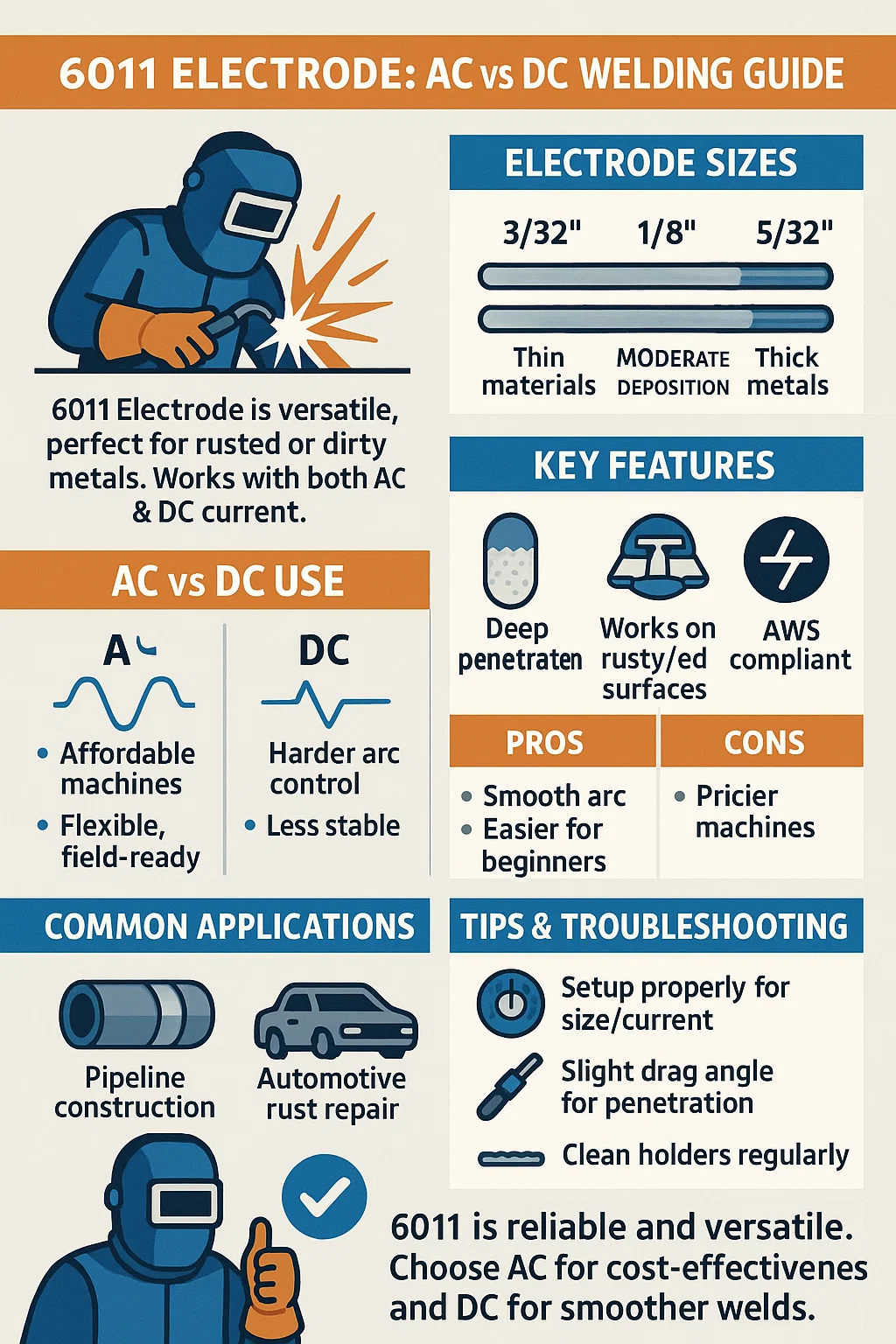
    6011 Rod: Best Practices for AC vs. DC Welding

    Introduction

    In the world of welding, choosing the right electrode and current type is pivotal for achieving optimal results. One common question among welders is whether to run the 6011 electrode on AC or DC current. This decision significantly impacts the welding process and the final outcome. The 6011 electrode is crucial in welding for its versatility and effectiveness in penetrating rusted or dirty metals. Both experienced welders and newcomers, including fabricators, students, and engineers, often examine this electrode for its unique benefits.

    Types / Variants

    While 6011 itself is a designated type of electrode, it comes in various sizes:

    • 1/8 inch: Typically used for medium-thickness metals.
    • 3/32 inch: Better suited for thinner materials.
    • 5/32 inch: Ideal for thicker metals requiring deeper penetration.

    Each size is chosen based on the metal thickness and desired penetration.

    Key Features or Specifications

    • Material: Cellulose-based coating
    • Deposition Rate: Moderate, providing a good balance between speed and control.
    • Compatibility: Usable with both AC and DC power sources, making it versatile for different settings.
    • Certifications: Often compliant with AWS (American Welding Society) standards.

    The main advantage of the 6011 electrode is its deep penetration capability, which is crucial for welding dirty or rusty materials.

    Usage & Compatibility

    AC Current Advantages:

    • Arc Stability: While more challenging, AC offers flexibility in stabilizing the arc.
    • Cost Effectiveness: Often more affordable than DC welding machines.
    • Versatility: Suitable for basic repairs and fabrication.

    DC Current Advantages:

    • Smoother Operation: Provides more stable arcs and smoother welds.
    • Easier for Beginners: Often easier to manage and control.
    • Directional Stability: Consistent electrode behavior.

    Disadvantages:

    • AC: Can be more difficult to control and produce less stable arcs.
    • DC: Equipment is usually more expensive.

    Best Use Case:

    6011 is predominantly used in the Shielded Metal Arc Welding (SMAW) process. Welders dealing with rusted or painted surfaces often lean towards using 6011 for its penetrating power, especially when cleaning the metal isn’t entirely feasible.

    Common Applications

    • Field Repairs: Known for effectiveness in less-than-ideal conditions.
    • Pipeline Construction: Excels in tasks demanding deep penetration.
    • Automotive Work: Handles rusted or imperfect surfaces effectively.

    The electrode’s adaptability makes it a staple in industries requiring durability and reliability.

    Tips & Best Practices

    • Setup: Ensure proper machine settings based on the electrode size and type of current.
    • Technique: Maintain a slight dragging angle for deeper penetration.
    • Maintenance: Regularly clean and inspect electrode holders for starch buildup.

    Troubleshooting:

    • Starting issues on AC: Adjust arc length and ensure connections are reliable.
    • Uneven weld bead: Review travel speed and heat settings.

    Conclusion

    Whether running 6011 on AC or DC depends on several factors, like equipment availability and specific project needs. AC is cost-effective and versatile for general repairs, whereas DC offers smoother operation suitable for detailed work. The 6011 electrode’s deep penetration and versatility make it indispensable for welding professionals and students. Understanding its advantages and applications allows for informed decisions tailored to individual project goals.


    Note for Readers: This post may contain affiliate links. If you purchase through them, we may earn a small commission at no cost to you. Thank you for supporting our site.


    Washington Alloy 6011 Stick Electrode 5LB Package (6011 3/32″)
    • Washington Alloy’s 6011 3/32″ Electrode
    • 60,000lbs Tensile strength
    • 5 Lb Package
    • All-position, Flux coated

    Last update on 2026-04-21 / Affiliate links / Images from Amazon Product Advertising API

    Washington Alloy 6011 Stick Electrode 5LB Package (6011 1/8″)
    • Washington Alloy’s 6011 1/8″ Electrode
    • 60,000lbs Tensile strength
    • 5 Lb Package
    • All-position, Flux coated

    Last update on 2026-04-21 / Affiliate links / Images from Amazon Product Advertising API

    Washington Alloy 6011 Stick Electrode 5LB Package (6011 5/32″)
    • Washington Alloy’s 6011 5/32″ Electrode
    • 60,000lbs Tensile strength
    • 5 Lb Package
    • All-position, Flux coated

    Last update on 2026-04-21 / Affiliate links / Images from Amazon Product Advertising API

    Washington Alloy 6011 10lbs Welding Stick Electrode (6011 1/8″ – 10 LBS.)
    • AWS A5.1 CLASS E6011
    • 10 LB Package – 6011
    • Tensile Strength (psi) 60,000

    Last update on 2026-04-21 / Affiliate links / Images from Amazon Product Advertising API

    Washington Alloy 6011 10lbs Welding Stick Electrode (6011 5/32″ – 10 LBS.)
    • AWS A5.1 CLASS E6011
    • 10 LB Package – 6011
    • Tensile Strength (psi) 60,000

    Last update on 2026-04-21 / Affiliate links / Images from Amazon Product Advertising API

  • Welding with 7018: Should You Use AC or DC Current? When to Use 7018AC

    Welding with 7018: Should You Use AC or DC Current? When to Use 7018AC

    Introduction

    Welding with 7018 electrodes is a staple in shielded metal arc welding (SMAW), also known as stick welding. Known for creating strong, smooth welds, the 7018 is frequently used in critical applications such as structural steel work. A common question among welders is whether to use AC or DC current with this electrode, and when to opt for the 7018AC variant. Understanding these choices is crucial for welders, fabricators, and students striving for optimal performance.

    Types / Variants / Models

    The primary variants include:

    • 7018 Electrode: Typically used with direct current electrode positive (DCEP).
    • 7018AC Electrode: Specifically designed for alternating current (AC) applications.

    Each variant excels under different conditions, making the choice between them vital depending on the available equipment and project requirements.

    Key Features or Specifications

    • Coating Composition: Low hydrogen, iron powder which minimizes the risk of cracking.
    • Current Type:
      • 7018: Best with DCEP for stability and penetration.
      • 7018AC: Optimized for AC, offering good arc stability even with lower voltage machines.
    • Sizes: Available from 3/32″ to 1/4″, depending on thickness needs.
    • Certifications: Meets AWS A5.1 standards ensuring quality and reliability across structural applications.

    The differences in current compatibility directly affect arc stability and penetration, essential for achieving robust, high-quality welds.

    Usage & Compatibility

    Welding Processes:

    • SMAW (Stick Welding): The preferred method for 7018, ensuring strength in welds.

    Machine Compatibility:

    • DC Machines: Offer stable arcs with deeper penetration for the standard 7018.
    • AC Machines: Enable the use of 7018AC, overcoming limitations of older or less robust machines prone to arc interruptions.

    Pros and Cons:

    • 7018 with DC:
      • Pros: Deeper penetration, better arc stability.
      • Cons: Requires DC-compatible equipment.
    • 7018AC:
      • Pros: Usable with AC machines, improved arc stability on fluctuating AC power.
      • Cons: Slightly different handling required due to AC characteristics.

    Common Applications

    Welding with 7018 electrodes is prevalent in:

    • Structural Steelwork: Essential for beams and columns due to its strength.
    • Pipeline Welding: Ensures solid joints crucial for durability.
    • Shipbuilding: Vital in combating metal fatigue and environmental pressures.

    The 7018AC variant is particularly useful in field repairs and projects where only AC power sources are available, providing necessary flexibility and reliability.

    Tips & Best Practices

    • Setup: For AC use, ensure a stable power supply to reduce fluctuations.
    • Handling: Maintain dry storage for electrodes to prevent moisture absorption, particularly for low-hydrogen types.
    • Troubleshooting: If experiencing arc blow on DC, try adjusting the grounding position or switch to 7018AC for better control.

    Avoid common mistakes such as incorrect polarity settings and improper storage, which can compromise weld quality.

     Conclusion

    Choosing between AC and DC currents for 7018 electrodes hinges on equipment availability and project needs. The 7018AC variant provides a viable option for those restricted to AC machines without sacrificing weld quality. Welders and students should assess their equipment and project requirements to make informed decisions, ensuring efficiency and optimal results in their welding tasks.

    In summary, understanding when and why to use the 7018 or 7018AC can significantly impact the success of your welding projects, guiding you toward making the best choices for each unique scenario.

  • Watch with Prime Video