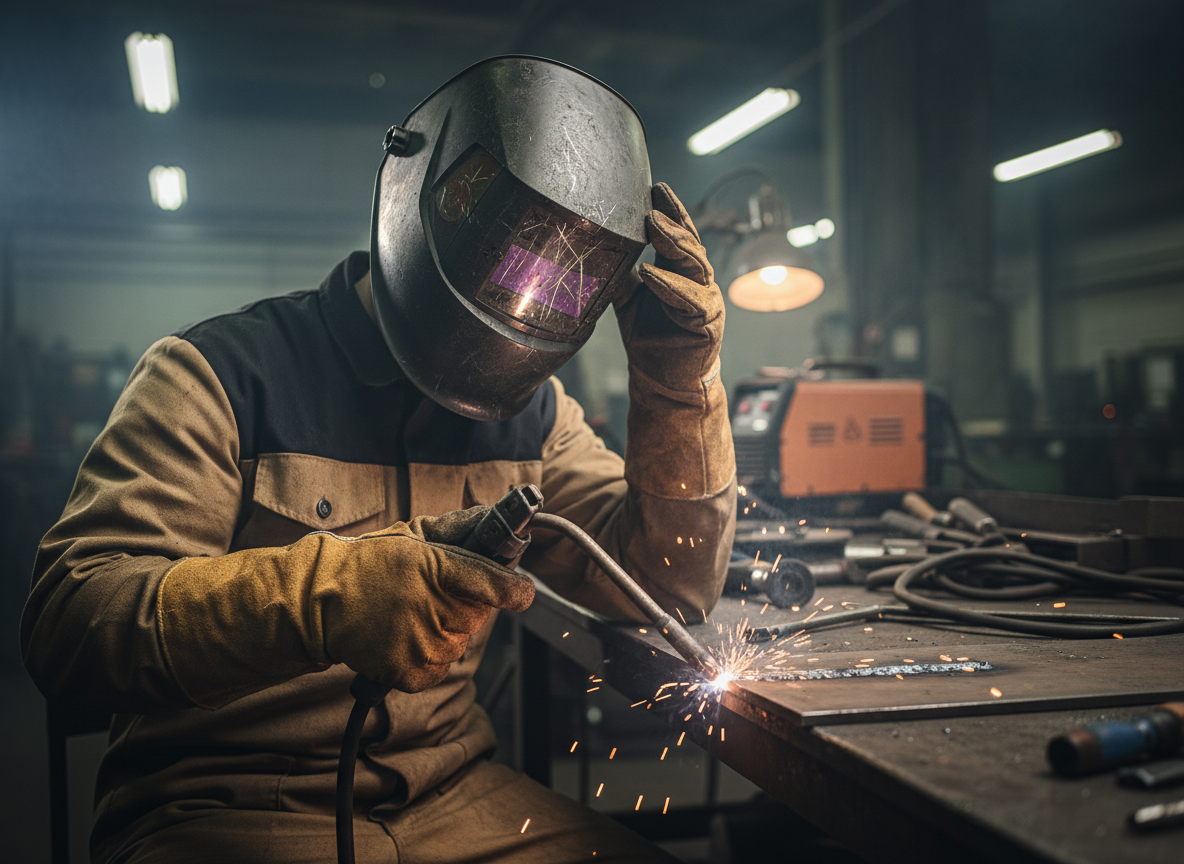
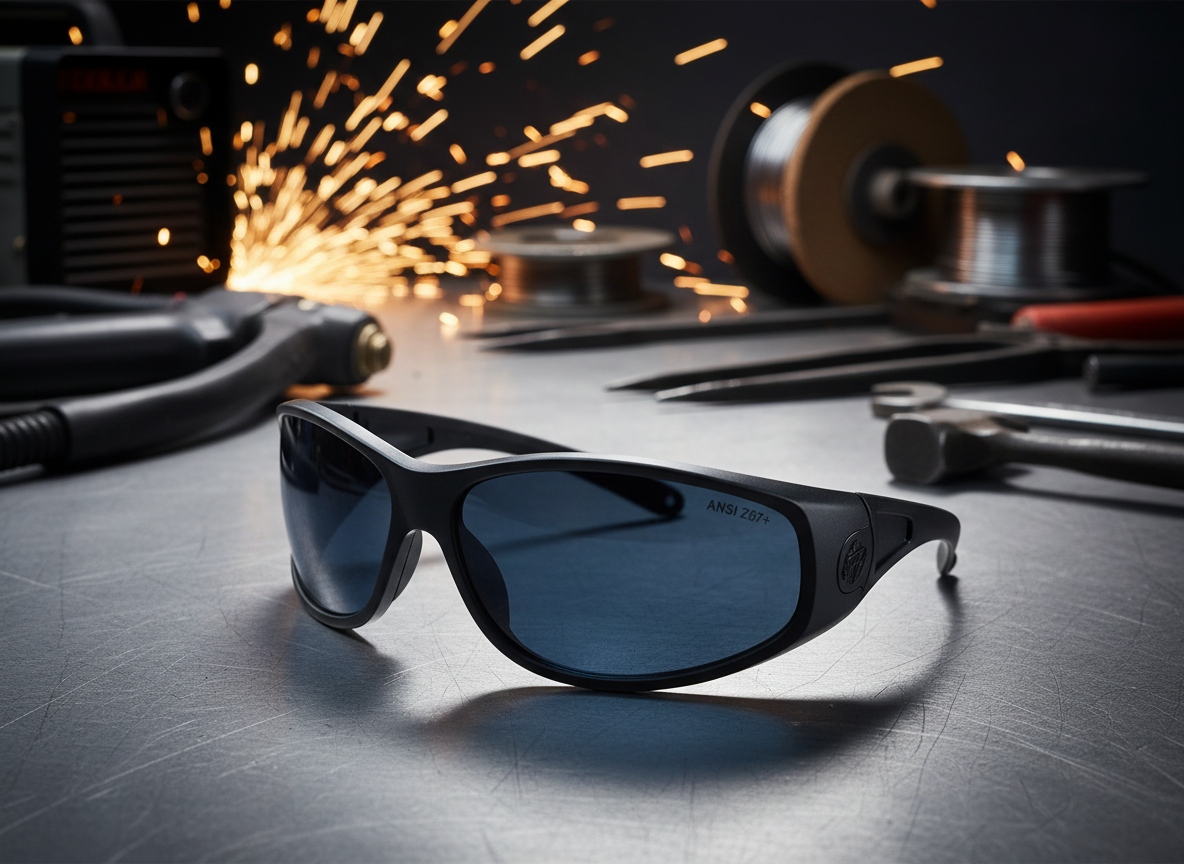
Tag: ANSI Z87.1

  • Best P100 Respirators for Welding Fumes (Seal Leak Fix)

    Your respirator is leaking fumes because your mask is worn out or the wrong size.

    Here are the best P100 respirators that seal properly and protect against welding fumes.

    WHERE TO BUY

    CKE 20 Pairs Cable Railing Kit – 3/16″ Swage Toggle Turnbuckle Hardware Kit – T316 Stainless Steel for Wood Post Cable Railing System – Angle 180ยฐ Adjustable Angle Stairs Deck
    • ๐Ÿ”ฆใ€Multi Angled & Wide Adjustmentใ€‘This cable railing kit works for 3/16″ wire rope in multi angled stairways or horizontal sections cable railing systems. The multi adjustable angle feature enables the turnbuckle to rotate from 0 to180 degrees, closed-body of the turnbuckle adjust freely length from the min 7.2″ to max 10.1 inch”. This cable railing hardware kit package can make 20 cable runs.
    • ๐Ÿ”ฆใ€T316 Marine Grade Stainless Steelใ€‘This 3/16″ Cable Railing Hardware Kit made from T316 marine grade stainless steel, which means it’s excellent resistance to rust, corrosion with long-lasting protection. It can handle extreme weather conditions, even in coastal areas where there’s a lot of humidity and salty air. CKE Swage Toggle Turnbuckle for Wood Post is ideal for indoor and outdoor black deck stair cable railing kit system.
    • ๐Ÿ”ฆใ€Sizeใ€‘Fit for 3/16 inch stainless steel cable, apply for both wood posts. Turnbuckle: 7.2″ Deck Toggle End: 3″. We suggest the post spacing about 3-4 ft between wood post ends, and the cable spacing about 3″ to 4″ for each post.
    • ๐Ÿ”ฆใ€Applicationsใ€‘This 3/16″ Swage Toggle Turnbuckle Cable Railing Hardware Kit with wide adjustable range with cleanly looks solve the problem for tighten and adjust the tension of attached cable in multi angled stairways and ramps also for horizontal section cable railing systems for straight, stair or angled sections when using timber posts. This cable railing kit is installed simply by tightening the screws, please refer the picture of 3 to install.
    • ๐Ÿ”ฆใ€Package List & 100% Satisfaction Guaranteeใ€‘20 Set 180 Degree Adjustable Angle Cable Railing Kit (Kti Includes: 20 Pcs Swage Toggle Turnbuckles, 20 Pcs Deck Toggle Terminal, 80 Pcs screws, 1 Pcs CKE Patent Design Spanner Multi Tool). This package can make 20 cable runs. โญBuy with confidence: If you’re not satisfied with this item at anytime within two years after purchased, we’ll provide a refund or replacement.

    Last update on 2026-04-20 / Affiliate links / Images from Amazon Product Advertising API

    Key Takeaways

    • P100 filters block 99.97% of welding fumes (manganese, chromium, nickel, particulates)
    • Silicone facepieces seal better than rubber and last longer
    • Half-face respirators are lighter and more comfortable than full-face for all-day wear
    • Size mattersโ€”small, medium, large; wrong size = seal failure
    • Replace filters every 40 hours of use or when hard to breathe through

    Comparison Table

    ModelTypeSize RangeFilter TypeBest ForPrice Range
    3M 6502QLHalf-face, reusableSmall/Medium/LargeBayonet P100Daily welding, MIG/TIG$35โ€“$50
    Honeywell 5500Half-face, reusableSmall/Medium/LargeBayonet P100General welding, grinding$30โ€“$45
    3M 6391Half-face, reusableLarge onlyBayonet P100Larger faces, high-volume use$40โ€“$55
    3M 2097 FiltersReplacement filtersUniversal fitP100 + organic vapor reliefFilter replacement$8โ€“$12 per pair

    Product Sections

    3M 6502QL Rugged Comfort Quick Latch Respirator

    The 3M 6502QL is the gold standard for welding shops. Quick Latch design means you can snap cartridges on and off without twisting, saving time between jobs. Silicone facepiece seals tight and won’t degrade like rubber. Cool Flow exhalation valve reduces fogging and heat buildup.

    Key Specs:

    • Facepiece: Silicone, soft and durable
    • Filter connection: Bayonet (quick-click)
    • Sizes: Small, Medium, Large
    • Exhalation valve: Yes (reduces heat/moisture)
    • Reusable: Yes (lasts 5+ years with care)
    • NIOSH certified: Yes (ANSI Z87.1)

    Best for: Daily MIG/TIG welding, confined spaces, high-fume environments.

    Amazon:

    CKE 20 Pairs Cable Railing Kit – 3/16″ Swage Toggle Turnbuckle Hardware Kit – T316 Stainless Steel for Wood Post Cable Railing System – Angle 180ยฐ Adjustable Angle Stairs Deck
    • ๐Ÿ”ฆใ€Multi Angled & Wide Adjustmentใ€‘This cable railing kit works for 3/16″ wire rope in multi angled stairways or horizontal sections cable railing systems. The multi adjustable angle feature enables the turnbuckle to rotate from 0 to180 degrees, closed-body of the turnbuckle adjust freely length from the min 7.2″ to max 10.1 inch”. This cable railing hardware kit package can make 20 cable runs.
    • ๐Ÿ”ฆใ€T316 Marine Grade Stainless Steelใ€‘This 3/16″ Cable Railing Hardware Kit made from T316 marine grade stainless steel, which means it’s excellent resistance to rust, corrosion with long-lasting protection. It can handle extreme weather conditions, even in coastal areas where there’s a lot of humidity and salty air. CKE Swage Toggle Turnbuckle for Wood Post is ideal for indoor and outdoor black deck stair cable railing kit system.
    • ๐Ÿ”ฆใ€Sizeใ€‘Fit for 3/16 inch stainless steel cable, apply for both wood posts. Turnbuckle: 7.2″ Deck Toggle End: 3″. We suggest the post spacing about 3-4 ft between wood post ends, and the cable spacing about 3″ to 4″ for each post.
    • ๐Ÿ”ฆใ€Applicationsใ€‘This 3/16″ Swage Toggle Turnbuckle Cable Railing Hardware Kit with wide adjustable range with cleanly looks solve the problem for tighten and adjust the tension of attached cable in multi angled stairways and ramps also for horizontal section cable railing systems for straight, stair or angled sections when using timber posts. This cable railing kit is installed simply by tightening the screws, please refer the picture of 3 to install.
    • ๐Ÿ”ฆใ€Package List & 100% Satisfaction Guaranteeใ€‘20 Set 180 Degree Adjustable Angle Cable Railing Kit (Kti Includes: 20 Pcs Swage Toggle Turnbuckles, 20 Pcs Deck Toggle Terminal, 80 Pcs screws, 1 Pcs CKE Patent Design Spanner Multi Tool). This package can make 20 cable runs. โญBuy with confidence: If you’re not satisfied with this item at anytime within two years after purchased, we’ll provide a refund or replacement.

    Last update on 2026-04-20 / Affiliate links / Images from Amazon Product Advertising API


    Honeywell North 5500 Series P100 Half Mask

    The Honeywell 5500 is the budget-friendly alternative that doesn’t sacrifice protection. Direct cartridge-to-face seal (no valve) makes it simple and reliable. Soft elastomer facepiece is comfortable for 8-hour shifts. Compatible with a wide range of filter types.

    Key Specs:

    • Facepiece: Elastomer (soft, durable)
    • Filter connection: Direct bayonet
    • Sizes: Small, Medium, Large
    • Exhalation valve: No (simpler design)
    • Reusable: Yes (lasts 3โ€“5 years)
    • NIOSH certified: Yes

    Best for: Budget-conscious shops, occasional welding, grinding and sanding.

    Amazon:

    Honeywell Safety Products Multi-Purpose Reusable Half Mask MC/P100 Respirator Convenience Pack, Large (RWS-54032)
    • READY TO WEAR CONVENIENCE: Includes 2 multi-contaminant P100 cartridge/filter combos for excellent protection against gases, vapors and particulates; economical safe breathing solution that does not compromise on features
    • COST-EFFECTIVE REUSABILITY: Cartridges and filters are easily replaced so the facepiece can be reused; compatible with all of our N-Series cartridge types for other uses around the home; latex-free mask is non-allergenic, tough and long-lasting
    • SECURE FIT: Contoured face seal with variable thickness for optimal seal in all facial areas; fits most face shapes & sizes; threaded cartridge connectors prevent accidental disconnection; low-profile cartridge allows increased field of vision
    • LONGWEARING COMFORT: Strategically placed exhalation valve keeps mask cool and comfortable; strong support around the chin area and good flexibility on the nose bridge; upper strap features minimum give for strong support through extended wear on the job
    • BACKPACK ADAPTOR OPTION: NIOSH-Approved for use with backpack adaptor for welding and painting applications (adaptor sold separately); sealed packaging ensures a tamper-free 100% hygienic product

    Last update on 2026-04-20 / Affiliate links / Images from Amazon Product Advertising API


    3M 6391 Half Facepiece Respirator (Large)

    The 3M 6391 is the large-size version of the 6502, designed for welders with bigger faces or those who need maximum comfort. Same silicone quality and Cool Flow valve as the 6502. Wider straps distribute pressure evenly.

    Key Specs:

    • Facepiece: Silicone, large fit
    • Filter connection: Bayonet
    • Sizes: Large only
    • Exhalation valve: Yes (Cool Flow)
    • Reusable: Yes (lasts 5+ years)
    • NIOSH certified: Yes

    Best for: Large-face welders, all-day high-volume welding, TIG work.

    Amazon:

    No products found.


    3M 2097 P100 Particulate Filters (Replacement)

    Fresh filters are critical. The 3M 2097 includes organic vapor relief, which helps with the smell of welding fumes. Magenta color makes it easy to spot when they’re saturated (turn dark brown). Compatible with 3M 6500 series respirators and most half-face masks.

    Key Specs:

    • Filter type: P100 (99.97% efficiency)
    • Organic vapor relief: Yes
    • Fit: Bayonet (3M 6500 series, 6000 series, 7000 series)
    • Lifespan: 40 hours of use or until hard to breathe through
    • Quantity: 2 pairs (4 filters) per box
    • NIOSH certified: Yes

    Best for: Replacing worn-out filters, maintaining seal integrity, reducing fume odor.

    Amazon:

    Last update on 2026-04-20 / Affiliate links / Images from Amazon Product Advertising API


    Still Deciding? Compare These Options Below

    Honeywell Safety Products Multi-Purpose Reusable Half Mask MC/P100 Respirator Convenience Pack, Large (RWS-54032)
    • READY TO WEAR CONVENIENCE: Includes 2 multi-contaminant P100 cartridge/filter combos for excellent protection against gases, vapors and particulates; economical safe breathing solution that does not compromise on features
    • COST-EFFECTIVE REUSABILITY: Cartridges and filters are easily replaced so the facepiece can be reused; compatible with all of our N-Series cartridge types for other uses around the home; latex-free mask is non-allergenic, tough and long-lasting
    • SECURE FIT: Contoured face seal with variable thickness for optimal seal in all facial areas; fits most face shapes & sizes; threaded cartridge connectors prevent accidental disconnection; low-profile cartridge allows increased field of vision
    • LONGWEARING COMFORT: Strategically placed exhalation valve keeps mask cool and comfortable; strong support around the chin area and good flexibility on the nose bridge; upper strap features minimum give for strong support through extended wear on the job
    • BACKPACK ADAPTOR OPTION: NIOSH-Approved for use with backpack adaptor for welding and painting applications (adaptor sold separately); sealed packaging ensures a tamper-free 100% hygienic product

    Last update on 2026-04-20 / Affiliate links / Images from Amazon Product Advertising API

    How to Choose the Right Respirator

    1. Get the Right Size Try on small, medium, and large. The mask should feel snug but not painful. You should feel gentle suction when you inhale. If it shifts or gaps appear, try the next size.

    2. Check Your Filter Type Most modern half-face respirators use bayonet cartridges (click-on). Older models use threaded cartridges (screw-on). Know which one you have before buying filters.

    3. Consider Comfort Silicone facepieces (3M 6502, 6391) are more comfortable for all-day wear. Elastomer (Honeywell 5500) is cheaper but less comfortable. Cool Flow valves reduce heat buildup.

    4. Plan for Filter Replacement P100 filters last 40 hours of use. If you weld 8 hours a day, 5 days a week, you’ll need new filters every 1โ€“2 weeks. Budget accordingly.

    5. Check Compatibility Not all filters fit all masks. 3M 6500 series uses bayonet cartridges. Honeywell 5500 uses direct bayonet. Verify before buying.

    FAQ

    Q: Can I use an N95 for welding? A: No. N95 masks are for dust and pollen, not welding fumes. Welding fumes contain toxic metals (manganese, chromium, nickel). You need a P100 respirator.

    Q: How long do P100 filters last? A: 40 hours of use or until they become hard to breathe through. If your filters are dark brown, replace them. Don’t guessโ€”replace them.

    Q: Can I reuse a P100 filter? A: No. Once saturated, they lose efficiency. Throw them away and install fresh filters.

    Q: What if I have a beard? A: Shave the area where the mask contacts your face. Even 1/8 inch of beard hair breaks the seal. A leaking mask doesn’t protect you.

    Q: Do I need a fit test? A: OSHA recommends annual fit testing in high-risk environments. For shop use, do a quick seal check: cover the cartridges, inhale hard, and feel for leaks around the edges.

    Safety Notes

    Welding fumes contain manganese, chromium, nickel, and other toxic metals. Chronic exposure causes neurological damage, respiratory disease, and kidney problems. ANSI Z87.1 requires proper respiratory protection in confined spaces or high-fume environments. A proper seal is criticalโ€”a leaking mask gives false confidence and exposes you to harmful particulates.

    Always wear a properly sealed P100 respirator when welding in enclosed or poorly ventilated spaces.


  • Why You’re Smelling Welding Fumes Through Your Respirator (And How to Fix It)

    You’re wearing a P100 respirator. You’ve got fresh filters. But you can still smell the fumes.

    That’s not normalโ€”and it means your mask isn’t protecting you.

    Here’s why it happens and how to fix it.

    Symptoms You Have a Seal Problem

    • Fume smell inside the mask during welding
    • Visible fumes leaking around the mask edges
    • Filters turn dark/brown faster than expected
    • Lip tingling or throat irritation despite wearing the mask
    • Fogging inside the mask (moisture escaping, not just condensation)

    Root Cause: Poor Mask Seal

    A P100 filter only works if air passes through the filter, not around it.

    If you smell fumes, one of these is happening:

    1. Facial Hair Breaks the Seal Beards, stubble, and sideburns create gaps between your face and the silicone facepiece. Even 1/8 inch of beard hair defeats the seal. Air (and fumes) bypass the filter entirely.

    2. Wrong Size Mask Half-face respirators come in small, medium, and large. A loose mask won’t seal; a too-tight mask causes discomfort and users remove it. Either way, you get leakage.

    3. Damaged Facepiece Cracked silicone, worn straps, or a loose exhalation valve let unfiltered air in. Silicone degrades over time, especially if stored in sunlight or heat.

    4. Filters Not Seated Properly Cartridges must click or screw in fully. Partial insertion leaves gaps. Dirty filter threads prevent a tight seal.

    5. Exhalation Valve Failure The one-way valve lets breath out but keeps fumes out. If it’s stuck open or damaged, fumes flow straight in.

    Per NIOSH and ANSI Z87.1, a proper seal is non-negotiable for respiratory protection.

    The Fix: 5 Steps to Stop Fume Leakage

    1. Shave Your Face Trim or shave facial hair where the mask contacts your skin. This is the #1 reason for seal failure. Check the mask fit lineโ€”anything touching that area must go.

    2. Verify Your Size Try on multiple sizes. The mask should feel snug but not painful. You should feel gentle suction when you inhale. If it shifts or gaps appear, try the next size up or down.

    3. Check Filter Seating Remove and reinstall cartridges. They should click (bayonet) or screw (threaded) until snug. Don’t forceโ€”just firm pressure. Wipe threads clean if they’re dusty.

    4. Inspect the Facepiece Look for cracks, tears, or discoloration in the silicone. Check the exhalation valve for cracks or debris. If damaged, replace the facepiece (most respirators have replaceable parts).

    5. Replace Old Filters P100 filters last 40 hours of use or until they become hard to breathe through. If your filters are dark brown or you’ve been using them for weeks, replace them. Clogged filters don’t seal well and reduce airflow.

    Real-World Tip

    Experienced welders do a fit test before every shift: put on the mask, cover the filter cartridges with your hands, and inhale hard. If you feel air being sucked in around the edges, the seal is broken. If it holds vacuum, you’re good.

    This takes 5 seconds and catches seal problems before you start welding.

    What to Do Next

    If this keeps happening, your facepiece is likely worn or your filters are clogged. See the best replacement respirators and filters โ†’ https://www.arcweld.store/collections/air-cleaning-equipment-and-respirators

    Safety Note

    Welding fumes contain manganese, chromium, nickel, and other toxic metals. ANSI Z87.1 requires proper respiratory protection in confined spaces or high-fume environments. A proper seal is criticalโ€”a leaking mask gives false confidence and exposes you to harmful particulates.


  • Why You Can’t See Your Weld Pool (And How to Fix It)

    Why You Can’t See Your Weld Pool (And How to Fix It)

    Your helmet lens is probably dirty, scratched, or damagedโ€”and it’s costing you quality welds.

    If you’re squinting through your helmet or struggling to see the puddle clearly, the problem isn’t your eyesight. It’s your lens. Dirty, scratched, or worn lenses block light and create a hazy view that makes precision impossible. The good news: this is an easy fix.

    Symptoms of a Bad Helmet Lens

    • Hazy or cloudy view even in good light
    • Scratches or scuffs visible on the lens surface
    • Difficulty seeing the weld pool or joint
    • Lens feels sticky or has residue buildup
    • Darkening is uneven or inconsistent across the lens
    • You’re lifting your helmet more often to see clearly

    Why This Happens

    Welding helmets take a beating. Spatter, grinding dust, and UV exposure degrade the lens over time. The outer clear lens (the protective layer) scratches easily from handling and contact with metal. The inner auto-darkening filter (if you have one) can accumulate dust and residue, especially in high-spatter processes like MIG.

    Even small scratches refract light and reduce contrast, making it harder to follow your bead. Residue from flux, spatter, or shop dust acts like a filter, dimming your view and forcing you to compensate by tilting your head or adjusting your shadeโ€”both bad habits that slow you down.

    AWS D1.1 welding standards don’t specify lens cleanliness, but they do require clear, undamaged optics for safe, quality welds. A damaged lens compromises both.

    The Fix (Step-by-Step)

    Step 1: Clean the lens thoroughlyStart with the outer clear lens. Use a soft, lint-free cloth and warm water with a drop of mild soap. Wipe gentlyโ€”don’t scrub. Dry completely. For the inner auto-darkening filter, use a dry cloth only (water can damage the LCD).

    Step 2: Inspect for damageHold the lens up to light. Look for scratches, cracks, or discoloration. If you see deep scratches or cracks, the lens needs replacement. Small surface scratches won’t affect visibility much, but they’ll get worse.

    Step 3: Replace if necessaryIf cleaning doesn’t help, order replacement lenses. Most helmets use standard sizes: outer clear lenses (usually 4.5″ x 5.25″ or similar) and inner filters (if auto-darkening). Check your helmet model or measure the lens.

    Step 4: Install the new lensMost helmets have a simple snap-in or screw-on design. Remove the old lens, snap or screw in the new one. Takes 30 seconds.

    Step 5: Test before weldingStrike a test arc or wave the helmet at a light source. The lens should darken instantly and evenly. If it doesn’t, check the battery (for auto-darkening) or reinstall the lens.

    Real-World Tip

    Experienced welders replace outer clear lenses every 2โ€“3 months in high-spatter environments (MIG, flux-core). It’s cheap insurance. Keep a spare pack of lenses in your toolbox. When visibility drops, swap them out immediately instead of fighting through a bad lens. You’ll weld faster and straighter.

    Safety Note

    ANSI Z87.1 requires helmets to have impact-resistant lenses and proper UV/IR protection. A cracked or heavily scratched lens fails this standard and puts your eyes at risk. Replace damaged lenses before your next weld.

    Next Steps

    If this keeps happening, your helmet lens is likely worn or damaged. See the best replacement options โ†’  Best Welding Helmet Replacement Lenses for Clear Visibility 

  • Welding Safety Glasses Guide 2025 | Shade Numbers, ANSI Z87.1 & UV Protection

    Welding Safety Glasses Guide 2025 | Shade Numbers, ANSI Z87.1 & UV Protection

    Welding safety glasses protect against UV radiation, infrared light, and impact hazards during grinding and fabrication. Choosing the right glasses depends on process type, shade number, and ANSI Z87.1 certificationโ€”not just lens color.

    ANSI Z87.1 Certification Requirements

    Impact Protection Levels

    Basic Impact (Z87) – Protects against low-velocity impact (1โ€ steel ball at 150 ft/sec) – Suitable for: General shop work, light grinding, non-welding tasks

    High Impact (Z87+) – Protects against high-velocity impact (1/4โ€ steel ball at 150 ft/sec) – Required for: Welding, grinding, chipping, cutting – Marking: โ€œZ87+โ€ stamped on frame and lens

    Side Shield Requirement: – All welding safety glasses must have side shields or wraparound design – Prevents spatter and debris from entering around lens edges

    Shade Number Selection by Process

    ProcessAmperage RangeShade NumberLens Type
    Oxy-fuel cuttingN/A#3-#6Fixed shade
    TIG (GTAW)10-50A#8-#10Fixed or auto-darkening
    TIG (GTAW)50-150A#10-#12Fixed or auto-darkening
    MIG (GMAW)60-160A#10-#12Fixed or auto-darkening
    MIG (GMAW)160-250A#12-#14Fixed or auto-darkening
    Stick (SMAW)60-160A#10-#12Fixed shade
    Stick (SMAW)160-250A#12-#14Fixed shade
    Plasma cutting20-40A#4-#5Fixed shade
    Plasma cutting40-80A#5-#8Fixed shade

    Note: Safety glasses are supplemental protection worn under welding helmets or for indirect arc exposure (helper/observer).

    Lens Types & Technologies

    Fixed Shade Lenses

    • Pros: No batteries, consistent darkness, low cost
    • Cons: Single shade only, must swap lenses for different processes
    • Best for: Dedicated single-process work, backup glasses
    • Cost: $10-$30

    Auto-Darkening Lenses

    • Pros: Adjustable shade range, no lens swapping
    • Cons: Battery replacement, higher cost
    • Shade range: Typically #5-#13
    • Reaction time: 0.0001-0.00004 seconds
    • Best for: Multi-process shops, frequent shade changes
    • Cost: $50-$150

    Passive IR/UV Protection (Clear Lenses)

    • Function: Blocks UV and infrared without visible light darkening
    • Use case: Grinding, fabrication, indirect arc exposure (helper/observer)
    • Shade equivalent: #1.5-#2
    • Best for: Non-welding tasks requiring impact protection

    UV & IR Protection Standards

    UV Protection (200-400nm wavelength): – All welding lenses must block 99.9%+ UV radiation – Permanent damage occurs from unprotected UV exposure (arc eye/welderโ€™s flash)

    Infrared Protection (780nm-1mm wavelength): – Blocks heat radiation from welding arc – Prevents retinal damage and cataracts from prolonged exposure

    Visible Light Transmission: – Shade #3: 14.3% transmission (light tint) – Shade #8: 0.58% transmission (moderate darkness) – Shade #12: 0.0018% transmission (very dark)

    Lens Coatings & Features

    Anti-Fog Coating

    • Purpose: Prevents condensation in humid environments or when wearing respirator
    • Best for: Summer welding, enclosed spaces, respirator use
    • Limitation: Coating wears off after 6-12 months

    Anti-Scratch Coating

    • Purpose: Extends lens life in high-abrasion environments
    • Best for: Grinding, fabrication, production shops
    • Hardness rating: 4-6H pencil hardness (military spec MIL-PRF-32432)

    Polarized Lenses

    • Purpose: Reduces glare from reflective surfaces (polished stainless, aluminum)
    • Best for: TIG welding on reflective materials
    • Limitation: Not necessary for carbon steel or general fabrication

    Frame Styles & Fit

    Wraparound Design

    • Coverage: Maximum side and peripheral protection
    • Best for: Grinding, cutting, high-spatter welding
    • Fit: Snug to face, minimal gap around edges

    Over-the-Glass (OTG) Design

    • Purpose: Fits over prescription eyeglasses
    • Best for: Welders who wear corrective lenses
    • Limitation: Bulkier, may not fit all prescription frame sizes

    Prescription Welding Glasses

    • Purpose: Combines corrective lenses with welding shade
    • Best for: Full-time welders who need vision correction
    • Cost: $150-$400 (requires optometrist fitting)

    When to Wear Safety Glasses vs. Helmet

    Safety Glasses (Supplemental Protection)

    • Grinding, cutting, or fabrication (no arc)
    • Indirect arc exposure (helper/observer 10+ feet from arc)
    • Under welding helmet as secondary protection
    • Oxy-fuel cutting or brazing (low UV output)

    Welding Helmet (Primary Protection)

    • Direct arc exposure (TIG, MIG, stick, flux-core)
    • Primary welder performing arc welding
    • Required for all arc welding processes per OSHA 1910.252

    OSHA Requirement: Safety glasses must be worn under welding helmets in environments with grinding, chipping, or multiple welding stations.

    Common Mistakes

    Using non-certified safety glasses for welding
    Fashion sunglasses or non-Z87+ glasses donโ€™t block UV/IR radiation. Result: arc eye (photokeratitis) and permanent retinal damage. Always verify Z87+ marking.

    Wrong shade number for amperage
    Shade #3 glasses for 150A MIG = retinal burn risk. Shade #12 for oxy-fuel cutting = canโ€™t see work. Match shade to process and amperage.

    Skipping safety glasses under helmet
    Grinding debris or spatter can enter under helmet. OSHA requires safety glasses as secondary protection in multi-hazard environments.

    Buying Checklist

    • โœ“ ANSI Z87+ certification marked on frame and lens
    • โœ“ Shade number matches process and amperage range
    • โœ“ UV/IR protection rated for welding (99.9%+ UV block)
    • โœ“ Side shields or wraparound design for peripheral protection
    • โœ“ Anti-fog coating if working in humid environments
    • โœ“ Anti-scratch coating for grinding/fabrication work
    • โœ“ Comfortable fit (no pressure points, secure without slipping)
    • โœ“ OTG design if wearing prescription glasses

  • Auto-Darkening Welding Helmet Buying Guide 2025 | Lens Speed, Shade Range & Standards

    Auto-Darkening Welding Helmet Buying Guide 2025 | Lens Speed, Shade Range & Standards

    Auto-darkening helmets protect your eyes by switching from light to dark state when arc strikes. Choosing the right one depends on lens speed, shade range, viewing area, and certificationโ€”not brand hype.

    Key Specifications

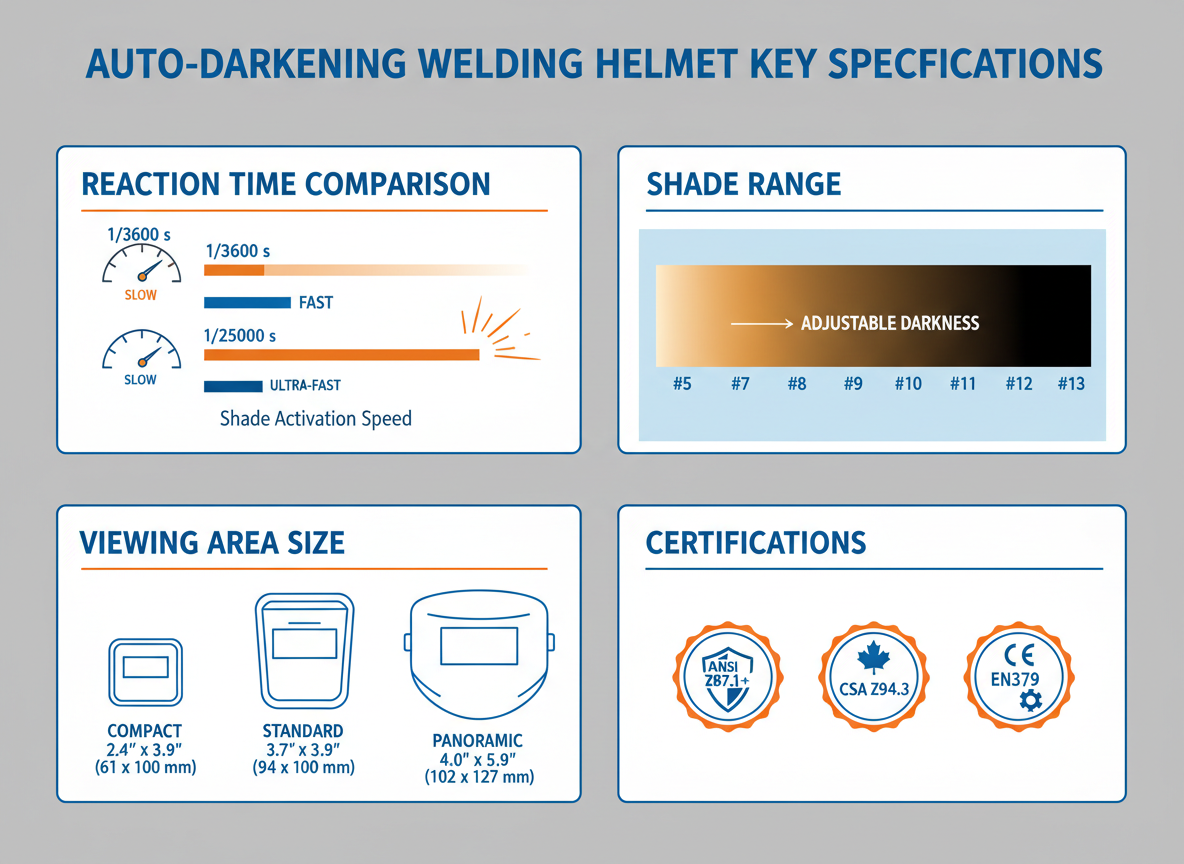
    Reaction Time (Switching Speed)

    LevelSpeedDecimal
    Entry-level1/3600 second0.00028s
    Mid-range1/10000 second0.0001s
    Professional1/25000 second0.00004s

    TIG welding requires faster response (1/20000s minimum) due to low-amperage arc initiation. MIG and stick work fine with 1/10000s.

    Shade Range

    • Standard range: #9โ€“#13
    • TIG-specific: #5โ€“#13 (low-amp visibility)
    • Grinding mode: #3โ€“#4 (light state)

    AWS D1.1 requires minimum shade #10 for 60โ€“160A stick welding, #11 for 160โ€“250A, #12 for 250โ€“550A.

    Viewing Area

    SizeDimensionsArea
    Compact3.5โ€ ร— 1.65โ€6 sq in
    Standard3.93โ€ ร— 2.36โ€9.3 sq in
    Wide-view3.93โ€ ร— 2.87โ€11.3 sq in
    Panoramic4.25โ€ ร— 3.25โ€13.8 sq in

    Larger viewing area improves peripheral awareness in tight spaces and multi-pass work.

    Optical Clarity Rating (1/1/1/1 to 1/1/1/3)

    Four numbers indicate: optical class / light diffusion / variations in luminous transmittance / angle dependence.

    • 1/1/1/1 = highest clarity (minimal distortion)
    • 1/1/1/2 = professional grade
    • 1/1/1/3 = acceptable for general fabrication

    Certification Requirements

    ANSI Z87.1+ (High-Impact Rated)
    Required for all industrial welding environments. Plus symbol (+) indicates high-velocity impact protection.

    CSA Z94.3
    Canadian standard equivalent to ANSI Z87.1+.

    EN379
    European standard covering optical class, switching time, and UV/IR protection.

    Process-Specific Requirements

    TIG (GTAW)

    • Reaction time: 1/20000s or faster
    • Shade range: #5โ€“#13 (low-amp start visibility)
    • Sensitivity adjustment: Essential for low-amperage starts

    MIG (GMAW)

    • Reaction time: 1/10000s acceptable
    • Shade range: #9โ€“#13
    • Spatter resistance: Check lens cover plate availability

    Stick (SMAW)

    • Reaction time: 1/10000s acceptable
    • Shade range: #10โ€“#13
    • Grinding mode: Useful for slag removal between passes

    Flux-Core (FCAW)

    • Same as MIG requirements
    • Higher spatter = more frequent cover plate replacement

    Power Source Options

    Solar-powered

    • Pros: No battery replacement, lighter weight
    • Cons: Requires adequate light exposure, slower recovery in dim environments

    Battery-powered

    • Pros: Consistent performance in all lighting
    • Cons: Battery replacement every 6โ€“12 months (CR2032 or AAA)

    Solar + Battery Hybrid

    • Best reliability for production environments
    • Battery backup prevents downtime

    True Color vs. Standard Lens Technology

    FeatureStandard Green LensTrue Color Lens
    Color perceptionGreen/blue tintNatural color
    Weld pool visibilityAdequateEnhanced
    Heat color distinctionStandardSuperior
    CostBase price2โ€“3ร— premium
    Best forStructural steelStainless/aluminum TIG

    True color improves precision on stainless and aluminum TIG work but isnโ€™t necessary for structural steel fabrication.

    Buying Checklist

    • โœ“ ANSI Z87.1+ certification marked on helmet
    • โœ“ Reaction time matches your primary process
    • โœ“ Shade range covers your amperage requirements
    • โœ“ Viewing area suits your work environment
    • โœ“ Optical clarity rating 1/1/1/2 or better
    • โœ“ Replacement lens covers readily available
    • โœ“ Adjustable sensitivity and delay controls
    • โœ“ Grinding mode if you do stick or flux-core

    Common Mistakes

    Buying based on viewing area alone
    Large viewing area with slow reaction time = retina damage risk. Verify switching speed first.

    Ignoring optical clarity rating
    1/1/1/3 lenses cause eye strain during 8+ hour shifts. Pay for 1/1/1/2 if you weld full-time.

    Skipping sensitivity adjustment testing
    Low-amperage TIG (10โ€“40A) wonโ€™t trigger poorly calibrated sensors. Test before buying.


  • ArcOne Vision X81VX Welding Helmet Review (2025): Premium Clarity for Pros

    ArcOne Vision X81VX Welding Helmet Review (2025): Premium Clarity for Pros

    Intro
    The ArcOne Vision X81VX is a professional-grade auto-darkening welding helmet designed for fabricators who spend long hours under the hood. It delivers wide viewing, fast switching, and rugged comfort that meets ANSI Z87.1 and CSA Z94.3 safety standards. Hereโ€™s how it stacks up for industrial and pipe work.


    Key Takeaways

    • Large View: 3.85 ร— 2.44 in (98 ร— 62 mm) viewing area for precise weld puddle control.
    • 4 Arc Sensors: Reliable switching < 1/25,000 s for SMAW, GTAW, GMAW, and Plasma.
    • Variable Shade: DIN 9 โ€“ 13 with grind mode and sensitivity/delay adjustments.
    • Comfort Fit: Balanced shell design and adjustable headgear reduce neck fatigue.
    • Durability: Meets ANSI Z87.1 + CSA Z94.3; ideal for shop and field environments.

    Performance and Build

    ArcOne engineered the X81VX for welders who need both optical clarity and long-term comfort. The XTREME series uses a lightweight polycarbonate shell that resists spatter and impact while keeping total weight manageable for multi-hour jobs. With true color filters and a fast reaction speed, arc starts and transitions are crisp, reducing eye strain throughout a shift.


    Applications

    • Structural steel and pipe fabrication
    • TIG and MIG precision work
    • Industrial maintenance and repair
    • Long-duration shop projects requiring wide view and comfort

    Comparison Table

    ModelKey SpecsBest ForArcWeld StoreAmazon
    ArcOne Vision X81VX (Black XTREME)3.85 ร— 2.44 in view โ€ข Shade 9โ€“13 โ€ข 4 Sensors โ€ข ANSI Z87.1 โ€ข True ColorPro-level MIG/TIG and pipe welding where clarity and comfort matter ArcOne Vision X81VX Black XTREME Auto Darkening Welding Helmet X81VX-1500 “>View at Arc Weld StoreAmazon Listing (disclosure) if out of stock

    Safety Notes

    Always verify that auto-darkening helmets meet ANSI Z87.1 and CSA Z94.3 for eye and face protection. Inspect lenses and batteries regularly, and store the helmet in a cool, dry place to protect sensors and optics. Replace lens covers as needed to maintain clarity.


    FAQ

    Q: Can the X81VX be used for low-amp TIG work?
    A: Yes. Its sensitivity control detects arcs as low as 5 amps, suitable for GTAW applications.

    Q: Does it support grind mode?
    A: Yes. Switch to grind mode for surface prep without filter darkening.

    Q: What is the power source?
    A: Solar assisted with replaceable lithium batteries.

    Q: Is the helmet compatible with cheater lenses?
    A: Yes โ€“ standard clip-in magnifiers fit inside the frame.


    Where to Buy

    ArcOne Vision X81VX Black XTREME Auto Darkening Welding Helmet X81VX-1500

    “>
    ArcOne Vision X81VX Black XTREME Auto Darkening Welding Helmet X81VX-1500

    ArcOne Vision X81VX Black XTREME Auto Darkening Welding Helmet X81VX-1500

    $327.82

    In Stock

    View Product

    (If out of stock, available:

    Last update on 2026-04-21 / Affiliate links / Images from Amazon Product Advertising API

    Disclosure: We may earn a small commission at no extra cost to you.)

Try Amazon Prime Free