Tag: aluminum TIG

  • TIG Tungsten Balling Causes on AC Welding: Aluminum Setup, AC Balance, Amperage, and Electrode Choice

    TIG tungsten balls on AC because the electrode is getting too hot at the tip. A small controlled ball can be normal on older transformer-style AC aluminum welding, especially with pure or zirconiated tungsten. Excessive balling, mushrooming, splitting, wandering arc, or tungsten dropping into the weld usually means the tungsten is overloaded, the AC balance puts too much heat on the electrode, the tungsten diameter is too small, the electrode type is wrong for the machine, or the shielding gas is not protecting the hot tungsten.

    On modern inverter AC TIG machines, a sharp or truncated point is usually preferred over a large ball. If the tungsten balls immediately reduce electrode-positive cleaning action, use a larger tungsten, switch to 2% lanthanated, ceriated, or zirconiated tungsten depending on the machine and procedure, shorten stickout, verify argon coverage, and confirm the torch is not overheating.

    Related TIG checks include why TIG tungsten turns black, TIG porosity troubleshooting, and TIG cup size and gas coverage selection.

    Common Symptoms

    SymptomLikely CauseFirst Check
    Tungsten forms a large ball immediatelyToo much heat on electrode, tungsten too small, wrong AC balanceCheck tungsten diameter and reduce cleaning action
    Ball grows wider than tungsten diameterElectrode overloadedUse larger tungsten or reduce amperage
    Arc wanders around the ballBall too large or contaminated tungstenRegrind to truncated point
    Tungsten splits or spits into puddleOverheating, contamination, wrong tungsten typeReplace electrode and verify AC settings
    Tungsten turns black after weldingPoor post-flow or gas coverage failureCheck argon flow, cup, gas lens, and post-flow

    What Causes Tungsten Balling on AC?

    • Too much electrode-positive time: More cleaning action puts more heat into the tungsten.
    • Tungsten diameter too small: A small electrode cannot carry the selected amperage without melting back.
    • Wrong tungsten for the machine: Pure tungsten balls easily and is mainly associated with older transformer AC machines.
    • Too much amperage: The electrode overheats before the puddle stabilizes.
    • Long tungsten stickout: Poor cooling and weak gas coverage let the tip overheat and oxidize.
    • Contamination: Touching filler, puddle, aluminum oxide, or dirty base metal makes the tip deform.
    • Poor shielding gas: Low flow, high turbulent flow, cracked cup, bad gas lens, or short post-flow damages the hot tungsten.

    Electrode Choice Notes

    For older transformer AC aluminum welding, pure tungsten may naturally form a balled end. Zirconiated tungsten is often used where a balled or rounded end is desired with better contamination resistance. On modern inverter AC machines, lanthanated and ceriated tungstens usually hold a prepared point better and give a more focused arc. Do not assume the same tungsten prep works for every AC TIG machine.

    Tungsten TypeAC BehaviorNotes
    Pure tungstenBalls readilyMostly for transformer AC; lower current capacity
    ZirconiatedRetains rounded/balled end betterGood AC choice where weld contamination is a concern
    LanthanatedHolds point well on inverter ACCommon modern AC/DC TIG choice
    CeriatedGood starts and stable arcOften used for lower-amperage TIG
    ThoriatedLess common for AC aluminum todayRadiation concern; verify shop procedure

    Inspection Steps

    1. Identify the machine type. Transformer AC and inverter AC do not use the same tungsten-prep approach.
    2. Check tungsten diameter. If the ball exceeds the electrode diameter or forms instantly, the electrode may be undersized for amperage.
    3. Check AC balance. Reduce cleaning action if the machine is putting excessive heat into the tungsten.
    4. Check AC frequency if available. Higher frequency focuses the arc but can require a stable prepared tip.
    5. Regrind the tungsten. Use a clean truncated point for inverter AC unless the procedure calls for a ball.
    6. Inspect gas coverage. Check cup size, cracked cup, gas lens condition, argon flow, and post-flow.
    7. Clean aluminum thoroughly. Remove oxide and contamination before welding; do not make the tungsten carry the cleaning burden.
    8. Watch torch heat. A hot air-cooled torch can contribute to consumable and tungsten failure.

    Field Fix vs Proper Fix

    ProblemField FixProper Fix
    Large ball forms instantlyLower amperage and reduce cleaning actionUse correct tungsten diameter and AC balance
    Arc wandersRegrind tungstenUse truncated point and correct AC frequency/balance
    Tungsten spits into weldStop and replace tungstenCorrect overheating, contamination, and tungsten type
    Black tungsten after weldIncrease post-flowRepair gas leaks and replace damaged cup/gas lens
    Repeated balling on aluminumMove to larger tungstenMatch electrode, amperage, machine type, and procedure

    Common Wrong-Part Mistakes

    • Using pure tungsten on an inverter machine when lanthanated or ceriated would hold shape better.
    • Using 1/16 in. tungsten for amperage that needs 3/32 in. or larger.
    • Buying cups, collets, or gas lenses without confirming torch series and tungsten diameter.
    • Trying to fix excessive balling by increasing gas flow until turbulence pulls in air.
    • Using a balled tip because it was common on old transformer machines, even though the inverter setup wants a truncated point.

    Compatibility Notes

    Tungsten choice depends on machine type, AC waveform control, amperage, tungsten diameter, base metal, and procedure. Torch consumables must match the torch family, cup style, collet size, and tungsten diameter. If using WP-17, WP-18, or WP-26 style parts, verify the actual torch body and gas lens setup before ordering.

    Related Failure Paths

    • Arc wandering from a large or contaminated tungsten ball.
    • Black tungsten from poor post-flow or gas leakage.
    • Aluminum porosity from poor cleaning or shielding.
    • Dirty weld starts from contaminated tungsten.
    • Gas lens/cup failure mistaken for tungsten failure.
    • Excess cleaning action overheating the electrode.

    Safety Notes

    • Let tungsten and torch parts cool before handling.
    • Use eye protection when grinding tungsten.
    • Use a dedicated tungsten grinder or wheel to avoid contamination.
    • Follow shop rules for thoriated tungsten handling and dust control.
    • Secure argon cylinders and use ventilation during test welds.

    Sources Checked

    • Miller guidance on AC TIG inverter tungsten selection.
    • CK Worldwide tungsten electrode characteristics guide.
    • CK Worldwide AC TIG aluminum setup notes.
    • Weld Support Parts TIG tungsten discoloration and gas coverage support pages.
    • Weld Support Parts TIG cup size and porosity troubleshooting pages.
  • Why Auto-Darkening Helmets Flicker on Aluminum TIG but Not MIG or Stick

    An auto-darkening helmet that behaves normally on MIG or stick but flickers on aluminum TIG is usually not failing in the same way as a helmet that will not darken at all. Aluminum TIG exposes weak points in sensor detection, sensitivity settings, low-current arc recognition, torch angle, reflected light, and delay settings. The arc can be stable at the weld, but the helmet may not be seeing enough consistent arc signal to stay dark.

    This is a narrower support article for welders who already have a working auto-darkening hood but only see flicker during AC aluminum TIG. For broader helmet selection, see the Best Auto-Darkening Welding Helmet for TIG guide and the auto-darkening welding helmet buying guide.

    Key Takeaways

    • Aluminum TIG flicker is commonly caused by low TIG arc signal, blocked sensors, low sensitivity, short delay, or reflective arc angles.
    • MIG and stick usually create brighter, broader, easier-to-detect arcs, so the same helmet may seem fine on those processes.
    • AC TIG, tight torch angles, cup position, filler hand position, and workpiece geometry can partly shield the arc from the helmet sensors.
    • Increase sensitivity, increase delay, clean the cover lens, replace weak batteries, and confirm that the helmet is rated for the TIG amperage used.
    • Do not keep welding with a helmet that flickers, flashes, or fails a pre-use darkening check.

    Problem / Context

    The symptom is specific: the helmet darkens normally for MIG or stick welding, but during aluminum TIG it rapidly switches between dark and light, pulses, or drops shade during starts, crater fill, or low-amperage sections. This is different from a dead helmet. For total failure, use the broader checklist in Auto-Darkening Welding Helmet Not Working: Causes and Fixes.

    Aluminum TIG is a harder detection case because the welder may run low current, use a tight cup angle, weld around corners, or move the torch in a way that hides part of the arc from the helmet sensors. MIG and stick normally throw more visible arc energy and spatter glow into the front of the hood, so a marginal sensor setup may still work there.

    Root Causes

    Low sensitivity setting: Many helmets have sensitivity ranges intended for different welding conditions. Some manufacturer instructions list higher sensitivity positions for stable TIG arcs, low-current TIG, inverter TIG, or cases where part of the arc is obscured. If the helmet is still on a lower general-purpose setting, it may detect MIG and stick but drop out on aluminum TIG.

    Short delay setting: If the delay is set too short, the lens may return to light state during brief arc intensity changes, pulsing, repositioning, or crater fill. This can feel like flicker even when the helmet is detecting the arc correctly at the start.

    Blocked arc sensors: The torch cup, filler rod hand, bench edge, pipe joint, corner joint, or the welderโ€™s head angle can block the arc from one or more front sensors. This matters more in TIG because the arc is smaller and more concentrated than a typical MIG or stick arc.

    Dirty or damaged cover lens: Smoke film, grinding dust, aluminum oxide dust, fingerprints, and spatter haze can reduce what the sensors see. A hazy lens can also make the puddle look washed out. If visibility is the main issue, see auto-darkening filter lens fit and visibility checks before assuming the whole helmet is bad.

    Weak battery or solar-assist limitation: Some helmets use replaceable batteries, some use solar assist, and some use sealed cells. Weak power can make response inconsistent, especially when welding starts and stops repeatedly.

    Helmet not suited for low-amp TIG: Some low-cost or older auto-darkening filters work acceptably on MIG and stick but are less reliable at low TIG amperage. Minimum TIG amp rating is often unclear on retailer listings. Treat missing low-amp TIG data as Unknown (Verify).

    Grinding mode or light-state lock: A helmet left in grind mode or light-state lock may not darken. A helmet partly stuck between modes can also behave inconsistently. Always confirm weld mode before striking an arc.

    Solution

    1. Stop welding and inspect the helmet before continuing. Do not keep welding through repeated flicker.
    2. Confirm the helmet is in weld mode, not grind mode, cut mode, or light-state lock.
    3. Clean or replace the outer cover lens. Clean the sensor windows according to the helmet manual.
    4. Replace the batteries if the helmet uses replaceable cells. Battery type: Unknown (Verify from helmet manual).
    5. Increase sensitivity one step at a time until the helmet stays dark during aluminum TIG starts and steady welding.
    6. Increase delay if the lens drops out during pulsing, crater fill, or brief arc-length changes.
    7. Reposition the hood and torch so the front sensors have a direct view of the arc.
    8. Test at the actual TIG amperage used, not only on MIG or stick.
    9. If flicker remains, compare the helmetโ€™s TIG amp rating and sensor count against manufacturer documentation. Missing rating: Unknown (Verify).
    10. Use a passive shade lens or a TIG-capable replacement helmet until the auto-darkening issue is resolved.

    Specs / Verification Notes

    Check PointWhy It Matters on Aluminum TIGStatus
    Minimum TIG amperage ratingConfirms whether the ADF is designed to detect low-current TIG arcsUnknown (Verify)
    Number of arc sensorsMore sensor coverage can reduce dropout when one sensor is blockedUnknown (Verify)
    Sensitivity controlNeeded for low-current TIG and partially obscured arcsVerify helmet has adjustable sensitivity
    Delay controlHelps prevent light-state return during arc pulsing or crater fillVerify helmet has adjustable delay
    Battery typeWeak batteries can cause inconsistent darkeningUnknown (Verify)
    ANSI Z87.1 markingConfirms eye and face protection compliance markingVerify on helmet and manual

    Product Section

    If the helmet uses replaceable CR2032 cells, fresh batteries are a low-cost maintenance step before replacing the full hood. Battery fit varies by helmet model, so confirm the required battery type in the manufacturer manual before ordering. Battery compatibility: Unknown (Verify).

    Rome Tech Welding Helmet CR2032 Batteries Compatible with Welding Helmet Viking / G5 9000 9100 FX x xx xxi 100 Series 3m SL100 9000 9002 9100 – CR 2032 Batteries for Welding Helmet (1 pcs)
    • Rome Tech CR2032 battery for Welding Helmet compatible with Welding Helmet Viking / G5 9000 9100 FX x xx xxi 100 Series 3m SL100 9000 9002 9100. Please, check your Welding Helmet needs battery CR2032 before purchasing!
    • RTB CR2032 batteries are designed to last long. Enjoy long CR2032 lithium 3V coin battery life without worry. Use this time with pleasure.
    • CR2032 lithium 3V coin battery is reliable and provides consistent power to your Welding Helmet. This means you can trust CR 2032 battery for Welding Helmet to work when you need it most, ensuring you always have working Welding Helmet.
    • CR2032 lithium battery is designed to withstand extreme temperatures, whether hot or cold. Battery CR2032 3V lithium cell robust construction makes it resistant to vibration and impact, ensuring it can withstand the rigours of daily use.
    • Rome Tech multifunctional CR 2032 3V battery for Welding Helmet can be used for various electronic devices such as watches, fitness trackers, calculators, digital cameras, remote controls, and many more.

    Last update on 2026-05-19 / Affiliate links / Images from Amazon Product Advertising API

    Comparison Table

    ProcessHelmet BehaviorLikely ReasonBest First Fix
    Aluminum TIGFlickers or drops shadeLow-current arc, blocked sensor, AC arc behavior, short delayRaise sensitivity and delay; clean sensors
    MIGUsually stableBrighter, broader arc signal with easier sensor detectionUse as comparison test only
    StickUsually stableStrong arc light and electrode angle often expose sensors clearlyUse as comparison test only
    Grinding modeMay stay lightDarkening function disabledReturn to weld mode before welding

    Related Failure Paths

    Helmet does not darken at all: This is usually a battery, mode, sensor, or cartridge failure issue. Use the auto-darkening helmet not working checklist.

    Wrong helmet type for the work: Some shops keep a passive hood as a backup for awkward TIG joints or outdoor stick welding. The auto-darkening vs passive welding helmet comparison explains where each type fits.

    Fixed-shade filter mismatch: A shade 10 filter may be useful in some compact hood setups, but it is not automatically correct for every TIG amperage or aluminum job. Check the ArcOne S240-10 auto-darkening filter support guide for fit and shade cautions.

    Low-amp TIG helmet selection: If the current helmet lacks a published TIG amp rating or has poor sensor coverage, compare it against helmets documented for TIG work in the TIG auto-darkening helmet buyer guide.

    Safety Notes

    Arc radiation can injure eyes and skin. A welding helmet must use the correct filter shade for the welding process and current. OSHA guidance states that protective eye and face devices must comply with ANSI Z87.1, and side protection or safety glasses may also be required where flying particles are present.

    Do not use a flickering auto-darkening helmet as a normal condition. If sensitivity and delay adjustments do not produce reliable darkening, remove the helmet from service until the battery, cartridge, cover lens, sensors, and safety markings are verified.

    Auto-darkening helmets do not provide respiratory protection by themselves. Aluminum TIG can still involve cleaning chemicals, ozone, shielding gas displacement, and fume exposure depending on the shop setup. Use ventilation and respiratory protection according to the job hazard assessment.

    FAQ

    Why does my helmet flicker only on aluminum TIG?

    Aluminum TIG can produce a smaller or more directional arc signal at the helmet sensors, especially at low amperage or with the cup blocking the arc. MIG and stick are usually easier for the sensors to detect.

    Should sensitivity be higher for TIG?

    Often yes. Many helmets require higher sensitivity for low-current TIG, inverter TIG, or arcs that are partly blocked from sensor view. Increase sensitivity gradually and confirm that the helmet still lightens correctly after welding.

    Can AC balance or pulse settings cause helmet flicker?

    They can contribute to the symptom if arc intensity changes enough for the helmet to drop below its detection threshold. The practical fix is usually helmet sensitivity, delay, sensor exposure, and confirming the helmetโ€™s TIG capability.

    Does flicker mean the helmet is unsafe?

    Repeated flicker means the helmet is not performing reliably for that task. Stop and troubleshoot before continuing. If it cannot be corrected, use a properly shaded passive helmet or a TIG-capable auto-darkening helmet.

    Will replacing the cover lens help?

    Yes, if the cover lens is dirty, scratched, smoky, or spatter-damaged. A poor cover lens can reduce both visibility and sensor performance.

    Can the same helmet be used for TIG, MIG, and stick?

    Yes, but only if the helmet has the correct shade range, reliable sensor performance, and manufacturer support for the TIG amperage used. Multi-process claims should be verified against the manual, not only retailer copy.

    Next Step

    Before replacing the helmet, test it in this order: weld mode, clean lens, fresh battery, higher sensitivity, longer delay, direct sensor view, and actual aluminum TIG amperage. If the hood still flickers while MIG and stick remain stable, the helmet may not be suitable for that TIG application. Use the helmet lens speed, shade range, and standards guide to compare replacement requirements.

    Sources Checked

    • 3M Speedglas 9100 Series user instructions: sensitivity positions for stable TIG, low-current TIG, inverter TIG, obscured TIG arcs, light-state lock, dark-state lock, and delay behavior.
    • OSHA Eye Protection against Radiant Energy during Welding and Cutting in Shipyard Employment fact sheet: ANSI Z87.1 compliance, side protection, filter lens shade guidance, and ANSI/AWS shade references.
    • Weld Support Parts: Auto-Darkening Welding Helmet Buying Guide 2025.
    • Weld Support Parts: Best Auto-Darkening Welding Helmet for TIG.
    • Weld Support Parts: Auto-Darkening vs Passive Welding Helmets.
    • Weld Support Parts: Auto-Darkening Welding Helmet Not Working: Causes and Fixes.
    • Weld Support Parts: ArcOne S240-10 Auto-Darkening Welding Filter Support Guide.
    • Amazon search result checked for ASIN B0D7J214QR. Battery compatibility remains Unknown (Verify).
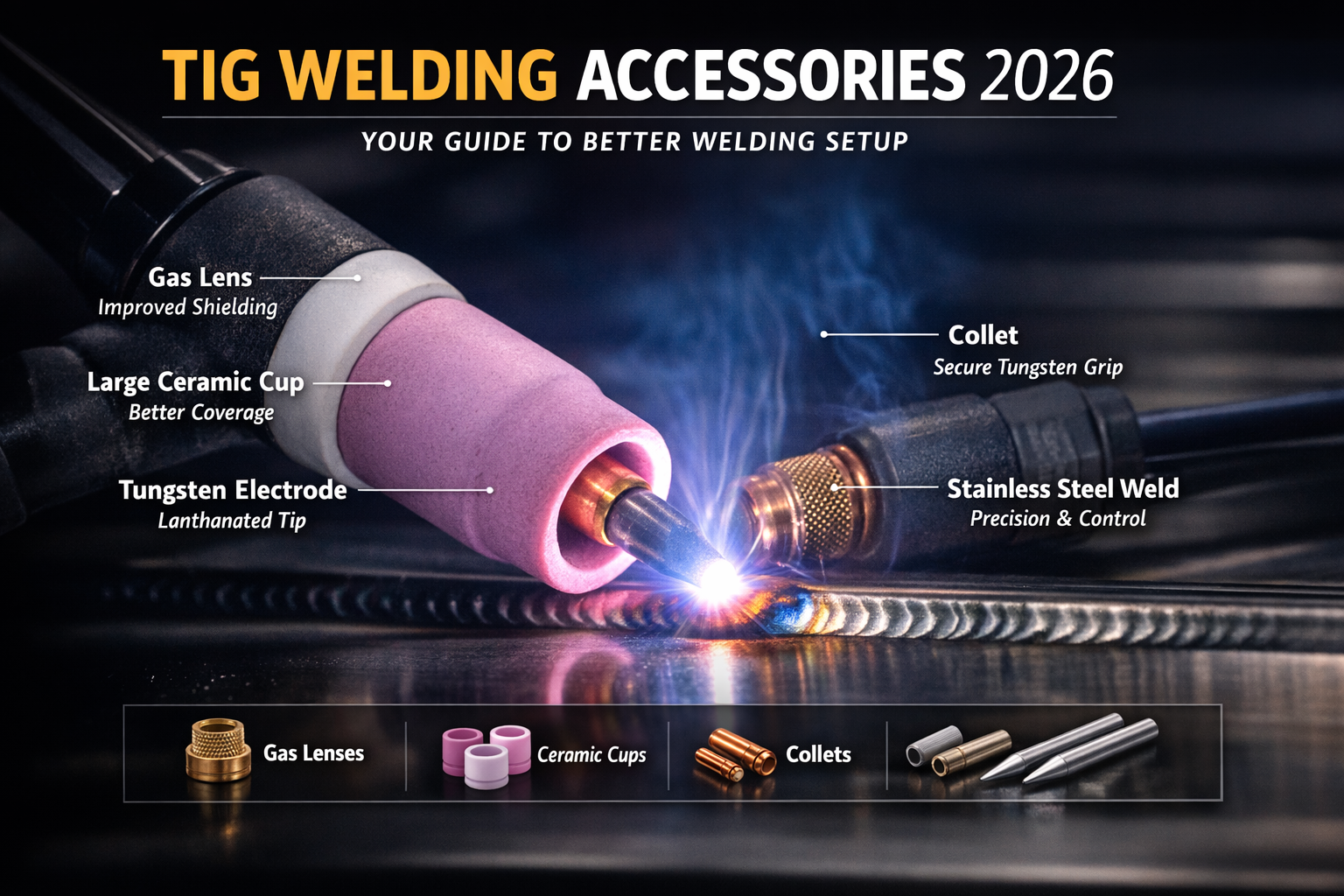
  • TIG Welding Accessories: Choosing the Right Setup for 2026

    TIG Welding Accessories: Choosing the Right Setup for 2026

    Selecting TIG welding accessories can make or break your results. The right setup improves arc stability, shielding coverage, and long-term torch reliabilityโ€”while the wrong parts waste time and money.

    Key Takeaways

    • Match collet, cup, and tungsten size to your torch series
    • Gas lens kits improve shielding and weld quality for most jobs
    • Verify compatibility for 17/18/26 vs. 9/20 series torches
    • Tungsten type and prep matter for steel, stainless, and aluminum
    • Accessory kits offer valueโ€”but confirm genuine components

    Performance & Use

    TIG welding demands tight arc control and consistent shielding gas coverage. Accessories such as gas lens kits and high-quality alumina cups help maintain a stable arc and reduce atmospheric contamination.

    Gas lenses straighten gas flow and allow greater tungsten stick-out without losing coverage. This is especially useful for stainless steel and critical welds where porosity is unacceptable.

    For aluminum, larger cups are common to improve shielding. Pure tungsten was historically used on AC aluminum, but many welders now use 2% lanthanated or other modern blends depending on machine settings. Always verify manufacturer recommendations for your specific power source.


    Durability & Build

    Accessory quality varies significantly. Genuine parts from manufacturers such as CK Worldwide and Weldcraft generally provide better fit and longer service life than low-cost generics.

    Inspect:

    • Cups for cracks or uneven glazing
    • Collets for proper tungsten grip
    • Threads for clean engagement

    Avoid mixing brands unless compatibility is confirmed. Poor fit leads to gas leaks and unstable arcs.


    Power / Specs

    AccessoryTypical RangeNotes
    Collet Size1/16″โ€“1/8″Must match tungsten diameter
    Cup Size#4โ€“#8 (standard), #12+ (large gas lens)Process dependent
    Gas LensStandard or LargeImproves shielding coverage
    Tungsten Type2% Thoriated, 2% Lanthanated, PureMatch material & polarity
    Torch Series17/18/26, 9/20Not interchangeable

    Unknown (Verify):

    • Exact kit contents
    • Part numbers
    • Included accessories
    • Country of origin
    • Warranty details

    Who Itโ€™s For

    Best for welders upgrading from a basic TIG setup, professionals seeking improved arc control, and anyone welding stainless or aluminum where shielding matters.

    Not necessary for shops running MIG or stick only.


    Quick FAQ

    Q: Can I use any collet with my torch?
    No. Torch series and tungsten size must match. 17/18/26 components do not fit 9/20 torches.

    Q: Do gas lens kits fit all torches?
    No. Confirm series and thread type before ordering.

    Q: What tungsten is recommended for stainless?
    2% lanthanated or 2% thoriated are common. Verify based on alloy and polarity.

    Q: Are generic kits reliable?
    Quality varies. Genuine parts are preferred for consistent fit and safety.

    Q: Does cup size affect weld quality?
    Yes. Larger cups improve shielding but require increased gas flow.

    Q: How do I confirm compatibility?
    Reference your torch manual or supplier documentation before purchase.


    Safety Notes

    • Wear ANSI Z87.1 safety glasses when grinding tungsten
    • Use a dedicated tungsten grinding wheel to prevent contamination
    • Provide proper fume extraction when welding stainless
    • Turn off power before changing torch components


Read with Kindle Unlimited