Category: Carbon Arc Support

Carbon Arc Torches, consumables, parts breakdowns, and accessories

  • Carbon Arc Gouging Produces Ragged Groove

    Arc Air 94-433-193 Insulator Assembly for K2000/K3000 Carbon Arc Gouging Torch - Durable & Reliable
    “>Arc Air 94-433-193 Insulator Assembly for K2000/K3000 Carbon Arc Gouging Torch - Durable & Reliable

    When carbon arc gouging produces a ragged groove, the cut is usually being driven too hard, too fast, or with poor torch control. In carbon arc gouging, groove shape is controlled by electrode angle, travel speed, air flow, amperage, and torch condition. If one of these is off, the groove edge can tear instead of staying clean.

    Key Takeaways

    • Ragged grooves usually come from inconsistent angle, travel speed, or arc length.
    • Poor air flow can leave slag, carbon, and irregular groove edges.
    • Wrong amperage can make the arc unstable or overcut the sidewalls.
    • Worn torch parts can reduce control and make the groove rough.

    Troubleshooting Carbon Arc Gouging Ragged Groove

    1. Check torch angle

    Use a steady angle and keep it consistent through the cut. If the torch is rolled too far, the arc can wash one side of the groove and leave the other side ragged. If the angle changes during travel, groove width and depth will vary.

    Start with the torch positioned so the arc is directed into the work, not skimming across the surface. Small changes in angle can have a large effect on groove quality.

    2. Check travel speed

    Travel speed must match amperage and work thickness. If you move too fast, the arc does not remove material evenly and the groove becomes torn or narrow. If you move too slow, the gouge can widen excessively and the sidewalls can become rough.

    Make one pass and inspect the groove. If the groove is ragged and shallow, reduce travel speed slightly. If the groove is overly wide or undercut, increase speed and recheck arc control.

    3. Check air flow

    Carbon arc gouging depends on air pressure and air direction to remove molten metal and carbon. Low or uneven air flow can leave debris in the groove and create a rough surface. Excessive or poorly aimed air can disturb the arc and make the groove irregular.

    Verify that the air delivery is stable at the torch and that the nozzle path is clear. If the air stream is weak, pulsing, or misdirected, correct that before changing other settings.

    4. Check amperage

    Amperage that is too low can make the arc unstable and leave a ragged groove with incomplete removal. Amperage that is too high can force the arc to dig aggressively, overheat the edges, and create sidewall damage. Use the current range recommended for the electrode and torch setup. Unknown (Verify).

    If the groove shows heavy spatter-like debris, erratic bite, or excessive sidewall erosion, test a small adjustment to amperage and inspect the result.

    5. Inspect arc length and electrode condition

    Arc length should stay controlled. A long arc can spread heat and make the groove rough. A short, unstable arc can chatter and leave a broken edge. Keep the electrode in good condition and replace it if it is worn, uneven, or contaminated.

    6. Inspect torch parts

    Worn or damaged torch components can reduce control during gouging. Check the torch for loose connections, heat damage, carbon buildup, and worn insulation. If the torch body or insulating parts are degraded, the operator may struggle to hold a stable angle and consistent arc.

    Support Part to Inspect

    If the torch is a K2000 or K3000 setup, inspect the insulator assembly as part of the troubleshooting process. A damaged insulator can affect torch condition and handling during gouging.

    Arc Air 94-433-193 Insulator Assembly for K2000/K3000 Carbon Arc Gouging Torch

    Arc Air 94-433-193 Insulator Assembly for K2000/K3000 Carbon Arc Gouging Torch - Durable & Reliable

    Arc Air 94-433-193 Insulator Assembly for K2000/K3000 Carbon Arc Gouging Torch – Durable & Reliable

    Introducing the Arc Air 94-433-193 Insulator Assembly, a crucial component designed to enhance the performance of your K2000 and K3000 carbon arc gouging torches. This high-quality insulator assembly is essential for ensuring optimal functioning and reliability during your gouging tasks. The Arc Air insulator assembly is engineered to withstand the demanding conditions of arc gouging. It is crafted with durable ma…

    View at Arc Weld Store

    Use this part only if it matches your torch model. Compatibility beyond the stated K2000/K3000 reference is Unknown (Verify).

    Related Cause to Check

    Ragged grooves can also appear when carbon pockets remain in the cut. See: Why Carbon Arc Gouging Leaves Carbon Pockets in the Groove

    Safety Notes

    • Wear eye, face, hand, and body protection suitable for gouging operations.
    • Keep clear of hot metal, carbon debris, and ejecta from the groove.
    • Verify air and electrical connections before starting work.
    • Allow the torch and work area to cool before inspection or part replacement.
    • Follow site procedures for ventilation, fire watch, and energy isolation.

    FAQ

    Why is my carbon arc gouging groove ragged on one side?

    Common causes are torch angle drift, uneven travel speed, or air flow that is not centered on the arc. Check torch control first.

    Can low air pressure make the groove rough?

    Yes. Low or unstable air flow can leave molten metal and carbon in the groove, which makes the surface irregular.

    Does amperage affect groove quality?

    Yes. Too little current can make the arc unstable. Too much current can overcut the edges and roughen the groove.

    Should I replace torch parts if the groove stays ragged?

    If the torch shows wear, heat damage, looseness, or insulation issues, inspect and replace the damaged parts as needed. If the exact part match is uncertain, verify the torch model before ordering.

    Sources Checked

    Related Weld Support Guides

  • Why an Air Carbon Arc Gouging Torch Sputters Instead of Cutting Clean

    When an air carbon arc gouging torch sputters, spits molten metal back, or leaves a rough wash instead of a clean groove, the problem is usually not one single part. It is normally a mismatch between amperage, carbon size, compressed air volume, torch angle, electrode stickout, cable condition, or work connection. This guide focuses on heavy-duty gouging setups such as the Weldmark by ArcAir WMK400010 CSK4000 air carbon arc gouging torch and related 1000-amp manual gouging applications.

    For nearby PPE checks, see the existing WSP guide on auto-darkening welding helmet shade range and standards. If fumes or helmet clearance are part of the problem, also compare low-profile welding respirators that fit under a hood.

    Key Takeaways

    • Most sputtering comes from low air flow, low amperage for the carbon size, poor work connection, or an incorrect torch angle.
    • The CSK4000-style gouging setup is commonly listed as a heavy-duty torch with up to 1000-amp capacity, 80 psi compressed air, and about 28 cfm flow requirement.
    • Air carbon arc gouging creates heavy sparks, noise, fumes, and intense arc radiation, so helmet shade, hearing protection, gloves, leathers, ventilation, and fire watch matter.
    • Do not use oxygen in place of compressed air for air carbon arc gouging.
    • Always verify carbon electrode size, machine output, cable capacity, and torch condition before blaming the torch body.

    Problem / Context

    Air carbon arc gouging removes metal by melting the workpiece with an arc while compressed air blows the molten metal out of the groove. When the setup is correct, the groove sounds steady and the metal clears forward. When the setup is wrong, the operator may see sputtering, uneven carbon burn-off, wandering arc, violent blowback, undercut edges, shallow wash, or heavy slag left in the gouge.

    This failure can look like a bad torch, but many shops find the cause upstream: air compressor capacity, hose restrictions, undersized welding leads, weak ground clamp contact, wrong carbon diameter, or a welding power source that cannot hold the required amperage under gouging load.

    Root Causes

    1. Air pressure or air volume is too low

    Air carbon arc gouging needs enough compressed air to clear molten metal from the groove. A gauge near the compressor can be misleading if long hoses, small fittings, clogged filters, or quick-connect restrictions reduce flow at the torch. A CSK4000-style torch is commonly listed with an 80 psi pressure requirement and approximately 28 cfm air flow requirement. If the compressor cannot keep up, the arc may still melt the metal, but the air stream will not clear it cleanly.

    2. Carbon electrode size does not match available amperage

    A larger carbon requires more welding current. If the carbon is too large for the machine output, the gouge may chatter, sputter, or only wash the surface. If the carbon is too small for the current, it can overheat and burn back too quickly. Use the torch manufacturerโ€™s amperage range for the carbon diameter instead of guessing from MIG, stick, or plasma settings.

    3. Work clamp contact is weak

    Carbon arc gouging is demanding on the welding circuit. Paint, mill scale, rust, loose clamps, undersized leads, hot cable lugs, or poor terminal connections can create voltage drop. That voltage drop may show up as arc wander, intermittent cutting, excessive spatter, and inconsistent groove depth.

    4. Torch angle or air jet direction is wrong

    The air jet must push molten metal out of the groove, not back toward the operator or sideways across the plate. If the electrode is rotated incorrectly in the jaws, or the torch angle is too steep, the air stream can fight the puddle instead of clearing it. A shallow travel angle with the air directed behind the arc usually gives a smoother groove.

    5. Electrode stickout is excessive

    Too much carbon stickout can make the electrode unstable and increase heating at the torch head. Too little stickout can put the torch too close to heat and molten metal. Verify the recommended stickout in the torch manual and adjust as the carbon burns back.

    6. Torch head, jaws, cable, or air valve are worn

    Worn jaws may not grip the carbon evenly. A damaged cable hose assembly can create heat, air leaks, or poor current transfer. A sticky air valve can delay air flow and leave molten metal in the groove. Inspect the torch before replacing it, especially if the sputter appears only after the torch heats up.

    Solution

    • Verify compressed air at the torch, not only at the compressor. Check pressure under flow and confirm the compressor can support the required cfm.
    • Remove small quick-connect restrictions where possible. Use air hose and fittings sized for gouging flow.
    • Match the carbon electrode diameter to the welding machineโ€™s actual output and duty cycle.
    • Clean the work clamp location to bright metal and tighten all cable lugs.
    • Confirm polarity. Many manual air carbon arc gouging setups commonly use DCEP, but the torch and carbon manufacturer instructions should control.
    • Set the electrode in the jaws so the air jet points in the direction needed to clear molten metal from the groove.
    • Maintain a stable travel angle and steady travel speed. Do not force the carbon into the plate.
    • Stop if the torch handle, cable, or connections become abnormally hot. Heat can indicate overload, poor connection, or damaged components.

    If arc flash risk or lens selection is also part of the shop setup, compare WSPโ€™s welding safety glasses shade and ANSI Z87.1 guide. For TIG shops that also gouge repairs before rewelding, WSPโ€™s best welding helmet for TIG guide can help separate low-amp TIG lens needs from high-intensity gouging needs.

    Specs / Verification Notes

    ItemVerified / CheckpointNotes
    Product typeAir carbon arc gouging torchUsed for heavy metal removal, back-gouging, weld removal, and repair prep.
    ASINB07143B4VPVerified as Weldmark by ArcAir WMK400010 CSK4000 listing on Amazon regional results.
    Arc Weld Store listingVerifiedArc Weld Store lists Weldmark by ArcAir WMK400010 CSK4000 air carbon arc gouging torch.
    Maximum amperageUp to 1000 ampsVerify against the exact torch label, cable assembly, and power source rating before use.
    Air pressure80 psiCommon listing value for CSK4000-style setup. Verify at the torch under flow.
    Air flow28 cfmCommon listing value. Compressor and hose system must support flow continuously.
    Cable assembly length10 ft / 3 mShown in supplier listings for WMK400010 / CSK4000.
    Compatible carbon sizesUnknown (Verify)Use the exact torch manual and carbon manufacturer chart.
    Power source compatibilityUnknown (Verify)Confirm DC output, amperage range, duty cycle, and polarity requirements.

    Product Section

    The Weldmark by ArcAir WMK400010 CSK4000 is a heavy-duty air carbon arc gouging torch option for shops that already have the correct welding power source, compressed air capacity, leads, PPE, and fire-control setup. Verify the exact model, cable length, amperage rating, air requirement, and return policy before ordering.

    Arc Weld Store option: Weldmark By ArcAir WMK400010 - CSK4000 Air Carbon Arc Gouging Torch

    “>Weldmark by ArcAir WMK400010 CSK4000 Air Carbon Arc Gouging Torch

    Weldmark By ArcAir WMK400010 – CSK4000 Air Carbon Arc Gouging Torch
    • 10Ft. (3M) cable assembly
    • Up to 1000 Amps
    • Air Requirements: Pressure: 80 psi (5.6kg/cm2) and Flow Rate: 28cfm (792.4L/Min)
    • Applications: Heavy-Duty Fabrication / Maintenance / Railroad / Shipyard
    • Weldmark by ArcAir

    Last update on 2026-06-05 / Affiliate links / Images from Amazon Product Advertising API

    Comparison Table

    SymptomLikely CauseCheck FirstCorrective Action
    Molten metal does not clearLow air volumeFlow at torch under loadIncrease air supply capacity, remove restrictions, inspect hose and fittings.
    Carbon burns back too fastToo much current or wrong carbon sizeCarbon diameter and amperage chartReduce current or use the proper carbon size.
    Arc wandersPoor work connection or unstable stickoutClamp location, cable lugs, electrode gripClean ground area, tighten leads, reset electrode in jaws.
    Heavy blowbackWrong torch angle or air jet directionElectrode orientation and air jet pathReposition carbon and travel angle so air clears forward.
    Torch gets hotOverload, loose connection, or damaged cableCable assembly, duty cycle, jaw conditionStop use, inspect components, verify machine rating.

    Related Failure Paths

    • Excessive fumes during gouging: usually tied to coating removal, base metal contamination, ventilation limits, or confined-space controls.
    • Arc flash exposure: commonly tied to wrong shade selection, helmet failure, observers without protection, or grinding mode left active on auto-darkening helmets.
    • Hearing exposure: air carbon arc gouging is loud enough that hearing protection should be part of the setup.
    • Fire risk: gouging throws molten metal farther than many welding operations, so sparks can travel behind fixtures, under benches, and into cable piles.

    For helmet-related failures, the WSP post on welding helmets with grind mode is a useful reminder because grind mode discipline matters any time a hood moves between prep work and arc work.

    Safety Notes

    • Use welding helmet filter protection suitable for arc gouging intensity. OSHA eye protection tables list carbon arc welding at shade 14.
    • Wear safety glasses with side shields under the hood when required by shop policy or impact hazard.
    • Use hearing protection. Air carbon arc gouging creates high noise exposure.
    • Use ventilation or respiratory protection appropriate for the material, coating, and workspace. Air carbon arc gouging can produce heavy fumes.
    • Remove combustibles from the spark path and assign fire watch when needed.
    • Never substitute oxygen for compressed air in an air carbon arc gouging setup.
    • Do not service torch, cable, or power connections while energized.

    FAQ

    Why does my gouging torch sputter even though the arc starts?

    The arc can start even when the air stream is too weak to clear molten metal. Check air flow at the torch under load, not just static pressure at the compressor.

    Can a small shop compressor run a CSK4000-style gouging torch?

    Only if it can supply the required pressure and cfm continuously. Supplier listings commonly show 80 psi and 28 cfm for this class of torch, which is beyond many small portable compressors.

    Is sputtering caused by bad carbon rods?

    Sometimes, but carbon size, amperage, air volume, and work connection should be checked first. Damaged, damp, mismatched, or poor-quality carbons can contribute, but they are not the only cause.

    What polarity should air carbon arc gouging use?

    Many manual gouging instructions show DCEP for common setups, but the exact torch, carbon, and power source instructions should be verified before operation.

    What PPE is most often missed during gouging?

    Hearing protection, side-shield eye protection under the hood, respiratory controls, and full flame-resistant coverage are often missed. Gouging throws heavy sparks and produces significant fumes compared with many basic welding tasks.

    Next Step

    Before replacing the torch, test the system in order: compressed air at the torch, carbon size versus amperage, work clamp contact, cable heat, electrode orientation, and PPE readiness. If the CSK4000 is the correct class of torch for the job, confirm the exact WMK400010 listing through Arc Weld Store or the verified ASIN box above.

    Sources Checked

    • Arc Weld Store: Weldmark by ArcAir WMK400010 CSK4000 Air Carbon Arc Gouging Torch listing.
    • Amazon regional listing results for ASIN B07143B4VP.
    • Victor / Arcair K3000 and K4000 manual gouging torch operating manual.
    • AWS air carbon arc gouging safety and technique guide.
    • OSHA 1910.133 eye and face protection standard.
    • OSHA eye protection against radiant energy during welding and cutting fact sheet.
    • AWS Z49.1 Safety in Welding, Cutting, and Allied Processes.
    • Existing WSP posts on welding helmets, welding safety glasses, respirators, and grind-mode helmet selection.
  • Why Carbon Arc Gouging Leaves Carbon Pockets in the Groove

    Carbon Arc Gouging Carbon Pockets Troubleshooting Infographic Infographic showing root causes, fixes, verification notes, and safety reminders for carbon pockets left after air carbon arc gouging. Carbon Pockets After Gouging? Air Carbon Arc Troubleshooting Checklist Fix black residue, rough grooves, and embedded carbon before welding Do not weld over carbon residue. Grind, brush, or re-gouge until clean base metal is exposed. Common Root Causes 1 Weak air blast Low pressure, poor flow, leaks, or air aimed away from groove. 2 Wrong amperage Current does not match rod diameter or torch rating. 3 Bad torch angle Air stream must follow behind the arc and clear molten metal. 4 Too much stickout Long electrode extension can cause wandering and rough cuts. Fast Fix Sequence 1. Verify air under load Check pressure and flow while gouging, not only at static regulator pressure. 2. Match rod, polarity, and amperage Confirm electrode diameter, torch capacity, machine output, and DCEP/AC requirements. 3. Correct angle and travel speed Keep the air blast behind the arc and move steadily enough to clear the groove. Verify Before Welding Clean Groove No black pockets Correct Setup Rod, air, amps, polarity Full PPE Helmet, hearing, FR gear Weld Support Parts | Carbon Arc Support

    Carbon pockets after air carbon arc gouging usually point to a setup or technique problem, not a bad batch of rods. The most common causes are low air flow, wrong electrode angle, excessive stickout, amperage mismatch, or moving so fast that molten metal and carbon are not fully blown out of the groove. If the gouged area will be welded afterward, trapped carbon must be removed before repair welding.

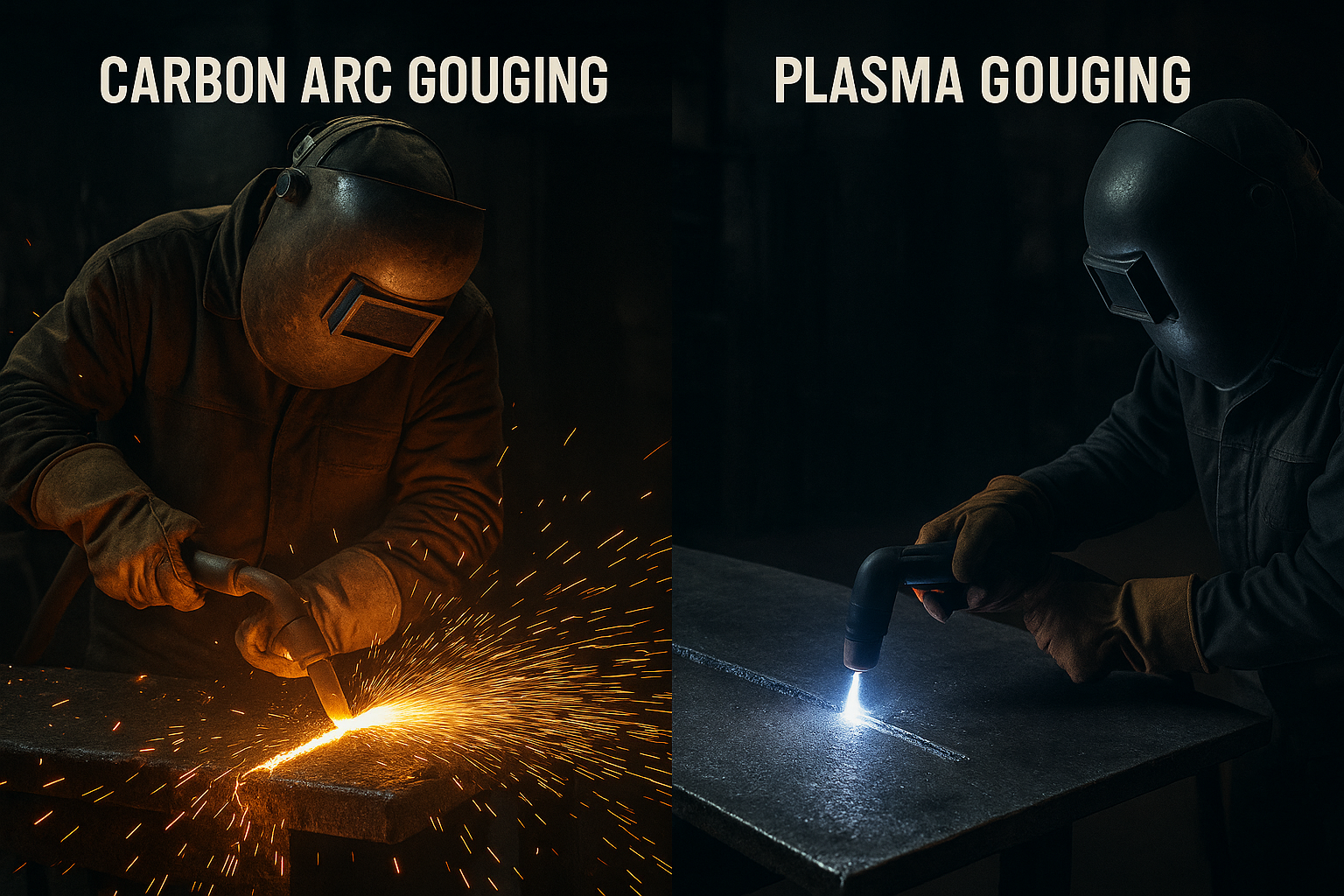
    This guide focuses on air carbon arc gouging carbon pockets, rough grooves, and black residue left in the cut. For a process comparison before changing equipment, see carbon arc gouging vs. Hypertherm plasma gouging.

    Key Takeaways

    • Carbon pockets are commonly caused by weak air blast, low amperage, incorrect rod angle, or excessive electrode extension.
    • Set air pressure and flow to the torch manufacturerโ€™s requirement before changing rods or power settings.
    • Most manual gouging setups use DCEP with copper-coated DC carbon electrodes, unless the electrode and machine documentation state otherwise.
    • Do not weld over black carbon residue. Grind, brush, or re-gouge until clean base metal is exposed.
    • Gouging produces high noise, sparks, molten metal, fumes, and UV radiation; PPE and ventilation are not optional.

    Problem: Black Carbon Left in the Gouge

    A clean air carbon arc gouge should leave a groove that can be inspected, ground, and prepared for repair welding. When the groove contains black streaks, embedded carbon, slag-like islands, or rough pockets, the air stream is not clearing the molten metal and carbon efficiently.

    The result is more grinding, more rework, and a higher chance of weld defects if the repair weld is made over contaminated metal. This is especially important on structural repair, hardfacing removal, cracked weld excavation, casting repair, and heavy equipment maintenance.

    Root Causes

    1. Air Pressure or Flow Is Too Low

    The carbon arc melts the metal, but compressed air removes it. If the air stream is weak, delayed, restricted, wet, or misdirected, molten metal can roll back into the groove and trap carbon. ESAB guidance commonly references about 80โ€“100 psi at the torch for effective air carbon arc gouging, while torch flow requirements vary by torch size and amperage rating.

    2. Electrode Stickout Is Too Long

    Too much carbon extending from the torch reduces control and can cause a wandering arc. ESAB guidance states that, under normal conditions, no more than about 7 inches of carbon should extend from the torch head. Aluminum applications may require less extension.

    3. Amperage Does Not Match Electrode Diameter

    If amperage is too low for the rod diameter, the arc may not produce enough melting force. If amperage is too high, the groove can become wide, violent, and hard to control. Always match electrode diameter to the power source, torch rating, and manufacturer current range.

    4. Torch Angle Is Wrong

    The air blast must stay behind the electrode tip and push molten metal out of the groove. If the torch is too steep, too flat, or pointed so the air stream does not follow the groove, the cut can become rough and contaminated.

    5. Travel Speed Is Too Fast or Too Slow

    Moving too fast can leave unremoved metal and carbon behind. Moving too slowly can overheat the groove, widen the cut, and create heavy cleanup. A steady travel speed with a consistent sound and chip flow is usually more reliable than forcing the rod through the work.

    Solution: Fix Carbon Pockets Step by Step

    1. Confirm the compressor can supply the torchโ€™s required pressure and flow under load, not just static pressure at the regulator.
    2. Inspect the air hose, fittings, torch valve, and cable assembly for restrictions, leaks, heat damage, or loose connections.
    3. Set the power source polarity and current range according to the electrode type and diameter.
    4. Use the correct carbon electrode diameter for the groove width and machine output.
    5. Keep the uncoated end of copper-coated electrodes toward the workpiece when specified by the electrode manufacturer.
    6. Reduce electrode stickout if the arc wanders or the groove becomes inconsistent.
    7. Hold the torch so the air blast follows behind the arc and clears molten metal from the groove.
    8. After gouging, grind or brush the groove until clean metal is visible before welding.

    For cleanup after gouging, a heavy wire cup brush can remove loose residue, but it should not replace grinding where embedded carbon or hardened surface contamination remains. See the Norton 53336 wire cup brush guide and the SALI 4-inch wire cup brush guide for surface prep context.

    Specs and Verification Notes

    ItemTypical GuidanceVerification Note
    ProcessAir carbon arc gougingVerify machine, torch, and electrode documentation
    PolarityDCEP for many DC copper-coated electrodesVerify electrode marking and manufacturer data
    Air pressureOften 80โ€“100 psi at the torchFlow requirement depends on torch size
    Air flowOften about 25โ€“33 cfm for many manual setupsVerify against torch model
    StickoutCommon guidance: no more than about 7 inches for normal conditionsAluminum may require shorter extension
    NoiseHigh-noise processHearing protection required

    Product Section

    For small gouging jobs where a 3/16-inch carbon is appropriate for the machine and torch, the Arcair 22033003 pointed copperclad DC gouging electrodes are a relevant consumable to verify against the setup. Confirm rod diameter, amperage range, torch capacity, and polarity before use.

    Last update on 2026-06-05 / Affiliate links / Images from Amazon Product Advertising API

    Comparison Table: Carbon Pocket Symptoms

    SymptomLikely CauseFirst Check
    Black streaks in grooveAir not clearing molten metalAir pressure, flow, and torch angle
    Rod burns unevenlyWrong current or poor contactAmperage range and torch jaws
    Groove is too wideToo much current or slow travelRod diameter and travel speed
    Groove is shallow and roughLow current or fast travelPower setting and arc length
    Heavy grinding requiredPoor technique or wrong process choiceConsider plasma gouging for cleaner control

    Related Failure Paths

    • Poor post-gouge weld quality caused by carbon contamination left in the repair groove.
    • Excessive grinding time from using carbon arc where plasma gouging would provide a cleaner groove.
    • Surface prep failure when wire brushing is used where grinding is required.
    • Poor arc stability from worn torch jaws, loose cable connections, or undersized power leads.

    If the issue is not just carbon residue but arc instability across the whole setup, review current path problems as well. A weak clamp, worn holder, or dirty work connection can create symptoms similar to an incorrect consumable setup.

    Safety Notes

    • Follow ANSI Z49.1 safety practices for welding and cutting operations.
    • Use OSHA-compliant ventilation and respiratory protection practices when fumes, dust, or confined space hazards are present.
    • Wear welding helmet protection, safety glasses, hearing protection, flame-resistant clothing, gloves, and appropriate footwear.
    • Protect nearby workers from sparks, molten metal, UV radiation, and high noise.
    • Do not gouge near flammables, uncleaned containers, or unknown coatings.
    • Verify the SDS and base metal/coating hazards before gouging galvanized, painted, plated, stainless, or alloy material.

    FAQ

    Can carbon pockets be welded over?

    No. Carbon residue should be removed before welding. Welding over contamination can contribute to cracking, porosity, lack of fusion, or poor repair quality.

    Does more air pressure always fix carbon pockets?

    No. The torch needs adequate pressure and flow, but angle, current, electrode size, and travel speed still matter. Too much turbulence or poor aim can still leave a rough groove.

    Should carbon arc gouging use AC or DC?

    Many common copper-coated gouging electrodes are DC electrodes and are commonly used on DCEP. AC electrodes and AC-capable setups exist, but the electrode and machine documentation must be verified.

    Why does the gouge look clean at first but fail inspection later?

    Loose slag and soot may hide embedded carbon or hard surface contamination. Grind and clean the groove before inspection and repair welding.

    Is plasma gouging better than carbon arc for avoiding carbon contamination?

    Plasma gouging can be cleaner and easier to control, but it has different equipment cost, consumable, and air-quality requirements. Carbon arc remains useful for heavy removal where adequate amperage and air are available.

    Next Step

    Before replacing the gouging torch or changing process, verify air pressure under load, torch flow rating, rod diameter, polarity, amperage range, and electrode stickout. If carbon pockets remain after setup correction, grind the groove clean and compare whether plasma gouging would reduce cleanup time for that job.

    Sources Checked

    • ESAB Arcair air carbon arc gouging guidance
    • AWS C5.3 recommended practices for air carbon arc gouging and cutting
    • Arcair air carbon arc gouging guide
    • Arcair manual gouging torch specifications
    • Amazon listing for Victor Arcair 22033003 gouging electrodes, ASIN B00V7UKT44
    • Weld Support Parts internal posts on carbon arc vs. plasma gouging and wire cup brush cleanup

  • Carbon Arc Gouging vs. Hypertherm Plasma Gouging: Whatโ€™s the Better Choice?

    Carbon Arc Gouging vs. Hypertherm Plasma Gouging: Whatโ€™s the Better Choice?

    Carbon arc gouging and plasma gouging both remove metal fastโ€”but they serve different jobs, budgets, and shop environments. This guide breaks down how each process works, when to use one over the other, and what to expect for performance, cost, and safety.


    Key Takeaways

    • Carbon arc gouging is cheaper to operate and works anywhere you have adequate air and amperage.
    • Plasma gouging (Hypertherm) delivers cleaner, more precise results with less post-grinding.
    • Plasma gouging has higher equipment cost but faster learning curve and less mess.
    • Carbon arc is loud, dirty, and requires high current; plasma is cleaner but more expensive to maintain.
    • For production shops and precision repair work, plasma wins. For heavy removal at lowest cost, carbon arc is still king.

    Where to Buy

    Arc Weld Store โ€“ Recommended:
    Carbon arc torches, gouging carbons, and air systems:
    https://www.arcweld.store/collections/esab-carbon-arc-slice-torch


    How Each Process Works

    Carbon Arc Gouging (CAC-A)

    Carbon arc gouging uses a graphite/carbon electrode to melt the base metal with high amperage while compressed air blows the molten metal away.

    Typical Specs (Manufacturer Ranges, AWS C5.3):

    • Current: 300โ€“1200 A depending on electrode size
    • Voltage: 35โ€“55 V
    • Air Pressure: ~80โ€“100 psi
    • Air Flow: ~20 cfm minimum
    • Electrode Types: DC+, copper-coated carbons
    • Noise: 110โ€“125 dB (hearing protection required)

    Strengths

    • Lowest equipment cost
    • Removes large volumes of metal quickly
    • Works indoors/outdoors, even in dirty field conditions
    • Repair shops & fab shops already wired for high amps

    Weak Points

    • Extremely loud
    • Heavy spatter and carbon dust
    • Large heat-affected zone
    • More grinding required after gouging

    Hypertherm Plasma Gouging

    Plasma gouging uses a constricted plasma arc to heat and remove metal with very controlled airflow. Hypertherm systems (Powermax series) are the industry standard.

    Typical Specs (Hypertherm Powermax):

    • Output: 45โ€“125 A depending on system
    • Gouge Depth: Light to medium removal
    • Air Pressure: ~90โ€“120 psi (per model spec sheet)
    • Duty Cycle: Model-dependent; most 60โ€“100% at rated output
    • Noise: Lower than carbon arc; still requires hearing protection

    Strengths

    • Very controlled and predictable gouge
    • Reduced post-grinding
    • Less carbon contamination
    • Quieter and cleaner than CAC-A
    • Works extremely well on stainless and aluminum

    Weak Points

    • Higher equipment cost
    • Consumables are more expensive
    • Not ideal for deep, aggressive removal
    • Requires dry, clean air supply

    Which One Should You Use?

    If you need maximum metal removal at lowest cost โ†’ Choose Carbon Arc Gouging

    Great for:

    • Heavy plate bevels
    • Removing welds on thick structural steel
    • Field repair
    • Shops already running 600โ€“1000 A power sources

    If you need cleaner, controlled gouges with minimal cleanup โ†’ Choose Hypertherm Plasma Gouging

    Great for:

    • Stainless & aluminum work
    • Pressure vessel repairs
    • Precision removal (cracks, isolated welds)
    • Indoor fabrication environments
    • Operators needing fast training curve

    Comparison Table

    Model/ProcessKey SpecsBest For
    CAC-A Carbon Arc Torch (Generic Industrial)300โ€“1200 A, 80โ€“100 psiHeavy gouging, lowest cost
    Hypertherm Powermax 65/85 Gouging65โ€“85 A plasma gouging, precise removalClean, controlled gouging

    Practical Considerations & Setup

    Air System Requirements

    Both processes require dry, steady airflow. Plasma is more sensitiveโ€”wet air destroys consumables.

    • Install a dryer or desiccant if plasma gouging.
    • Carbon arc tolerates โ€œshop airโ€ but still benefits from dryness.

    Power Requirements

    • Carbon arc requires sizable 3-phase machines or engine drives.
    • Plasma gouging can run on standard Hypertherm Powermax units (45โ€“125 A).

    Skill Level

    • Carbon arc demands better hand control to avoid digging.
    • Plasma gouging is easier to learn; the arc is more stable and directional.

    Safety Notes

    • Use ANSI Z87.1-rated eye protection (shade per AWS F2.2 recommendationsโ€”typically shade 10โ€“12 for CAC-A, 8โ€“10 for plasma).
    • Wear full PPE, flame-resistant clothing, and hearing protection (both processes exceed 100 dB).
    • Ensure adequate ventilation; carbon arc creates carbon dust and fumes.
    • Follow manufacturer guidelines for electrode size, air pressure, and duty cycle (Hypertherm, AWS C5.3 for CAC-A).

    FAQ

    Is plasma gouging as fast as carbon arc gouging?
    No. Plasma is cleaner and more controlled, but CAC-A removes metal significantly faster.

    Is carbon arc gouging bad for stainless?
    It can leave carbon contamination. Plasma is preferred for stainless/aluminum.

    Can you gouge outdoors with plasma?
    Yes, but wind can disrupt arc stability more than CAC-A.

    Does Hypertherm sell dedicated gouging consumables?
    Yesโ€”consult the Hypertherm Powermax series gouging nozzle and shield charts.


    Sources Checked

    • Hypertherm Powermax 45/65/85/105 Spec Sheets
    • AWS C5.3: Recommended Practices for Air Carbon Arc Cutting and Gouging
    • Manufacturer data for carbon electrodes and torches

    Where to Buy
    Arc Weld Store:

    https://www.arcweld.store/collections/esab-carbon-arc-slice-torch

  • Stream with Amazon Music