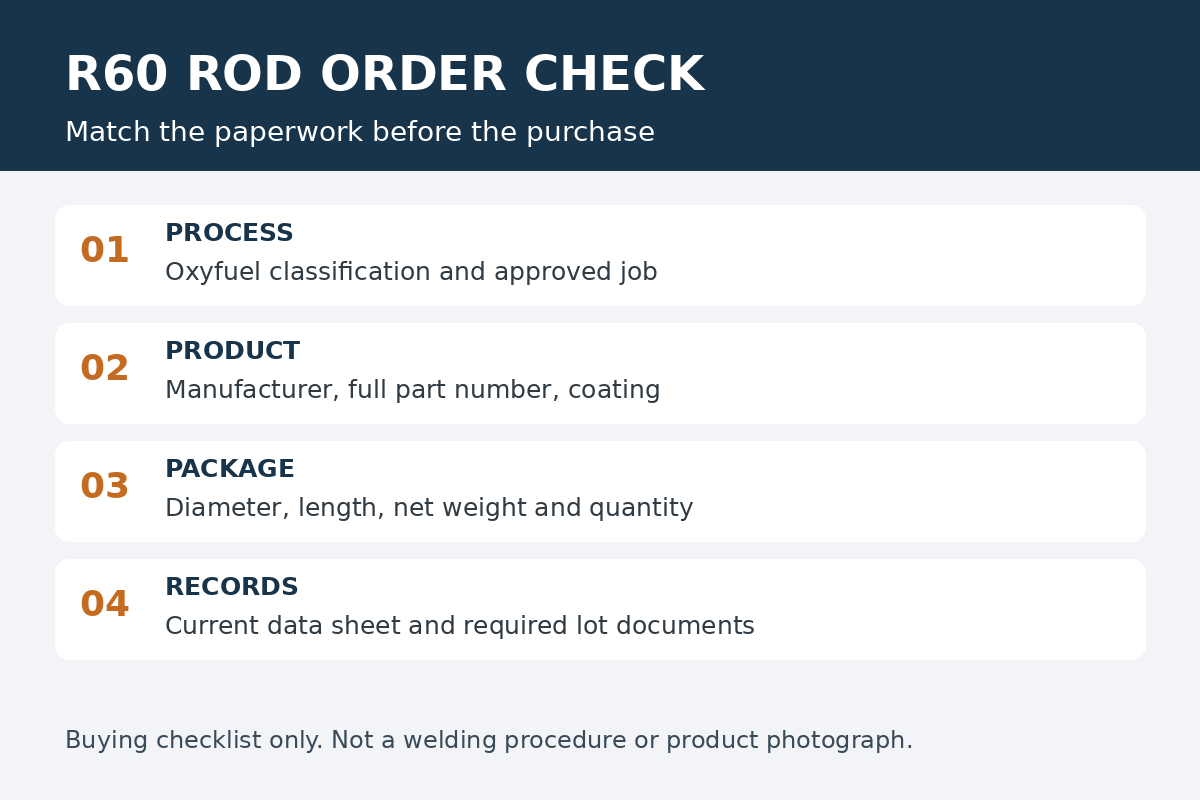
Before ordering R60 welding rod, confirm that the job calls for an oxyfuel gas-welding filler and that the exact product meets the procedure. Washington Alloy identifies its R60, also labelled RG60, as an AWS A5.2 mild-steel oxyfuel torch rod. A listing filed under “TIG rods,” a copper-colored surface or a familiar diameter does not settle the process or product selection.
The useful purchasing question is specific: which manufacturer, classification, coating, diameter, length and selling unit does the approved job require? This guide follows Washington Alloy’s original R60 sheet and the AWS specification description. It does not approve a substitution, supply torch settings or establish that an unidentified steel repair can be welded safely.
Start with the process written on the data sheet
Washington Alloy’s one-page R60 technical sheet is headed “Mild Steel Oxyfuel Torch Rod” and lists ANSI/AWS A5.2 R60 and ASME SFA 5.2 R60. The sheet is marked June 2017. That is useful identification evidence, but it is an older document, so obtain the current sheet and any required certification for the product being supplied.
The AWS A5.2/A5.2M:2025 public description covers carbon- and low-alloy-steel rods for oxyfuel gas welding. It says the specification includes classification requirements for weld-metal mechanical properties, rod chemistry, manufacture, sizes, lengths and packaging. The public abstract establishes the scope; it is not the full standard or a certificate for a particular lot.
Write the actual welding process on the purchase request. If the job calls for TIG/GTAW, do not approve R60 solely because a store placed it in a TIG category. Ask the responsible welding person to check the exact product documentation and procedure. Changing the process is a technical decision, not a search-filter choice.
R60 and RG60: reconcile the label, then identify the product
Washington Alloy uses both R60 and RG60 on its documentation and explains that AWS changed the class designation from “RG” to “R” in 1969. That makes RG60 a useful search term for this documented product. It does not make every listing containing those letters an exact match.
Keep the manufacturer name and full part number alongside the classification. A package photograph may show a family of rods rather than the offered diameter. A seller’s shortened title may omit a coating suffix or package weight. Resolve those details against the actual label, current manufacturer documentation and quotation before ordering.
For navigation, WSP’s R60 oxy-fuel reference page brings the classification and related brand paths together. Its marketplace searches are discovery links, not verified inventory or exact-product approvals. The Filler Metal Finder is also a starting point, not a substitute for the governing procedure.
Coating and package deserve their own order lines
The 2017 Washington Alloy sheet lists non-copper-coated R60 and describes selected copper-coated versions separately. It also refers to a one-pound mini-pack. Those distinctions matter when comparing quotations: the classification alone does not tell you which surface finish or selling unit will arrive.
The sheet lists several diameters, but a historical size list is not current stock confirmation. Do not copy an abbreviated part-number example into an order without supplier confirmation. Ask for the complete current manufacturer part number, diameter, rod length, coating and net weight. Confirm whether the quoted quantity means individual rods, tubes or another package.
- Classification: Record R60 and the applicable specification and edition required by the job.
- Exact product: Record manufacturer, complete part number and any coating suffix.
- Dimensions: Confirm diameter and cut length rather than estimating from a photograph.
- Selling unit: Specify package weight and how many packages are being ordered.
- Traceability: Ask for the lot identification and required certificate before accepting the shipment.
Keep R45 and R60 separate on the request
Washington Alloy publishes R45 and R60 as separate AWS A5.2 classifications. Its R45 page emphasizes ductility and machinability, while its R60 sheet describes low-carbon and low-alloy-steel applications. These descriptions help identify the intended product families. They do not authorize replacing one classification with the other on a specific job.
A higher number is not enough reason to change a purchase request. The base material, required properties, service conditions and any heat-treatment requirements still need to match the approved procedure. If the specified filler is unavailable, have the proposed alternative reviewed before accepting a supplier’s “equivalent” suggestion. Keep that decision attached to the order rather than relying on a verbal shorthand.
Use source discrepancies as a reason to verify
The manufacturer’s web page and older PDF do not present every technical entry consistently. This guide therefore does not reproduce chemistry values, strength guarantees or operating settings from the web table. Ask Washington Alloy for current applicable technical information when those details affect the job. A generic page heading should not override the product identity on an original technical sheet.
Likewise, a catalog’s mention of critical applications is not permission for a particular structural, pressure or safety-critical repair. The responsible welding authority must establish suitability, procedure requirements and inspection. Keep unknown base material or uncertain service conditions unresolved until that review is complete.
A usable request to send to the supplier
Ask the supplier to quote the exact approved R60 product with its complete part number, coating, diameter, length and net package weight, and to identify the current data sheet and available lot documents. State that substitutions require review. On receipt, compare the label and paperwork with that request before releasing the rods to the job.
That short check prevents an attractive price on the wrong unit from becoming the wrong material at the bench. It also leaves a record the next person can understand. For more stories about the habits behind shop work, explore Arc Life.
Sources reviewed November 10, 2026. Manufacturer application descriptions are attributed guidance; WSP lookup pages are navigation resources. No current seller stock, price, exact purchasable SKU or job-specific welding approval is claimed.
Leave a Reply