For an ER385 TIG-rod order, confirm three things before comparing packages: the exact base-metal and service requirement, the approved welding procedure, and the cut-length product being supplied. A listing that says “904L filler” is not enough to settle all three. The same manufacturer sheet can cover both spooled wire and straight rod, with different process tables.
Washington Alloy identifies its ER385 product under AWS A5.9 and ASME SFA 5.9. Its published sheet describes a high-alloy austenitic stainless filler for base metals of similar composition, including applications associated with 904L. That is a useful starting point for procurement, not permission to choose a filler for an unidentified vessel, chemical line or repair.
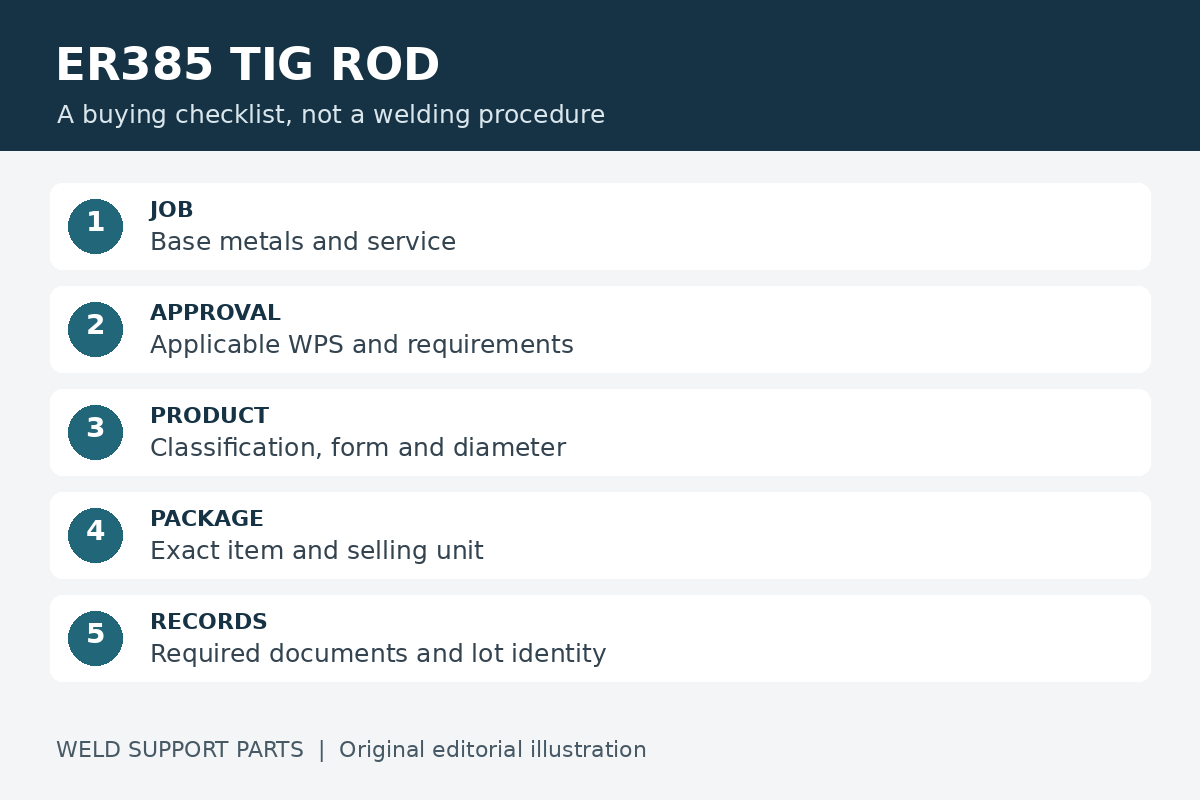
Start with the job record, not the rod color
The useful question is not whether ER385 is a “better” stainless filler. It is whether the specified product is appropriate for this joint and its service. Washington Alloy describes applications involving processing equipment, tanks, vessels and piping exposed to certain acids and chlorides. It also mentions particular dissimilar stainless combinations. Those descriptions do not establish that every concentration, temperature, joint or operating condition is covered.
Ask for the base-metal identification on both sides of the joint, the applicable drawing or repair instruction, and the current WPS when required. Keep any corrosion-service requirement with the order request rather than reducing the description to “stainless TIG rod.” If the material or service is unknown, the next step is technical review. Buying a more highly alloyed filler does not resolve missing identification.
The WSP ER385 TIG lookup page provides the AWS family and a route into supporting information. It expressly requires verification of the exact alloy and service conditions. Its brand-search paths are not verified SKU lists, and its Amazon fallback is currently held until the filler form, package and marketplace match can be reviewed. Do not read a search button or grade-page heading as purchasing approval.
Separate the classification from the supplied form
The manufacturer’s 904L (385) wire-and-rod sheet lists “TS 904L” for spools and “TT 904L” for cut lengths. Both appear on the same sheet. For a TIG job requiring straight rod, a quote for a spool is not an equivalent order merely because the classification matches.
The sheet lists several cut-length diameters, but it does not settle the complete current package for a particular supplier quote. Rod length, net package weight, package count, current catalog number and availability still need confirmation. Treat the listed sizes as documented catalog information, not a promise that every size is available today.
A clean request to a supplier identifies the manufacturer, ER385 classification, TIG/GTAW cut-length form, required diameter and rod length, requested net quantity, and documentation required by the job. Ask the supplier to return its exact part number and selling unit. Then compare that response with the request before ordering. “One package” is not a usable quantity until the package contents are known.
Read the process heading before using a data table
This particular sheet places GMAW and GTAW guidance on the same page. Its GMAW section is headed “Typical GMAW Welding Procedures” and includes gas-mixture information. The separate GTAW section identifies its own current/polarity and gas columns. A reader who copies a nearby gas recommendation without checking the heading can carry information from one process into another.
That distinction is especially important when a product landing page compresses a longer technical sheet into a short description. Use the original document to establish what a statement belongs to. This article does not turn either table into a welding procedure, supply settings for your equipment, or approve a gas substitution. The sheet itself says procedures can vary with position, base metal, filler metal, equipment and other changes.
The linked sheet bears a “2012 *DC*” marking. It remains linked from the manufacturer’s product page as checked on November 8, 2026, but that does not establish a newly revised procedure. Request current manufacturer guidance and the governing project documents when approving the purchase or work. Do not silently treat the website retrieval date as the technical document’s revision date.
Make the paperwork match the physical package
Washington Alloy’s ER385 product page offers a product sheet, certificate link and safety data sheet. A downloadable reference document is useful for review. It is not, by itself, proof that an incoming package has the required lot documentation or that the delivered material was accepted for your project.
Before placing the order, establish which documents the customer or quality system requires and ask the supplier whether they accompany the exact material. At receiving, compare the manufacturer identification, classification, diameter, form, quantity and lot markings against the purchase order and supplied documents. Keep unresolved discrepancies out of the job’s accepted filler supply until they are resolved through the responsible process.
A five-line ER385 buying check
- Job: exact base metals, service conditions and applicable drawing or repair requirements are identified.
- Authority: the WPS, customer specification and responsible technical review support the intended filler and process.
- Product: manufacturer, ER385 classification, cut-length form, diameter and rod length match the request.
- Package: exact supplier part number, selling unit, net quantity and current availability are confirmed.
- Records: required certificates, lot identification and receiving checks are agreed before purchase.
Use Find My Filler Metal to organize an initial classification lookup, or browse Alloy Support by process and alloy family. Both are navigation aids. Neither replaces the applicable code, manufacturer documentation or engineering approval.
The practical result is an order that can be checked without guessing. If the request still lacks a confirmed base metal, approved procedure, exact form or selling unit, hold that part of the decision and obtain the missing information. A clear classification is valuable, but it is only one line in a complete filler-metal order.
For more on the people and craft behind shop work, explore Arc Life.
Leave a Reply