Tag: welding processes

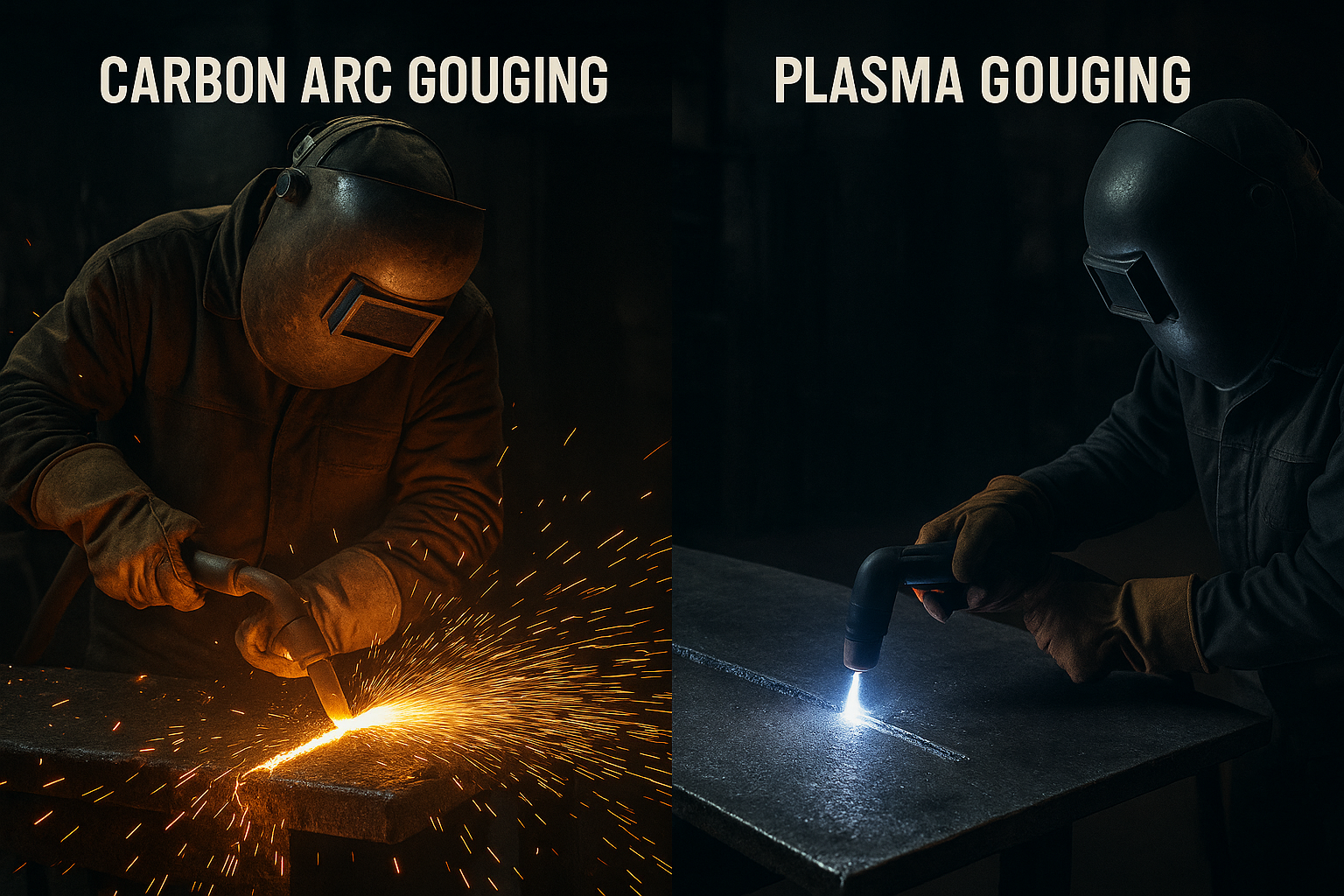
  • Carbon Arc Gouging vs. Hypertherm Plasma Gouging: What’s the Better Choice?

    Carbon Arc Gouging vs. Hypertherm Plasma Gouging: What’s the Better Choice?

    Carbon arc gouging and plasma gouging both remove metal fast—but they serve different jobs, budgets, and shop environments. This guide breaks down how each process works, when to use one over the other, and what to expect for performance, cost, and safety.


    Key Takeaways

    • Carbon arc gouging is cheaper to operate and works anywhere you have adequate air and amperage.
    • Plasma gouging (Hypertherm) delivers cleaner, more precise results with less post-grinding.
    • Plasma gouging has higher equipment cost but faster learning curve and less mess.
    • Carbon arc is loud, dirty, and requires high current; plasma is cleaner but more expensive to maintain.
    • For production shops and precision repair work, plasma wins. For heavy removal at lowest cost, carbon arc is still king.

    Where to Buy

    Arc Weld Store – Recommended:
    Carbon arc torches, gouging carbons, and air systems:
    https://www.arcweld.store/collections/esab-carbon-arc-slice-torch


    How Each Process Works

    Carbon Arc Gouging (CAC-A)

    Carbon arc gouging uses a graphite/carbon electrode to melt the base metal with high amperage while compressed air blows the molten metal away.

    Typical Specs (Manufacturer Ranges, AWS C5.3):

    • Current: 300–1200 A depending on electrode size
    • Voltage: 35–55 V
    • Air Pressure: ~80–100 psi
    • Air Flow: ~20 cfm minimum
    • Electrode Types: DC+, copper-coated carbons
    • Noise: 110–125 dB (hearing protection required)

    Strengths

    • Lowest equipment cost
    • Removes large volumes of metal quickly
    • Works indoors/outdoors, even in dirty field conditions
    • Repair shops & fab shops already wired for high amps

    Weak Points

    • Extremely loud
    • Heavy spatter and carbon dust
    • Large heat-affected zone
    • More grinding required after gouging

    Hypertherm Plasma Gouging

    Plasma gouging uses a constricted plasma arc to heat and remove metal with very controlled airflow. Hypertherm systems (Powermax series) are the industry standard.

    Typical Specs (Hypertherm Powermax):

    • Output: 45–125 A depending on system
    • Gouge Depth: Light to medium removal
    • Air Pressure: ~90–120 psi (per model spec sheet)
    • Duty Cycle: Model-dependent; most 60–100% at rated output
    • Noise: Lower than carbon arc; still requires hearing protection

    Strengths

    • Very controlled and predictable gouge
    • Reduced post-grinding
    • Less carbon contamination
    • Quieter and cleaner than CAC-A
    • Works extremely well on stainless and aluminum

    Weak Points

    • Higher equipment cost
    • Consumables are more expensive
    • Not ideal for deep, aggressive removal
    • Requires dry, clean air supply

    Which One Should You Use?

    If you need maximum metal removal at lowest cost → Choose Carbon Arc Gouging

    Great for:

    • Heavy plate bevels
    • Removing welds on thick structural steel
    • Field repair
    • Shops already running 600–1000 A power sources

    If you need cleaner, controlled gouges with minimal cleanup → Choose Hypertherm Plasma Gouging

    Great for:

    • Stainless & aluminum work
    • Pressure vessel repairs
    • Precision removal (cracks, isolated welds)
    • Indoor fabrication environments
    • Operators needing fast training curve

    Comparison Table

    Model/ProcessKey SpecsBest For
    CAC-A Carbon Arc Torch (Generic Industrial)300–1200 A, 80–100 psiHeavy gouging, lowest cost
    Hypertherm Powermax 65/85 Gouging65–85 A plasma gouging, precise removalClean, controlled gouging

    Practical Considerations & Setup

    Air System Requirements

    Both processes require dry, steady airflow. Plasma is more sensitive—wet air destroys consumables.

    • Install a dryer or desiccant if plasma gouging.
    • Carbon arc tolerates “shop air” but still benefits from dryness.

    Power Requirements

    • Carbon arc requires sizable 3-phase machines or engine drives.
    • Plasma gouging can run on standard Hypertherm Powermax units (45–125 A).

    Skill Level

    • Carbon arc demands better hand control to avoid digging.
    • Plasma gouging is easier to learn; the arc is more stable and directional.

    Safety Notes

    • Use ANSI Z87.1-rated eye protection (shade per AWS F2.2 recommendations—typically shade 10–12 for CAC-A, 8–10 for plasma).
    • Wear full PPE, flame-resistant clothing, and hearing protection (both processes exceed 100 dB).
    • Ensure adequate ventilation; carbon arc creates carbon dust and fumes.
    • Follow manufacturer guidelines for electrode size, air pressure, and duty cycle (Hypertherm, AWS C5.3 for CAC-A).

    FAQ

    Is plasma gouging as fast as carbon arc gouging?
    No. Plasma is cleaner and more controlled, but CAC-A removes metal significantly faster.

    Is carbon arc gouging bad for stainless?
    It can leave carbon contamination. Plasma is preferred for stainless/aluminum.

    Can you gouge outdoors with plasma?
    Yes, but wind can disrupt arc stability more than CAC-A.

    Does Hypertherm sell dedicated gouging consumables?
    Yes—consult the Hypertherm Powermax series gouging nozzle and shield charts.


    Sources Checked

    • Hypertherm Powermax 45/65/85/105 Spec Sheets
    • AWS C5.3: Recommended Practices for Air Carbon Arc Cutting and Gouging
    • Manufacturer data for carbon electrodes and torches

    Where to Buy
    Arc Weld Store:

    https://www.arcweld.store/collections/esab-carbon-arc-slice-torch
  • Welding Science: MIG vs TIG vs Stick Cost per Foot

    Welding Science: MIG vs TIG vs Stick Cost per Foot

    The Science of Welding: MIG, TIG, and Stick Compared – Plus the Real Cost Per Foot of Weld


    Introduction

    In the world of metal fabrication, welding is both art and a science. Understanding not just how to weld but why certain processes work better—and cost less—in specific scenarios is essential for:

    • Welders are optimizing efficiency in the booth.
    • Engineers and designers make process-specific decisions during material selection.
    • Fabrication buyers and project managers estimate costs accurately and competitively.

    From the molecular thermodynamics of arc formation to the economic reality of consumables, each welding process—MIG (GMAW), TIG (GTAW), and Stick (SMAW)—brings trade-offs that can dramatically affect weld quality and cost per foot.

    In this guide, we’ll break down:

    • The science behind MIG, TIG, and Stick welding.
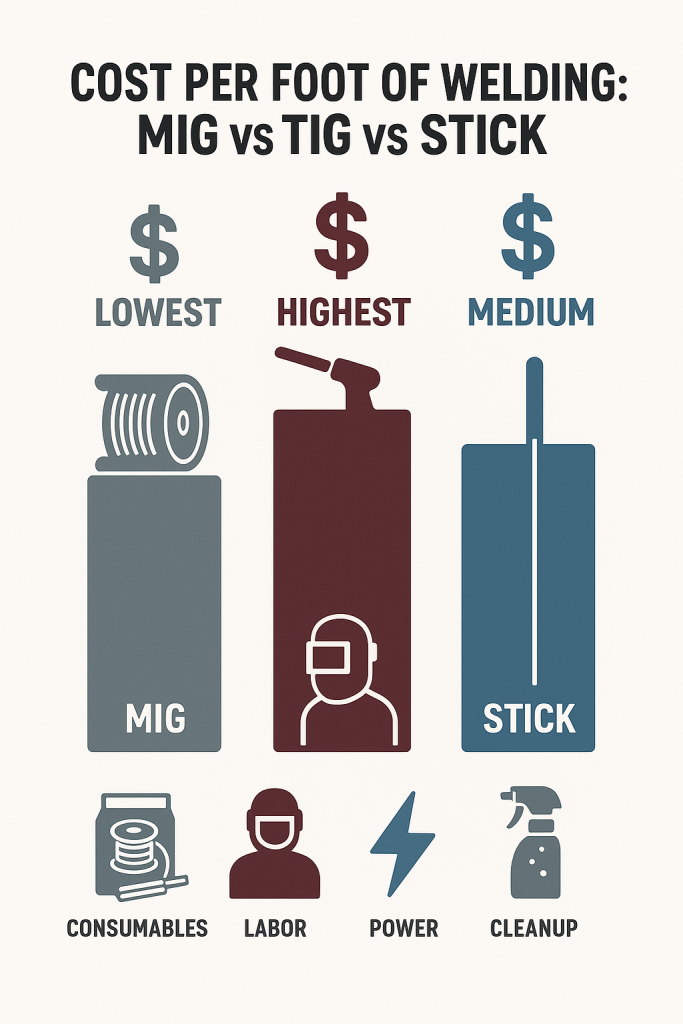
    • How variables like speed, consumable use, and labor affect cost per linear foot.
    • Real-world cost breakdowns and comparisons—to help you make informed decisions and reduce waste.

    The Science of Welding Processes


    🔌 MIG Welding (GMAW) – High Speed, Low Cost
    Science Behind the Process:

    • Arc Formation: A continuous solid wire is fed through a MIG gun, producing an electric arc between the wire and base metal.
    • Shielding Gas: Typically a mix of argon and CO₂ to protect the weld zone from atmospheric contamination.
    • Filler Metal Transfer: Spray or short-circuit transfer, depending on settings and thickness.

    Molecular Level Insight:

    • The arc melts both the electrode and base metal, fusing them at a localized point as electrons bombard the joint.
    • Shielding gas prevents oxygen and nitrogen from contaminating the weld pool, which is crucial for metallurgy.

    Strengths:

    • High deposition rate and travel speed.
    • Easy to learn and automate.
    • Ideal for production shops and thin to mid-thickness steel.

    Weaknesses:

    • Requires shielding gas, limiting portability.
    • Less suitable for windy outdoor environments or dirty/oxidized metal.

    TIG Welding (GTAW) – Precision and Cleanliness

    Science Behind the Process:

    • Non-Consumable Tungsten Electrode creates the arc without melting itself.
    • Filler rod is added manually (or autogenously).
    • Shielded with pure argon (and sometimes helium blends).

    Precision Metallurgy:

    • Arc is extremely focused—ideal for very thin materials and dissimilar metals.
    • Allows precise control of heat input, reducing heat-affected zones (HAZ) and distortion.

    Strengths:

    • Produces the highest quality and cleanest welds.
    • Ideal for aluminum, stainless steel, nickel alloys, and precision aerospace components.

    Weaknesses:

    • Slowest process—low deposition rate.
    • Skill-intensive; long arc-on time per weld.
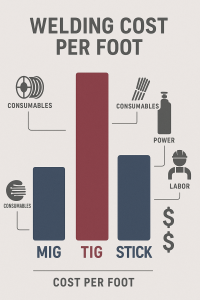
    • Highest cost per foot.

    Stick Welding (SMAW) – Versatility and Ruggedness

    Science Behind the Process:

    • Uses a flux-coated consumable electrode.
    • An arc is created between the electrode tip and the base metal.
    • Flux burns off to create shielding gas and leaves a protective slag layer.

    Molecular Dynamics:

    • Flux deoxidizes and scavenges impurities in the weld pool.
    • Slag forms a protective crust, improves cooling rates, and must be chipped away after the weld.

    Strengths:

    • Works in windy/outdoor settings without shielding gas.
    • Lower upfront equipment costs.
    • Suitable for structural steel, piping, and field repairs.

    Weaknesses:

    • Slower than MIG, more cleanup.
    • Stub loss and slag introduce waste.
    • Arc-on time is lower than GMAW.

    Welding Variables That Impact Cost

    To get to the real cost per foot, consider these key variables:

    Variable MIG (GMAW) TIG (GTAW) Stick (SMAW)
    Travel Speed Fast Slow Medium
    Deposition Rate High Low Medium
    Consumable Efficiency High (~90–95%) Moderate (~75%) Lower (~60% with stub loss)
    Power Usage Moderate High Moderate
    Labor Skill Level Moderate High Moderate
    Cleanup/Rework Minimal Minimal Significant (slag chipping)

    Cost Breakdown Per Foot of Weld

    Let’s compute the average cost per linear foot using common practices, consumables, and hourly wage estimates.

    📌 Assumptions:

    • Labor rate: $40/hour
    • Electricity: $0.12/kWh
    • Mild steel or stainless steel applications
    • Weld size: 1/4” fillet weld, 12” long

    🧮 MIG Welding Cost Example

    Consumable & Indirect Costs:

    Item Cost Estimate
    Wire (ER70S-6) $2.50/lb; ~0.035 lb/ft = $0.09
    Shielding gas $1.00/CFH; ~35 CFH ≈ $0.12/ft
    Power 4 kW/hr @ 12 in/min = ~0.067 kWh = $0.01
    Labor 12 in/min = 1 ft/min = $0.67/ft
    Total per Foot ⚙ $0.89/ft

    🧮 TIG Welding Cost Example

    Consumable & Indirect Costs:

    Item Cost Estimate
    Filler (ER308L rod) $12/lb; ~0.045 lb/ft = $0.54/ft
    Argon (pure) $1.10/CFH @ 20 CFH = $0.18/ft
    Power 5 kW/hr @ 6 in/min = ~0.167 kWh = $0.02
    Labor 6 in/min = 2 min/ft = **$1.34/
Watch with Prime Video