Tag: tungsten electrode

  • TIG Torch Slipping Tungsten? Your Collet Body Is Worn (Here’s the Fix)

    Intro

    You’re TIG welding and the tungsten keeps slipping out of the collet. You tighten the back cap, it holds for a few seconds, then slides again. The arc starts inconsistent, the puddle wanders, and your bead looks rough. The problem isn’t the tungstenโ€”it’s a worn collet body that can’t grip anymore.

    Key Takeaways

    • Tungsten slipping is almost always caused by a worn or damaged collet body, not the tungsten itself
    • A collet body wears from repeated insertion and removal of tungsten
    • Replacement collet bodies are cheap ($5โ€“$15) and take 30 seconds to swap
    • Gas coverage improves dramatically with a fresh collet body
    • Keep spares on hand for every torch size you use

    The Problem

    A worn collet body shows up as:

    • Tungsten slides out even when the back cap is tight
    • Inconsistent arc initiation
    • Poor gas coverage (visible oxidation on the weld)
    • Difficulty maintaining arc length
    • Collet body threads are stripped or loose

    The collet is a small tapered sleeve that grips the tungsten. Every time you insert or remove tungsten, the collet compresses and expands. Over hundreds of cycles, the taper wears out. The grip weakens. Eventually, no amount of back cap tightening will hold the tungsten in place.

    Why It Matters

    A slipping tungsten means an unstable arc. Your puddle control suffers. Weld quality drops. On precision work (aerospace, stainless, thin-wall), a wandering arc is a reject. On production runs, it’s rework and lost time. Plus, a loose tungsten can break mid-weld and contaminate your shielding gas.

    The Fix

    1. Disconnect the torch and let it cool. Safety first.
    1. Unscrew the back cap and remove the old collet body.
    1. Inspect the threads. If they’re stripped, you may need a new torch head (rare).
    1. Install the new collet body. Slide it in and hand-tighten the back cap.
    1. Insert tungsten and tighten firmly. The tungsten should not move when you pull on it.
    1. Test the arc. You should see immediate improvement in arc stability and gas coverage.

    Why This Product Solves It

    The TIG Gas Lens Collet Body #17, 18, 26 Torch 2PK (45V27-1/8″) is a direct replacement for standard TIG torches and includes a gas lens design that improves shielding gas flow. The tapered bore is precision-machined to grip tungsten consistently, and the gas lens allows larger tungsten stick-out for better visibility and control. Two-pack means you have a spare.

    Product Link:  Product not found.
    “>
    Product not found.
     

    What to Check Before You Buy

    • Torch series: This fits #17, #18, and #26 torches (most common sizes)
    • Tungsten size: This collet is sized for 1/8″ (3.2mm) tungsten
    • Gas lens compatibility: Confirm your torch head accepts a gas lens (most do)
    • Thread type: Standard collet body threads (verify if you have an older torch)

    Real-World Use

    A TIG fabricator working on stainless tubing noticed poor gas coverage and arc wander. Swapped the collet body. Tungsten stayed put, arc was stable, and the bead came out clean. One collet body lasted 18 months before needing replacement.

    Common Mistakes

    • Tightening the back cap excessively (damages the new collet body)
    • Using the wrong collet size for your tungsten diameter (loose fit)
    • Not replacing the collet body when it’s visibly worn (keeps struggling with slipping)
    • Forgetting to clean the collet body threads before installation (cross-threading)
    • Buying a single collet body instead of keeping spares (downtime when it fails)

    Safety Notes

    Always let the torch cool before handling. Collet bodies get hot during welding. Wear gloves when removing hot components. If tungsten slips during welding, stop immediatelyโ€”a loose electrode can break and contaminate your argon supply.

    Always follow the manufacturer’s instructions and your shop’s safety procedures. If you’re unsure about fitment or ratings, verify before you buy or install.

    Related Reading

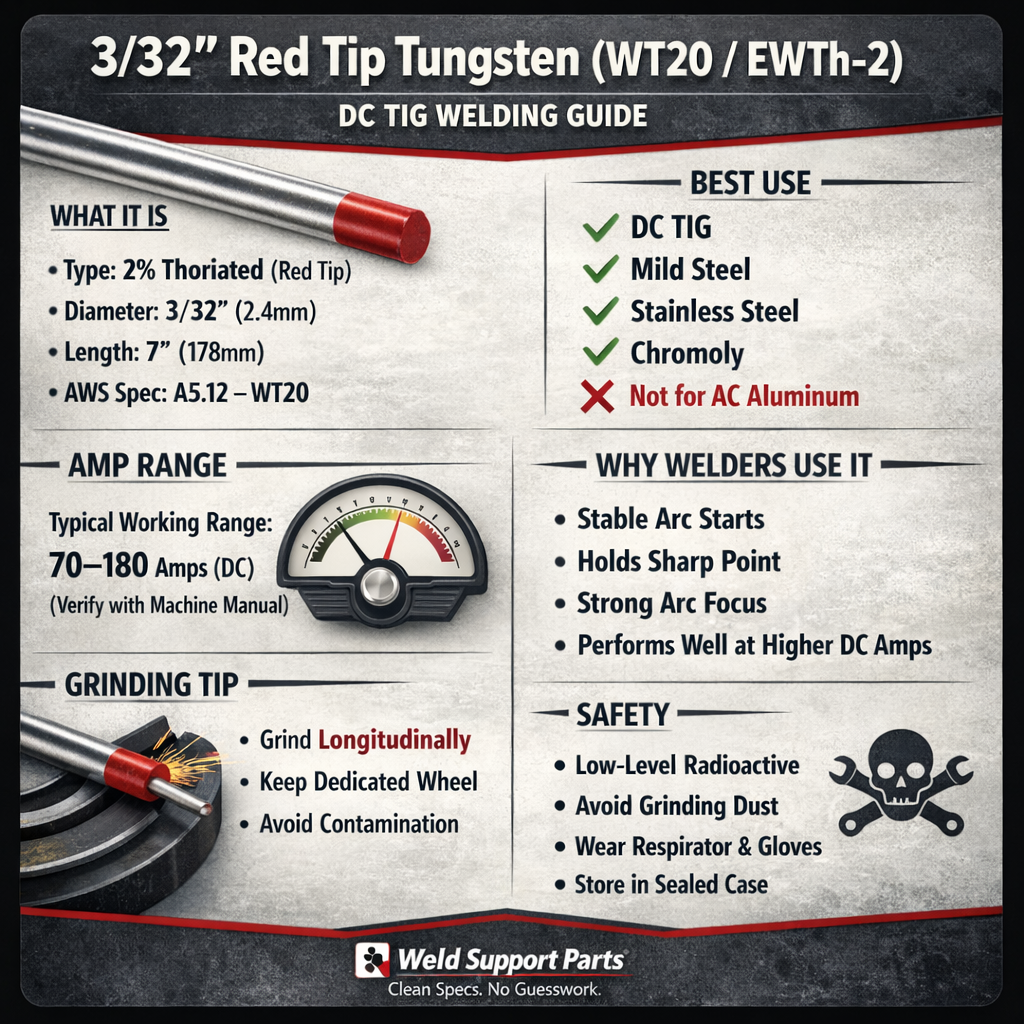
  • TIG Welding Tungsten Electrodes 3/32″ (WT20 Red Tip) โ€“ Specs, Safety & Buying Guide

    TIG Welding Tungsten Electrodes 3/32″ (WT20 Red Tip) โ€“ Specs, Safety & Buying Guide

    Selecting the correct tungsten electrode directly affects arc stability, weld appearance, and electrode life. 3/32″ 2% thoriated (WT20/EWTh-2) is a long-time standard for DC TIG welding on steel and stainless. Hereโ€™s what matters before you buy.


    Key Takeaways

    • 3/32″ (2.4mm) fits most 70โ€“180A DC TIG applications
    • Red tip (2% thoriated) offers stable arc starts and strong arc focus
    • Best for DC welding on steel and stainless
    • Not recommended for AC aluminum
    • Grind longitudinally to maintain arc control

    Where to Buy

    YESWELDER TIG Welding Tungsten Electrode Red Tip 3/32″ x 7″ (Red, WT20/EWTh-2) 10-pk
    • RED TIP: The red band tungsten electrode is a traditional outstanding welding electrode, whose arc is continuous, stable, without spreading and dispersing. As it is not easy to get a round top with thermostability, it performs well in a lifetime.
    • AWS CERTIFIED: AMERICAN Welding Society standard AWS A5.12M/A5.12:2009 conformance
    • UPGRADED PACKAGING: We’ve upgraded from a plastic case to a high-strength, sealed aluminum tube. This airtight design prevents electrode oxidation, ensuring stable arc performance and perfect welds. The innovative dual-open design offers easy access to all electrode lengths, while the rugged, compact build is drop-resistant and portableโ€”ready for your pocket, toolbox, or belt loop
    • PERFECT DESIGN: By checking the color of the outer packaging, you can quickly and easily distinguish the color and model of tungsten electrodes, saving your time and reducing the possibility of errors
    • SPECIFICATION: Diameter: 3/32″; Length: 7″; Quantity: 10pk

    Last update on 2026-04-03 / Affiliate links / Images from Amazon Product Advertising API

    Disclosure: As an Amazon Associate, Weld Support Parts earns from qualifying purchases.


    Why 3/32″ WT20 Is Popular

    Arc Stability

    Thoriated tungsten maintains a sharp point under DC current, producing a focused arc and clean starts.

    Amp Range

    Typical usable range: 70โ€“180A DC (verify with machine manual).
    Works well for:

    • Mild steel
    • Stainless steel
    • Chromoly
    • Field repair work

    Grind Matters

    Always grind lengthwise (not around the circumference).
    Use a dedicated tungsten grinder or clean wheel to prevent contamination.


    Specs

    SpecValue
    Diameter3/32″ (2.4mm)
    Length7″ (178mm)
    ClassificationWT20 / EWTh-2
    Composition2% Thoriated
    ProcessDC TIG
    AC AluminumNot recommended

    Who Should Use This

    Best for:

    • DC TIG welders running steel or stainless
    • Shop and field repair
    • Welding instructors

    Skip if:

    • You weld mostly aluminum (use lanthanated or pure)
    • You prefer non-radioactive options (choose ceriated or lanthanated)

    Safety

    • Thoriated tungsten contains low-level radioactive material
    • Avoid inhaling grinding dust
    • Wear respirator and gloves when sharpening
    • Follow AWS A5.12 classification guidance

    FAQ

    Can I use red tip tungsten on aluminum?
    No. Itโ€™s designed for DC welding.

    Is thoriated tungsten radioactive?
    Yes, at low levels. Safe in use but avoid dust inhalation.

    Whatโ€™s the advantage over ceriated?
    Better performance at higher DC amperage.

    How often should I regrind?
    When arc stability decreases or contamination occurs.


  • Read with Kindle Unlimited