Tag: MIG welding

  • Strong Hand Tools MET11 Mini MagTab Review (2025)

    Strong Hand Tools MET11 Mini MagTab Review (2025)

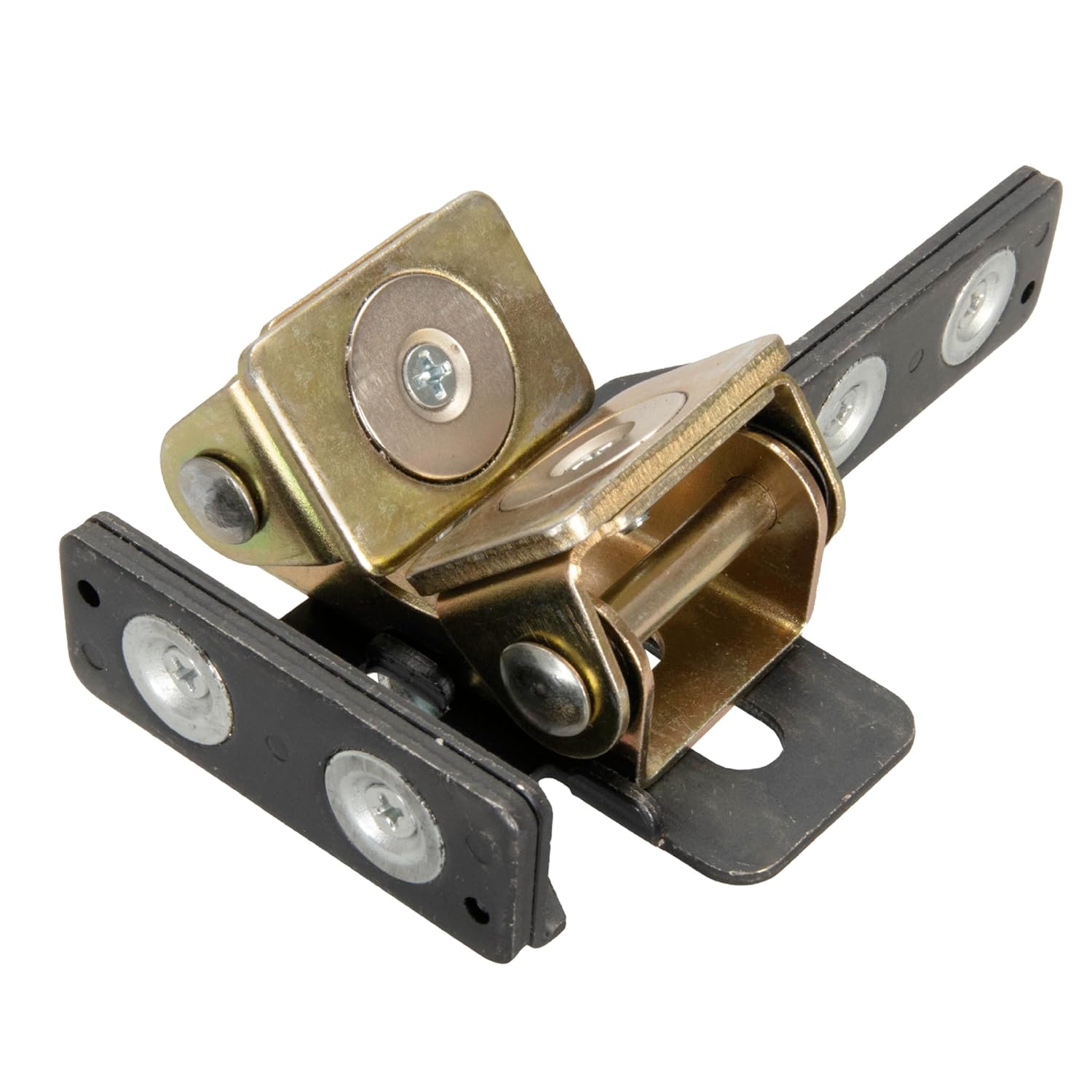
    The Strong Hand Tools MET11 Mini MagTab is one of those small, under-$20 fixtures that ends up earning a permanent place on the bench. It’s a compact magnetic clamp designed for holding tabs, flat bar, flanges, and small brackets square during tack welding. For layout, light fab, and repeated parts alignment, the Mini MagTab solves a real problem: securing small pieces accurately without bulky clamps.


    Key Takeaways

    • Holds small brackets, tabs, and flat bar square during fit-up.
    • Compact design fits places larger magnets can’t.
    • Adjustable V-shaped face for tubing and irregular parts.
    • Replaceable pads extend service life.
    • Ideal for TIG and MIG layout work where speed and accuracy matter.

    What the Mini MagTab Solves

    Regular welding magnets struggle with:

    • Small parts
    • Tight spaces
    • Consistent 90° alignment
    • Thin materials that shift under clamp pressure

    The MET11 addresses these issues by combining a precision 90° face, a pivoting V-block, and a low-profile body that doesn’t fight you during tack welding. It’s built for repetitive work and small-part fabrication — handrails, brackets, gussets, race-car tabs, control-arm brackets, or anything where placement accuracy matters.


    Features & Build

    Body: Steel housing with replaceable pads
    Magnet Type: Permanent magnet
    Faces: 90° fixed face + adjustable V-face
    Adjustment: Slotted hardware for micro-alignment
    Applications: Brackets, tabs, 1/2″–1-1/2″ tube, flat bar, sheet fab
    Heat Considerations: As with all magnetic fixtures, avoid excessive heat exposure; remove before completing full welds.


    Performance in the Shop

    The MET11 shines when:

    • Holding two small parts at 90°
    • Aligning tabs on round tube
    • Keeping parts from drifting while tacking
    • Doing repetitive work where speed matters

    The magnet strength is balanced — strong enough to hold parts reliably, but not so aggressive that it “snaps” pieces out of alignment.


    Best Use Cases

    • Tube-frame tabs
    • Brackets on square or round tube
    • Jigging small assemblies
    • Motorcycle fabrication
    • Sheet metal fit-ups
    • Fixture work on limited-space tables

    Where to Buy

    Strong Hand Tools, MagTab 2.0, Adjustable Magnetic Tab Holder, 6 x Replaceable Magnets, Knurled Knob, Slotted Bracket, Adjustable Magnetic V-Pad Base, Magnetic Tack Welding Tool, MET11
    • 6 replaceable magnets for 3x STRONGER magnetic holding force than the Standard MagTab
    • Magnetic pull force from 22 ~ 44 lb. (10 ~ 20 kg) based on flat surface with the two larger magnets
    • Knurled knob provides comfrotable and easy grip
    • Slot on hte bracket for workpiece alignment
    • Dim: 4.5″ x 2.6″ x 2″

    Last update on 2025-12-05 / Affiliate links / Images from Amazon Product Advertising API


    Comparison Table

    FeatureStrong Hand MET11 Mini MagTabStandard Magnet Square
    SizeCompact, fits small partsBulky for small fab
    AlignmentPrecise 90° + adjustable VFixed 90° only
    PadsReplaceableUsually not replaceable
    Tube SupportYes (V-block)Limited
    Best ForTabs, brackets, tube workGeneral layout

    Safety Notes

    • Keep magnets away from high heat; prolonged exposure can weaken magnetic force.
    • Do not rely on magnets for load-bearing support — use mechanical clamping when welding beyond tacking.
    • Maintain clean surfaces; metal dust reduces holding strength.
    • Always follow ANSI Z49.1 welding safety guidelines.

    FAQ

    Can the Mini MagTab hold heavy parts?
    It’s designed for small and medium-light parts. For thicker brackets, pair it with a mechanical clamp.

    Can it be used on stainless or aluminum?
    The magnet won’t stick directly to non-ferrous metals, but it can support steel fixtures that hold stainless/aluminum parts in place.

    Does the heat from TIG arcs damage it?
    Prolonged heat will weaken any magnet. Remove the MagTab after tack welding.

    Are the pads useful long term?
    Yes — the replaceable pads extend life and keep the faces accurate.


    Sources Checked

    • Strong Hand Tools product materials
    • Manufacturer datasheets

  • ArcOne Vision X81VX Welding Helmet Review (2025): Premium Clarity for Pros

    ArcOne Vision X81VX Welding Helmet Review (2025): Premium Clarity for Pros

    Intro
    The ArcOne Vision X81VX is a professional-grade auto-darkening welding helmet designed for fabricators who spend long hours under the hood. It delivers wide viewing, fast switching, and rugged comfort that meets ANSI Z87.1 and CSA Z94.3 safety standards. Here’s how it stacks up for industrial and pipe work.


    Key Takeaways

    • Large View: 3.85 × 2.44 in (98 × 62 mm) viewing area for precise weld puddle control.
    • 4 Arc Sensors: Reliable switching < 1/25,000 s for SMAW, GTAW, GMAW, and Plasma.
    • Variable Shade: DIN 9 – 13 with grind mode and sensitivity/delay adjustments.
    • Comfort Fit: Balanced shell design and adjustable headgear reduce neck fatigue.
    • Durability: Meets ANSI Z87.1 + CSA Z94.3; ideal for shop and field environments.

    Performance and Build

    ArcOne engineered the X81VX for welders who need both optical clarity and long-term comfort. The XTREME series uses a lightweight polycarbonate shell that resists spatter and impact while keeping total weight manageable for multi-hour jobs. With true color filters and a fast reaction speed, arc starts and transitions are crisp, reducing eye strain throughout a shift.


    Applications

    • Structural steel and pipe fabrication
    • TIG and MIG precision work
    • Industrial maintenance and repair
    • Long-duration shop projects requiring wide view and comfort

    Comparison Table

    ModelKey SpecsBest ForArcWeld StoreAmazon
    ArcOne Vision X81VX (Black XTREME)3.85 × 2.44 in view • Shade 9–13 • 4 Sensors • ANSI Z87.1 • True ColorPro-level MIG/TIG and pipe welding where clarity and comfort matter ArcOne Vision X81VX Black XTREME Auto Darkening Welding Helmet X81VX-1500 “>View at Arc Weld StoreAmazon Listing (disclosure) if out of stock

    Safety Notes

    Always verify that auto-darkening helmets meet ANSI Z87.1 and CSA Z94.3 for eye and face protection. Inspect lenses and batteries regularly, and store the helmet in a cool, dry place to protect sensors and optics. Replace lens covers as needed to maintain clarity.


    FAQ

    Q: Can the X81VX be used for low-amp TIG work?
    A: Yes. Its sensitivity control detects arcs as low as 5 amps, suitable for GTAW applications.

    Q: Does it support grind mode?
    A: Yes. Switch to grind mode for surface prep without filter darkening.

    Q: What is the power source?
    A: Solar assisted with replaceable lithium batteries.

    Q: Is the helmet compatible with cheater lenses?
    A: Yes – standard clip-in magnifiers fit inside the frame.


    Where to Buy

    ArcOne Vision X81VX Black XTREME Auto Darkening Welding Helmet X81VX-1500

    “>
    ArcOne Vision X81VX Black XTREME Auto Darkening Welding Helmet X81VX-1500

    ArcOne Vision X81VX Black XTREME Auto Darkening Welding Helmet X81VX-1500

    $327.82

    Sold Out

    View Product

    (If out of stock, available:

    Last update on 2025-12-05 / Affiliate links / Images from Amazon Product Advertising API

    Disclosure: We may earn a small commission at no extra cost to you.)

  • Welding Science: MIG vs TIG vs Stick Cost per Foot

    Welding Science: MIG vs TIG vs Stick Cost per Foot

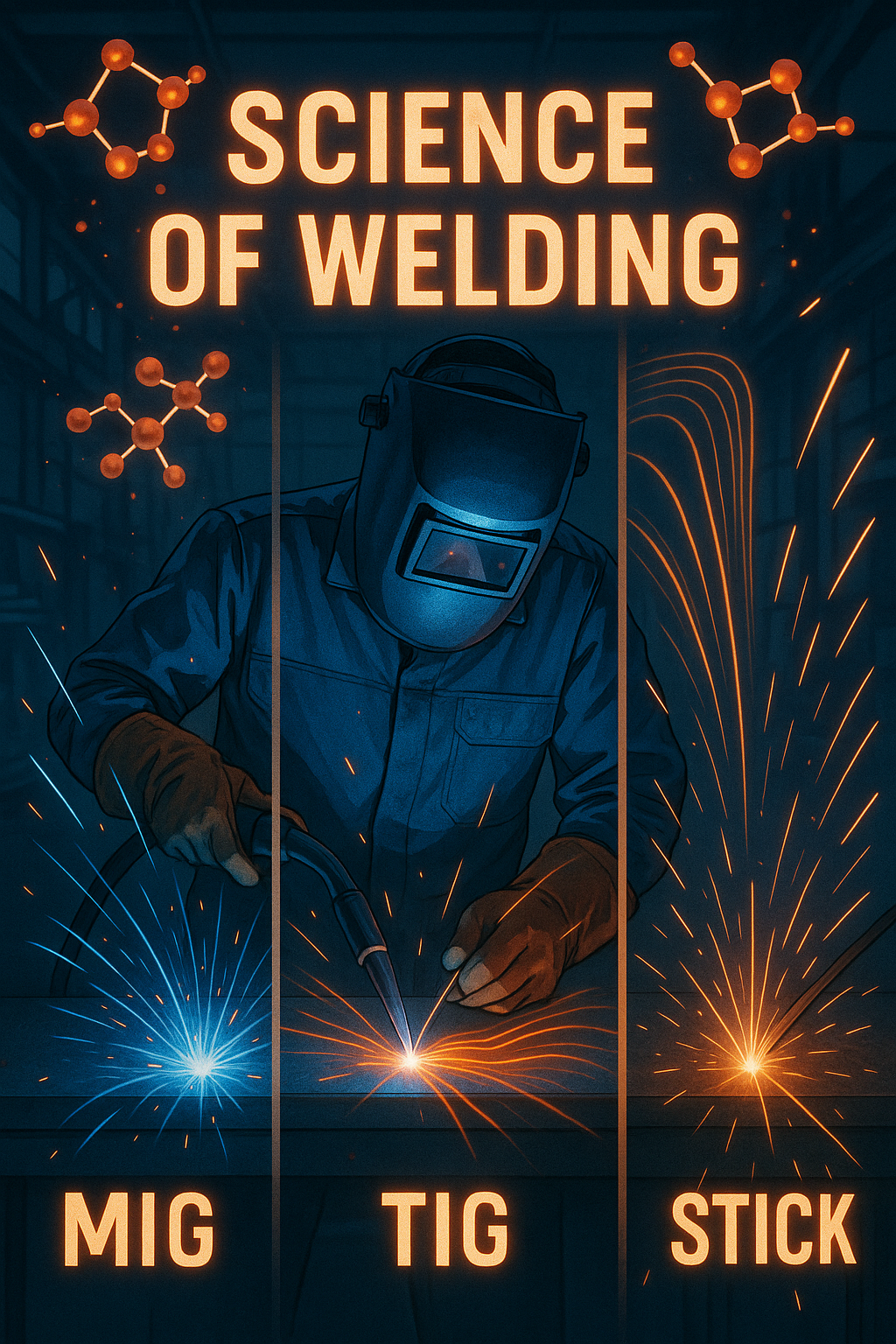
    The Science of Welding: MIG, TIG, and Stick Compared – Plus the Real Cost Per Foot of Weld


    Introduction

    In the world of metal fabrication, welding is both art and a science. Understanding not just how to weld but why certain processes work better—and cost less—in specific scenarios is essential for:

    • Welders are optimizing efficiency in the booth.
    • Engineers and designers make process-specific decisions during material selection.
    • Fabrication buyers and project managers estimate costs accurately and competitively.

    From the molecular thermodynamics of arc formation to the economic reality of consumables, each welding process—MIG (GMAW), TIG (GTAW), and Stick (SMAW)—brings trade-offs that can dramatically affect weld quality and cost per foot.

    In this guide, we’ll break down:

    • The science behind MIG, TIG, and Stick welding.
    • How variables like speed, consumable use, and labor affect cost per linear foot.
    • Real-world cost breakdowns and comparisons—to help you make informed decisions and reduce waste.

    The Science of Welding Processes


    🔌 MIG Welding (GMAW) – High Speed, Low Cost
    Science Behind the Process:

    • Arc Formation: A continuous solid wire is fed through a MIG gun, producing an electric arc between the wire and base metal.
    • Shielding Gas: Typically a mix of argon and CO₂ to protect the weld zone from atmospheric contamination.
    • Filler Metal Transfer: Spray or short-circuit transfer, depending on settings and thickness.

    Molecular Level Insight:

    • The arc melts both the electrode and base metal, fusing them at a localized point as electrons bombard the joint.
    • Shielding gas prevents oxygen and nitrogen from contaminating the weld pool, which is crucial for metallurgy.

    Strengths:

    • High deposition rate and travel speed.
    • Easy to learn and automate.
    • Ideal for production shops and thin to mid-thickness steel.

    Weaknesses:

    • Requires shielding gas, limiting portability.
    • Less suitable for windy outdoor environments or dirty/oxidized metal.

    TIG Welding (GTAW) – Precision and Cleanliness

    Science Behind the Process:

    • Non-Consumable Tungsten Electrode creates the arc without melting itself.
    • Filler rod is added manually (or autogenously).
    • Shielded with pure argon (and sometimes helium blends).

    Precision Metallurgy:

    • Arc is extremely focused—ideal for very thin materials and dissimilar metals.
    • Allows precise control of heat input, reducing heat-affected zones (HAZ) and distortion.

    Strengths:

    • Produces the highest quality and cleanest welds.
    • Ideal for aluminum, stainless steel, nickel alloys, and precision aerospace components.

    Weaknesses:

    • Slowest process—low deposition rate.
    • Skill-intensive; long arc-on time per weld.
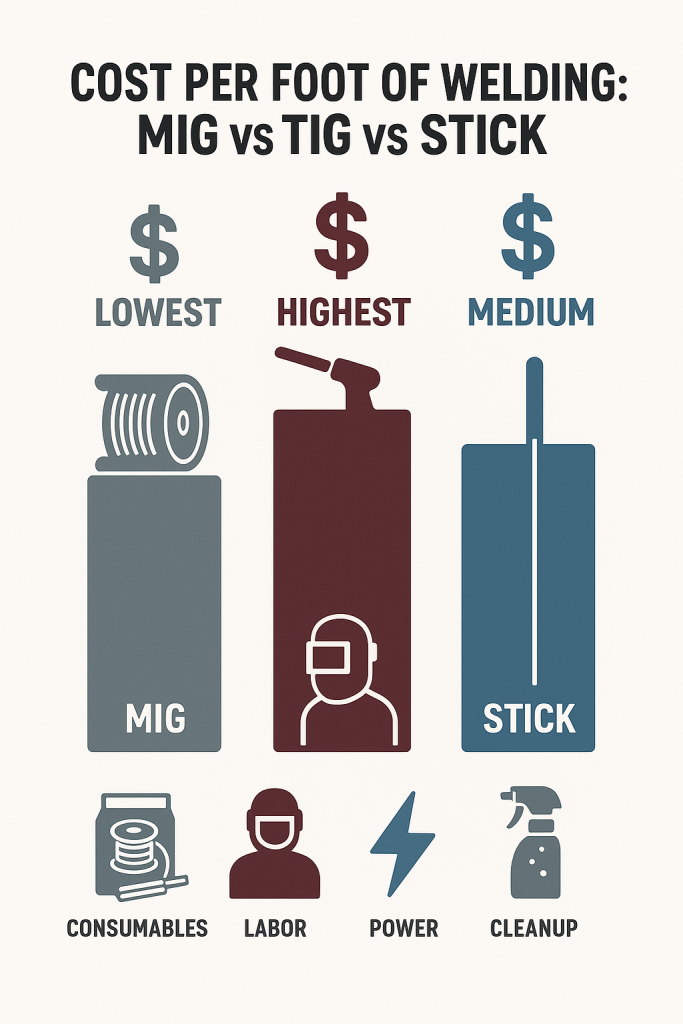
    • Highest cost per foot.

    Stick Welding (SMAW) – Versatility and Ruggedness

    Science Behind the Process:

    • Uses a flux-coated consumable electrode.
    • An arc is created between the electrode tip and the base metal.
    • Flux burns off to create shielding gas and leaves a protective slag layer.

    Molecular Dynamics:

    • Flux deoxidizes and scavenges impurities in the weld pool.
    • Slag forms a protective crust, improves cooling rates, and must be chipped away after the weld.

    Strengths:

    • Works in windy/outdoor settings without shielding gas.
    • Lower upfront equipment costs.
    • Suitable for structural steel, piping, and field repairs.

    Weaknesses:

    • Slower than MIG, more cleanup.
    • Stub loss and slag introduce waste.
    • Arc-on time is lower than GMAW.

    Welding Variables That Impact Cost

    To get to the real cost per foot, consider these key variables:

    Variable MIG (GMAW) TIG (GTAW) Stick (SMAW)
    Travel Speed Fast Slow Medium
    Deposition Rate High Low Medium
    Consumable Efficiency High (~90–95%) Moderate (~75%) Lower (~60% with stub loss)
    Power Usage Moderate High Moderate
    Labor Skill Level Moderate High Moderate
    Cleanup/Rework Minimal Minimal Significant (slag chipping)

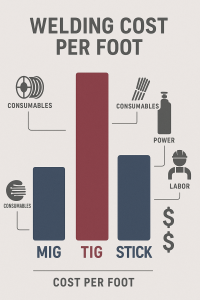
    Cost Breakdown Per Foot of Weld

    Let’s compute the average cost per linear foot using common practices, consumables, and hourly wage estimates.

    📌 Assumptions:

    • Labor rate: $40/hour
    • Electricity: $0.12/kWh
    • Mild steel or stainless steel applications
    • Weld size: 1/4” fillet weld, 12” long

    🧮 MIG Welding Cost Example

    Consumable & Indirect Costs:

    Item Cost Estimate
    Wire (ER70S-6) $2.50/lb; ~0.035 lb/ft = $0.09
    Shielding gas $1.00/CFH; ~35 CFH ≈ $0.12/ft
    Power 4 kW/hr @ 12 in/min = ~0.067 kWh = $0.01
    Labor 12 in/min = 1 ft/min = $0.67/ft
    Total per Foot ⚙ $0.89/ft

    🧮 TIG Welding Cost Example

    Consumable & Indirect Costs:

    Item Cost Estimate
    Filler (ER308L rod) $12/lb; ~0.045 lb/ft = $0.54/ft
    Argon (pure) $1.10/CFH @ 20 CFH = $0.18/ft
    Power 5 kW/hr @ 6 in/min = ~0.167 kWh = $0.02
    Labor 6 in/min = 2 min/ft = **$1.34/
  • Stream with Amazon Music